You’re on ERAS, 30 tabs open, “IMG-friendly residency programs” in the search bar, and every website claims their program is “diverse and inclusive.” Useless. What you actually need to know is: which specific policies tell you a program is truly IMG-friendly—and which are just marketing fluff.
Let me walk you through the policies that actually matter, how to verify them, and how to quickly filter programs so you don’t waste applications or interview days.
The 8 Policies That Matter Most for IMGs
Here’s the short list. If you remember nothing else, remember these:
- Visa sponsorship and type (J‑1 vs H‑1B)
- Minimum USMLE attempts and score/percentile expectations
- Graduation year cutoffs and recency of clinical experience rules
- Requirement for US clinical experience (USCE) and how strict they are
- History and proportion of IMGs in the program
- ECFMG status and timing requirements
- Communication and transparency culture (how they treat applicants)
- State and institutional restrictions on IMGs/visas
Now I’ll break each down, including what’s good, what’s bad, and what’s “run away.”
1. Visa Sponsorship: The First Hard Filter
If you need a visa, this is your first gate. Don’t ignore it and “hope they’ll make an exception.” They won’t.
Key policy questions
You’re looking for clear statements on:
- Do they sponsor visas at all?
- If yes, which type(s): J‑1, H‑1B, or both?
- Any restrictions (e.g., “no H‑1B for prelims,” “no visa for advanced positions”)?
Here’s what the landscape usually looks like:
| Program Type | Typical Visa Policy |
|---|---|
| University Internal Medicine | J‑1 common, some H‑1B |
| Community Internal Medicine | Often J‑1 only or none |
| University Surgery | J‑1 preferred, rare H‑1B |
| Community Family Medicine | Often J‑1 only, some none |
| Big-name university hospitals | J‑1 only, strict rules |
What “IMG-friendly” looks like
Strong signs:
- Website explicitly says: “We sponsor J‑1 and H‑1B visas”
- Current residents list includes several IMGs with degrees from outside the US/Canada
- They respond directly to email questions about visas (not vague “please see GME office”)
Yellow flags:
- “We sponsor J‑1 visas only” – not bad, just limiting if you absolutely want H‑1B
- “Visa sponsorship determined by GME office” with no examples – could go either way
Red flags:
- “We do not sponsor or accept visa holders”
- Nothing about visas anywhere + zero IMGs in the recent resident list
If you need H‑1B, your pool is small. Filter hard. If J‑1 is acceptable, you can focus more on other policies.
2. USMLE Attempts, Scores, and Step Policies
Plenty of websites say “no minimum score,” then you see their matched residents all have 250+. Don’t be naive.
Policies that actually affect you
Look for clear, written rules on:
- Maximum number of attempts per Step (often “no more than 1–2 attempts per exam”)
- Requirement that all Steps be passed on first try (some surgical and competitive programs)
- Step 2 CK deadline (e.g., must be passed before rank list vs before starting)
Programs that are truly IMG-friendly usually say things like:
- “We accept applicants with multiple attempts but prefer first-attempt passes.”
- “No official minimum score; we evaluate applications holistically. Recent matched residents had Step 2 CK scores 220–240.”
Programs that are not IMG-friendly for you (if you have gaps) say:
- “We require passing all USMLE exams on first attempt.”
- “Applications with multiple failed attempts will not be considered.”
How to estimate their real bar
They rarely publish exact cutoffs, but you can:
- Look at program type and geography:
- Community IM / FM in less competitive regions often comfortable with 210–220+
- University programs in big cities often 230+
- Ask directly on open houses or email:
“Do you have an unofficial Step 2 CK range for your typical matched residents?”
If you have:
- Multiple failures: target community and smaller programs that explicitly state they consider them.
- One failure: you need evidence they don’t auto-filter these out (some do).
3. Graduation Year and “Freshness” Policies
Here’s where a lot of IMGs quietly get filtered without realizing why.
What to look for
Typical policies:
- “We prefer applicants who graduated within the last 3–5 years.”
- “We require graduation within 3 years of starting residency.”
- “No graduation year cutoff.”
For IMGs, this “year of graduation” rule can be more rigid than for US grads. Especially in competitive metros.
Real talk:
- ≤3 years since graduation: You’re fine almost anywhere that accepts IMGs.
- 3–5 years: You need to show active clinical work, research, or relevant experience.
- >5 years: Very tough unless you have:
- Strong USCE
- Solid scores
- Active clinical practice or fellowship abroad
Programs that are genuinely IMG-friendly will say either:
- “No strict graduation cutoff if applicant has recent clinical experience,” or
- “We accept applicants up to 5–7 years since graduation with continuous medical activity.”
If you graduated a while ago, this policy can matter more than any minor score difference.
4. US Clinical Experience (USCE) Requirements
You’ll see this line a lot: “US clinical experience preferred.” That phrase is useless unless you decode what they really mean.
Types of USCE that matter
Ranked from strongest to weakest:
- US residency/fellowship (if reapplying)
- Hands-on US externship/sub-internship with direct patient care
- Observerships with letters that clearly state what you did
- Research-only experience (good for academics, weak for clinical skills proof)
Key policy details
You want answers to:
- Is USCE required or just preferred?
- Do observerships count as USCE?
- Do they specify a minimum length (e.g., 2–3 months)?
IMG-friendly patterns:
- “US clinical experience is preferred but not required.”
- “Observerships will be considered, especially if in internal medicine/specialty X.”
- “We value continuity, even if experience is abroad, as long as it is recent.”
Non-friendly patterns if you lack USCE:
- “At least 3–6 months of hands-on USCE required.”
- “We only consider applicants with US inpatient experience.”
- “We do not consider observerships as clinical experience.”
5. Actual IMG Representation in the Program
This is one of the most reliable “IMG-friendly” signals. Not their mission statement. Their resident roster.
How to check quickly
Go to the residency site → “Residents” or “Current residents” page. Then:
- Count how many MDs are from outside US/Canada
- Look at medical schools (e.g., India, Pakistan, Caribbean, Eastern Europe, Middle East, Latin America)
- Check PGY‑1 and PGY‑2 especially (that’s the current policy in action)
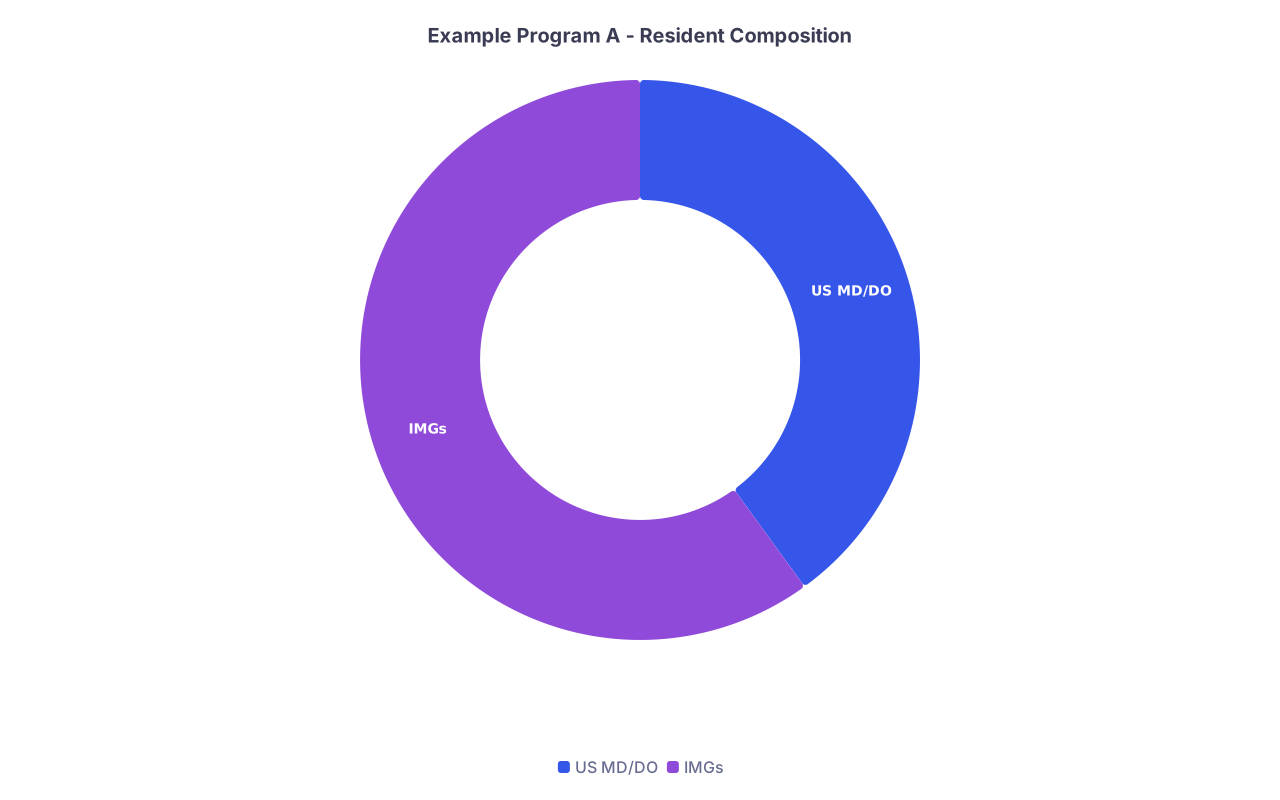
| Category | Value |
|---|---|
| US MD/DO | 40 |
| IMGs | 60 |
If you see:
- 0–1 IMG total in a 3‑year program: not IMG-friendly, whatever they say.
- 1–2 per class at least: they’re open, but maybe selective.
- Majority IMGs: strongly IMG-friendly, especially for community IM/FM, psych, peds.
Also, look at leadership:
- Any IMG chief residents recently?
- Any faculty who are IMGs? People who remember the path usually advocate for you.
6. ECFMG and Documentation Policies
You’d think this is standard, but timing matters a lot, especially if you’re still waiting for exams.
Critical questions
Do they require ECFMG certification before:
- Applying?
- Interviewing?
- Ranking?
- Starting residency only?
Do they require:
- OET already done?
- Diploma uploaded by a certain date?
More IMG-friendly:
- “ECFMG certification must be obtained prior to the start of residency.”
- “You may apply and interview before certification is complete.”
Less friendly (if you’re still mid-process):
- “Applicants must be ECFMG certified at the time of application.”
- “We only interview ECFMG-certified candidates.”
If you’re still waiting on OET/Step 2 CK/ECFMG, this can straight-up decide where you can realistically apply this year.
7. Culture of Communication and Transparency
This one doesn’t show up as a formal “policy,” but it might matter the most for your sanity.
Signs of a program that respects IMGs
- Website FAQ specifically addresses IMG questions (visas, ECFMG, USCE).
- They answer emails in 3–7 days with clear, non-copy-pasted answers.
- They host open houses / Q&A sessions and explicitly say IMGs are welcome.
- Current residents (especially IMGs) reply to polite questions on LinkedIn or via email.
Programs that will make your life miserable often look like this:
- Vague answers like “We evaluate all applications holistically” to every specific question.
- “Due to volume, we cannot respond to individual applicant questions” + no IMG info anywhere.
- No IMGs in the program and no acknowledgment of visas.
You’re not just choosing where to match. You’re choosing who will help you navigate licensing, visas, and maybe immigration law for years. Take this seriously.
8. State, Hospital, and Institutional Rules That Affect IMGs
Sometimes the program wants you, but the system over them makes it hard.
Patterns to watch:
State licensing rules:
Some states have:- Minimum months of clinical rotations (for IMGs)
- Restrictions on certain foreign schools
- Rules about number of attempts per Step
Hospital or GME office rules:
- “Our institution only sponsors J‑1 visas.”
- “No H‑1B for first-year trainees.”
- “Visa residents must meet X language or exam requirements.”
You won’t always find this neatly written on the program page. If something feels unclear, email either:
- The program coordinator
- The GME office (often listed as “International Medical Graduates” or “Visa & immigration info”)
How to Compare Programs Side-by-Side (Without Losing Your Mind)
Here’s a simple framework. Take your shortlist and for each program, score these 0–2:
- Visa support: 0 = none; 1 = J‑1 only; 2 = J‑1 & H‑1B or very clear policies
- IMG presence: 0 = almost none; 1 = some; 2 = majority or many per year
- Attempts/score flexibility: 0 = first attempt only; 1 = some flexibility; 2 = overtly accepting of attempts
- Graduation year flexibility: 0 = strict (≤3 yrs only); 1 = 3–5 yrs; 2 = >5 yrs with activity accepted
- USCE requirement: 0 = rigid months of hands-on; 1 = prefers; 2 = accepts minimal/observership
- ECFMG timing: 0 = must be certified to apply; 1 = must be certified to interview; 2 = only by start date
- Communication/culture: 0 = opaque; 1 = ok; 2 = clear + inclusive
Then prioritize applying where you’re scoring highest, especially on non-negotiables like visas and attempts.
Here’s how that kind of comparison might look:
| Factor | Program X | Program Y | Program Z |
|---|---|---|---|
| Visa (0–2) | 2 | 1 | 0 |
| IMG presence (0–2) | 2 | 1 | 0 |
| Attempts flexibility | 1 | 2 | 0 |
| Grad year flexibility | 1 | 2 | 0 |
| USCE flexibility | 2 | 1 | 0 |
| ECFMG timing | 2 | 1 | 0 |
| Culture/communication | 2 | 1 | 0 |
You can see instantly where your effort is more likely to pay off.
Where to Actually Find These Policies (Without Hours of Clicking)
Most people look only at ERAS and miss better info. Use a stack:
- Program website:
- “Eligibility,” “Application Requirements,” “International Graduates,” “Visa Policy”
- Institution GME site:
- Search “GME” + “[Hospital name]” + “visa” or “international graduates”
- FREIDA:
- Check “Accepts IMGs,” “Visa types,” and “Requirements”
- Open houses / info sessions:
- Often clarify unofficial cutoffs and common IMG paths
- Email the coordinator:
- One short, specific question per email; don’t send a life story
And yes, sometimes what they say and what they do are misaligned. That’s where current or recent residents (often on LinkedIn or their profiles) can fill the gap.
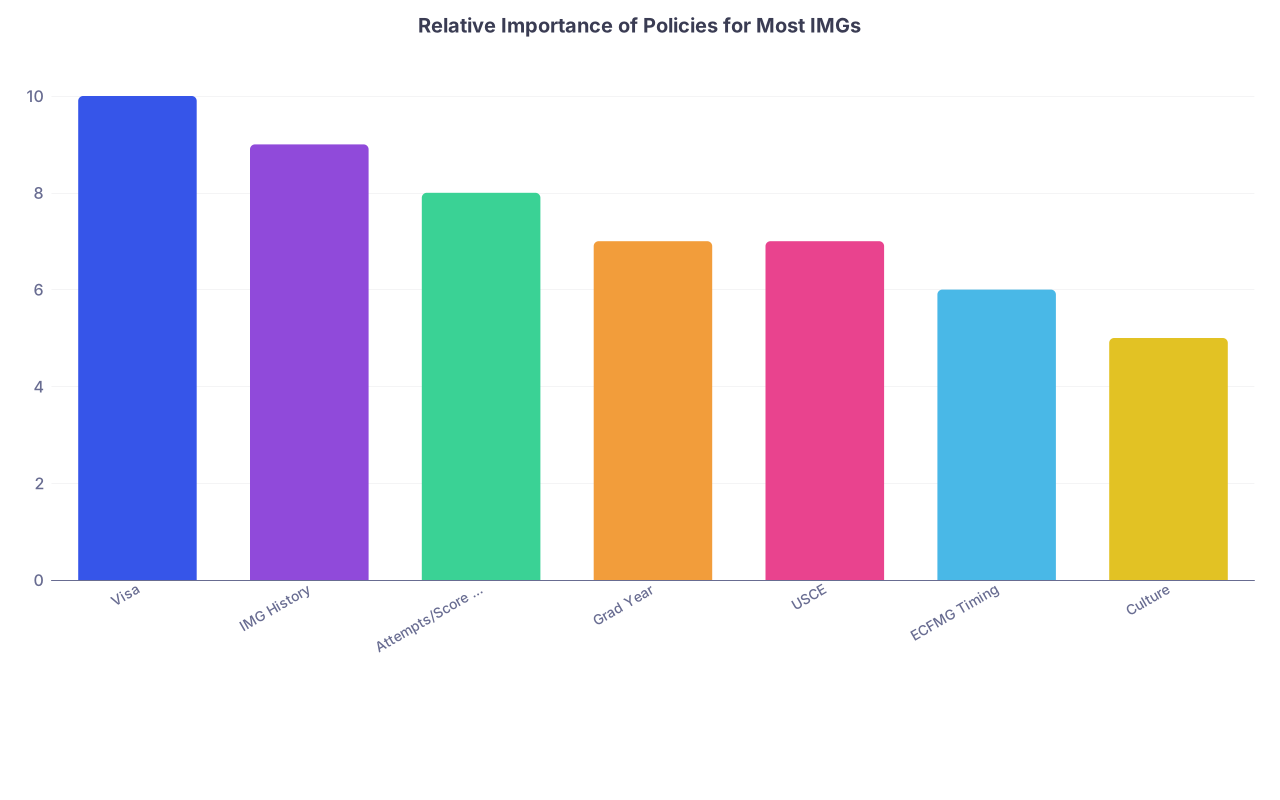
| Category | Value |
|---|---|
| Visa | 10 |
| IMG History | 9 |
| Attempts/Score Rules | 8 |
| Grad Year | 7 |
| USCE | 7 |
| ECFMG Timing | 6 |
| Culture | 5 |
(Obviously this varies per person, but visa + real IMG history almost always sit at the top.)
FAQ: IMG-Friendly Policies
1. If a program says “we accept IMGs,” does that mean it’s IMG-friendly?
Not necessarily. “We accept IMGs” might mean they accepted one person 7 years ago. Look at:
- Current resident list (how many IMGs, especially in PGY‑1/2)
- Visa sponsorship details
- How specific and honest their requirements are
If the resident page is basically all US MD/DOs, I don’t care what the blurb says. That’s not an IMG-focused program.
2. Is H‑1B always better than J‑1 for IMGs?
Not “always.” It depends on your long-term plan.
H‑1B is better if:
- You absolutely want to avoid J‑1 waiver service later
- You’re targeting a specific immigration pathway early
J‑1 is okay (and more available) if:
- You’re open to a waiver job in a medically underserved area after residency
- You prioritize more program options now versus theoretical immigration flexibility later
For many IMGs, “any visa that lets me train” is the first priority. Don’t cripple your match chances chasing H‑1B only.
3. How many years after graduation is “too many” for most IMG-friendly programs?
For most internal medicine, family medicine, peds, psych:
- 0–3 years: generally fine
- 3–5 years: you need active clinical work or strong USCE
5 years: very program-dependent
Plenty of community programs will consider >5 years if:
- You’ve been clinically active
- You have decent scores
- Your letters are recent and relevant
But if you’re 10+ years out, you need to be very selective and realistic.
4. Do observerships really count as US clinical experience?
Sometimes yes, sometimes “technically, but not really.”
Look at the wording:
- “Hands-on US clinical experience required” → observerships usually don’t count.
- “US clinical experience preferred” → observerships often count, especially with good letters.
- If they don’t define it, you can ask: “Do observerships qualify as US clinical experience for your program?”
For most community IM/FM/psych programs that take many IMGs, a solid set of observerships with strong letters can absolutely help.
5. I have a Step failure. What policies should I prioritize?
You need programs that:
- Don’t require “first attempt pass on all Steps”
- Explicitly say they consider applicants with attempts
- Have a history of matching IMGs (many IMG-heavy programs are used to reviewing applications more holistically)
Emailing coordinators with a direct question can help:
- “Do you consider applicants with one failed attempt on Step 1 if Step 2 CK is a strong pass?”
If they say no or dodge the question, don’t waste an application.
Key takeaways:
- Don’t trust generic “IMG-friendly” labels. Trust visa policies, resident rosters, and written requirements.
- Your non-negotiables (visa, attempts, graduation year) should drive your program list more than prestige.
- Programs that are truly IMG-friendly are very clear about what they want—and they already have people like you in their resident photos.