The generic advice about “IMG-friendly programs” is lazy and often wrong.
If you’re an IMG, you can’t afford lazy or wrong. You need a clear, repeatable way to tell if a residency is actually IMG-friendly before you waste money applying.
Here’s the answer you’re looking for.
Step 1: Ignore the Marketing. Follow the Match Data.
Programs will say nice things on their website: “We welcome diverse backgrounds,” “We consider all applicants,” “We value international graduates.”
I don’t care what they say.
I care who they rank and who they match.
Your first filter should always be: what does their resident roster and match history look like?
Here’s how to check in 15–20 minutes per program:
- Go to the program website → “Current Residents” or “Our People.”
- Open 2–3 resident profiles per PGY year (especially PGY1–PGY3).
- Look for:
- Medical school name and country
- Degree type (MD vs MBBS vs DO vs “Overseas Graduate”)
- Any explicit note like “graduated from XYZ in India/Pakistan/Nigeria/etc.”
If you see:
- Multiple residents from non‑US schools across several years → strong IMG signal
- Only one IMG in PGY1 and none in PGY2/PGY3 → probably a fluke, not a pattern
- Only Caribbean grads and zero other non‑US schools → technically “IMGs,” but often a different category in their mind
You’re looking for consistency over years, not one token IMG.
To structure this for yourself, use something like:
| Signal | Strong IMG-Friendly | Weak/Unfriendly |
|---|---|---|
| % IMGs in program | ≥ 30–40% | 0–10% |
| Countries represented | 3+ | 0–1 |
| Recent classes | IMGs in each class | Only senior IMGs |
It doesn’t need to be exact math—but if you scroll their residents and mentally feel, “This looks like a lot of US grads and maybe one or two IMGs from 2015,” that’s not your program.
Step 2: Use NRMP and FREIDA Like a Statistician, Not a Tourist
Most applicants glance at NRMP and FREIDA. You’re going to dissect them.
What to check in FREIDA
On FREIDA (AMA’s database), for each program:
- Check “Residents and Fellows” section:
- US MD %
- US DO %
- International Medical Graduates %
Programs that are truly IMG-friendly in core fields (IM, FM, psych, peds) often have 30–60% IMGs.
If you see 0–5% IMGs over several years, don’t waste your money unless you’re an ultra‑competitive “exception candidate” (260+ scores, heavy research, US grad equivalent). Most people aren’t that exception.
What to watch in NRMP specialty data
NRMP publishes “Charting Outcomes” and “Program Director Survey” data.
You want to understand:
- How many IMGs matched into that specialty?
- What were typical scores / number of US clinical experiences?
- How PDs in that specialty rank IMGs vs US grads on importance of factors.
This tells you two things:
- Realistic competitiveness for IMGs in that specialty
- How hard you need to filter programs (e.g., surgery vs family med)
Use that to set your expectations. For competitive specialties (derm, ortho, ENT, plastics, rad onc, neurosurgery), “IMG-friendly” is basically fantasy except for unicorns. In those, “friendly” just means “maybe one IMG every 10 years.”
Step 3: Read Between the Lines of Eligibility Requirements
This part is where a lot of IMGs get burned because they don’t read carefully.
On each program’s site, usually under “How to Apply” or “Eligibility,” look for:
USMLE/COMLEX Requirements
- Do they require Step 1 and Step 2 CK?
- Do they say “We do not sponsor visas” (that’s a full stop)?
- Any explicit cutoff: “We prefer scores > 220” or “We generally interview applicants with Step 2 ≥ 235”
Medical School Graduation Year
- “Within 3 years” or “Within 5 years”
- If you graduated 8 years ago and they want ≤ 3 years, don’t romanticize it. They aren’t talking to you.
US Clinical Experience (USCE)
- Requirements like: “At least 3 months of US clinical experience”
- Watch for “observerships do not count” vs “observerships accepted”
-
- “We sponsor J-1 only” → OK for many
- “We sponsor J-1 and H-1B” → gold for some specialties and test‑takers
- “We do not sponsor visas” → move on if you need a visa
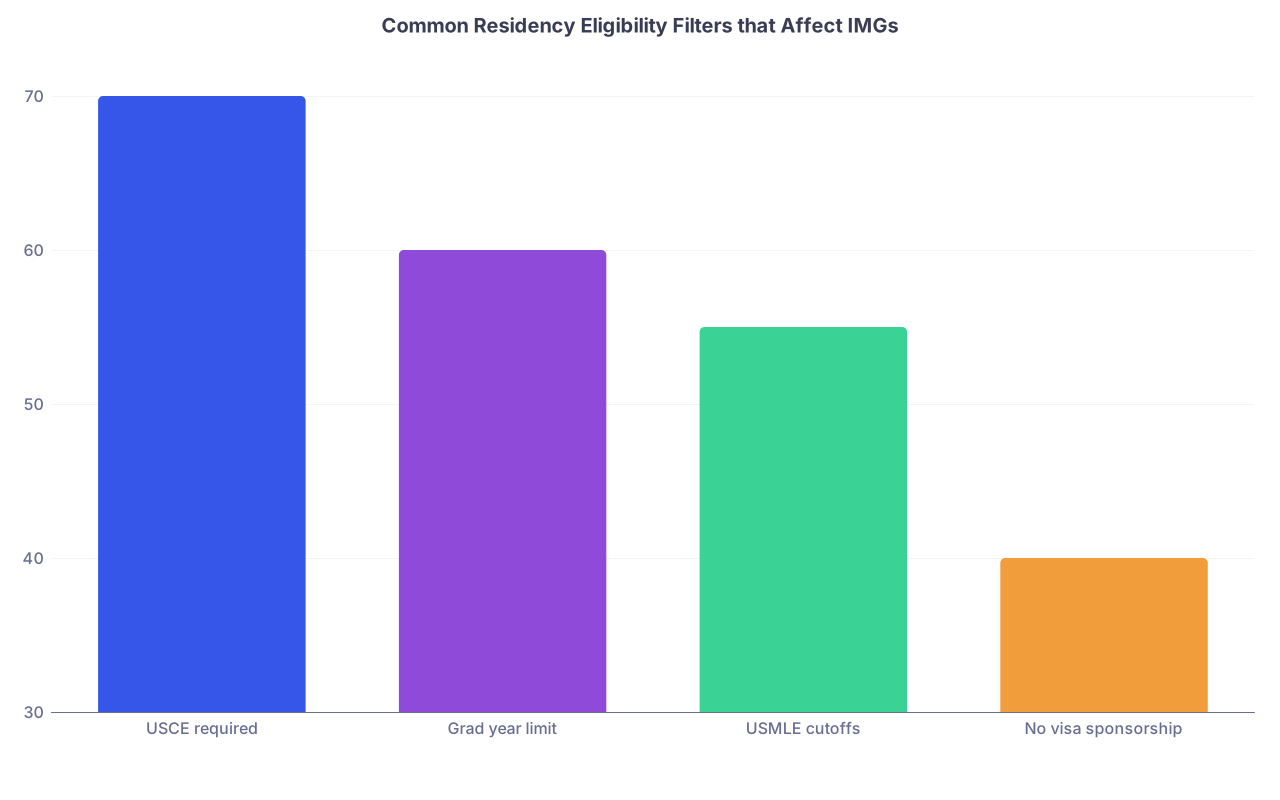
| Category | Value |
|---|---|
| USCE required | 70 |
| Grad year limit | 60 |
| USMLE cutoffs | 55 |
| No visa sponsorship | 40 |
(Values represent approximate % of programs using each filter in some specialties—varies, but you get the idea: these filters are common.)
The key point: if their written policies already exclude you, their “IMG-friendly” reputation doesn’t matter. Policy wins.
Step 4: Actually Look At Where Their Residents Went to Medical School
Don’t stop at “Has IMGs: yes/no.” Go a level deeper.
You want to know: Are they IMG-friendly broadly, or only to a tiny specific subset?
Patterns I see all the time:
- Program has 8 IMGs, all from 3 or 4 well-known Caribbean schools → “friendly” to those schools, not necessarily to everyone.
- Several IMGs all from one big Indian, Pakistani, or Middle Eastern school → likely a pipeline connection via alumni.
- A mix of schools across Latin America, Europe, Asia, Middle East, Africa → genuinely broad IMG-friendly culture.
What you’re trying to judge:
- Do they have systems for onboarding international grads (licensing, visas, cultural stuff)?
- Do attendings/residents already understand the IMG transition issues?
- Is there a track record of multiple schools and countries—or just a narrow channel?
If you see a wide geographic spread across residents, that’s a strong green flag.
Step 5: Use Targeted Outreach, Not Desperate Emails
Cold email spam like, “Dear Program Director, I’m very interested, please consider me,” is useless. They ignore it.
But a very specific, short email can give you high‑value intel.
Who to contact:
- A current IMG resident (PGY1 or PGY2 ideally)
- Or the chief resident, if they obviously trained abroad
- If no public emails, program coordinator is next best
What to ask (pick 1–2 questions, keep it under 6 lines):
- “How many IMGs did your program interview last year?”
- “Do you commonly rank IMGs, or is it rare?”
- “Would you consider older graduates (I’m class of 2016) if other parts of the app are strong?”
- “Does observership experience count as USCE for your selection committee?”
If they say:
- “We interview lots of IMGs and usually match several each year” → strong sign
- “We rarely interview IMGs, but it happens sometimes” → borderline, only apply if you’re strong for that specialty
- “Honestly, we have not taken many IMGs in recent years” → take the hint and save your money
You’re not begging. You’re gathering data.
Step 6: Cross-Check with Real IMG Match Lists (Not Random Forums)
There’s a lot of noise online about “IMG-friendly programs.” Most of it is outdated or based on one person’s story.
Still, used correctly, crowdsourced data is useful.
Smarter ways to use it:
- Look at recent “IMG match list” posts from real schools (e.g., specific Indian, Pakistani, Nigerian, Caribbean schools)
- Find LinkedIn profiles of IMGs in the US and see which programs actually appeared repeatedly
- Ask recent grads from your own school where they matched and where their friends matched
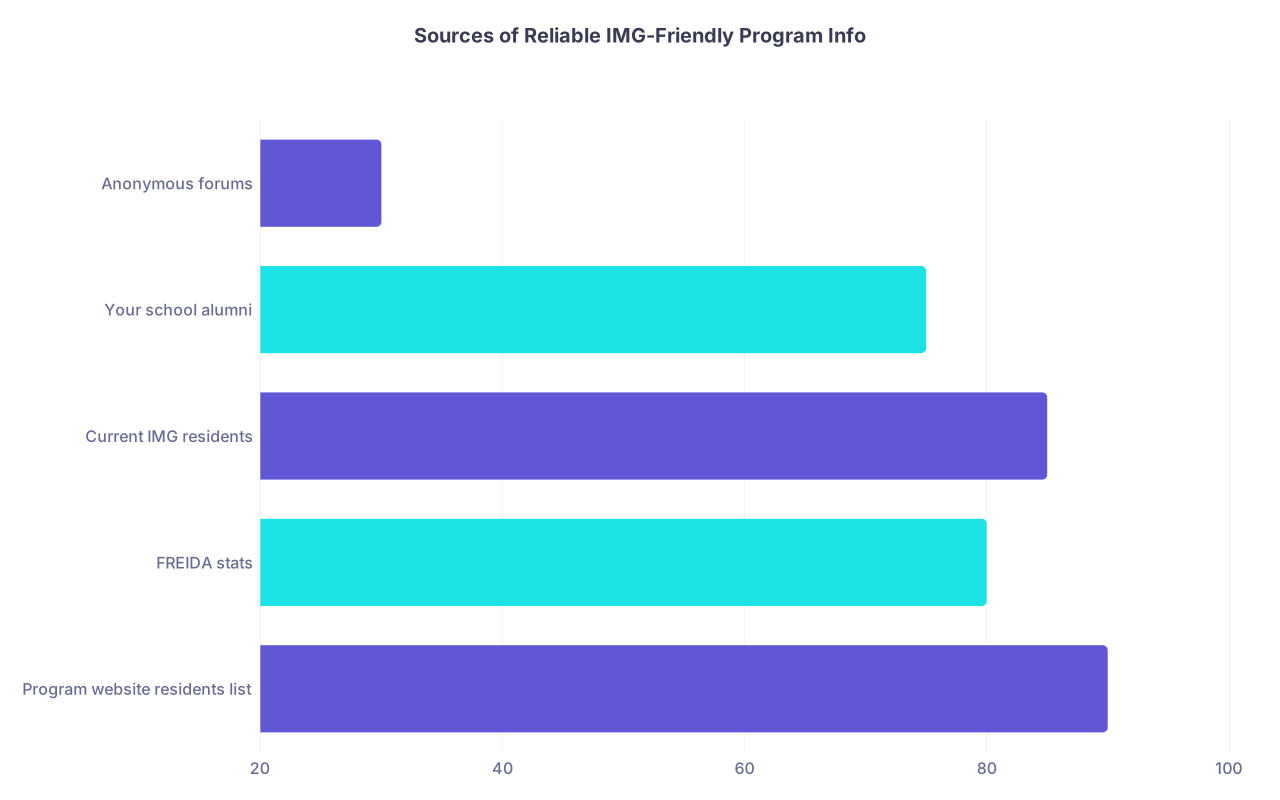
| Category | Value |
|---|---|
| Program website residents list | 90 |
| FREIDA stats | 80 |
| Current IMG residents | 85 |
| Your school alumni | 75 |
| Anonymous forums | 30 |
(Think of these numbers as relative reliability. If you’re trusting forums more than actual rosters, you’re doing it backwards.)
Bottom line: a program that appears repeatedly on multiple real match lists from different non‑US schools is probably legitimately IMG-friendly.
Step 7: Adjust Expectations by Specialty and Region
Not all specialties and regions treat IMGs the same.
Specialties where “IMG-friendly” is realistic
Generally more attainable:
- Internal Medicine
- Family Medicine
- Pediatrics
- Psychiatry
- Neurology
- Pathology
In these fields, you can realistically find many programs with 30–70% IMGs. Your real job is sorting them by how high your own stats are relative to their usual intake.
Specialties where IMG-friendly is rare
- General Surgery (especially academic)
- Anesthesiology
- Emergency Medicine
- OB/GYN
- Radiology
- Subspecialty surgery (ortho, urology, ENT, neurosurg, plastics, etc.)
Here, “IMG-friendly” often means:
- Community programs
- Non-university hospitals
- Sometimes smaller cities or less popular states
You can still match. People do it every year. But you cannot just apply blind to big-name academic centers and call it a strategy.
Step 8: Use a Simple Scoring System to Decide Where to Apply
You can easily drown trying to “research everything.” Don’t.
Make a basic spreadsheet. For each program, rate 1–5 on:
- IMG proportion among residents
- Visa support (0 if none, 5 if J-1 + H-1B)
- Clear, realistic eligibility (grad year, USCE, scores)
- Specialty competitiveness vs your stats
| Factor | 1 (Bad) | 3 (Neutral) | 5 (Good) |
|---|---|---|---|
| IMG proportion | 0–5% | 10–20% | ≥ 30% |
| Visa policy | No visas | J-1 only | J-1 and H-1B |
| Eligibility fit | Clear mismatch | Some concerns | Fully aligned |
| Alumni presence | None | 1–2 total | Multiple recent IMGs |
Then:
- Apply broadly to programs that score 15–20
- Be more selective with those scoring 10–14
- Avoid anything below ~9 unless there’s a very specific reason
That’s much better than “I saw a Reddit post that said it’s IMG-friendly.”
Step 9: Watch for Red Flags Pretending to Be “Opportunities”
There are some traps that catch desperate IMGs every year.
Be careful with:
- Programs that suddenly flip from 0 IMGs for years → 80% IMGs in one match cycle (often a sign of instability or US grads avoiding them)
- New or unaccredited programs aggressively recruiting IMGs without a track record
- Programs with terrible board pass rates or tons of resident resignations/terminations
If all the IMGs in the program are PGY1 and PGY2 with nothing older, ask yourself why no one sticks around.
You’re not just trying to match. You’re trying to finish training and become board certified without misery.
Step 10: Put It All Together in a Simple Decision Flow
Here’s how your thought process should roughly go for each program:

| Step | Description |
|---|---|
| Step 1 | Find program |
| Step 2 | Check residents list |
| Step 3 | Skip program |
| Step 4 | Estimate IMG proportion |
| Step 5 | Check FREIDA stats |
| Step 6 | Review eligibility and visa policy |
| Step 7 | Look at IMG schools and countries |
| Step 8 | Optional - Contact current IMG resident |
| Step 9 | Score program 1-5 on each factor |
| Step 10 | Target program |
| Step 11 | Maybe - apply only if room |
| Step 12 | IMGs present? |
| Step 13 | Policies fit my profile? |
| Step 14 | Score >= 15? |
Takes effort, yes. But this is how you stop throwing application fees into a black hole.
FAQs (Exactly 7)
1. Is a program with only Caribbean graduates considered IMG-friendly?
Sort of, but not in the way you probably need. If a program’s only non‑US grads are almost all from big Caribbean schools, it often reflects direct relationships with those specific schools and a comfort level with that training pathway. It doesn’t always translate into being open to IMGs from Asia, the Middle East, Africa, or Europe. You want to see a mix of IMGs from multiple regions to call it truly IMG-friendly.
2. What’s the minimum IMG percentage I should look for in a program?
There’s no magic line, but I’d be skeptical of anything below about 10% IMGs if you’re a typical non‑US grad. For genuinely IMG-friendly internal medicine, psych, FM, or peds programs, 30–60% IMGs is common. In more competitive fields, you may have to accept lower percentages, but then you should be brutally honest about your own competitiveness (scores, USCE, research).
3. If a program says “we consider all applicants,” does that mean they’re IMG-friendly?
No. That’s just legal and PR language. You should treat it as meaningless without supporting evidence. “We consider all applicants” is cheap. A resident roster with consistent IMGs across multiple years is expensive—time, training, systems. Believe the expensive signal. Ignore the cheap one.
4. How many IMG-friendly programs should I apply to as an IMG?
Depends on specialty and your profile, but most IMGs who match apply a lot. For core specialties (IM, FM, peds, psych), 80–150 programs isn’t crazy for an average IMG. For more competitive specialties, many IMGs apply even broader or add a backup specialty. The key is not just volume; it’s selecting programs where you actually meet basic criteria and where there’s a real IMG presence.
5. Can strong USMLE scores compensate for a program’s weak IMG history?
Sometimes, but not routinely. A 260+ might crack a few doors, but if a program has never taken IMGs, you’re fighting policy, culture, and bias. Strong scores help within IMG-friendly or IMG-neutral programs way more than they convert IMG-unfriendly places into options. Don’t build your entire strategy on being “the exception.”
6. Are community programs always more IMG-friendly than university programs?
Not always, but often. Many community hospitals rely heavily on IMGs and have entire ecosystems built around supporting them. Some university programs also have large IMG contingents, especially in internal medicine and neurology. Again, don’t assume. Look at the actual resident list. Some big-name university affiliates are quietly very IMG-friendly; some small community programs are surprisingly US‑heavy.
7. Should I avoid programs that only sponsor J-1 visas if I’m an IMG?
Not necessarily. Plenty of IMGs build great careers starting on J‑1 visas. If you absolutely need H‑1B for personal or immigration strategy reasons, then yes, filter for that. But if your main goal is to match and train, J‑1 only programs can be excellent options. Just be intentional: know your long-term immigration and career plans before you decide that J‑1 is a dealbreaker.
Key takeaways:
- Judge IMG-friendliness by who they actually train, not what they say. Resident rosters and FREIDA data don’t lie.
- Eligibility rules (USCE, grad year, visas, scores) are hard filters—if you don’t meet them, move on instead of hoping you’re the exception.
- Build a simple, ruthless system: score programs, focus your money on those with real IMG track records, and stop guessing based on rumors.