
You’re staring at a spreadsheet with 80, maybe 140 programs listed. Your credit card is already hurting from ERAS fees. Everyone on forums is yelling different numbers: “Apply to 200+ as an IMG” vs “I did 80 and matched.” You’re trying to answer one simple question:
How many IMG‑friendly programs should you realistically apply to so you’re not wasting money or killing your chances?
Let me give you a straight answer first, then we’ll fine‑tune it.
For most IMGs:
- If you’re relatively competitive: 60–100 IMG‑friendly programs in your specialty.
- If you’re average for IMGs: 100–150.
- If you’re weaker or in a very competitive specialty: often 150–200+ or you seriously reconsider specialty/strategy.
Now let’s make that specific to you instead of a vague forum number.
Step 1: Know Your Lane – What Type of IMG Are You?
Before you decide how many programs, you need to be brutally honest about what you bring to the table.
Here’s how I sort IMGs in the real world, not the fantasy world Reddit lives in.
| Tier | Profile Snapshot |
|---|---|
| Strong | Step 2 ≥ 240, recent grad ≤ 3 years, 1+ USCE, some research, no major red flags |
| Moderate | Step 2 225–239, grad ≤ 5 years, some USCE or strong home clinicals, maybe 1 small issue |
| High-Risk | Step 2 < 225 or multiple attempts, older grad, minimal USCE, or big red flags |
Now layer this over your specialty.
| Specialty Type | Examples |
|---|---|
| Relatively IMG-Friendly | Internal Medicine, Family Medicine, Pediatrics, Psychiatry, Pathology |
| Moderate | Neurology, PM&R, OB/GYN (borderline for IMGs) |
| Very Competitive | General Surgery, EM, Anesthesia (US‑IMG has better odds than FMG), Radiology |
If you’re a moderate‑tier IMG chasing a very competitive specialty with no backup, you either:
- Apply very widely (200+),
- Have a realistic backup specialty, or
- Accept a high chance of not matching.
Harsh, but true.
Step 2: Understand What “IMG-Friendly Programs” Actually Means
People misuse “IMG‑friendly” all the time.
A program being technically open to IMGs isn’t the same as being realistically friendly.
Here’s what I consider truly IMG‑friendly:
- They actually rank and match IMGs regularly (look at current residents).
- They don’t have “US MD/DO only” or “no visas” hidden on their website.
- They don’t set insane cutoffs (like Step 2 ≥ 250) that 90% of IMGs don’t hit.
- They’ve taken IMGs in the last 2–3 years, not just once in 2011.
You want those programs. Not just “we accept ECFMG certified applicants” boilerplate.
Step 3: The Real Numbers – How Many Programs for Each Scenario
Let’s talk realistic ranges, not fantasy.
These numbers assume a single specialty and that you’re applying primarily to programs that are at least somewhat IMG‑friendly.
Scenario A: Strong IMG + IMG-Friendly Specialty
Examples: IM, FM, Peds, Psych, Path
Profile: Step 2 around 240+, recent grad, some USCE, decent letters.
Realistic target:
- 60–100 well‑selected IMG‑friendly programs.
- 40–60 if you’re truly top‑tier (240–250+, recent grad, strong US LORs, US clinical experience, no red flags) and applying to a very IMG-welcoming field like FM or Psych.
Here, quality of list matters more than raw volume. I’ve seen strong IMGs match with 40–60 internal medicine programs because they picked smartly.
Scenario B: Moderate IMG + IMG-Friendly Specialty
Profile: Step 2 225–239, 2–5 years since graduation, some USCE or research, maybe 1 retake or gap.
Realistic target:
- 100–150 programs.
- Closer to 100 if you’re recent and have USCE.
- Closer to 150 if you’re older grad or have some weaker parts.
This is the classic “apply broadly but intelligently” group. You’re not bad, but programs will screen you out more than you think.
Scenario C: High-Risk IMG + IMG-Friendly Specialty
Profile: Step 2 < 225, multiple attempts, older graduate, minimal USCE.
Realistic target:
- 150–220+ programs plus:
- A true backup specialty, or
- A clear plan to strengthen your app for next cycle.
This is where spray‑and‑pray happens. It isn’t ideal, but if you’re not willing to fix underlying weaknesses (scores, USCE, time‑since‑grad), volume becomes your only real play.
Scenario D: Strong/Moderate IMG + Moderately Competitive Specialty
Examples: Neurology, PM&R, OB/GYN (for many IMGs), maybe some community EM.
Realistic target:
- Strong IMG: 80–140 programs.
- Moderate IMG: 140–200+ plus a backup specialty (FM, IM, Psych).
Here I start pushing people very hard to have a dual‑application strategy (e.g., Neurology + IM).
Scenario E: IMG + Highly Competitive Specialty (Gen Surg, Ortho, Derm, Rad, ENT, etc.)
If we’re talking FMG and not US‑IMG:
For most, this is a lottery without serious connections, outstanding metrics, or unique circumstances.
Realistic target:
- 150–250 programs + a backup specialty where you’d genuinely be okay matching.
- Or don’t do a primary application in that specialty until your file is stronger (research year, publications, high‑end USCE).
Step 4: Factor In Budget vs Probability
ERAS fees climb fast. You can absolutely bankrupt yourself applying to 250 programs.
Use this rough relationship for IMG‑friendly specialties like IM/FM/Psych:
- About 40–60 well‑chosen programs → you might get a few interviews if you’re a strong IMG.
- 80–100 → better cushion; this is where many strong to moderate IMGs land.
- 120–160 → higher coverage for moderate/older grads.
- 180–220+ → you’re trying to overcome weak metrics via raw volume.
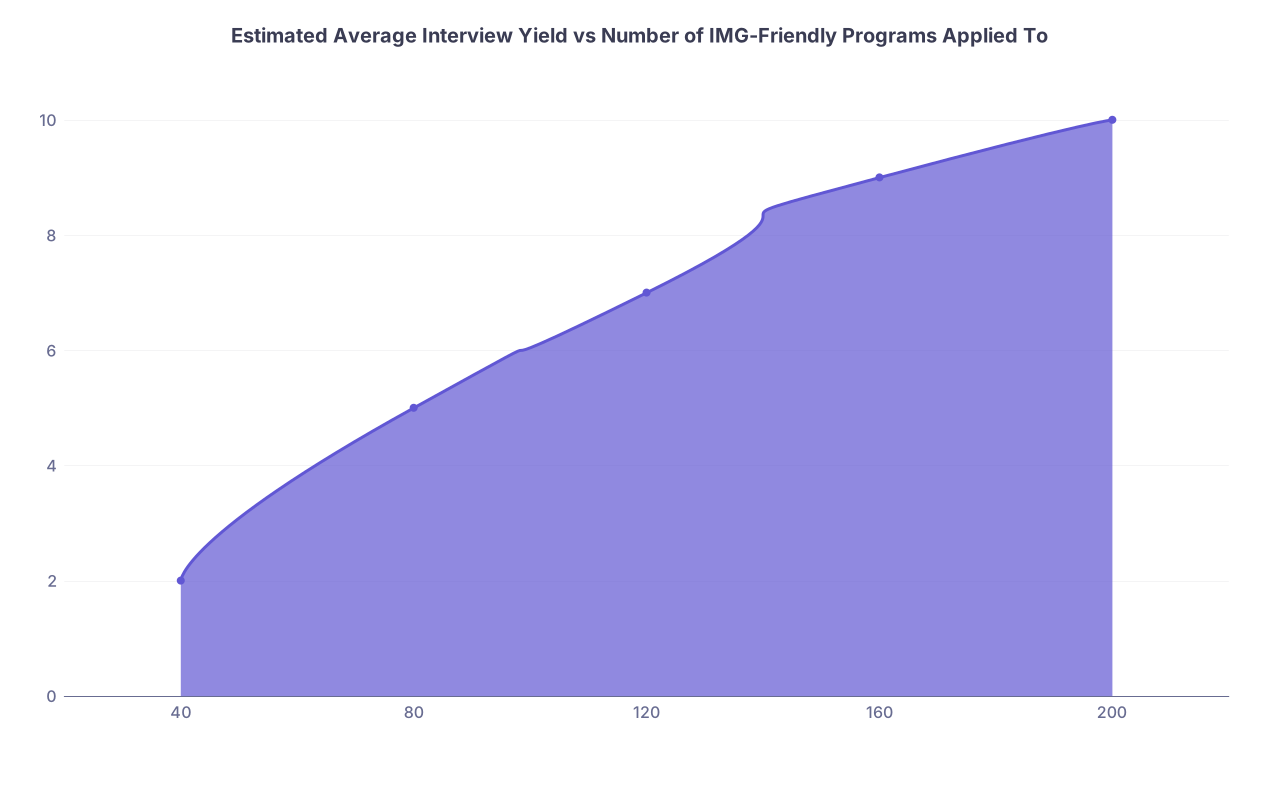
Here’s a quick visualization of how interview yield tends to behave. Not exact, but directionally right for many IMGs in friendly specialties:
| Category | Value |
|---|---|
| 40 | 2 |
| 80 | 5 |
| 120 | 7 |
| 160 | 9 |
| 200 | 10 |
Diminishing returns are real. Going from 40 to 80 targeted programs can double or triple interviews. Going from 160 to 200 might add 1–2 at best.
So you ask:
- What’s my absolute max budget?
- How many interviews do I realistically need? (IMGs generally want 8–12+ interviews in friendly specialties to feel safer.)
Then you back‑calculate your application volume using your profile.
Step 5: Build a Tiered List Instead of a Giant Mess
You don’t want 150 random “IMG‑friendly” programs. You want a structured list.
Use a simple 3‑tier system.
Tier 1 – Safer / Very IMG‑Friendly
- Historically take lots of IMGs.
- Reasonable score cutoffs.
- Community or lower‑mid tier university programs.
Tier 2 – Middle / Reachable
- Take some IMGs, not packed with them.
- Slightly higher expectations on scores, recency, USCE.
Tier 3 – Reach
- Rarely take IMGs, but not 0%.
- Higher Step averages, more academic.
Rough ratio for a moderate IMG in IM or FM applying to 130 programs:
- 50–60 Tier 1
- 50–60 Tier 2
- 20–30 Tier 3
If you’re weaker, shift more toward Tier 1. If you’re stronger, you can afford more Tier 2 and a few more Tier 3.
Step 6: How to Identify Programs That Are Truly Worth Applying To
This is where a lot of IMGs waste money. They pull lists from random blogs that haven’t been updated in 5 years.
Better approach:
Check current residents on program sites
Do you see multiple IMGs? Are they only from one favored country or a mix?Use filters wisely
On FREIDA or program sites, filter by “Accepts IMGs,” “Sponsorship available,” etc. But don’t trust that alone—verify.Confirm visa policies
No point applying if they categorically don’t sponsor the visa you need.Check their Step and graduation cutoffs
If they say “Grad within 3 years” and you’re 8 years out, that’s a tough sell unless you have something extraordinary.Avoid obvious dead ends
Programs that say “We do not consider international grads” or “US MD/DO only” → skip, no matter what some 2016 forum post says.
Step 7: Single vs Dual Specialty – When to Split Applications
If you’re an IMG in an IMG‑friendly field and your profile fits the stronger or moderate tier, focusing on one specialty is usually fine.
But you should strongly consider applying to two specialties if:
- Your dream specialty is not classically IMG‑friendly (e.g., Neurology, EM, OB/GYN in many regions).
- You have red flags: multiple fails, very old graduate, minimal USCE.
- You’re mentally okay matching into either field.
Example split for a moderate IMG:
- 80–100 programs in main specialty (Neurology)
- 80–120 programs in a backup (Internal Medicine)
Yes, that’s expensive. But a failed cycle plus a gap year and another application cycle is even more expensive.
Step 8: Timeline and Strategy – Don’t Just Dump Apps on Day One
You also need to think about when and how you’re hitting programs.
Here’s a simple flow for planning.

| Step | Description |
|---|---|
| Step 1 | Assess Scores and Profile |
| Step 2 | Choose 1 main specialty |
| Step 3 | Choose 1 main and maybe backup |
| Step 4 | Strongly consider backup specialty |
| Step 5 | Build tiered program list 60-100 |
| Step 6 | Build tiered list 100-150 |
| Step 7 | Build tiered list 150-220 |
| Step 8 | Check visa and IMG history |
| Step 9 | Finalize budget and ERAS applications |
| Step 10 | Strong, Moderate, or High-Risk |
Don’t just grab numbers. Build the plan:
- Honestly classify yourself (strong / moderate / high‑risk).
- Choose 1–2 specialties that actually accept IMGs.
- Decide your budget.
- Use that to set a target number of programs based on your tier.
- Create a tiered, filtered list of actual IMG‑friendly programs.
A Quick Example: Putting It All Together
Let’s walk through a realistic case.
You’re an FMG applying Internal Medicine.
- Step 2: 232
- Step 1: Pass (first attempt)
- YOG: 4 years ago
- USCE: 2 months observership, 1 month hands‑on externship
- No major red flags
You’re a moderate IMG for a friendly specialty.
Reasonable plan:
- Target: 120–140 Internal Medicine programs.
- Make sure at least 60 are clearly IMG‑heavy, community‑based programs.
- Add 40–50 mid‑tier programs that take some IMGs.
- Add 20–30 that are slight reaches.
If your budget can’t handle 140 programs, you cut first from the highest‑reach tier. Not from the safer ones.
Where People Go Wrong (And Blow Money)
I’ve seen IMGs tank their chances and eat thousands in fees because they:
- Applied to 200+ programs with no regard for visa policy or IMG history.
- Focused on prestige instead of interview yield.
- Ignored time‑since‑graduation filters and got auto‑screened.
- Tried a single very competitive specialty with weak stats and no backup.
You’re not trying to impress anyone with how many applications you sent. You’re trying to get enough realistic interviews to match.
Helpful Visual: Application Volume vs Candidate Type
Short Answer by Category
Here’s the distilled version for IMG‑friendly specialties (IM, FM, Peds, Psych, Path) when programs are reasonably chosen:
| IMG Type | Suggested Range |
|---|---|
| Strong | 60–100 |
| Moderate | 100–150 |
| High-Risk | 150–220+ |
If you’re outside these ranges, you should have a very clear reason why.
FAQs (Exactly 7)
1. Is 50 programs enough for an IMG?
For most IMGs in Internal Medicine, Family Medicine, or Psychiatry, 50 is on the low side unless you’re genuinely strong: high Step 2 (240+), very recent grad, solid USCE, and strong letters. If you’re moderate or high‑risk, 50 is usually not enough.
2. How many interviews do I need as an IMG to feel “safe”?
In IMG‑friendly specialties, I like to see 8–12+ interviews to feel reasonably confident. People match with fewer, but below 6 interviews, your risk of not matching rises sharply. Your goal in picking how many programs to apply to is to give yourself a realistic shot at hitting that 8–12 interview range.
3. Should I apply to programs that say they don’t sponsor visas?
No. If a program clearly states “no visa sponsorship,” you’re wasting money applying there if you need a visa. They’re not going to make a special exception because you wrote a nice personal statement.
4. Are “IMG-friendly program lists” online reliable?
They’re a starting point, not the final word. Many are outdated by several years. Use them to generate an initial list, then verify each program’s current residents, recent match lists, and website policies. I’ve seen programs move from IMG‑heavy to almost zero IMGs in under 3 years.
5. Should I cut back on applications to save money?
You can trim a little if money is tight, but cutting from 140 to 60 as a moderate IMG will likely hurt your chances much more than it helps your wallet. A smarter compromise is cutting clear long‑shot programs and focusing funds on well‑researched, truly IMG‑friendly programs.
6. Is it better to apply to 2 specialties with fewer programs each, or 1 specialty with a lot of programs?
If your primary specialty isn’t very IMG‑friendly or your application is weaker, splitting between two logical specialties (e.g., Neurology + IM, or OB/GYN + FM) is often smarter than going all‑in on one. Just don’t under‑apply in each—aim for at least ~80+ programs per specialty if possible.
7. Do I still need to apply to a lot of programs if I have strong connections or US mentors?
Connections help, but they don’t replace volume. Even with strong letters and mentors, as an IMG you’re still facing filters and competition. You can lean a bit lower (say 70–100 instead of 120–150 if you’re strong), but I wouldn’t slash your list in half just because someone promised to “make some calls.”
Two things to walk away with:
- The right number of IMG‑friendly programs isn’t random; it comes from your profile strength, specialty, and budget.
- A well‑researched list of 100–150 realistic programs often beats a blind 200‑program spray that ignores visas, cutoffs, and IMG history.
Aim for smart breadth, not blind panic.