
The vague “We welcome IMGs” line on program websites is one of the most misleading phrases in residency applications.
Sometimes it’s genuine. Sometimes it’s PR fluff. You need to know which is which.
Here’s how to read between the lines and figure out whether a program actually takes IMGs… or just doesn’t want to look bad online.
1. Step one: Ignore the slogan. Look at the receipts.
Don’t start with what they say about IMGs. Start with what they do.
You care about exactly three questions:
- Do they consistently match IMGs?
- What kind of IMGs (US vs non‑US, visa vs no visa)?
- How many, and how recently?
If a program website says “We welcome IMGs” but their last 3 classes are 100% US MD, it’s noise. They might technically accept IMGs, but it’s not a realistic target.
Where to find the “receipts”
Here’s the order I’d check:
Program website “Current Residents” page
Look for:- Medical school names you don’t recognize (often IMGs)
- Schools in India, Pakistan, Caribbean, Eastern Europe, Middle East, etc.
- DO vs MD vs foreign schools
Match lists / “Our graduates”
If they show where residents came from or where they matched for fellowship, check if any IMGs are even getting in the door.Social media (program Instagram, Twitter/X, sometimes Facebook)
You’ll often see “Welcome Intern Class of 2024!” posts. Zoom in. Look for foreign schools listed in bios or on graphics.Program coordinator email (only after you’ve done your homework)
Ask very specific questions:- “How many IMGs have you matched in the last 3 years?”
- “Do you sponsor H‑1B and/or J‑1 visas?”
- “Do you consider applicants with graduation year before 2018?”
Vague answers = red flag.
If you can’t find a single IMG in any recent class, then “We welcome IMGs” is just legalistic language. It means “we don’t officially ban you, but we basically never rank you.”
2. Decode the usual IMG language on websites
Most programs reuse the same soft phrases. Here’s what they usually actually mean.
| Website Phrase | Likely Meaning |
|---|---|
| "We welcome applications from IMGs" | Legal boilerplate; check resident list for proof |
| "We have a long history of training IMGs" | Good sign, verify years and current classes |
| "We consider all applicants holistically" | No numeric cutoffs listed; may still filter quietly |
| "We accept J‑1 visas" | They don't do H‑1B; visa options limited |
| "Currently, we do not sponsor visas" | Non‑US citizens effectively blocked |
| "US clinical experience preferred" | Without USCE, your chances drop a lot |
Now, some concrete translations:
“We welcome IMGs”
= Could mean anything from “half our class is IMG” to “we took one IMG five years ago.” Zero information by itself.“We have many residents from diverse backgrounds”
= Might be racial/ethnic diversity, not necessarily international grads. Don’t assume.“We value international experience”
= Marketing language. Again — find actual IMGs in the program.Actual strong phrase: “Historically, 40–50% of our residents are international medical graduates.”
= That’s what you want to see. Numbers. History. Specifics.
Whenever a phrase feels fluffy, your follow-up question is:
“Can I prove this by looking at the current residents page?”
If the answer is no, treat the phrase as advertising, not data.
3. Hard filters: the numbers that matter for IMGs
Most IMGs get screened out before a human ever reads their application. Program websites sometimes hint at their filters, but rarely spell them out fully.
Here are the core things to check and how to interpret them.
1. USMLE/COMLEX scores and attempt limits
Look for:
“We require a passing Step 1 and Step 2 on first attempt”
Multiple failures? You’re probably out, regardless of “welcoming” messaging.“Minimum score of 220 on Step 2 CK” (or whatever number)
If you’re below their posted minimum, don’t waste your money. For IMGs, “we sometimes make exceptions” almost always means: for US MDs or “special cases,” not you.“We do not have a minimum score requirement”
This does not mean they accept low scores. It means they don’t want angry emails. For IMGs, assume they still have an internal range. Use current resident profiles and NRMP/Charting Outcomes averages to guess where that range is.
2. Year of graduation
Watch for lines like:
“We prefer applicants who graduated within the last 3–5 years”
If you’re older than that, you might still match there, but now you need:- Strong, recent USCE
- Great scores
- Clear explanation of what you’ve done since graduation
“We do not consider applicants who graduated before 2018”
That’s a hard wall. Believe them.
No mention of graduation year? That’s actually good. Then you look at residents: if you see a 2012 graduate in PGY‑1, they’re flexible. If everyone is 1–3 years from graduation, they’re not.
3. Visa sponsorship
This one is brutal but simple.
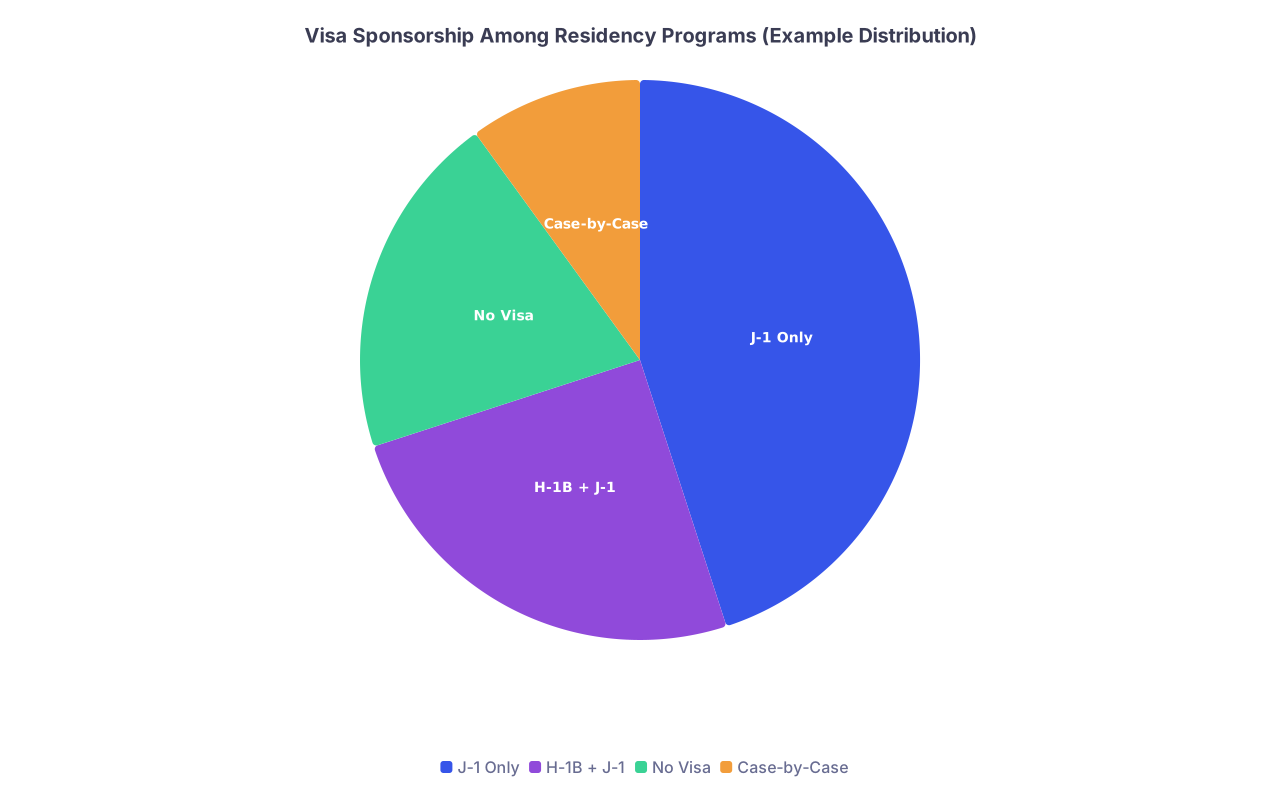
| Category | Value |
|---|---|
| J-1 Only | 45 |
| H-1B + J-1 | 25 |
| No Visa | 20 |
| Case-by-Case | 10 |
You’ll see a few clear categories:
“We sponsor J‑1 visas only.”
If you need H‑1B, cross them off. Don’t try to argue or negotiate.“We sponsor both J‑1 and H‑1B visas for eligible candidates.”
Good sign. But H‑1B may still require:- Step 3 passed before residency
- Higher score thresholds
- No attempt failures
“We do not sponsor visas.”
If you’re not a citizen/green card holder, it’s a dead end.“Visa sponsorship is determined on an individual basis.”
Translation: maybe, but don’t count on it. Check current residents — any on J‑1 or H‑1B? If yes, email to clarify.
4. How to read the “Current Residents” page like a detective
This is where you separate real IMG‑friendly programs from pretend ones.
Open the page. Don’t just glance at faces and feel reassured. Actively count and categorize.
Here’s a simple framework:
| Metric | Strong IMG-Friendly | Weak/Token IMG |
|---|---|---|
| % of IMGs per class | 30–80% | 0–10% |
| US vs non-US IMGs | Mix of both | Mostly US-IMG or none |
| Visa sponsorship history | Recent J-1/H-1B residents | No visa residents |
Concrete steps:
- Count total residents per PGY year.
- For each year, count:
- US MD
- US DO
- US‑IMG (e.g., Caribbean schools)
- Non‑US IMG (India, Pakistan, etc.)
- Note their med school and country. Look for patterns:
- “We welcome IMGs” but all IMGs are US‑IMG Caribbean → they’re technically IMG‑friendly, but not necessarily friendly to non‑US IMGs.
- Multiple residents requiring visas, from multiple countries → genuinely IMG‑friendly.
If you see:
- PGY‑1: 5/10 IMGs
- PGY‑2: 4/10 IMGs
- PGY‑3: 6/10 IMGs
…that’s a real track record. The website phrase now means something.
If you see:
- PGY‑1: 1 Caribbean grad
- PGY‑2: 0 IMGs
- PGY‑3: 1 Caribbean grad
…they “accept” IMGs in theory but don’t rely on them to fill. Your odds are slim unless your app is exceptional for that program.
5. Using outside data to confirm (FRIEDA, Doximity, etc.)
Program websites are marketing. You want third‑party data too.
Key tools:
FREIDA (AMA)
Check:- “International medical graduates accepted” (yes/no)
- “Visa sponsorship” details
- Average Step scores (if listed)
- Number of positions vs applicants
NRMP/Charting Outcomes
Use this to check:- Typical Step scores for matched IMGs in your specialty
- Match rate by score range, specialty competitiveness
Forums (Reddit r/IMGreddit, Student Doctor Network)
Yes, there’s noise. But pattern recognition is useful:- “This program said they welcome IMGs but rejected almost all IMG applicants this year.”
- “They interview 1–2 IMGs but haven’t matched one in 3 years.”
Filter gossip through data. If both the resident list and multiple IMGs say it’s bad for IMGs, believe it over the website.
6. How “vague but positive” programs fit into your rank list
You’re not choosing between “all‑IMG‑friendly” and “IMG‑hostile.” You’re building a portfolio.
Think of programs in 4 tiers:
Proven IMG-heavy programs
Multiple IMGs every year, visas sponsored regularly, clear track record. These should be your core targets.Moderately IMG-friendly
10–40% IMGs, occasional visa sponsorship, stronger scores needed. Worth applying if you’re competitive.Vague “We welcome IMGs” but no real proof
0–1 IMG per class, no clear visa track record. Apply only if:- You have high scores,
- Strong USCE,
- Or a specific tie to that region or program.
Non-viable for you (no visa / no IMGs / strict cutoffs you don’t meet)
Don’t waste money “just in case.”
Your mistake as an IMG is usually this: spending $1000+ applying to too many Tier 3–4 programs just because their website sounded “open.” Cut those first. Pour your money into places that actually match people like you.
7. Exact email templates to clarify vague IMG policies
If a website is unclear but not obviously IMG‑hostile, one short, targeted email can help.
Keep it simple and factual. For example:
Subject: Question about IMG applicants and visas
Dear [Coordinator Name],
I’m an international medical graduate applying this cycle and had a quick question about your selection process.
- Do you sponsor J‑1 and/or H‑1B visas for residents?
- How many IMGs have you matched in the last 3 years?
Thank you very much for your time,
[Your Name], MD
[Med School, Graduation Year]
If they respond:
- With clear numbers and details → good sign.
- With “We consider all applicants holistically. Please refer to our website.” → they’re either overwhelmed or not that IMG-focused.
- With “We generally do not sponsor visas / have not matched IMGs recently.” → cross them off.
Don’t turn this into a debate. Take the hint and move on.
8. A quick decision flow you can reuse
Here’s a simple mental flowchart for any program with “We welcome IMGs” on the site:

| Step | Description |
|---|---|
| Step 1 | See We welcome IMGs |
| Step 2 | Check current residents |
| Step 3 | Low priority or skip |
| Step 4 | Count IMG percentage |
| Step 5 | IMG-friendly target |
| Step 6 | Borderline - apply only if strong |
| Step 7 | Check visa, scores, YOG |
| Step 8 | Apply |
| Step 9 | Skip |
| Step 10 | Any IMGs in last 3 years? |
| Step 11 | IMGs >= 20 percent? |
| Step 12 | Visa and stats match you? |
You can run through that in 3–5 minutes per program once you get used to it.
FAQ (exactly 7 questions)
1. If a program has no IMGs in the last 3 years but says they “welcome IMGs,” should I still apply?
Usually no, unless:
- You’re a US‑IMG with very strong scores and USCE, and
- It’s your home region or dream location.
Programs don’t suddenly flip from 0 IMGs to multiple IMGs without a clear reason. Your application money is better spent where there’s a proven track record.
2. How many IMGs in a class is “enough” to call a program IMG‑friendly?
If 20–30% or more of residents are IMGs across multiple classes, I’d call that reasonably IMG‑friendly. When half or more of the class is IMG, that’s strongly IMG‑friendly. One IMG sprinkled every few years doesn’t count as friendly; that’s token.
3. I’m a non‑US IMG who needs a visa. Should I even bother with programs that don’t explicitly mention visas on their website?
You can, but carefully. First, check FREIDA for visa info. If it’s blank or unclear, scan resident lists for anyone clearly on a J‑1/H‑1B. If you still can’t figure it out, send one short email asking specifically about visa sponsorship. If they can’t answer clearly, assume it’s a no.
4. Do community programs tend to be more IMG‑friendly than university programs?
Often, yes, especially in internal medicine, family medicine, pediatrics, psych. Community and smaller university‑affiliated programs frequently rely on IMGs to fill spots. But don’t stereotype; some big university programs have very IMG‑heavy classes, and some small community programs rarely take IMGs. Always check the actual resident list.
5. How do I tell if a program prefers US‑IMGs (Caribbean) over non‑US IMGs?
Look at the source schools. If all “IMGs” are St. George’s, AUC, Ross, etc., and there are no grads from foreign schools outside the US system, they probably lean heavily toward US‑IMGs. If you’re a non‑US IMG, your chances there are usually lower than at programs with a wider range of foreign schools represented.
6. If my Step scores are below a program’s posted minimum, is there any reason to apply?
For IMGs? Almost never. Those minimums are mainly enforced on IMGs and non‑traditional applicants. The rare exceptions are usually for US MDs or people with very strong internal connections. Unless someone in leadership is personally asking you to apply, save your money.
7. What’s the single best quick indicator that a “we welcome IMGs” program is actually real about it?
A resident page showing multiple IMGs in every class, from varied international schools, with at least one or two obviously on visas (e.g., recent graduates from non‑US schools with foreign citizenship). If that’s there, the website message is probably genuine. If it’s not, assume the line is just polite wording.
Key points to keep in your head:
- Ignore the slogan. Believe the resident list and recent match history.
- Visa policy + actual IMG numbers + your stats = your real chance, not the website phrase.
- Ruthlessly cut programs that don’t match people like you and focus your time and money where IMGs are actually getting in.