The prestige ladder in residency is a lot more fragile than people think.
Everyone talks like there’s this neat hierarchy: “top-tier programs” at big-name places, then “mid-tier,” and way down at the bottom… the “IMG-friendly” community programs where, supposedly, careers go to die. And if all or most of your interview invites are at those “lower-tier, IMG-friendly” places, it starts to feel like the hierarchy is very real and you’re stuck on the wrong rung forever.
Let me just say the quiet part out loud: you’re probably low-key panicking that this is it. That this is your ceiling. That you’ll never be competitive for fellowship, never get a good job, never escape the “IMG box.”
Let’s walk through this honestly. Worst-case scenarios and all. Because staying in that vague dread of “I ruined my career” is way worse than facing what’s actually true.
What “Lower-Tier, IMG-Friendly” Really Means (Versus What Your Brain Thinks It Means)
Your brain’s version is something like:
“If I only have interviews at IMG-heavy community programs, it means I’m a weak applicant, programs think I’m trash, my career is already limited, and I’ll be the backup resident that nobody takes seriously.”
Harsh? Yes. But that’s what it sounds like inside, doesn’t it?
Here’s the real translation of “IMG-friendly community program” 90% of the time:
- They are willing to invest in people who didn’t have a perfect path.
- They understand visa issues, non-traditional paths, attempts, gaps.
- They may not be name brands, but they are workhorses that keep hospitals running.
- They literally exist so patients can get care. That’s not “low-tier.” That’s the point of medicine.
Are there weak programs out there? Yes. Some are disorganized, malignant, under-resourced. I’ve seen places where residents are glorified scut machines and nobody’s teaching. But “IMG-friendly” does not automatically equal “garbage program.” That’s a lazy assumption people make on SDN and Reddit to feel superior.
Let me put some structure on this.
| Thought in Your Head | More Accurate Reality |
|---|---|
| Only IMG-friendly invites = I’m a bad applicant | It mostly reflects visa status, scores, YOG, and specialty competitiveness |
| Community program = no fellowship | Many fellows in cards, GI, pulm/crit come from solid community programs |
| No university name = no good job later | Jobs depend more on performance, networking, and references than the logo |
| IMG-heavy = low quality | IMG-heavy often means they’re more flexible and understand non-perfect paths |
Your invites say more about how the system is structured than about your potential as a physician.
The Big Fear: Am I Doomed in My Career If I Match at These Places?
Let’s not sugarcoat the fear. You’re probably thinking:
- “If I match here, I’ll never get a competitive fellowship.”
- “No one will respect my training.”
- “I’ll be stuck in low-paying, undesirable jobs.”
- “I’ll always be ‘the IMG from that no-name program.’”
There are differences between programs. Some places have strong fellowship pipelines, robust research, connections, and name recognition. Others don’t. Pretending it’s all identical would be dishonest.
But the jump your brain is making—from “not big-name” to “career over”—is wrong.
Look at how people actually get to competitive fellowships:
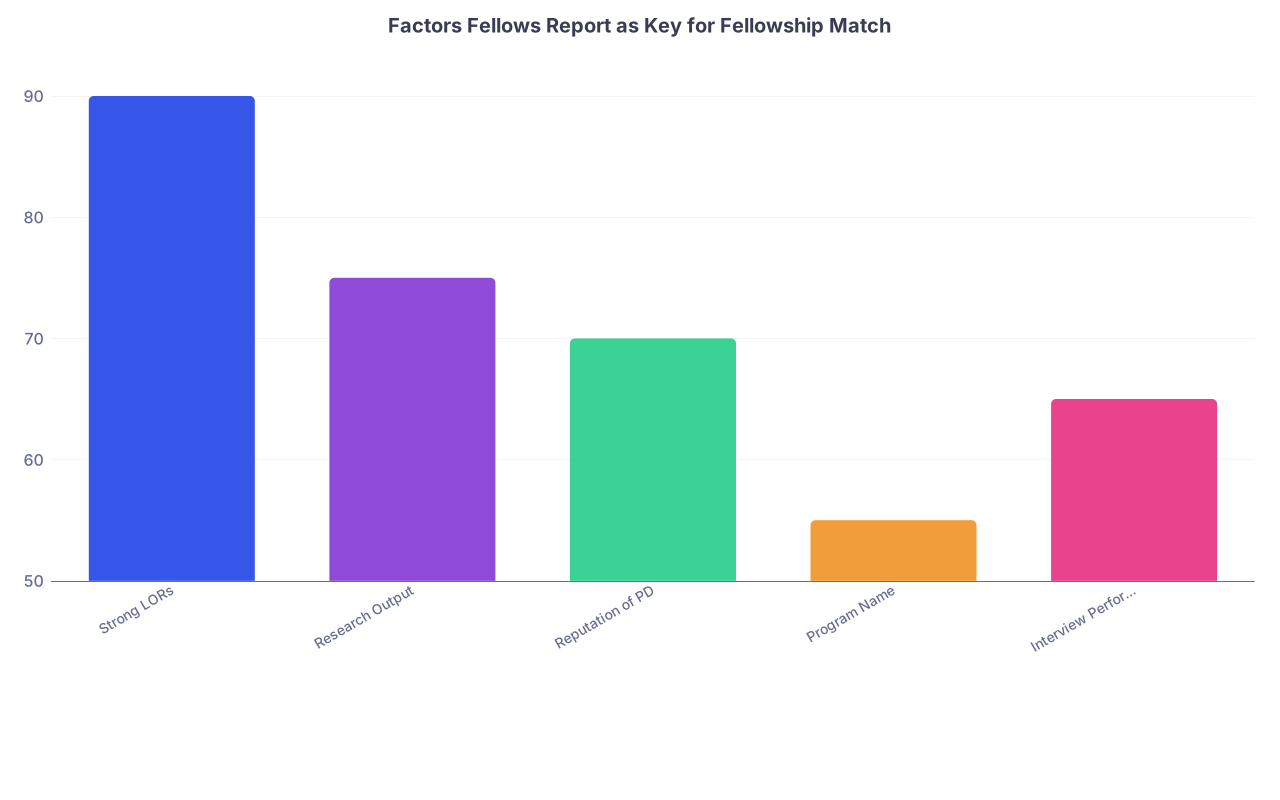
| Category | Value |
|---|---|
| Strong LORs | 90 |
| Research Output | 75 |
| Reputation of PD | 70 |
| Program Name | 55 |
| Interview Performance | 65 |
That’s not “wishful thinking.” Over and over, what matters for the next step is:
- How strongly your attendings are willing to go to bat for you
- What you actually did in residency (research, QI, leadership, performance)
- How you performed on in-training exams / boards
- How you come across in fellowship interviews
Does a big-name residency help? Of course. It opens doors faster. People recognize the brand and assume a baseline of training quality.
But I’ve watched people from community, IMG-heavy, so-called “lower-tier” internal medicine programs match into cards, GI, pulm/crit, heme/onc. They usually share a pattern: top of their class in residency, obsessive about learning, strategically productive with at least a couple of decent projects and strong letters.
They used the program. They didn’t let the program define them.
You’re not doomed. You are going to have to be intentional.
Hidden Advantages of IMG-Friendly “Lower-Tier” Places That No One Brags About
No one posts “Matched at a mid-sized community hospital in the Midwest, IMG-heavy, decent teaching, lots of scut but I’m going to quietly build a strong CV and match a good fellowship later.” That doesn’t go viral.
But that is many people’s actual story.
Here’s what these programs often give you that the prestige-obsessed crowd doesn’t appreciate:
Sheer patient volume and responsibility.
A lot of community programs will throw you in. You’re the primary. You’re writing notes, fielding pages, making decisions. It’s terrifying, but you grow fast. A big fancy place may have a fellow, an APP, a senior, and you’re one cog. Community? You might actually run the show at 2 am.Program directors who understand IMG struggles.
The PD at a community IMG-heavy place is often someone who’s advocated for visa spots, fought with GME to get you in, and gets the uphill battle you’re facing. If you impress them, they can write career-changing letters.Less competition for limited research opportunities.
At brand-name places, everyone is clawing for the same big-shot mentor. At a smaller program, if there are only a few residents trying to publish, you can become the “research person” pretty quickly if you’re persistent.Strong clinical reputation locally.
A lot of community program grads end up very employable in the region. Private groups, hospital systems, community practices know the program and respect its training.
None of this is sexy for Instagram. But it’s how real careers are built.
The Actual Worst-Case Scenario (And Why It’s Probably Not What You Think)
Let’s indulge your brain for a second and spell out the “worst case” you’re quietly catastrophizing about.
You’re thinking worst case is:
“I match at a low-tier IMG-heavy program. I’m stuck there forever, miserable, underpaid, disrespected, never doing the subspecialty I want.”
That’s not actually the worst case.
The real worst case is:
You don’t match because you were too proud or too anxious to rank these programs highly, and now you’re SOAPing into something you don’t want or sitting out an entire year with an even weaker application next cycle.
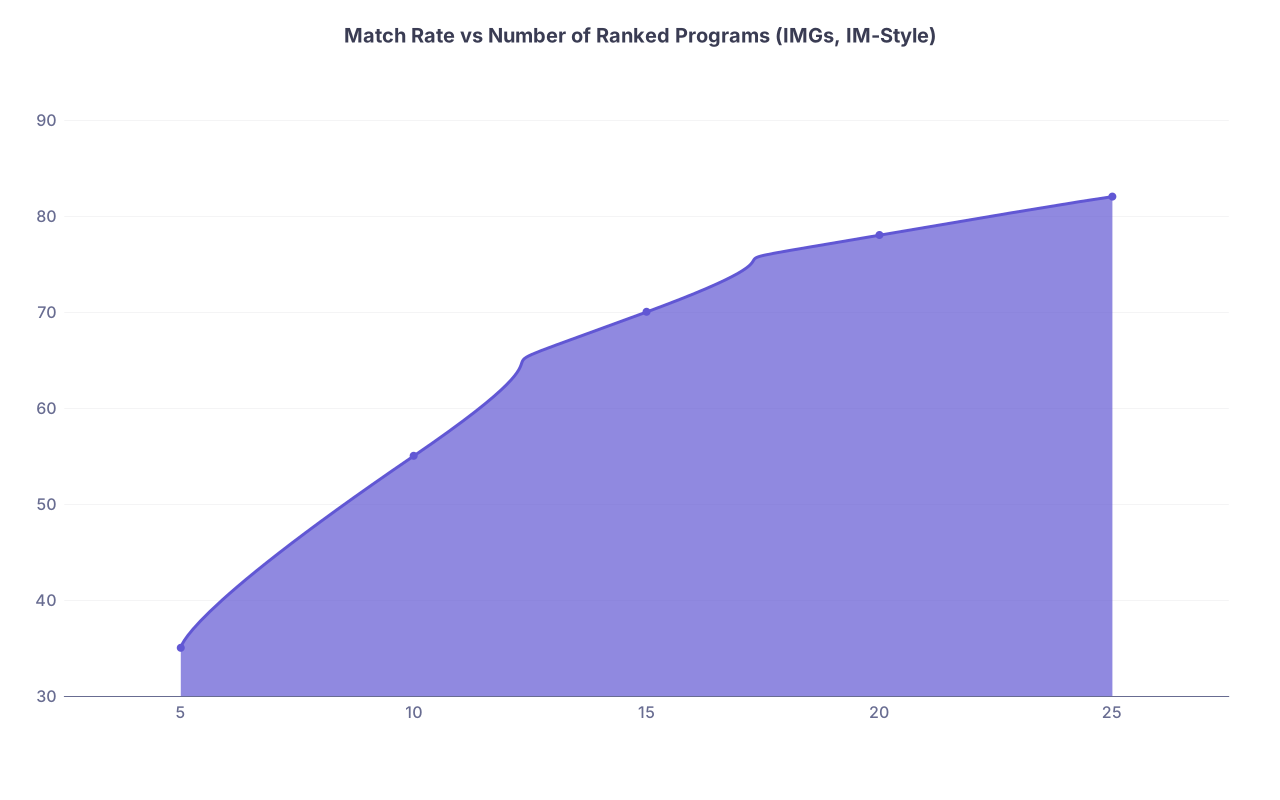
| Category | Value |
|---|---|
| 5 | 35 |
| 10 | 55 |
| 15 | 70 |
| 20 | 78 |
| 25 | 82 |
The data is brutal: for IMGs, ranking more programs—especially the ones that actually invite you—matters more than “tier.” A “low-tier” program where you match is better for your career than a “top-tier” dream that rejected you in October.
The nightmare isn’t “I end up at an IMG-friendly place.”
The nightmare is “I end up with no residency at all.”
Harsh. But grounding.
So if all (or most) of your interviews are at these programs, step one is accepting a painful truth:
This is your lane this cycle. And your primary job is to match. Full stop.
You cannot build a career if you can’t even get through the door.
How Much Does Program “Tier” Matter for Future Fellowship & Jobs?
Let’s be honest and not delusional.
For competitive fellowship (cards, GI, heme/onc, derm, ortho, etc.)
Tier matters some, but not as much as you’re convinced it does. What matters more is:
- Were you top 10–20% in your residency program?
- Did your PD and key attendings write glowing letters that say things like “one of the best residents I’ve worked with in 10 years”?
- Do you have at least a couple of decent publications/posters, showing you can engage with academic work?
- Did you crush your in-training exams / boards?
Can a low-resource, disorganized program make this harder? Yes. If you’re in a place with zero culture of research and no one supports your projects, you’re climbing with a weight on your back. But I have seen people still do it.
For non-competitive fellowship (endo, nephro, rheum in some places, geri, etc.)
Program tier matters even less. Your consistency, letters, and exam scores talk louder.
For hospitalist / primary care jobs
Program tier is barely on the radar. What employers actually ask:
- Do your references like you or do they pause when asked?
- Do you function independently and safely?
- Do you show up, do the work, not create drama?
If you want academic hospitalist jobs, teaching gigs, or to be in a super-desirable coastal city, then yes, a strong name helps. But I’ve seen community grads land academic jobs simply by being excellent and networking with the right people at conferences or through mentors.
The Real Question: Are Your Specific Programs “Good Enough”?
Here’s where the anxiety is actually useful. Because not every IMG-friendly program is safe. Some are red flags with residency-shaped branding.
You don’t need “top-tier.”
You need “good enough to train you, not abuse you, and give you a platform to grow.”
Watch for these signs on interview day or through current residents:

Green-ish flags:
- Residents who are tired but not dead inside
- People willingly say, “The leadership listens when we bring up problems”
- Alumni who’ve gone to at least some fellowships or decent jobs
- A sense that there’s at least a skeleton of teaching: noon conference, morning report, real feedback
- Residents warning you indirectly: “We’re very busy” with a weird look
- High or mysterious attrition: “Some residents left but…” (and no one explains)
- PD dodges questions about how they support visas, research, or poor performers
- Chaos stories: lost schedules, last-minute changes, no backup when things go bad
If your list is “all IMG-friendly community programs,” you’re not doomed.
If your list is “all malignant disaster zones,” then yes, your concern is warranted.
You’re not choosing between “Hopkins vs community.”
You’re choosing between “healthy-enough place where I can grow” vs “this might actually harm my training.”
That’s the real decision.
What You Can Actually Control Now (Instead of Just Spiraling)
You can’t magically summon MGH or UCSF into your inbox. That ship has sailed for this cycle.
But you are absolutely not powerless.
Here’s what you can still do this season:
Treat every “low-tier” interview like a top-tier opportunity.
Show up prepared. Know their program. Ask real questions. Be humble and enthusiastic. PDs can smell it when you think you’re “settling” for them. And that kills your rank position faster than your Step score ever did.Interrogate the training quality, not the prestige.
Ask current residents quietly:- “Do you feel supported when you’re overwhelmed?”
- “Do you get direct teaching on rounds or mostly service?”
- “Have residents gotten fellowships? Jobs they wanted?”
Their faces will tell you more than their words.
Rank all places where you could tolerate being trained.
Not where you’d be “excited on Instagram.” Where you could genuinely show up for three years and not burn out completely. Swallow your pride. Empty rank lists do not win awards.Start thinking like someone who will need to overperform in residency.
You are not going to coast. You will likely have to be in the top 10–20% of your class to escape the “tier anxiety” later. That means being ready to grind: show up prepared, volunteer for learning opportunities, seek feedback, do small QI projects that are actually finishable.

| Step | Description |
|---|---|
| Step 1 | Match at IMG friendly program |
| Step 2 | Show up prepared and professional |
| Step 3 | Earn PD and attending trust |
| Step 4 | Take on research or QI projects |
| Step 5 | Strong letters and exam scores |
| Step 6 | Fellowship or solid job offers |
Is it fair that you might have to work harder than someone at a famous program? No. But medicine has never been fair to IMGs. You already know that.
The Ego Hit: Grieving the “Dream” While Still Moving Forward
There’s a grief process nobody talks about.
Maybe you imagined yourself at a big academic center, sleek white coat, huge research machine, name-brand fellowship lined up by PGY2. And now your real option is a 300-bed community hospital somewhere you had to Google on a map.
You’re allowed to be sad about that. To feel disappointed. To feel like you “underperformed” your potential.
But then there’s the part after the grief where you decide:
“Okay. This is where I am. What can I actually do from here?”

I have seen IMGs from programs nobody talks about end up with careers they’re genuinely proud of. Happy hospitalists. Solid intensivists. Cards and GI fellows. Academic faculty. Did they all get exactly what they dreamed of at 22? No. But they built something real out of less-than-perfect starting points.
The badge on your ID card matters. It’s just not the only thing that matters.
A Reality Check on Social Media and “Tier Culture”
Instagram and Reddit are poison for this particular anxiety.
You’re seeing:
- “Matched at Mayo!”
- “So blessed to be going to Columbia IM!”
- Endless “My rank list” flex posts
You’re not seeing:
- The person who matched a mid-tier community program, worked hard, and now has a fellowship at a solid university hospital
- The person who chased “tier” so hard they under-ranked community programs and ended up unmatched
- The PGY3 at a famous place who’s miserable, unsupported, and unsure if they even want a job in medicine anymore
Nobody posts, “Matched at a very normal program that will train me well and let me have an actual life.” But that’s honestly the best-case scenario for a lot of people.
You’re comparing your quiet reality to everyone else’s highlight reel and then drawing existential conclusions. That’s a rigged game.
So What If All Your Interviews Are at Lower-Tier, IMG-Friendly Programs?
Then here’s what’s true:
- You’re still in the game. You have interviews. You’re not out.
- Those programs saw something in your file and decided you were worth their time.
- Your main job is to convert those interviews into a match.
- Your second job is to figure out which of those places will train you well enough that your hard work can translate into a good career.
You are not locked into a life sentence of mediocrity because your programs aren’t “top 10.” But you are at a crossroads where your choices and effort matter a lot.
The worst version of you, from here, will be bitter, checked out, convinced you’re doomed, and half-assing interviews and residency because “it doesn’t matter.”
The best version of you, from here, will be realistic, humble, quietly angry at the system—but channel that anger into outworking your label and making sure that three years from now, your CV and your letters tell a completely different story than “just an IMG at a lower-tier place.”
Today, do this: open your interview list and, next to each “lower-tier, IMG-friendly” program, write one concrete thing you’ll ask on interview day to assess training quality—not prestige. Use that to decide how you’ll rank them, not the name on the door.