
The brutal truth: the 8‑year gap is a problem. But it’s not an automatic death sentence.
The “8 Years Since Graduation” Panic
You’re not crazy for obsessing over that one line you keep seeing on program websites:
“Preferred graduation within 3–5 years.”
“Must have graduated within the last 5 years.”
And you’re sitting there with:
Graduation year: 8 years ago.
IMG. Maybe with some attempts. Maybe with no USCE. Maybe with gaps.
And your brain is doing what mine did:
So… am I just done? Is this whole thing over and I’m the last one to realize it?
Let me say this outright: there are IMGs who match 8+ years after graduation. I’ve seen 10, 12, even 15-year gaps. But they are not doing it by “just applying to IMG-friendly programs and hoping for the best.”
If you’re 8 years out, you’re playing on “hard mode.” And most people don’t realize how different the rules are on hard mode.
Let’s talk about what actually matters, which “IMG‑friendly” residues still might consider you, and what you need to fix before you burn thousands of dollars on ERAS.
How Programs Actually See Your 8‑Year Gap
Forget the marketing language on websites for a second. Inside the committee room, there are three big thoughts when they see “Graduated: 2016” for the 2025 Match.
- Is this person still clinically safe?
- Is this person going to struggle massively with the learning curve?
- Why has it taken 8 years to apply?
The “years since graduation” thing is mostly a proxy for those questions. They’re not trying to punish you for your birthday. They’re trying to avoid a resident who’s completely de-skilled or can’t adjust to the system.
Typical internal reactions I’ve heard from PDs or faculty:
- “If they haven’t touched a hospital in 5 years, I’m nervous.”
- “If they’ve been practicing elsewhere, okay, but can they unlearn bad habits?”
- “Eight years and only now Step 2? What happened?”
So the core problem is not the number. It’s what the number suggests.
If you want any shot, you have to aggressively fight those assumptions with evidence.
Do IMG‑Friendly Programs Actually Help With Old Grads?
Here’s the part nobody explains clearly:
“IMG‑friendly” does NOT automatically mean “old-grad friendly.”
Many so‑called IMG‑friendly programs love fresh IMGs: 0–3 years out, Step scores done, recent USCE, easy to train, willing to work hard. They might even explicitly say “we accept IMGs” while quietly filtering for ≤5 years since graduation.
On the other hand, some programs that don’t scream “IMG‑friendly” on blogs and spreadsheets are quietly more flexible if:
- You have strong, recent clinical work (even abroad)
- You have US experience that isn’t 10 years old
- You’ve done research or fellowships
- You have insanely strong letters from credible people
To make it concrete, here’s how the “friendliness” actually breaks down.
| Program Type | Typical Years Since Grad Limit |
|---|---|
| University categorical IM | 3–5 years preferred |
| Community hospital IM (non-urban) | 5–10 years, often flexible |
| Family medicine community programs | 5–10 years, case-by-case |
| Internal medicine prelim/TY spots | More flexible, but competitive |
| Highly competitive specialties | Usually 3 years max |
This is not absolute, but it’s the pattern.
So can IMG‑friendly residencies help you if you graduated 8 years ago?
Some can. Some absolutely won’t. Your job is to:
- Stop wasting time on programs that hard‑filter old grads
- Find the ones that actually look at context instead of a simple year cutoff
Which means you need to stop thinking like “I’ll just apply to 150 IM programs” and start thinking like a sniper, not a sprinkler.
Hard Reality Check: Where You Stand at 8 Years Out
Let me be as blunt as you’re afraid an advisor would be.
If the following are true:
- 8 years since graduation
- No recent clinical practice (last 3–5 years mostly out of medicine)
- No US clinical experience in the last 2–3 years
- Average or low USMLE scores, maybe attempts
- No real research, no US mentors
Then your chances in a single cycle are low. Not zero. But low. And most people in this exact situation do exactly the wrong thing: they panic-apply to 100–200 programs, blow $3–6k, sit all season with no interviews, then crash emotionally in February.
If any of that describes you, your main problem is not that you’re an IMG. It’s that your file doesn’t prove you’re a safe, current, trainable physician.
On the other hand, if you’re 8 years out but:
- You’ve been working clinically (even outside the US)
- You’ve passed all Steps, preferably with no failures
- You can get letters from recent supervisors
- You can explain your timeline without sounding evasive
Then you’re old, yes, but not “hopeless.” Programs will occasionally take a chance on someone like that. Especially in community internal medicine and family medicine.
What You Need To Do Before Counting On IMG‑Friendly Programs
Let’s assume you’re not ready to just give up. (If you were, you wouldn’t be reading this.)
Here’s what I’d focus on, in order of urgency.
1. Prove you’re clinically current
If the last time you touched a patient was during your internship 7 years ago, that’s what kills you. You need something recent and concrete.
Options that actually help:
- Recent paid clinical work as a physician in your home country or another system
- Observerships/shadowing in the US within the last 1–2 years (not as strong, but better than nothing)
- Hands‑on assistant roles if your visa/status allows, like clinical assistant or scribe in a hospital setting
Does a 1‑month observership suddenly erase 8 years? No. But a complete absence of anything recent is basically a red flag screaming “rusty.”
2. Tighten your exam profile
Programs are more willing to “forgive” an old graduation date if your exam performance shows you’re sharp now.
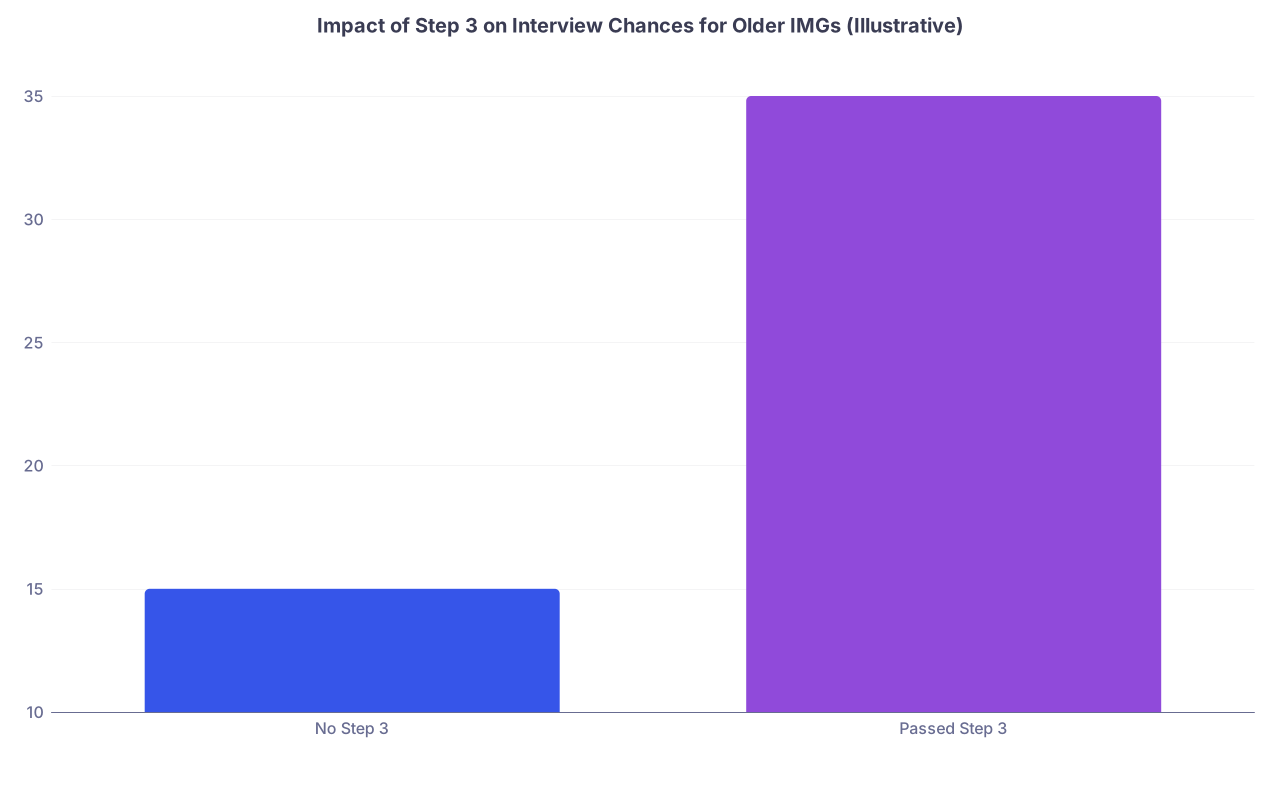
If you still don’t have Step 3 and you’re 8 years out? That’s a problem you can actually fix.
For older IMGs, Step 3 is not optional in my opinion. It:
- Shows current knowledge
- Helps overcome that “can they pass boards?” anxiety
- Makes you more attractive to visa‑sponsoring programs (especially H‑1B)
If your Step scores are weak or you have attempts, Step 3 is one of the few tools you have to change the narrative a little: “Look, I can still learn and pass.”
| Category | Value |
|---|---|
| No Step 3 | 15 |
| Passed Step 3 | 35 |
(This isn’t exact NRMP data; it’s the kind of jump I’ve repeatedly seen in real applicant pools.)
3. Build recent, believable US connections
Programs love “safe bets.” A US letter from 2024 saying:
“I worked with Dr. X on the wards and would absolutely trust them as an intern at our hospital”
is a different universe from a 2015 letter from your med school dean saying you were “a diligent student.”
For an 8‑year‑out IMG, you want at least:
- 2–3 letters from the last 1–2 years
- At least 1 from someone with US affiliation if humanly possible
Not “family friend doctor.” Not “Dr. So‑and‑so who saw me for two days.” Someone who actually saw you interact with patients and a team.
4. Have a non‑cringey explanation for the gap
You don’t need a dramatic story. But you do need a coherent one.
Bad version: “I had some issues, then family things, and COVID, and then it was hard, and…”
Better version: “After graduation I worked as a general physician in X country for Y years, then took time for [family/relocation/immigration], and in the last 2 years I’ve done [concrete things] to prepare for US residency.”
Own your path without sounding like you’re making excuses.
Where To Actually Apply If You’re 8 Years Out
You can’t just trust online “IMG‑friendly lists” blindly. Many are outdated or don’t specify anything about graduation year.
You need to actively sort programs by two filters:
- Do they even allow older grads?
- Are they realistically open to IMGs, not just in theory?
Look at these signs in program descriptions / websites:
- “No cut‑off for year of graduation” → promising
- “Graduation within last 5 years required” → don’t waste an application
- “Preference given to recent graduates” → maybe, but risky for 8+ years unless you’re strong
- “International graduates must have recent clinical experience” → they’re telling you the game

Realistic target buckets for an 8‑year‑out IMG
You’re more likely to get looked at in:
- Community internal medicine programs (especially in less popular geographic areas)
- Family medicine programs that openly accept older grads
- Transitional / prelim medicine years in hospitals that already have lots of IMGs
- Programs with stated flexibility on graduation date
You’re less likely (almost zero, honestly) to get love from:
- Competitive specialties (derm, ophtho, ortho, radiology, ENT, etc.)
- Most university “brand name” categorical spots
- Programs with strict “within 3 years” language
If nobody told you this before, I’m a little angry on your behalf.
Should You Wait a Year And “Fix” Your CV?
This is the real question underneath all your anxiety:
Should you apply now and risk getting nothing, or wait a year or two to strengthen your file?
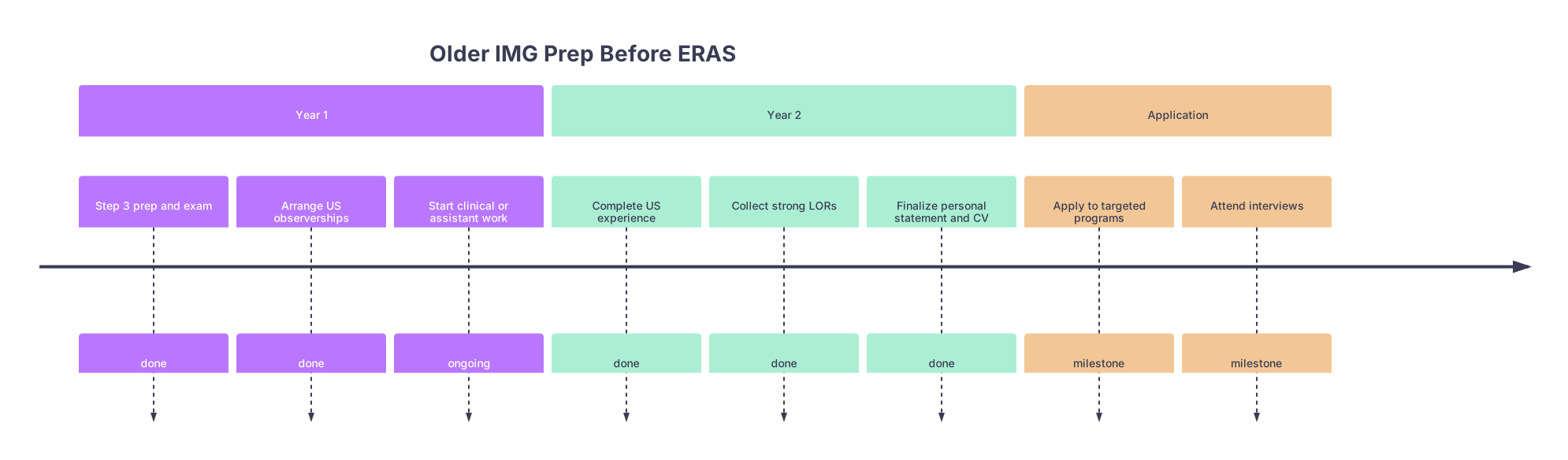
Here’s the uncomfortable answer: if you are 8 years out and currently weak in multiple areas (no USCE, no Step 3, no recent letters, long nonclinical gap), it’s usually smarter to:
- Take 1–2 years
- Fix as many of those deficits as possible
- Then apply one “all‑in” cycle
Yes, you’ll be 9 or 10 years out then. But you’ll be 9–10 years out with Step 3, recent experience, and better letters, instead of 8 years out with nothing changed.
Time by itself is not the problem. Unused time is.
| Period | Event |
|---|---|
| Year 1 - Step 3 prep and exam | done |
| Year 1 - Arrange US observerships | done |
| Year 1 - Start clinical or assistant work | ongoing |
| Year 2 - Complete US experience | done |
| Year 2 - Collect strong LORs | done |
| Year 2 - Finalize personal statement and CV | done |
| Application - Apply to targeted programs | milestone |
| Application - Attend interviews | milestone |
How Many Programs Should You Apply To?
This is the part where everyone lies to you. They’ll say “just apply broadly!” as if money and emotional energy are infinite.
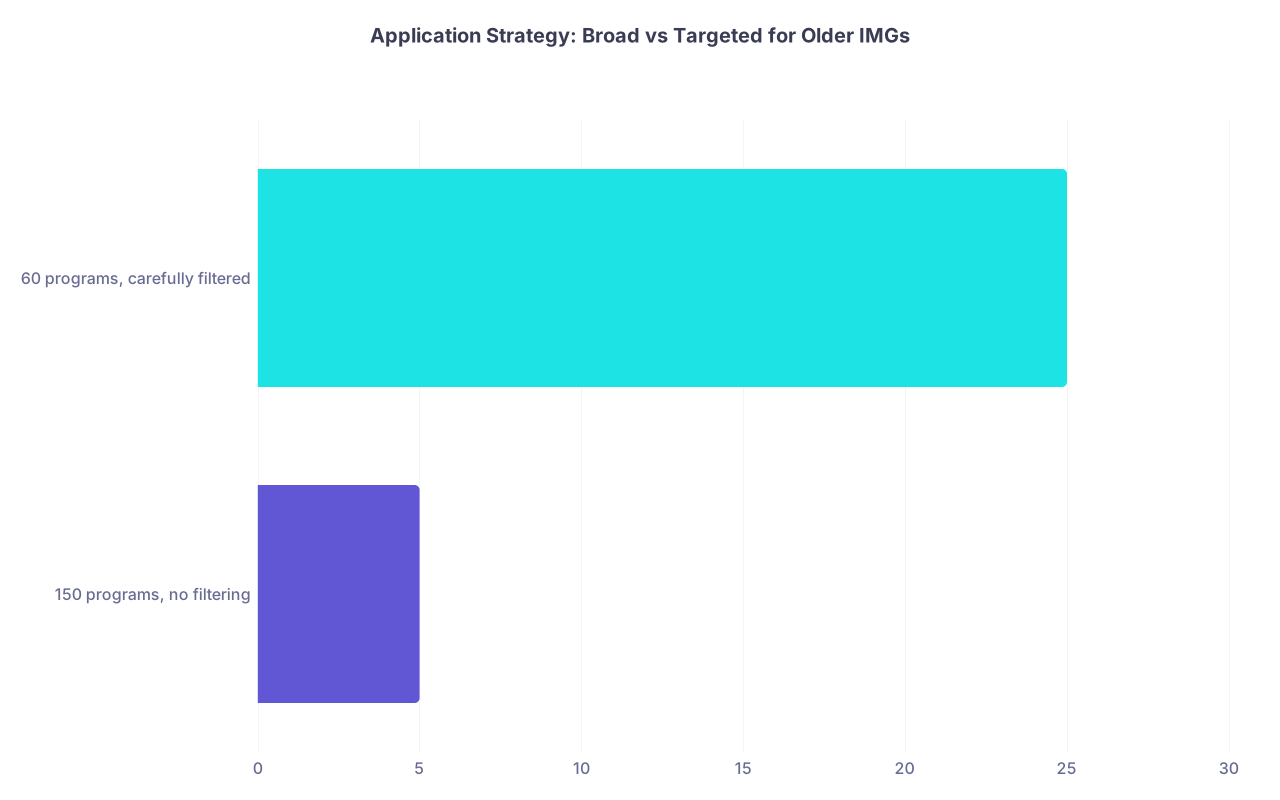
As an 8‑year‑out IMG, your problem isn’t just quantity. It’s relevance. Applying to 150 programs that auto‑filter you based on year of graduation is just an expensive way to hurt yourself.
Here’s a much saner approach:
- Make a spreadsheet of, say, 80–120 programs you think might work
- Go through each website and filter out those that clearly say “≤5 years since graduation”
- Of what’s left, prioritize community programs, places with past IMGs, and those with no hard cutoff mentioned
You might end up with 40–70 truly realistic targets. That’s fine. Better 60 realistic than 150 fantasy.
| Category | Value |
|---|---|
| 150 programs, no filtering | 5 |
| 60 programs, carefully filtered | 25 |
Again, this is illustrative, but I’ve watched applicants do both. The ones who filter tend to actually get interviews.
The Emotional Side No One Talks About
The worst part of being an older IMG isn’t just the stats. It’s watching people 10 years younger than you match easily while you’re rewriting your personal statement for the 5th time, wondering if you’ve wasted your life.
You start asking very dark questions:
“Did I miss my only window?”
“Should I just quit medicine?”
“Are people secretly laughing at me for still trying?”
You’re not alone in that. I’ve watched extremely capable, compassionate doctors give up, not because they weren’t good enough for residency, but because the waiting and uncertainty just crushed them.
So here’s the line I draw:
- If you’re willing to actually change your profile (get Step 3, get recent experience, fix letters), then continuing is rational, even at 8–10 years out.
- If you’re not in a position to change anything and you’re just reapplying every year with the same application… then yeah, at some point that stops being persistence and becomes self‑harm.
Only you know which category you’re in.
But your 8‑year gap, by itself, is not the whole story. Programs absolutely have taken people with that kind of gap—usually the ones who did the hard, boring work of rebuilding their file.
Years from now, you won’t remember the exact wording of every email from ERAS or every night you spiraled over “years since graduation.” You’ll remember whether you faced this moment passively or deliberately.
FAQ (Exactly 6 Questions)
1. Is there any realistic chance to match as an IMG 8 years after graduation?
Yes, but only if you’re willing to aggressively fix your weaknesses. If you’re 8 years out with no recent clinical work, no USCE, no Step 3, and weak scores, the chance this cycle is low. If you work 1–2 years to add Step 3, recent clinical/US experience, and strong letters, your chances become real—still below average, but not fantasy.
2. Should I even bother applying if programs say “within 5 years of graduation preferred”?
“Preferred” is soft language; “required” is hard. If your CV is strong (recent practice, solid scores, Step 3, good US letters), you can still throw a few applications at those “preferred” programs. If your profile is weak, don’t waste money there. And if they say “must have graduated within 5 years” or “no exceptions”—skip it completely.
3. Does Step 3 really matter that much for older IMGs?
For you? Yes. It’s one of the few objective signals you can still change. A recent Step 3 pass tells programs you’re not academically stale and reduces their fear you’ll fail boards. It doesn’t magically erase the gap, but older IMGs without Step 3 are fighting with one arm tied behind their back.
4. Will an observership or externship actually help with my 8‑year gap?
It won’t fix everything, but it’s definitely better than nothing. Programs care that you’ve been in a hospital recently, seen US workflows, and had someone credible observe you. A 4–8 week US observership with a strong letter attached can be the difference between “automatic no” and “let’s at least look at this file.”
5. I’ve reapplied 2–3 times already with no interviews. Should I keep trying?
Not unless something major changes between cycles. If you’re just reusing the same CV, same gaps, same lack of USCE, the answer isn’t “apply again,” it’s “pause and rebuild.” Add Step 3, get recent experience, rewrite your personal statement with a clear narrative. If after real changes you still get nothing, then it’s time to seriously consider alternative paths.
6. Are there specific specialties I should avoid as an older IMG?
Yes. For 8‑year‑out IMGs, highly competitive specialties (derm, radiology, ortho, ENT, ophtho, neurosurgery, etc.) are functionally closed unless you have an extraordinary, unique profile. Your best realistic options are usually internal medicine (especially community programs), family medicine, and occasionally pediatrics or psych in less competitive locations. It’s not fair, but pretending otherwise just wastes years you can’t get back.