
The myth that “one exam failure kills your chances as an IMG” is lazy, outdated, and flat-out wrong.
I’m not saying it doesn’t hurt. It does. Especially as an IMG. But this idea that you’re now dead in the water for every decent program? That’s not reality. It’s just the story your panic is telling you at 2 a.m.
Let me walk through this like I’m sitting beside you, scrolling through ERAS, muttering, “Okay, who’s actually going to still take you seriously?” Because that’s what you really want to know:
Not theory. Not generic “don’t worry” pep talk.
You want: “With a failed exam attempt, will IMG-friendly programs still consider me, or am I wasting this entire cycle and thousands of dollars?”
First: The Ugly Truth (So Your Brain Stops Making It Worse)
Here’s the part your anxious brain is half-right about:
A failed USMLE/COMLEX attempt does:
- Knock you out of some programs instantly (automatic filters)
- Make competitive specialties nearly impossible (as an IMG)
- Force you to be more strategic and realistic than classmates who passed on the first try
But here’s the part your brain keeps twisting into something worse than it is:
It does not mean:
- “Nobody will rank me”
- “I can never match in the U.S.”
- “All IMG-friendly programs will ignore me”
- “My whole career is ruined”
I’ve seen IMGs with a failed Step 1 or Step 2:
- Match Internal Medicine at solid university-affiliated community programs
- Match Family Medicine in the same state they dreamed of
- Match Psychiatry after a rocky start
- Even match Pediatrics with a rough transcript but strong improvement
Were they at Harvard, Mayo, or UCSF? No.
Did they have to be strategic, picky, and brutally honest with themselves? Yes.
So yes, IMG-friendly programs do still consider you. Just not all of them. And not blindly.
How Programs Actually Look At Your Failure (Not the Story in Your Head)
When a PD or selection committee sees “Fail” on your transcript, they don’t just see “bad doctor.”
They ask three questions:
- Was this a pattern or a single event?
- Did you recover strongly?
- Is there a plausible, honest story that matches everything else in the file?
Programs that are actually IMG-friendly don’t expect perfect transcripts. They do expect to see evidence you’re not a chronic academic problem.
Here’s how that usually breaks down in their heads:
| Scenario | Typical Program Reaction |
|---|---|
| Single fail, strong later scores | Still in the game |
| Fail + just-barely passes after | Concerned but may consider context |
| Multiple exam failures | Many programs auto-reject |
| Fail + no explanation + weak CV | Almost no chance |
| Fail + strong improvement + proof | Considered, especially IMG-friendly |
So if you:
- Failed once
- Then passed comfortably on your next try
- And your other scores are at least okay (not amazing, just okay)
You’re not “toxic.” You’re “risky but maybe worth a closer look.”
That’s actually the zone where IMG-friendly programs live. They’re used to imperfect applicants. They just want:
- Effort
- Growth
- Honesty
- Consistency
What “IMG-Friendly” Really Means When You Have a Failure
A lot of people throw “IMG-friendly” around like it means “desperate, takes anyone.” That’s not what it is.
IMG-friendly usually means:
- They routinely take IMGs, not just one person in 2015
- Their current residents include non-US IMGs, not just US-IMGs from Caribbean schools
- Their Step score averages are reasonable, not insane
- They don’t have a hidden “no failures ever” rule
That last part is what you care about.
Here’s the pattern I’ve seen in programs that still consider IMGs with a failure:
- Community or community–university affiliated
- Mid-tier or lower-tier academic programs that actually work with IMGs
- Specialties like:
- Internal Medicine
- Family Medicine
- Pediatrics
- Psychiatry
- Neurology (select places)
Programs less likely to care about one failure if everything else is okay:
- Places that proudly say they are “IMG-inclusive” on their website
- Programs with 30–80% IMGs in their resident list
- Programs in less competitive locations (Midwest, rural, non-coastal cities)
Where you’re basically done with a failure (as an IMG):
- Dermatology, Ortho, Plastics, ENT, NSG, IR, Rad Onc
- Super-elite academic IM programs (Heme-Onc factory places)
- Places with strict filters: “No failures. No exceptions.”
That’s painful, but it’s also a relief. You don’t have to chase stuff that will never touch your application.
Your Score Profile: Where You Actually Stand
Your anxiety is probably screaming: “I failed Step 1 once. No one will want me.” But this is what programs actually see:
- Fail on Step __ → Passed with ___ later
- Step 2 CK: ___
- Any shelf exam or school failures? Y/N
- Time since graduation: ___ years
They don’t just see “FAIL = trash.”
They see risk vs potential.
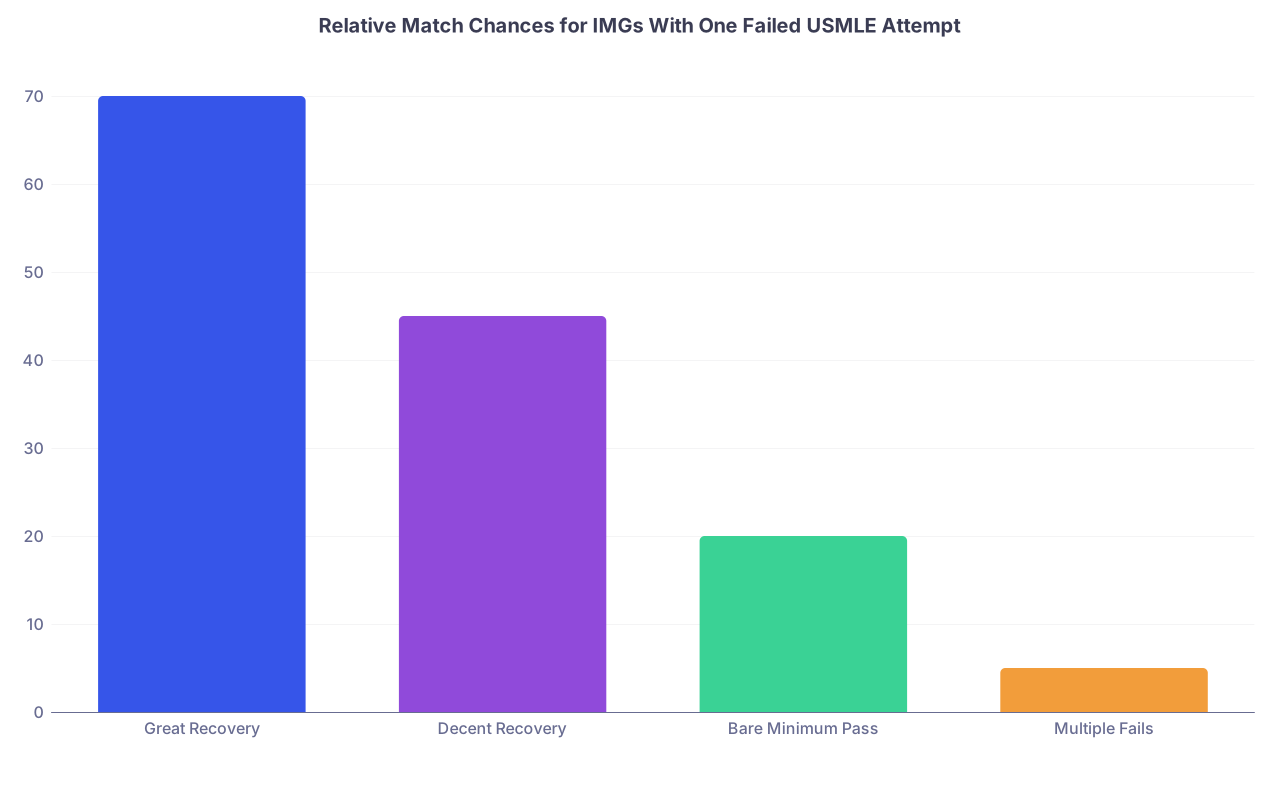
Here’s the brutal-but-true spectrum for IMGs with a failure:
| Category | Value |
|---|---|
| Great Recovery | 70 |
| Decent Recovery | 45 |
| Bare Minimum Pass | 20 |
| Multiple Fails | 5 |
Interpretation (rough idea, not exact stats):
- Great recovery (big jump in score, strong Step 2): “We’ll seriously consider them.”
- Decent recovery: “Maybe, if the rest of the app is good.”
- Bare minimum pass: “Possible, but we’re cautious.”
- Multiple fails: “Almost always no, except ultra-desperate programs.”
If you’re in the first two groups with decent clinicals and some letters? You’re still in the race.
If you’re in the third or fourth group, you’re not doomed, but your list has to be extremely targeted and realistic.
How To Make IMG-Friendly Programs Actually Take You Seriously
Here’s the part nobody tells you clearly:
Programs don’t reject you for the failure alone. They reject you because the rest of your file doesn’t overpower that red flag.
So you fight back by overcompensating. Aggressively.
1. Step 2 CK Becomes Your Make-Or-Break
If Step 1 was a fail, Step 2 is now the “proof of concept” exam.
Program director logic looks like this:
- “They failed once but Step 2 is 240+? Okay, they figured it out.”
- “They failed once and Step 2 is 221? That’s a soft pass. Risky.”
- “They failed Step 1 & Step 2? Absolutely not.”
If you haven’t taken Step 2 yet, this is the exam where you can partially erase the psychological weight of that fail. Not fully, but a lot.
If you’ve already taken it and it’s just okay: then you really need strong clinical performance, letters, and a targeted specialty (not competitive ones).
2. Your Personal Statement Needs a Calm, Straight Explanation
You can’t pretend the failure didn’t happen. They’re literally looking at it on the transcript.
But you also can’t turn your personal statement into a 2-page apology letter. That looks weak and desperate. Programs hate that.
The goal: 3–5 calm, direct sentences with:
- Brief context (not drama)
- What you changed
- Clear evidence of improvement
Something like:
“During my initial attempt at Step 1, I underestimated the adjustment needed from my school’s exam style to the USMLE format and did not structure my study time effectively. After failing, I reassessed my approach, met weekly with a mentor, and used a dedicated question-bank strategy. On my next attempt, I passed comfortably and later scored ___ on Step 2 CK. This experience forced me to build better systems and resilience that I now bring to my clinical work.”
That’s it. No sob story. No blaming. No oversharing about personal crises unless they were truly major and verifiable (serious illness, war, etc.).

| Step | Description |
|---|---|
| Step 1 | See failed attempt |
| Step 2 | Assume poor habits |
| Step 3 | High risk - reject |
| Step 4 | Consider full application |
| Step 5 | Is there an explanation? |
| Step 6 | Did they improve later? |
You’re trying to move them from auto-reject to “Okay, let’s look closer.”
3. Letters of Recommendation Need To Quiet Their Fears
Programs worry that a failure means:
- You’re disorganized
- You can’t handle pressure
- You’re going to struggle with in-training exams
Good letters can calm that down.
The best letters for someone with a failure say things like:
- “Shows excellent clinical reasoning on the wards”
- “Adapted quickly to our system and performed at or above the level of our other students”
- “Diligent, teachable, and responds well to feedback”
- “One of the strongest IMGs we’ve worked with in recent years”
If your letter writers know about your failure (they often will, if they ask about gaps), them explicitly saying you’re academically solid now is huge.
4. Your Program List Has To Match Reality, Not Fantasy
This is where a lot of IMGs with a failure destroy themselves: they build a delusional program list.
They apply like nothing happened. Heavy on university programs. Big coastal cities. “Because my cousin matched there.”
No.
You need a data-driven list:
Look for programs that:
- Have 40–80% IMGs
- List non-US IMGs on their website
- Are in less glamorous locations
- Have softer minimum requirements
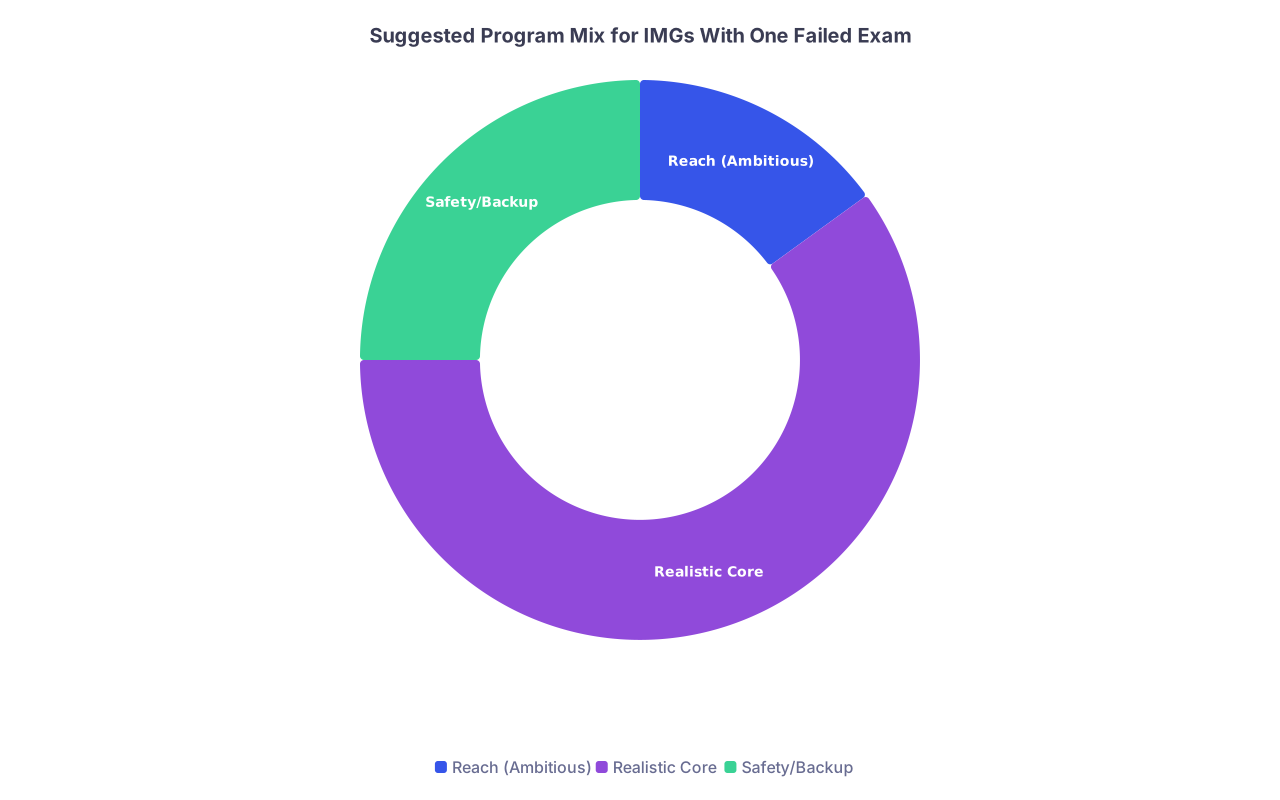
Balance:
- A small number of “reach” programs
- A big chunk of realistic community / community-affiliated programs
- Maybe a few backup specialties if you’re really risk-averse
| Category | Value |
|---|---|
| Reach (Ambitious) | 15 |
| Realistic Core | 60 |
| Safety/Backup | 25 |
And yes, that probably means 100+ applications in many cases. Not because you’re “bad,” but because your risk profile is higher and you need volume plus targeting.
Red Flags You Can’t Ignore (Even If You Want To)
Your brain is probably cycling through: “What if I’m just the exception? What if one program loves me anyway?”
Sometimes that does happen. But don’t rely on miracles.
There are scenarios where matching is brutally hard:
- Multiple exam failures
- Very low Step 2 score + failure history
- Graduated >5–7 years ago and no recent clinical experience
- No U.S. clinical experience at all
- Weak English/communication on top of exam issues
That doesn’t mean zero chance. It means you cannot approach this casually. You might need:
- Research or observer positions in the U.S.
- Extra time building experience before applying
- Another cycle
- Or, yes, a backup non-U.S. plan
But if we’re talking one failed attempt, decent recovery, and otherwise okay profile?
You’re in the uncomfortable middle zone. Not safe. Not doomed.
High anxiety territory.
Which is exactly where you are right now.
How To Survive The Mental Spiral While You Apply
Your brain is going to replay this failure every time:
- You hit “submit” on ERAS
- You get no email for 3 days
- You see someone on Reddit say “failed = no chance”
So here’s the only way I’ve seen people stay functional:
- Accept it’s a red flag. Stop arguing with that.
- Commit to doing everything else so well that your file is impossible to ignore.
- Make a plan for “If I don’t match” before Match Week, so that fear stops owning you.

You’re not trying to erase the failure. You’re trying to outweigh it.
That’s what IMG-friendly programs are looking for:
Not perfection. Just enough proof that your worst day on an exam is not who you are as a resident.
FAQ (Exactly The Questions You’re Afraid To Ask)
1. I failed Step 1 once but passed Step 2 with a good score. Will programs still seriously consider me?
Yes, many IMG-friendly Internal Medicine, Family Medicine, Pediatrics, and Psychiatry programs will still consider you. Your Step 2 score becomes the main signal. If it’s strong, it reassures them that Step 1 was an outlier, not your true ceiling. You won’t be competitive at top academic or super selective places, but you’re absolutely still in the running at many community and mid-tier programs.
2. Should I mention the failure in my personal statement or just hope they ignore it?
You should address it briefly and confidently. Ignoring it doesn’t work; they can see it. Over-explaining makes you look insecure. The sweet spot is 3–5 sentences: what happened, what you changed, how you improved, and the evidence (your later scores and performance). Then move on to who you are now, not who you were on that bad exam day.
3. Is it even worth applying this year, or should I wait to “fix” my application first?
If you already have:
- Passed all steps required for your specialty
- A decent Step 2 score
- Some U.S. clinical experience and solid letters
Then yes, it’s usually worth applying, as long as your program list is realistic and IMG-heavy. If you’re missing U.S. experience, your letters are weak, or Step 2 is also borderline, it might be smarter to take a year to strengthen your application instead of burning money and hope on a very low-chance cycle.
4. Will programs actually tell me if they have a “no failures” policy?
Sometimes, but not always. A few programs openly state “no failed attempts accepted.” Many just use filters inside ERAS and you’ll never know. That’s why it’s smart to email or call a few programs and ask neutrally: “Do you consider applicants with a single failed USMLE attempt who have since passed and improved?” The answers you get will help you sense how strict similar programs might be.
5. Does being an older graduate plus having a failure basically kill my chances?
It makes things harder, yes, but not automatically impossible. A single failure plus >5–7 years since graduation is a serious combo, especially without recent clinical work. You’d need strong, recent U.S. clinical experience, convincing letters, and a very targeted list of highly IMG-friendly, often less competitive programs. This is the scenario where having a backup plan outside the U.S. or in a different role (research, non-clinical) is smart, not defeatist.
6. How many programs should I apply to as an IMG with a failed exam?
More than the “average.” For many IMGs with a single failure, that means something like 80–150 programs in a less competitive specialty, with the majority being truly IMG-friendly community and community-affiliated programs. The exact number depends on your Step 2 score, recency of graduation, U.S. experience, and specialty. The mistake is applying to 30–40 dreamy name-brand programs and then acting surprised when nobody calls.
Key points, stripped down:
- One failed exam does not end your chances with IMG-friendly programs, but it absolutely changes which programs are realistic.
- Your recovery — especially Step 2, letters, and honest explanation — matters more now than the failure itself.
- You’re not applying as the “perfect” candidate. You’re applying as the candidate who fell once, fixed it, and has the proof to back that up.