
It’s 1:23 a.m. You’re staring at your ERAS “Letters of Recommendation” section. Three empty gray boxes. Maybe one is “pending” from a home-country attending. Zero from US physicians. And the thought in your head is blunt and brutal:
“Every IMG-friendly program says they ‘prefer US clinical experience’… so with no US LORs, will anyone take me seriously at all?”
Let me be direct before your brain spins all the way off the rails:
You are not automatically dead in the water. But you are playing on hard mode, and pretending otherwise is lying to yourself.
Let’s walk through how bad this really is (and where it’s survivable).
What “No US LORs” Actually Signals To Programs
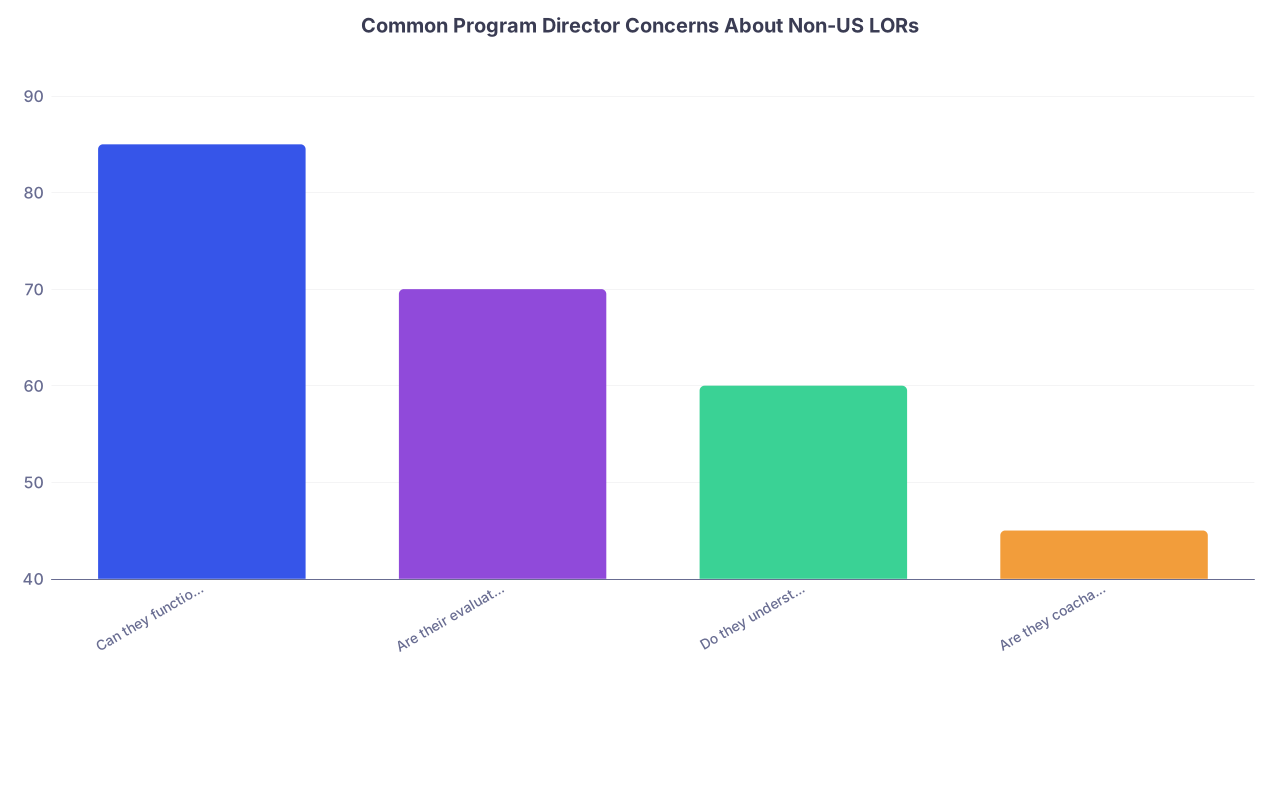
| Category | Value |
|---|---|
| Can they function in US system? | 85 |
| Are their evaluations inflated? | 70 |
| Do they understand US culture? | 60 |
| Are they coachable? | 45 |
Here’s what freaks me out as an applicant: the story programs might be telling themselves when they see only foreign letters.
They’re not just thinking “Oh, international letters. Interesting.” They’re thinking things like:
- “Has this person ever worked in a US-style team, with EMR, pages, cross-cover, etc.?”
- “Are these grades and superlatives inflated because of a different grading culture?”
- “Can I trust that ‘outstanding’ from a system where everybody is ‘outstanding’?”
- “Why didn’t they manage to get even one US-based evaluation? Red flag? Visa issues? Performance issues?”
That’s the ugly internal monologue you’re competing against.
But here’s the part your 2 a.m. brain is ignoring: programs also see context, not just checkboxes.
They weigh:
- Where you graduated from
- Your scores/attempts
- How long you’ve been out of med school
- Your research / work activity
- Your personal statement story
- Your geographic and visa situation
- And then, your letters
Letters are one part of the story. A loud part, yes. But not the whole thing.
Which Programs Might Still Take You Seriously (and Which Won’t)
Not every “IMG-friendly” program is actually IMG-friendly when you look under the hood. Especially if you don’t have US LORs.
Here’s the harsh reality:
- Highly competitive university programs:
Almost all expect US letters. They might interview 1–2 unicorns without US LORs, but that’s usually someone with insane research or Step scores. - Mid-level university affiliations / strong community programs:
Many will strongly prefer at least 1–2 US letters. But they might seriously consider you if other parts of your app are strong and your letters are detailed and legit. - True community / safety-type IMG-heavy programs:
These are the ones most likely to actually read your non-US letters carefully and not just auto-filter you out.
If I had to oversimplify it (and your anxious brain probably needs that right now):
| Program Type | Will They Take You Seriously With No US LORs? |
|---|---|
| Top university academic | Almost never |
| Mid-tier university / strong affiliate | Rare, needs compensating strengths |
| Community with some IMGs | Possible, case-by-case |
| Heavy-IMG community (“safety” type) | Most likely to give you a fair read |
| Newer programs / unfilled programs | Often yes, if other metrics are decent |
So no, your situation isn’t hopeless. But you absolutely cannot apply like a US grad and hope for the same outcome.
How Bad Is “No US LORs” Compared To Other Weaknesses?
This is the part that kept me up at night: “Is this worse than a low Step? A gap? Multiple attempts?”
It depends on the specialty and the rest of the file, but roughly:
- One Step failure + strong US LORs from recent USCE can sometimes be forgiven by some IMG-friendly programs.
- No US LORs + perfect scores + fresh grad can still get interviews at IMG-heavy places.
- Old grad (>5–7 years out) + no US LORs = really hard unless you have serious compensating strengths.
So having no US LORs isn’t an automatic death sentence. It’s more like a huge question mark hanging over your file: “Can this person actually function here?”
Your job is to answer that question loudly in every other section of your application.
What You Can Do If You Truly Can’t Get US LORs This Cycle
This is the nightmare scenario: the application cycle is now, you don’t have USCE, observerships either didn’t happen or didn’t lead to letters, and you can’t magically fly to the US tomorrow.
Complaining won’t fix that. So you have to weaponize what you do have.
1. Make Your Non-US Letters As “US-Style” As Possible
Programs hate vague, fluffy letters. They love:
- Specifics: exact responsibilities, number of patients, type of setting
- Comparisons: “top 5% of students I’ve worked with in 10 years”
- Concrete behaviors: “never late,” “handled cross-cover calls independently,” “presented at morning report clearly”
If your letters are:
“X is a very good student. He worked hard. He is polite and friendly.”
…you’re dead.
If there’s any chance to nudge your letter writers (gently, professionally) to include concrete details and US-relevant info, do it. You don’t write the letter, but you can send:
- Your CV
- A short bullet list of things you did (call, admissions, procedures, presentations)
- A sample format (if they’re open to it)
2. Use Your Personal Statement To Explain, Without Sounding Like Excuses
You don’t write, “I have no US letters, please don’t reject me.”
You do write something that clarifies:
- Visa/cost/family limitations that made extended US time impossible
- What you did instead (research, full-time clinical work, teaching)
- How those experiences still prepared you for US residency
Something like:
“Due to visa restrictions and financial constraints, I have not yet been able to complete extended clinical electives in the United States. Instead, I have worked as a full-time internal medicine resident in a high-volume tertiary hospital, where I routinely manage 18–20 inpatients per day, supervise junior trainees, and participate in multidisciplinary rounds. This environment has required rapid learning, clear communication, and professional accountability—skills that I know will transfer directly to a US residency program.”
You’re not begging. You’re reframing.
3. Overcompensate With Clarity About Your Clinical Skills
If they can’t rely on US letters, they’ll look at:
- Your CV activity descriptions
- Any US-style courses / observerships (even if no LOR came out of them)
- Evaluations from internships or home-country residency
- Publications, QI projects, teaching roles
Don’t just list: “Internal medicine resident, XYZ Hospital.”
Spell it out like someone who’s afraid no one will believe they can actually function on day one:
- Patient load
- Complexity of cases
- Night call responsibilities
- Team structure
- Types of procedures
- Any leadership or teaching roles
You want them reading your experience and thinking, “Okay, this person has actually done the work.”
4. Be Brutally Strategic With Your Program List
This is where a lot of anxious IMGs screw themselves: they apply to “IMG-friendly” programs that haven’t actually taken anyone like them recently.
Go to the program’s “current residents” page. Look for:
- How many IMGs
- How recent their graduation years are
- Whether any graduated from your region or similar schools
- Whether the program took people without obvious US med school or US fellowships
If a program’s current residents are:
- 90% US MD/DO
- 2–3 IMGs, all with US MD research fellowships and Step 260s
…you, with no US LORs, are not their target demographic. Don’t burn an application there unless you have money to set on fire.
Focus heavily on:
- Community programs with many IMGs from various schools
- Programs that routinely list residents who graduated 5–8 years ago
- Programs in less competitive locations (Midwest, South, less urban)
- Newer programs that still struggle to fill
5. Decide Honestly: Apply Now vs Delay For Real USCE
This is the painful fork in the road.
If:
- You’re a very recent grad (0–2 years)
- Scores are strong
- You have at least 2 very strong, specific non-US letters
- You can afford to apply broadly
…then applying this cycle isn’t insane, even without US LORs. You’ll be limited but not doomed.
If:
- You’re 5+ years out
- Average or low scores / attempts
- Only generic non-US letters
- Money is tight
…throwing thousands into ERAS right now might be a glorified lottery ticket. In that situation, it might genuinely be smarter (even though it feels awful) to spend a year getting:
- A real US clinical observership or externship
- At least 1–2 US letters
- Fresh clinical experience and maybe Step 3
Instead of grieving later over 0–1 interviews and a big negative bank account.
I’ve seen people match because they waited, did 3–6 months of USCE, got two solid LORs, and reapplied with a real story to tell.
What About Programs That Explicitly “Accept Non-US Letters”?
Some programs actually write on their sites:
- “We accept international letters”
- “US LORs are preferred but not required”
- “We value strong letters from any clinical supervisor”
Those are your best shots. Don’t just hope they exist—hunt them down.
Check:
- Program websites for LOR language
- FREIDA comments
- Old Reddit / SDN threads where people mention “I matched here with only foreign LORs”
- Alumni from your school—where did they go without USCE?
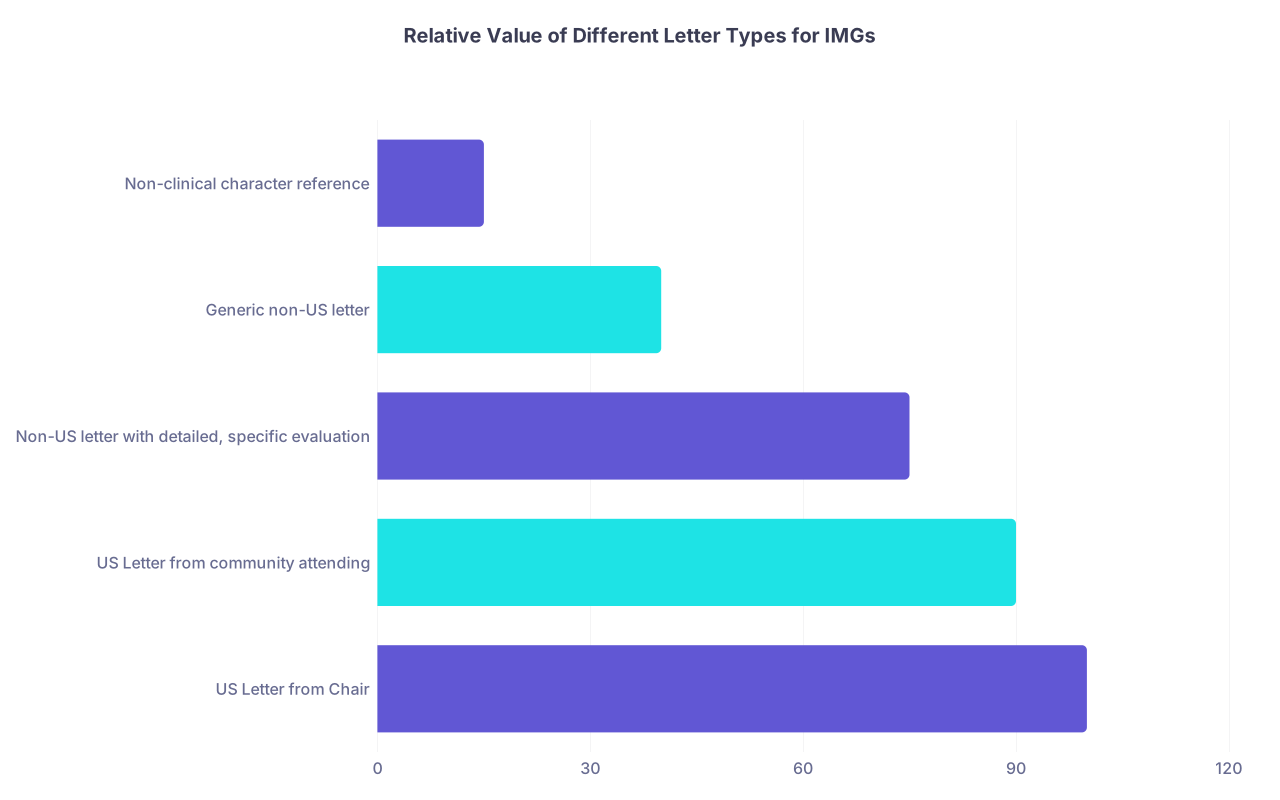
| Category | Value |
|---|---|
| US Letter from Chair | 100 |
| US Letter from community attending | 90 |
| Non-US letter with detailed, specific evaluation | 75 |
| Generic non-US letter | 40 |
| Non-clinical character reference | 15 |
Notice that a detailed, specific non-US letter is still way better than a generic one. So if you can’t change the country, change the quality.
Reality Check: How Programs Actually Read Your File
Imagine you’re the PD at a community program that takes lots of IMGs. You open a file:
- IMG, grad 2 years ago
- Step 1 pass, Step 2 CK 238, Step 3 planned
- No USCE, no US LORs
- Three letters from home-country internal medicine attendings
- Decent research poster at a regional conference
- Clear gaps explained (visa, finances, family care)
If the letters are:
“She is the top 5% student in my 12 years of teaching. She independently managed complex patients with decompensated heart failure and DKA on busy call nights, and presented succinctly at morning rounds, adjusting plans after consultant feedback.”
…you might actually get a serious look. Especially if the rest of your file is consistent.
If instead the letters all read like copy-paste fluff, that’s when you get quietly filtered out—even if nobody says it to your face.

| Step | Description |
|---|---|
| Step 1 | Open IMG Application |
| Step 2 | Reject |
| Step 3 | Check graduation year and gaps |
| Step 4 | Scan letters of recommendation |
| Step 5 | Review personal statement and experiences |
| Step 6 | Invite to interview |
| Step 7 | Meets exam filters |
| Step 8 | Any strong evidence of clinical ability |
| Step 9 | Fits program profile and visa needs |
Letters are a gate, but not the only one.
If You’re Spiraling Right Now
Let me say this clearly:
You are not the only IMG applying without US LORs. Every year some of them match. Not into Harvard IM, but into real, ACGME-accredited programs with actual patients and real training.
Your options are basically three:
- Apply this cycle with eyes wide open, focus heavily on more forgiving, IMG-heavy programs, and accept that your odds are limited but non-zero.
- Delay a cycle, grind for real USCE and letters, and give yourself a much stronger shot later.
- Apply to a narrow set this year (cheapest, most realistic programs) while planning USCE for next year as Plan B.
None of those are fun. But they’re all better than pretending this isn’t an issue.

FAQ: “I Have No US LORs” Panic Edition
1. Can I match internal medicine as an IMG with zero US LORs?
Yes, but usually only at the more IMG-heavy, community-type programs, and only if other parts of your app are strong: recent grad, decent scores, solid clinical experience, and strong, detailed non-US letters. You’re unlikely to get love from big-name university IM programs without at least one US-based letter, unless you have something exceptional (like serious research or sky-high scores).
2. Should I ask a US observership preceptor for a letter if they barely knew me?
A weak, generic US letter does not magically fix your problem. If your observership was short, mostly shadowing, and the attending can’t write specific things you did, that letter might hurt more than help. I’d rather have a strong, specific foreign letter than a bland, one-paragraph “I met this person for two weeks; they were polite” US letter. Quality > geography.
3. How many foreign LORs is “okay” if none are US?
Most programs want 3 letters, sometimes 4 including the MSPE/Dean’s letter. If you have 3 strong, detailed, clinically focused foreign letters all in the same specialty you’re applying to (e.g., all IM if you’re applying IM), that’s your best-case scenario. Don’t mix in random character references or unrelated specialties just to fill space. Three solid ones are better than two solid + one useless.
4. Is it better to rush a low-quality US letter this month or wait a year for stronger USCE and LORs?
If your entire long-term career depends on the US match (and for most of us it does), I’d rather see you wait and do it properly than burn an application cycle with a weak file. A rushed, low-quality US letter stapled to an otherwise shaky application won’t magically get you interviews. A year spent getting real USCE, stronger letters, and maybe Step 3 can literally be the difference between never matching and having a real shot.
5. Will programs think I’m “hiding something” if I don’t explain my lack of USCE/LORs?
If you’re an IMG with no USCE and no US LORs, they will absolutely wonder why. You don’t need a sob story, but you should give a clean, straightforward explanation somewhere—usually in your personal statement or a short ERAS description. Visa limitations, finances, family obligations, or political issues in your home country are all reality. Silence makes them fill in the gaps with worst-case assumptions.
6. What’s one concrete thing I can do this week if I’m stuck with only foreign letter writers?
Email each potential letter writer a short, respectful packet: your updated CV, a paragraph about the specialty you’re applying to, and 5–7 bullet points of specific things you did under their supervision (patient load, types of cases, any leadership or presentations). Politely say this is to “help provide specific examples of my work.” You’re not writing the letter for them—you’re making it easier for them to write a strong, detailed, US-style one instead of vague fluff.
Here’s what you can do today, before you spiral again at 2 a.m.:
Open your ERAS “LORs” section, list every possible letter writer you could have, and next to each name write: “Weak / Generic / Could be strong / Already strong.” Then pick two who could realistically write strong, detailed letters and email them tonight with your CV and bullet points to help them. Don’t wait.