
The message dropped into the applicant group chat at 11:47 on a Tuesday night. A screenshot of an email header. Four words that made my stomach fall through the floor: "Leadership transition, effective immediately."
The program director, the one who'd built that program's IMG pipeline from scratch, whose name I'd memorized, whose interview I'd watched three times, was leaving. And within about ninety seconds, the chat went from confusion to full panic. Does this mean they're stopping J-1 sponsorship? Should we withdraw? Is the program folding?
I spiraled that night. Refreshed my email. Checked FREIDA. Read r/IMGreddit until my eyes burned. And then, over the following weeks, I learned a lot about how programs actually work when leadership changes, most of which directly contradicts what your anxiety is telling you at 3:00 AM.
If this just happened to you, breathe. The short answer is: almost certainly, yes, the program will still support you. But "almost certainly" has never satisfied an anxious brain. So let's do what anxious brains do best, drag every worst-case scenario into the daylight and examine it until it loses its power.
The 3:00 AM Scenario: The PD Resignation Nightmare
Before you panic, verify if these concerns align with real structural issues by reviewing 10 Red Flags That a Supposedly IMG-Friendly Program Isn't.
Let's name exactly what happens in your body when you find out. You see the announcement, usually wrapped in that bloodless corporate language, "Dr. X has decided to pursue other opportunities", and your brain skips every rational step and lands directly on catastrophe. Not "a person changed jobs." Instead: the program is collapsing, and I will be the first one cut.
That thought deserves to be taken seriously for a second, because it's not random. It comes from a very specific place. When you're an IMG, you don't experience a program as a workplace that hired you on merit. You experience it as a door that someone graciously opened for you. The PD wasn't just a boss or a future interviewer, in your mind, they were your sponsor, your shield, your living proof that somebody at that institution wanted people like you there. A US graduate loses a mentor and shrugs. You feel like you're losing the person who cosigned your entire existence in American medicine.
The visa stakes make it worse. If you're counting on a J-1 or fighting for one of the limited H-1B spots, "IMG-friendly" isn't a vibe, it's infrastructure your whole life depends on. So when the architect of that infrastructure walks out the door, of course your brain screams that the building is coming down too.
Here's what I want you to notice, though: every single one of those fears assumes the program's IMG-friendliness lived inside one person. That it was a personality trait. A favor. And favors can be withdrawn.
That's the assumption we're going to dismantle.
The Mechanics of Program Continuity: Who Actually Stays?
Here's the thing your 3:00 AM brain doesn't know: the program director doesn't own the program. The sponsoring institution does.
For added clarity, evaluate if these shifts are truly indicative of a deeper problem by comparing them against signs of how to tell if an IMG-Friendly program actually gives you interview consideration.
Accreditation doesn't live with the PD. It lives with the hospital or university, overseen by the ACGME, with a Designated Institutional Official, the DIO, a person you've probably never heard of, whose entire job is making sure programs keep functioning regardless of who's sitting in the PD's office. When a PD resigns, a very unglamorous bureaucratic machine kicks in. The institution must notify the ACGME. An interim PD gets appointed, usually an existing associate program director. The GME office continues operating on Monday morning like nothing happened, because for them, mostly, nothing did.
And the residents? Current residents cannot just be "cut." They're protected by contracts, by accreditation requirements, and by the simple fact that a program dumping residents over a leadership change would be putting itself on a fast track to citations and a destroyed reputation. It doesn't happen. It can't happen, not quietly.
Now, the part that actually matters for your visa anxiety: J-1 sponsorship runs through ECFMG and the institution's GME office, not through the PD's personal generosity. If a program has sponsored IMGs for a decade, that machinery, the legal counsel, the credentialing workflows, the institutional knowledge, does not evaporate because one person updated their LinkedIn.
And then there's the hidden layer of supporters nobody tells applicants about. The associate program directors who've been running recruitment for years. The GME staff. And the program coordinator, I will die on this hill, who is the actual institutional memory of that program. The coordinator has onboarded every IMG who ever matched there. They know where every body is buried. They're not going anywhere.
Institutional policy outlasts individual leadership because it has to. Hospitals are built for exactly this kind of churn. Your fear imagines a personality cult collapsing; the reality is a bureaucracy continuing. Boring. Wonderful.
How to Read the Signs: Survival Tactics for the Anxious Applicant
Okay. So the machine keeps running. But your anxiety is clever, it'll pivot. Fine, the program survives. But what if the new leadership quietly stops ranking IMGs? What if the culture shifts and nobody announces it?
Fair question. Here's how to investigate it like a strategist instead of a spiraler.
First, read the actual announcement closely. Not for what it says, corporate emails are 90% filler, and "pursuing other opportunities" means nothing, everyone knows this, but for what's around it. Did they name an interim PD immediately, by name, with warmth? That's an institution with a succession plan. Did residents get mentioned and reassured in the first 48 hours? Good sign. Silence and vagueness for weeks? Note it.
Second, ignore the mission statement and look at the match lists. Websites lie; match results don't. Pull up the last three years of incoming classes, most programs list their residents publicly, and count the international graduates. If the program matched eight IMGs a year for three straight years, that's a pipeline, not a poster. Pipelines don't get dismantled over one resignation.
Third, talk to a current resident. Yes, you're allowed to do this. No, you won't sound desperate, unless you sound desperate. The wrong message is: "Is the program still safe for IMGs???" The right message is: "Hi Dr. X, I'm an applicant who's really excited about [program]. I saw the leadership announcement and would love to hear how things feel on the ground." Curious, warm, professional. Residents are honest, sometimes brutally, and most will tell you the truth in one reply.
Finally, learn to separate genuine red flags from anxiety artifacts, because your brain will not do this for you. A genuine red flag is a pattern: the coordinator and two APDs leaving within the same month, interviews being cancelled, residents going weirdly silent. An anxiety artifact is one departure plus a bland email plus a Reddit thread you read at 3 AM. One person leaving is a personnel change. Three people leaving is a pattern. Learn that distinction and it will save you months of sleep.

Data Check: Assessing Program Resilience Post-Turnover
Here's a fact that reframed everything for me: PD turnover is normal. Not a crisis, a routine feature of academic medicine. PDs get promoted, recruited, or simply burn out (PD burnout is a documented epidemic, and honestly, no wonder). The average tenure is only a handful of years, which means the typical program survives several PD transitions across its lifespan. The program you're mourning has probably already done this before, and you never noticed, because it went fine.
Where you should focus instead is program size and infrastructure. Big university-based programs absorb leadership change almost invisibly, deep benches of APDs, layered GME offices, succession plans in drawers somewhere. The risk concentrates in small community programs where the PD personally built the IMG-friendly reputation and the entire GME office is one person named Linda who also does credentialing. If that's your program, yes, watch it more closely. Not panic. Watch.
As for morale, programs we've tracked through transitions follow a remarkably consistent shape: satisfaction dips hard during the uncertainty window, then recovers once the new leader settles in and everyone realizes the building didn't burn down.
That middle bar is where your anxiety lives. Notice it's temporary. Notice the recovery. The dip is the story of a hard few months, not a dying program.
Moving Forward: Turning Panic Into a Strategic Plan
Now the reframe, and I need you to actually hear this one: a new PD is not automatically a downgrade. New program directors frequently arrive with a mandate, to grow, to modernize, to diversify. I've watched programs become noticeably more IMG-friendly under new leadership, because the incoming PD wanted to make their mark and broadening the applicant pool was the fastest way to do it. Your catastrophizing brain has not once considered that possibility. Consider it.
In the meantime, here's your checklist, short, concrete, doable this week:
- Wait ten to fourteen days before doing anything reactive. Let the dust settle and the interim appointment get announced.
- Look up the interim PD. Where did they train? Have they worked with IMGs? Were they already an APD on the recruitment committee?
- Check three years of match lists, not the website photos.
- Message one current resident with the curious, non-accusatory script above.
- Confirm visa sponsorship runs through the GME office, not the PD. (It does.)
- Keep the program on your list unless you find an actual pattern of red flags, not a vibe, a pattern.
One hard rule on communication: do not email the program asking whether they still plan to rank IMGs. It reads as accusatory, it puts you on the radar for the wrong reason, and no one will answer it honestly anyway. If you reach out at all, keep it to brief gratitude and continued interest. Let your application do the talking.
Three things I need you to carry out of this article:
- Programs are protected by institutional GME policy that exists independently of any PD's personal preferences.
- A leadership change is a free stress test, you get to watch how the hospital handles a crisis, which tells you more about its real culture than any polished website ever will.
- Never let your anxiety drive your communication. Curious, warm, and resilient, always.
You are not a line item on one person's desk, subject to deletion when they leave. You're a future physician backed by an institution's legal commitments, accreditation standards, and an entire office of people whose jobs continue on Monday morning.
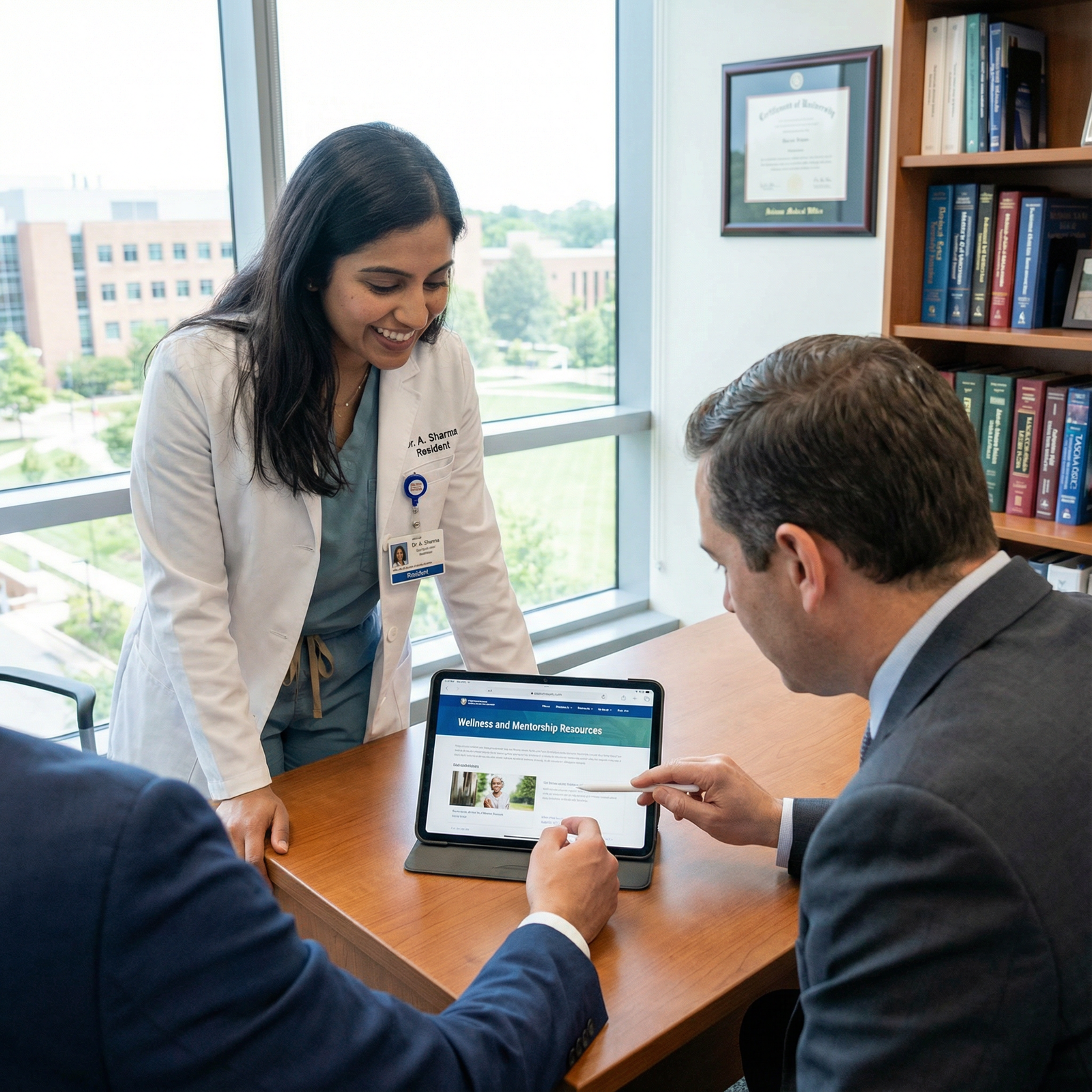
And you don't have to figure this out alone at 3:00 AM, refreshing a group chat full of other terrified people. Download our free Program Stability Tracker, it walks you through exactly what to monitor after any leadership change, week by week, and join our IMG applicant support community, where someone who survived this exact scenario will talk you down, the way I'm talking you down right now.
Stop spiraling alone. The program is fine. And so are you.