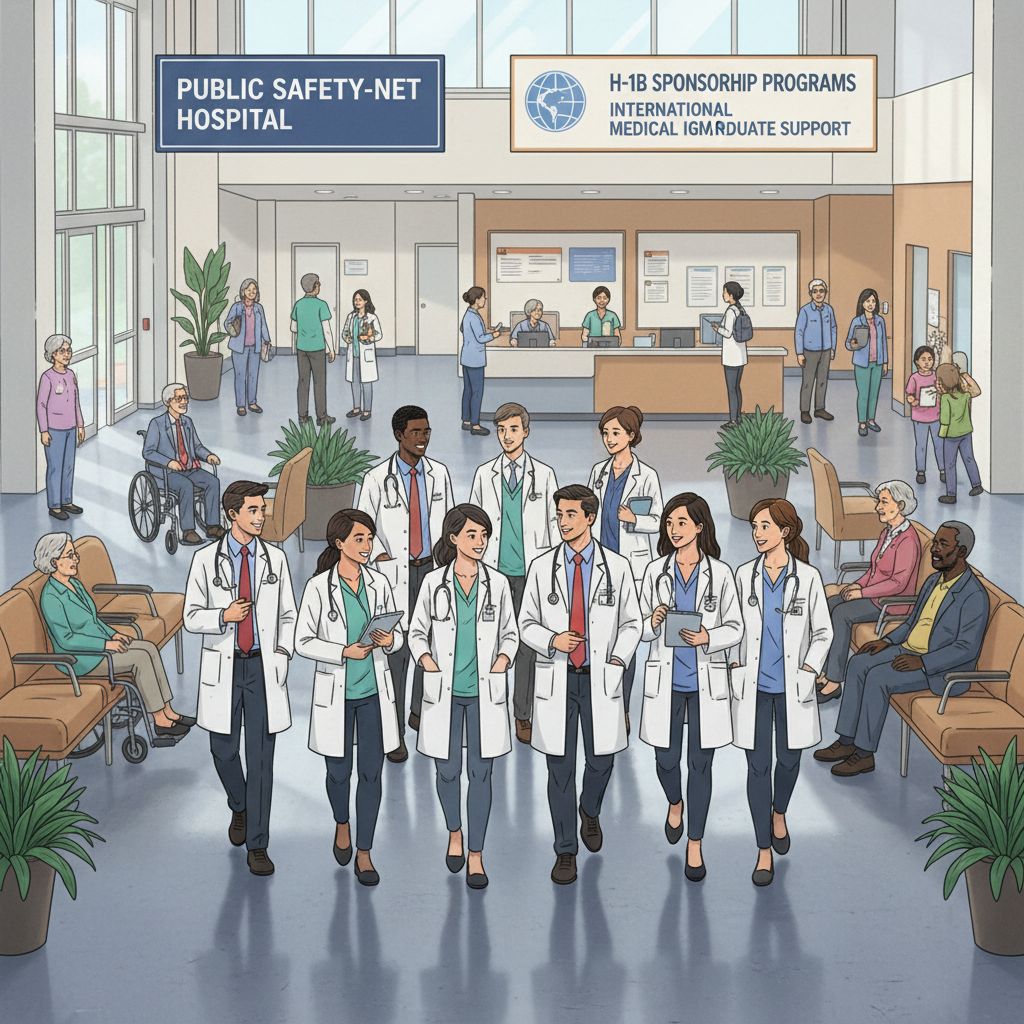
Understanding H-1B Sponsorship in Internal Medicine
For international medical graduates (IMGs), finding internal medicine residency programs that sponsor H-1B visas can significantly shape career options in the United States. While many programs are comfortable sponsoring J-1 visas, far fewer offer H-1B support—especially for categorical positions.
This guide explains how H-1B sponsorship works in the context of internal medicine residency, how it differs from the J-1 route, how to strategically target programs, and what to expect at every stage of the IM match process.
We will focus on:
- How H-1B works for residency training
- Eligibility and exam requirements
- Identifying H-1B residency programs and creating your own “H-1B sponsor list”
- Application and interview strategies tailored to H-1B-seeking IMGs
- Contract, timing, and risk considerations
Throughout, we’ll focus specifically on internal medicine residency and the unique aspects of IM programs that sponsor H-1B visas.
H-1B vs J-1 for Internal Medicine Residency
Before targeting H-1B-friendly residency programs, you need to understand why the choice matters and how it impacts your long-term plans.
Core Differences
J-1 (ECFMG-sponsored Exchange Visitor Visa)
- Most common visa for IMGs in residency
- Sponsored by ECFMG, not the residency program itself
- Requires a two-year home-country physical presence after training (unless you obtain a J-1 waiver)
- Typically not dual-intent, which can complicate long-term immigration planning
- Relatively standardized, predictable process
H-1B (Temporary Worker in Specialty Occupation)
- Sponsored directly by the residency employer/program
- Dual intent: allows you to pursue permanent residence (e.g., green card) while in training
- No mandatory two-year home-country return requirement
- More complex and often more expensive for the sponsoring institution (legal + filing fees)
- Limited duration (generally max 6 years, including any prior H-1B time)
Why Internal Medicine Applicants Seek H-1B
For internal medicine, the choice can influence both fellowship and long-term practice opportunities:
Fellowship Planning
- Many IM graduates seek subspecialty training (Cardiology, GI, Pulm/CC, Heme/Onc, etc.).
- An H-1B during residency can make it easier (though not guaranteed) to continue on H-1B for fellowship or move to an employer willing to sponsor a green card.
Avoiding the J-1 Waiver Requirement
- J-1 IMGs must usually complete a J-1 waiver job (often in underserved or rural areas) to stay in the U.S. after training.
- Some applicants want this pathway; others prefer H-1B to keep geographic and job flexibility.
Path to Permanent Residency
- Because H-1B is dual intent, some employers start the green card process during residency or fellowship.
- This is especially relevant in internal medicine, where hospitalist and academic positions often offer sponsorship.
Downsides of H-1B for Residency
Despite the advantages, the H-1B route is not perfect:
- Fewer programs sponsor H-1B vs J-1
- Some H-1B residency programs only sponsor after year 1, or only for exceptional candidates
- Legal and filing fees sometimes cause programs to limit or discontinue H-1B sponsorship
- H-1B filing can be time-sensitive and stressful, especially for IMGs graduating close to July 1
These trade-offs mean you must approach the IM match strategically if H-1B is your priority.
H-1B Basics in the Context of Residency Training
To navigate H-1B residency programs effectively, you must understand a few key structural concepts.
Cap-Subject vs H-1B Cap-Exempt
For residency, the distinction between cap-subject and H-1B cap exempt is critical.
Cap-Subject H-1B
- Subject to the annual national quota (currently 65,000 + 20,000 for U.S. master’s or higher)
- Lottery-based selection if applications exceed the cap
- Regular filing timeline (usually March registration, October 1 start date)
H-1B Cap-Exempt
- Certain institutions are exempt from the numerical cap, including:
- Non-profit academic institutions
- Non-profit entities related/affiliated with higher education institutions
- Some research organizations
- Many large teaching hospitals and university-based internal medicine residency programs fall in this category.
For internal medicine residency:
- Most university-affiliated IM programs are H-1B cap exempt.
- This means they can file H-1B petitions at any time of year and are not restricted by the lottery.
- This is a major advantage, as it greatly increases the predictability of obtaining your H-1B for July 1.
When researching your own H-1B sponsor list, always ask:
“Is this program part of an H-1B cap exempt institution?”
Duration and Timing
Key timing considerations for IMGs:
- Standard H-1B duration: Up to 6 years in total (initial period + extensions).
- Internal medicine residency is typically 3 years.
- If you later enter a 3-year fellowship (e.g., Cardiology, GI, Heme/Onc), you could use up the full 6 years during training. Beyond that, you will need either:
- A green card process in progress, or
- A reset after leaving the US for a required period (usually 1 year) before a new cap-subject H-1B cycle.
Programs familiar with H-1B IMGs are often aware of these constraints and may discuss long-term planning during or after residency.
Who Files and Pays?
- Employer (residency program/hospital) is the petitioner and must file your H-1B.
- Regulations require the employer to pay certain mandatory fees (e.g., ACWIA training fee).
- Some institutions allow or require the applicant to cover:
- Premium processing fees
- Some attorney fees (depending on local policy and legal advice)
Always get clarity during or immediately after the match regarding:
- Whether the program uses in-house counsel vs external attorneys
- Which fees the institution covers
- Whether premium processing will be used (often important for IMGs with tight timelines)

Eligibility and Requirements for H-1B Internal Medicine Residency
Not every IMG is a strong candidate for H-1B sponsorship, even at programs that regularly sponsor. There are several non-negotiable requirements and some common program-specific expectations.
Core Legal Requirements
USMLE Step Exams
- For H-1B, you must have passed USMLE Step 3 before the hospital can file the H-1B petition.
- Step 1 and Step 2 CK are required for ECFMG certification and ERAS application, but Step 3 is uniquely critical for H-1B.
Timing tip:
- Aim to sit for Step 3 no later than early spring of the match year if you are hoping to start residency on H-1B that July.
ECFMG Certification
- For IMGs, ECFMG certification is required to start residency, regardless of visa type.
- Many H-1B programs require ECFMG certification to be complete before ranking or at least before contract issuance.
State Medical License or Training License
- Some states require that you be eligible for a limited/training license before an H-1B petition is filed.
- Programs are usually familiar with their state’s requirements, but you should still verify:
- Does the state board require Step 3 for a training license?
- Are there additional documentation steps for IMGs?
No Need for Prior H-1B
- You do not need a prior H-1B to qualify; residency H-1B can be your first.
Program-Specific Academic Expectations
Many internal medicine programs that sponsor H-1B visas tend to have:
- Higher USMLE score cutoffs, especially for Step 3
- Preference for:
- Recent graduates
- Strong clinical experience, particularly US clinical experience (USCE)
- Good communication skills and strong letters of recommendation
Examples of typical expectations (these are not strict rules, but patterns):
- Step 1/2 CK: Often above program’s general IMG thresholds
- Step 3: Pass on first attempt; some programs may informally prefer scores ≥ 220–230
- No failed attempts on USMLE (if there are failures, a very strong overall profile is needed)
Who Is a Good Candidate for H-1B Sponsorship?
You are a strong H-1B candidate for internal medicine residency if:
- You have passed Step 3 or will definitely do so early in the match year
- You have solid exam scores and no major red flags
- You have clear long-term plans in the US and can articulate why H-1B fits your path
- You understand basic visa concepts and can communicate professionally with program leadership about them
You are a weaker candidate if:
- Step 3 is not yet passed and scheduling looks uncertain
- You have multiple exam failures or very low scores
- You cannot convincingly explain why you are requesting H-1B instead of J-1
In the latter scenario, it may be wise to remain open to J-1 programs rather than strictly limiting yourself to H-1B residency programs.
Building and Using Your Own H-1B Sponsor List for Internal Medicine
There is no official, complete, and permanently accurate H-1B sponsor list for internal medicine residency. Policies change frequently. Instead, you need to build and maintain your own targeted database.
Step 1: Start with Publicly Available Information
Use these sources to identify potential H-1B residency programs:
Program Websites
- Many IM programs list visa policies under “Eligibility,” “International Applicants,” or “FAQ.”
- Look for phrases like:
- “We sponsor J-1 and H-1B visas”
- “We sponsor J-1 visas only”
- “Visa sponsorship is limited to J-1”
FREIDA (AMA Residency & Fellowship Database)
- Some programs indicate visa types accepted.
- FREIDA is not always up to date, so verify with official sites.
Previous Applicant Reports & Forums
- Online communities (e.g., Reddit, specialty forums, IMG Telegram/WhatsApp groups) often share:
- Recent H-1B sponsorship experiences
- Program-specific notes (e.g., “only sponsors H-1B if Step 3 passed by rank list deadline”)
- Online communities (e.g., Reddit, specialty forums, IMG Telegram/WhatsApp groups) often share:
Institution Type Clues
- Large university or university-affiliated hospitals are more likely to be H-1B cap exempt and familiar with H-1B sponsorship.
- Community-based programs may still sponsor, but policies vary widely.
Step 2: Categorize Programs by Policy
As you research, categorize each internal medicine residency program:
Category A – Clearly H-1B Friendly
- Website explicitly states they sponsor H-1B
- Recent verifiable reports of IMGs matching on H-1B
Category B – Possibly H-1B Friendly / Case-by-Case
- Website ambiguous or outdated
- Hints such as: “Visa sponsorship is considered on a case-by-case basis”
- Institution is known to be H-1B cap exempt
Category C – J-1 Only
- Website clearly states J-1 only
- Communication confirms no H-1B sponsorship
Maintain your list in a simple spreadsheet with columns like:
- Program name & ACGME ID
- Institution type (university, university-affiliated, community)
- H-1B policy category (A/B/C)
- Cap-exempt status (likely/confirmed)
- Last verification date
- Source (website, email, peer report)
Step 3: Verify via Direct Communication
As you narrow your target list:
- Email the program coordinator or check the program’s FAQ for the most recent policy.
- Ask short, focused questions, for example:
“I am an IMG planning to apply to your internal medicine residency program. I have passed USMLE Step 3 and will require visa sponsorship. Does your program sponsor H-1B visas for categorical internal medicine residents, or only J-1 visas?”
Key tips:
- Be polite and concise.
- Ask before application season if possible, so you can plan strategy.
- Don’t send repeated emails if they have already answered clearly.

Application and Interview Strategy for H-1B-Seeking IMGs
Once you’ve identified likely H-1B residency programs, you must adapt your entire IM match strategy—from ERAS to interviews and ranking—to your visa goals.
ERAS Application Strategy
Clearly Indicate Step 3 Status
- If Step 3 is passed, highlight it in:
- ERAS exam section
- CV portion
- Possibly in your personal statement if relevant
- If Step 3 is passed, highlight it in:
Personal Statement (Subtle, Not Dominant)
- You do not need to write a “visa-focused” personal statement.
- You can include a brief line in your final paragraph, such as:
- “I have completed USMLE Step 3 and am prepared to begin training on an H-1B or J-1 visa, depending on program policy.”
- This communicates readiness without making visa the central theme.
Letters of Recommendation
- Aim for at least two US-based letters from internists (if possible).
- H-1B programs that take fewer IMGs may be especially attentive to US-based performance.
Program List Balance
Consider a three-tiered approach:- Tier 1: H-1B-friendly internal medicine residency programs (from your Category A list)
- Tier 2: Programs with case-by-case policies (Category B)
- Tier 3: Strong IM programs known to take IMGs on J-1 (if you are open to J-1 as a backup)
Avoid over-restricting yourself. Having only a few H-1B programs on your list can dramatically reduce your chances of an IM match.
Discussing Visa During Interviews
Visa discussion is a sensitive but normal part of IMG interviews.
When you should bring it up:
- If the program hasn’t clarified policy and it’s not on their website
- Typically after you’ve established rapport and discussed clinical/academic interests
How to phrase it:
- To program director (PD) or associate PD:
- “I am an IMG and have passed Step 3. Do you anticipate sponsoring H-1B visas for residents in the upcoming cycle, or is your sponsorship limited to J-1?”
- To coordinator (often via email or post-interview Q&A):
- “Could you please confirm the types of visas your program sponsors for incoming categorical internal medicine residents?”
What programs may ask you:
- Why are you specifically requesting H-1B instead of J-1?
- Prepare a brief, honest answer:
- Long-term career in the U.S.
- Desire to avoid two-year home requirement
- Plans for subspecialty training and possible green card sponsorship
- Prepare a brief, honest answer:
Be factual and professional; avoid sounding as if your primary interest in the program is only visa-related.
Ranking Strategy
When it’s time to create your rank list:
Rank Based on Combination of Fit + Visa Reality
- Rank H-1B-friendly programs highly if they are clinically strong and you felt a good fit.
- Include J-1 programs if you are realistically open to that visa.
Avoid Ranking Programs with No H-1B Sponsorship
- If a program has explicitly stated “J-1 only,” and you are unwilling to accept J-1, do not rank it. If you match there, you must either:
- Accept J-1, or
- Drop out of the match and lose the opportunity.
- If a program has explicitly stated “J-1 only,” and you are unwilling to accept J-1, do not rank it. If you match there, you must either:
Update Your Personal H-1B Sponsor List Post-Interview
- After each interview, document:
- Official stance on H-1B
- Any conditional statements (e.g., “we only file H-1B if Step 3 is passed by X date”)
- Your overall impression of the program
- After each interview, document:
Post-Match: Contracts, Petitions, and Common Pitfalls
Matching into an internal medicine residency that sponsors H-1B is the beginning, not the end, of the visa process.
After You Match
Once you match:
Offer Letter and Contract
- The program will issue an appointment letter or contract.
- This document is often needed for H-1B filing, along with:
- Your CV
- ECFMG certificate
- USMLE scores (including Step 3)
- Passport and prior immigration documents (if any)
Confirm H-1B Process Timeline
- Ask the GME office or coordinator:
- When will the H-1B petition be filed?
- Are they using premium processing (usually recommended for tight timelines)?
- What documents do they need from you and by when?
- Ask the GME office or coordinator:
Coordinate with State Licensing Requirements
- Ensure that applications for a training license (if needed) are submitted early.
- Delays at the state board can delay H-1B filing.
Common Pitfalls and How to Avoid Them
Late Step 3 Pass
- If you pass Step 3 too late (e.g., May/June) and your program cannot file in time, you may:
- Start on J-1 and convert later (if allowed)
- Delay start (rare and complicated)
- Prevention: Take Step 3 well before rank list deadline if H-1B is a priority.
- If you pass Step 3 too late (e.g., May/June) and your program cannot file in time, you may:
Ambiguous Policies
- Some programs may say “we sponsor H-1B” but only do so selectively, or only for PGY-2+ transfers.
- Always clarify: “Do you sponsor H-1B for incoming PGY-1 categorical residents?”
Assuming H-1B Lasts Forever
- Remember the 6-year total limit. If you plan on a 3-year fellowship after a 3-year IM residency, think early about:
- Cap-exempt vs cap-subject positions after fellowship
- Possible green card sponsorship timelines
- Remember the 6-year total limit. If you plan on a 3-year fellowship after a 3-year IM residency, think early about:
Overlooking H-1B Cap-Exempt Status
- During and after training, working at an H-1B cap exempt institution (like an academic medical center) can:
- Simplify renewals
- Avoid the lottery problem
- But moving from cap-exempt to cap-subject later may require lottery participation.
- During and after training, working at an H-1B cap exempt institution (like an academic medical center) can:
Frequently Asked Questions (FAQ)
1. Can I match into internal medicine on a J-1 and later switch to H-1B during residency?
In some programs, yes—but it is not guaranteed. Policies vary:
- Some IM programs allow switching from J-1 to H-1B after you pass Step 3 or after the first year, particularly in H-1B cap exempt institutions.
- Others have strict “J-1 only” rules for the entire residency.
If this is important to you, ask explicitly during interviews:
“Do residents who start on a J-1 ever convert to H-1B during training at your institution?”
2. Is it realistic to apply only to H-1B internal medicine residency programs?
It depends on your profile and goals:
- If you have excellent scores, strong US clinical experience, and Step 3 passed early, and you are willing to apply very broadly, it may be possible—but still risky.
- Many strong IMGs adopt a mixed strategy, focusing on H-1B-friendly IM programs but including some J-1 programs to maintain reasonable match odds.
Fully restricting yourself to a small pool of H-1B programs can severely reduce your chance of matching into internal medicine.
3. Does an H-1B during residency guarantee that I can get H-1B for fellowship or attending jobs?
No. While having H-1B experience helps demonstrate that you meet requirements, each subsequent employer must:
- Also be willing and able to sponsor H-1B
- File a separate petition for your new role (fellow or attending)
However, being trained at a cap-exempt academic institution and already on H-1B does make you a more familiar and often more attractive candidate for fellowship programs with similar sponsorship capacity.
4. Where can I find an official H-1B sponsor list for internal medicine residency programs?
There is no single official, constantly updated H-1B sponsor list specific to internal medicine. Instead:
- Use program websites, FREIDA, and GME office emails to confirm current policy.
- Compile your own spreadsheet of H-1B-friendly internal medicine residency programs, and update it yearly.
- Network with current residents and recent graduates; IMGs in the match cycle are often the best source of near-real-time data on which programs sponsored H-1B most recently.
By understanding how H-1B works in the specific context of internal medicine residency—cap-exempt institutions, Step 3 timing, program policies, and long-term planning—you can design an IM match strategy that aligns with both your training goals and your immigration needs.