
At this point you should stop treating your letters of recommendation (LORs) as a simple checklist item. They are time-sensitive assets.
Every year, applicants waste hundreds of hours crushing audition electives, securing glowing verbal promises from big-name attendings, only to watch their ERAS application sit incomplete on opening day because an away letter is trapped in institutional bureaucracy.
Away rotations yield punchy, high-impact external validation. They prove to program directors that you can perform outside your cozy home environment. But away letters come with massive logistical drag. Home letters are easier to secure, quicker to upload, and far more predictable, but they carry the implicit discount of home-court bias.
The strategy isn't choosing one over the other. The strategy is mastering the calendar. Here is your month-by-month, week-by-week, and day-by-day roadmap to getting every letter written, signed, and uploaded before ERAS opens for program review.
Program directors rely on letters of recommendation to answer one fundamental question: Can this person handle our specific clinical environment without breaking?
Data from national program director surveys consistently ranks letter quality, specifically specialty-specific commentary, comparison to peers, and recent clinical evaluation, near the top of interview invitation criteria. An away letter from a recognized academic center carries tremendous weight. It offers objective proof that an evaluator with zero institutional bias observed your work and deemed you top-tier.
However, data also reveals a brutal operational truth: away letters take significantly longer to reach your ERAS dossier than home letters.
Home faculty members operate within your native systems. You can walk down the hall to their clinic, poke their clinical administrative assistant, or bump into them at morning report. Away attendings don't have that proximity. Once your block ends and you leave the building, out of sight means out of mind. Many visiting rotations run letters through departmental review committees or standardized letter platforms (like the SLOE in Emergency Medicine or eSLOR in Orthopedics), adding weeks of administrative buffer time.
Here is the hard rule of residency applications: A good letter uploaded on time beats an extraordinary letter sitting in draft status on September 25th.
If a program director opens your application and sees only two letters because your away writer is on vacation in August, your application is functionally incomplete. You won't get the interview. The yield of an away letter drops to zero the second it misses the initial review window.
Month-by-Month Planning Guide Before ERAS
To avoid an emergency panic in September, map your timeline backward from the date ERAS opens to programs.
Months -6 to -4 (March, May): Blueprinting Phase
- Identify home anchors. Pinpoint at least two home faculty members who know your work thoroughly. These are your baseline safety letters.
- Audit away rotation dates. Look at your VSLO/away blocks. If your away rotation takes place in August, you are operating on a razor-thin timeline for an ERAS upload. Prepare accordingly.
- Draft your core documents. Build a polished CV and a working draft of your Personal Statement. You cannot ask a busy attending for a letter without these ready to hand over.
Months -3 to -2 (June, July): The Execution & Home Capture
- Lock in home letters. At this point you should officially ask your home letter writers. Give them a soft deadline of August 15th.
- Start Away Rotation #1. If rotating away in June or July, establish immediate rapport. Identify attendings who work multiple shifts or clinics with you.
Month -1 (August): The Critical Away Window
- Request away letters immediately. For July/August away rotations, formal requests must happen before the rotation ends.
- Generate ERAS Letter ID Forms. Create your LOR slots in ERAS and send the official upload link forms directly to your writers.
- Set expectations. Explicitly state: "ERAS opens to programs in late September; I am aiming to have all materials uploaded by September 1st to ensure processing."
Month 0 (September): Finalization and Emergency Swaps
- September 1st: Audit your ERAS dashboard. If an away letter isn't uploaded, send your first polite, structured check-in.
- September 10th: If the away letter is still missing, contact the departmental program coordinator at the away institution.
- September 15th: If zero movement has occurred on a missing away letter, activate your backup home LOR in the portal. Do not wait for a late miracle.
Week-by-Week Checklist During an Away Rotation
When you step onto an away rotation, the clock is running. You have roughly 20 working days to impress a stranger enough for them to write a compelling evaluation.

Week 1: Establish Rapport and Scope Evaluators
- Identify potential writers. Look for faculty who are active in the residency program (Program Directors, Associate PDs, Division Chiefs, or core teaching attendings). Avoid non-academic adjuncts if you want maximum weight.
- Show up over-prepared. Learn the institutional templates, show up early, and master the electronic medical record (EMR) workflows immediately.
- Signal intent early. By mid-week, let your chief resident or attending know your target specialty and your desire to work hard for a potential recommendation.
Week 2: Build Clinical Proof and Seek Mid-Rotation Feedback
- Ask for explicit feedback. On Thursday or Friday of Week 2, ask your attending: "Is there anything specific I can improve on over the next two weeks to perform at the level of an intern?"
- Log your cases. Write down patient presentations, complex diagnoses, or procedures you managed directly under that attending. You will need these details later.
Week 3: Execute the Direct Ask
- Make the formal request. At this point you should ask directly: "Do you feel you know my clinical work well enough to write me a strong letter of recommendation for [Specialty]?" If they hesitate, thank them and move on. You only want a enthusiastic letter.
- Deliver the Application Packet. Hand over a single PDF containing:
- ERAS LOR Request Form (with Letter ID and instructions).
- Updated CV.
- Draft Personal Statement.
- Bulleted summary of key patient interactions you shared during the block.
Week 4 & Post-Rotation: Exit and Hand-Off
- Send an immediate thank-you email. Within 24 hours of finishing the rotation, send a formal thank-you note reiterating your appreciation for their mentorship and confirming the ERAS upload logistics.
- Log post-rotation tracking. Set calendar prompts on your personal phone for 14 days and 28 days post-rotation to track LOR submission status.
Day-by-Day Decision Guide: When to Ask, Follow Up, and Submit
Managing LOR logistics requires granular execution. A single missed email can stall your application for weeks.
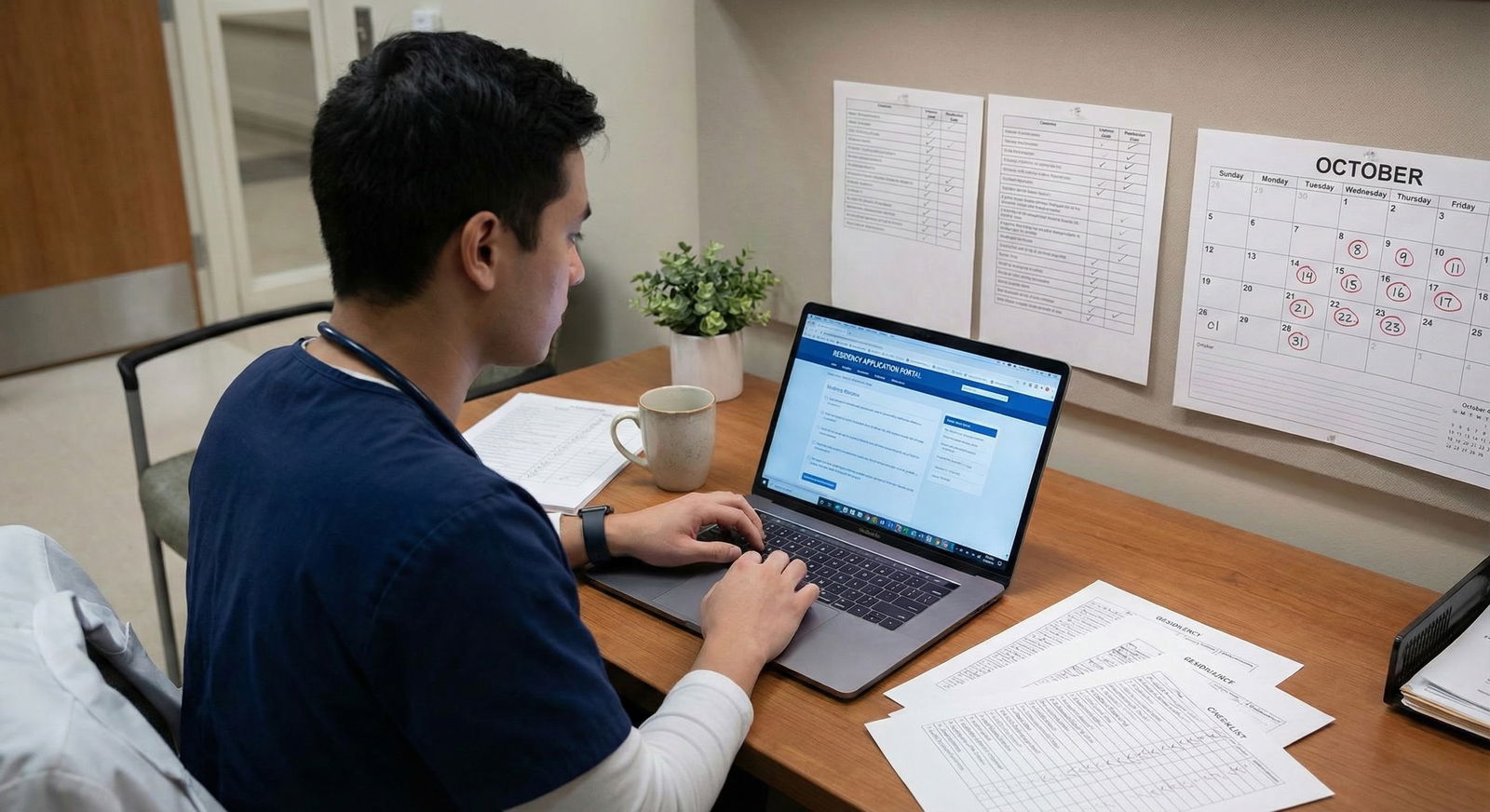
The Exact Day to Ask
Never ask for a letter of recommendation on your absolute last day while walking out to your car. It looks like an afterthought and catches the attending unprepared.
- Best Time: Mid-shift or end-of-day on Wednesday or Thursday of your third week (for a 4-week rotation). This leaves time to hand over your paperwork in person before your rotation concludes.
The Follow-Up Cadence
Follow-ups require striking a delicate balance: persistent, professional, but never annoying. Use this exact timeline:
- Day +1 (Post-Rotation): Send the initial thank-you email with your LOR packet attached.
- Day +14: Check ERAS portal. If not uploaded, send a quick status email:
"Dear Dr. [Name], I hope your week is going well. I'm following up to confirm you have everything you need from my end regarding the ERAS letter of recommendation. Thank you again for your time!"
- Day +28 (or September 5th, whichever comes first): Send a high-priority, brief nudge highlighting the approaching ERAS release date.
- Day +35: If you receive no response, assume the letter will not arrive in time. Assign your home backup LOR in ERAS to ensure your profile shows complete on launch day.
Summary Key Takeaways
- Treat LOR timing as a structural requirement, not an administrative detail. The absolute quality of an away letter drops to zero if it is not uploaded by the time program directors pull application files in late September.
- Home letters provide immediate stability; away letters provide high-yield external validation. Secure two home letters early as your bedrock foundation so you aren't held hostage by a delayed away letter.
- Always ask for a strong letter explicitly. Never settle for a generic recommendation. If an attending seems reluctant during Week 3 of an away rotation, pivot to another evaluator immediately.
- Set hard deadlines for backup activation. If an away letter isn't uploaded by mid-September, don't gamble your application on a late submission. Swap in your home backup and lock your dossier.
Ready to bulletproof your application strategy? Start auditing your LOR calendar today, map your home writers, verify your away rotation upload windows, and build your fallback options before ERAS opens.