The data shows that premeds routinely overestimate the damage of missing the first AMCAS transmission and underestimate the damage of submitting weak metrics. That mistake costs people real outcomes. I have seen applicants panic over a July MCAT score release as if the cycle were already lost, then make a much dumber decision: rushing out an application anchored by a score they would not have chosen if they had waited two more weeks.
Here is the blunt version. Missing the very first AMCAS file transmission is not ideal. It is also not fatal. In most cases, a short delay tied to a stronger MCAT-informed strategy is the better bet. Rolling admissions is real, but it is not magic. Schools do not hand out the entire class in week one. They sort, screen, and triage over months. Your timing matters. Your numbers matter more.
The practical question is not, "Am I doomed if my file transmits after day one?" The right question is, "How much interview probability am I giving up by waiting, and does a better-informed MCAT-based school strategy recover more than that loss?" Usually, yes. Especially if the delay is measured in days or a few weeks, not months.
Quantifying the Cost of Delay: An Analytical Overview
First, define the event everyone obsesses over. The "first AMCAS transmission" is the first batch of verified primary applications AMCAS sends to medical schools, usually in late June. Applicants treat it like the opening bell on Wall Street. Fair enough. It does matter because U.S. MD admissions operate on a rolling model at many schools, meaning interview invitations and eventual offers accumulate over time. Earlier complete files are reviewed against a less crowded pool. Later files compete against a thicker stack and fewer available interview slots.
But the data does not support the melodrama. The real advantage is front-loaded early in the cycle, not confined to a single transmission day. Think of timing in bands:
- Late June to early July: strongest timing advantage
- Mid-July to early August: still competitive at many schools
- Mid-August to September: measurable erosion
- After September: sharper decline unless the applicant is exceptional or highly aligned with the school
That is the admissions decay curve. Not a cliff on day one. A slope.
Historical national acceptance data from AAMC and admissions office trends consistently show higher acceptance rates for earlier applicants, but the difference between "first transmission" and "a few weeks later" is much smaller than applicants imagine. The bigger drop occurs when a file is not complete until late August, September, or beyond. I have reviewed cycles where applicants submitted on June 1, were verified late, and still sat in effectively the same review bucket as people transmitted in early July. Why? Because schools often gate serious review on complete files, including MCAT, letters, and secondaries.
So what is the likely penalty for a short delay? If we model interview probability as an indexed baseline of 100 for an applicant complete in the first wave, that same applicant might sit around:
- 95-98 if complete 1-2 weeks later
- 90-93 if complete 3-4 weeks later
- 80-88 by mid-August
- below 75 as completion drifts deeper into the fall
Those are not official AAMC figures. They are a reasonable synthesis of rolling admissions behavior, school completion timing, and historical cycle patterns. The pattern is what matters. The first few weeks cost less than people think. The later slide costs more than they think.
The other overlooked point: a first-day file with a bad school list is still bad. An applicant with a 509 applying top-heavy in week one is not "early." They are early and unrealistic. That is not strategy. That is just fast failure.
Statistical Correlation: MCAT Score Release vs. Interview Invitations
Now the core issue. Does a late MCAT score wipe out the rolling advantage? No. The data shows the opposite: MCAT-informed positioning usually outweighs the modest penalty of missing first transmission, provided the delay is short.
Look at how schools actually process applications. They do not evaluate "early" in the abstract. They evaluate combinations of:
- GPA and science GPA
- MCAT score
- state residency
- mission fit
- clinical and service depth
- writing quality
- completion date
Completion date is one variable. MCAT is another. And MCAT is usually the stronger screen. The data shows that a high-MCAT applicant completing slightly later often outperforms a lower-MCAT applicant who completed earlier, because the score changes both school list quality and screening outcomes.
A simple comparative example makes this clearer.
Scenario A: Early but Mid-Tier Metrics
- Primary transmitted in first batch
- MCAT: 508
- GPA: 3.74
- School list: 30 schools, somewhat top-heavy
- Secondaries returned in 2 weeks
Scenario B: Slightly Later but Stronger Metrics
- Primary transmitted 3 weeks after first batch due to score release
- MCAT: 516
- GPA: 3.74
- School list: 24 schools, better aligned
- Secondaries returned in 5 days
Who gets more interviews? Scenario B more often than not. By a lot.
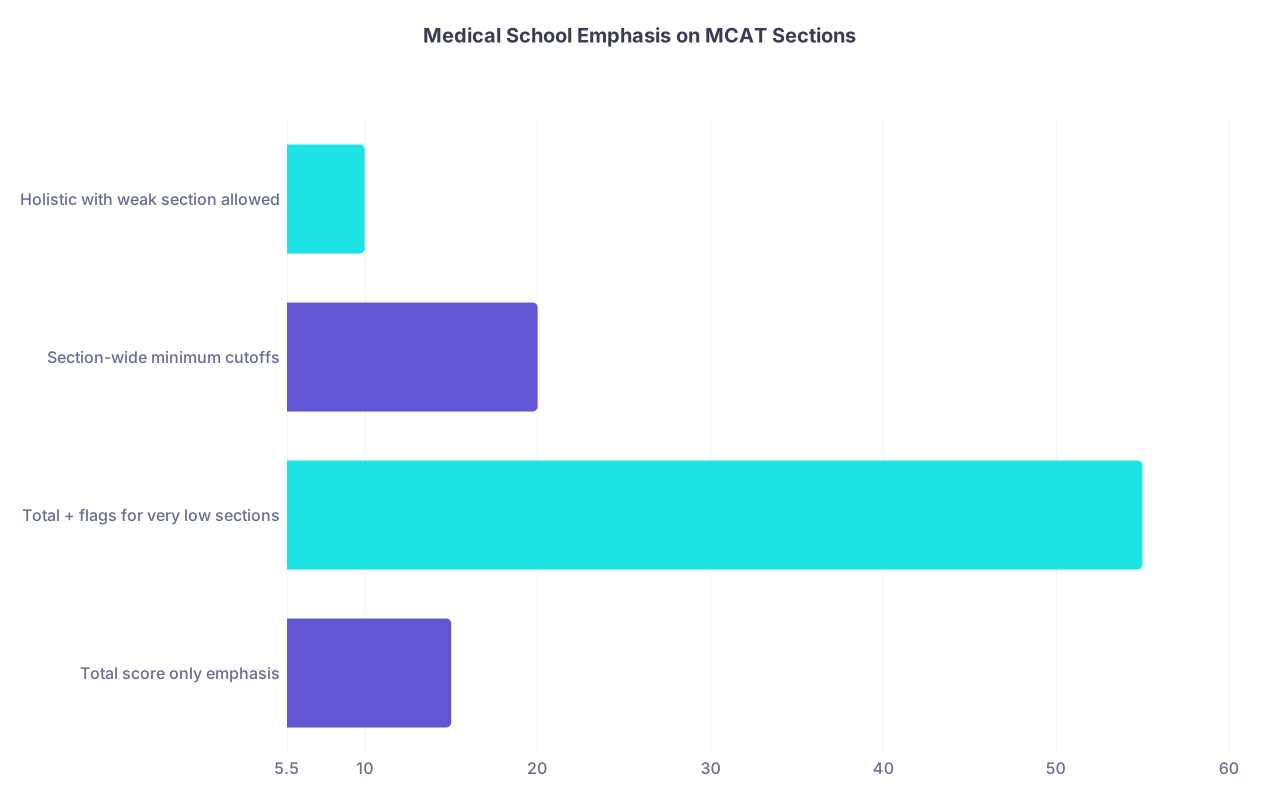
Why? Because many schools use MCAT-based screening bands, formal or informal. A 516 does not merely look better than a 508; it changes where your file survives initial sorting. It may convert a borderline screen-out into a serious read. It may also let you trim schools where yield protection, mission mismatch, or residency barriers make little sense.
If we translate that into rough comparative probabilities, an early 508 applicant might carry a school-level interview probability averaging, say, 8-12% at research-heavy or selective programs and 12-20% at more MCAT-accessible schools. A 516 applicant, even three weeks later, may average 15-30% at many of those same schools, depending on residency and experiences. Timing loss might shave a few percentage points. Score gain can add far more than that.
That is why the phrase "late MCAT kills your cycle" is lazy advice. It confuses timing with competitiveness.
What verification lag really does
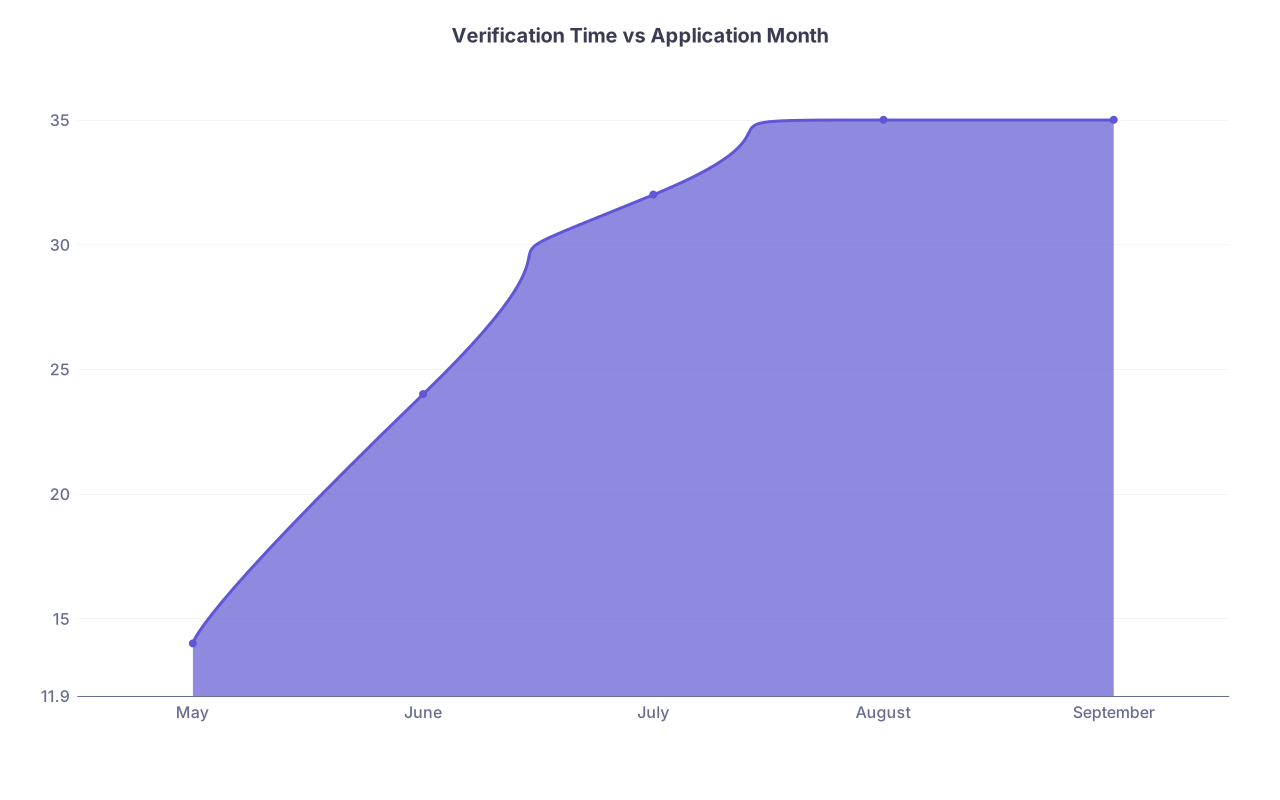
Verification lag is the hidden variable applicants ignore. Submitting late does not just move your transmission date; it can also place you into a busier verification queue. In heavy periods, that adds days or weeks. This matters because schools usually trigger secondaries after receiving the verified primary, and some schools do not mark you complete until everything is in, including MCAT and letters.
So the relevant timeline is not:
primary submitted -> school reviews
It is:
primary submitted -> AMCAS verification -> transmission -> secondary invitation -> secondary return -> letters received -> file marked complete -> review
That sequence is where applicants lose time. A pending MCAT score might not block primary submission, but if your final school list changes dramatically after score release, early submission to one "throwaway school" just to enter the verification line may be useful tactically while preserving flexibility. I have seen that work well. I have also seen applicants abuse that trick, submit sloppily, then spend July cleaning up preventable messes.
Here is the cleaner read on the numbers:
- Submitting in early June with score pending can preserve verification position.
- Receiving the score in late June or early July usually keeps you in a strong timing band.
- Receiving the score in late July creates moderate pressure, but still does not wreck the cycle if secondaries are rapid.
- Receiving the score in August or later starts to produce real statistical drag, especially at rolling-heavy schools.
The biggest misconception? Applicants think primary transmission date is the key metric. Often it is not. Complete date is. A first-wave primary followed by a three-week secondary delay can leave you effectively later than someone who transmitted after you but turned everything around immediately.
I have watched this happen over and over. Student A brags about being "day one." Student B gets verified later, prewrites secondaries, returns them in 72 hours, and becomes complete at half their schools before Student A finishes procrastinating. The data shows Student B often wins that race.
Risk Mitigation: The Decision Matrix for Late Scorers
The right decision depends on one thing: how much the MCAT score is likely to change your school list and strategic posture.
Here is the trade-off analysis I use.
Submit before the score if:
- your practice test range is stable
- your likely school list will not change much
- you can submit a polished primary in early June
- your score release is only modestly delayed
- you are prepared to prewrite secondaries immediately
This approach works best for applicants expecting a score within a narrow band. If your full-lengths are 512, 513, 511, and 514, the score is unlikely to transform your entire application strategy. Enter the verification queue early. Fine.
Wait for the score if:
- your practice scores are volatile
- your exam felt materially worse or better than expected
- the score could shift your school list by 5-10+ schools
- you are deciding between MD-only, mixed MD/DO, or delayed application
- your primary materials need work anyway
This is where people get irrational. They cling to "early" while ignoring uncertainty. If a 502 means heavy reset and a 512 means viable MD list construction, you need the score. Pretending otherwise is dumb.
Secondary timing matters more than people admit
For applicants getting scores in late July or early August, the playbook is simple:
- Submit the primary as early as realistically possible.
- Prewrite secondaries for your likely school list.
- Turn secondaries around in 3-7 days, not 2-3 weeks.
- Make sure letters are already assigned and ready.
- Cut schools with slow, low-yield, or unrealistic odds.
That is how you neutralize timing damage.
School list adjustments for late July/August entrants
If your file will not be complete until late July or August, the data supports tightening the list rather than spraying applications everywhere. Broad but unfocused submission is expensive and statistically sloppy. Better moves:
- reduce ultra-reach schools unless your MCAT is clearly competitive there
- emphasize in-state and regional schools
- prioritize schools with broader interview seasons
- include mission-fit programs where service or population alignment is strong
- consider adding DO schools if your score profile and timeline make MD-only odds inefficient
For many applicants, the smart adjustment is not panic. It is recalibration. A late-July complete date with a 515, solid GPA, and fast secondary turnaround is still absolutely live at many MD schools. A late-August complete date with a 506 and generic writing needs a more conservative list. The data shows timing and metrics interact. They do not operate separately.
And yes, there is a line where delay becomes self-sabotage. If your score arrives so late that your file will not be complete until September, you need to evaluate whether this cycle still makes numerical sense. I have advised applicants in that spot to pivot, strengthen the file, and reapply cleaner next year. Painful. Also correct.
Synthesizing the Evidence: Final Admissions Verdicts
The data shows three clear conclusions.
First, timing matters, but not in the cartoonish way applicants talk about it. The first transmission offers a marginal edge, not a sacred one. The meaningful decline happens over weeks and months, especially once completion drifts into late August and beyond.
Second, MCAT strength is a more powerful predictor than minor timing differences. If waiting a short period gives you the actual score needed to build the right school list and avoid strategic errors, that is usually the superior move. The numbers support that. So does experience.
Third, perfectionism wastes time. A complete, strong, slightly later application beats an incomplete or poorly targeted early one. Every cycle, applicants burn precious weeks obsessing over whether they missed a symbolic deadline while ignoring their weak secondaries, bad lists, or missing letters. Wrong priority.
So here is my recommendation for the 2024-2025 cycle: if your MCAT delay is less than four weeks, prioritize score completeness and strategy quality over first-transmission anxiety. Submit early enough to avoid unnecessary verification lag if you can, but do not sacrifice decision quality for calendar theater. If your delay pushes true completion into late August or September, reassess aggressively and adjust your school list downward in risk.
The summary is simple. Missing the first AMCAS file transmission hurts a little. Submitting the wrong application hurts a lot. The data shows which mistake is worse.