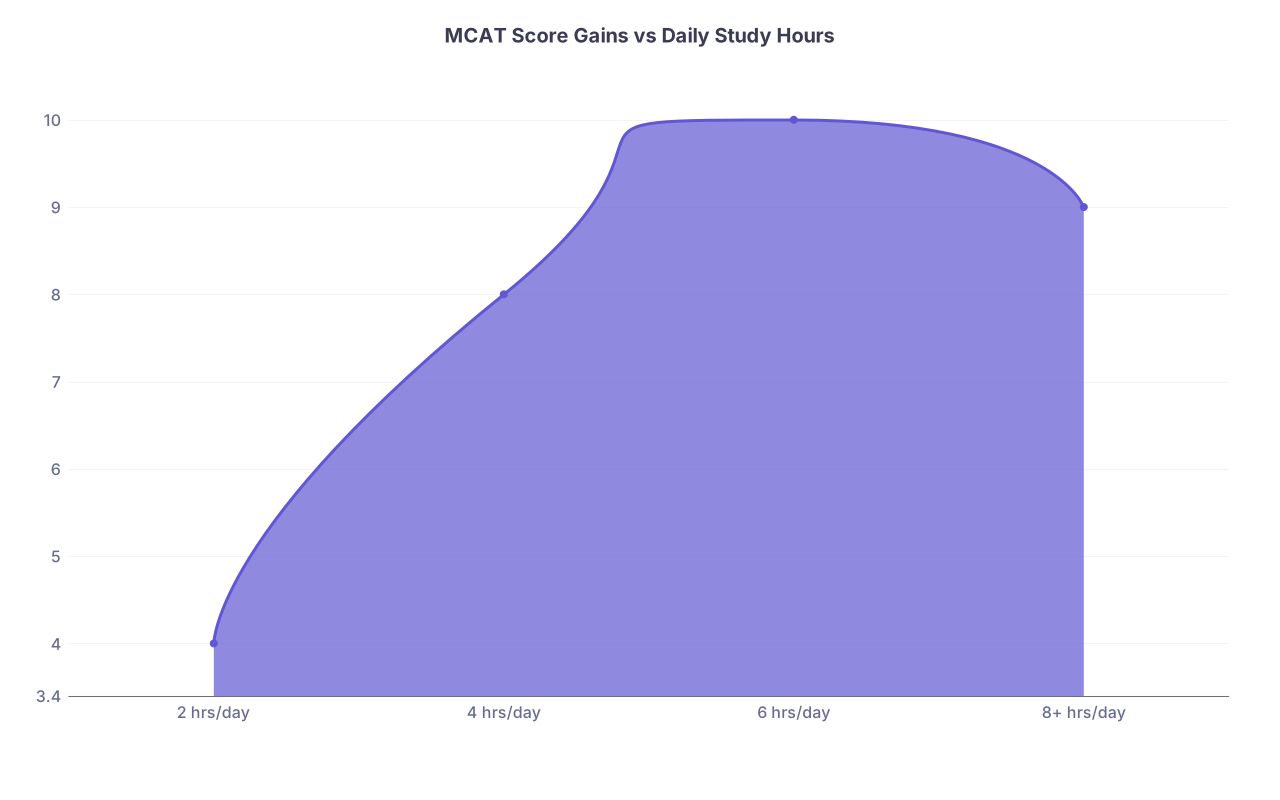
| Category | Value |
|---|---|
| 2 hrs/day | 4 |
| 4 hrs/day | 8 |
| 6 hrs/day | 10 |
| 8+ hrs/day | 9 |
The ‘10 Hours a Day’ MCAT Study Myth: Optimal Time by Outcome
The “serious” MCAT grind of 10+ hours a day is not a flex. It’s usually a red flag.
Every year I watch the same movie: a student posts, “Studying 10–12 hours a day, 6 days a week, aiming for a 520+.” By week 3 they’re exhausted, by week 6 their scores flatline, and by week 8 they’re asking why more time is giving them worse results.
Because the 10‑hours‑a‑day model is built on vibes, not data.
If you care about outcomes—actual score gains, not bragging rights—you need to throw out the “more hours = better” thinking and look at what actually correlates with improvement: quality, spacing, and retention. Not raw time.
Let’s break the myth and replace it with something that actually works.
Where the 10‑Hour Myth Comes From (And Why It’s Broken)
The 10‑hour grind culture comes from three places: panic, misreading success stories, and commercial marketing.
You’ve seen the posts:
“I studied 10–12 hours a day for 3 months and got a 522.”
Then everyone quietly ignores the part where they started with a 509 diagnostic, had already finished biochem with an A, and took AP Chem and Physics.
Survivorship bias at work. You see the survivors, not the thousands who tried the same thing and crashed.
There’s also this lazy extrapolation: “The MCAT is hard. Hard things require extreme effort. Therefore, extreme hours must be good.” That’s not how learning works. The brain is not a bottomless pit that you can shovel Kaplan chapters into for 10 hours straight and magically get a 520.
From cognitive science and from watching real students across multiple cycles, here’s what I see:
- After about 4–6 genuinely focused hours of high‑intensity study, quality falls off a cliff.
- Above ~7–8 hours per day, students don’t consolidate anything. They just re‑expose themselves to material and feel “busy.”
- Burnout rates skyrocket in those trying to sustain 8–10+ hours over more than a few weeks. Scores plateau or even drop on later full‑lengths.
The myth survives because it sounds hardcore. It also lets people feel like they’re “doing everything possible,” even if what they’re doing is objectively inefficient.
What the Data and Learning Science Actually Support
We do not have a single giant RCT called “Randomized Trial of 4 vs 10 Hours of MCAT Studying.” But we do have three useful sources:
- Cognitive psychology on how humans encode and retain information.
- Longitudinal data from test prep companies and AAMC patterns.
- The correlation between prep length, intensity, and typical score gains.
Let’s anchor this in something concrete.
The AAMC’s own data show that average total score gain from first practice to real exam is around 8–10 points for many students using commercial prep. The big jumps (15+ points) are possible but not the norm and almost always tied to longer timeframes and higher‑quality study, not nuclear‑level days.
Most companies that actually track their students’ habits (not just their market copy) tend to quietly recommend a total of around 300–400 effective hours over 3–5 months for most test takers. That’s 15–25 hours per week, not 60.
Let me put that next to the grind myth:
| Plan Type | Hours/Week | Months | Total Hours | Typical Outcome Pattern |
|---|---|---|---|---|
| Moderate, focused | 20–25 | 4–5 | 320–500 | 8–12 point gain |
| Heavy but sustainable | 30–35 | 3–4 | 360–560 | 10–15 point gain |
| Grind myth (10 hrs/day) | 60–70 | 2–3 | 480–800 | High burnout, flat gains |
Notice something: you can hit the same total hours with a sustainable plan as with a 10‑hour death march. The difference is nervous system survival and how much of it you actually remember.
The core science pieces:
- Spacing effect: Material studied over multiple days is remembered far better than the same material crammed in a single long session.
- Retrieval practice: Testing yourself (q‑banks, flashcards, active recall) beats rereading or passive review, especially once you’re mentally fresh enough to reflect on errors.
- Cognitive fatigue: Executive function and working memory degrade as you slog through the day. Past a point, each additional hour produces very little durable learning.
The result: 4–6 hours of high‑quality, active work, consistently, beats 10 hours of scattered, low‑quality, panic‑driven effort.
Optimal Daily Study Time Depends on Your Target and Starting Point
The smart way to think about “how many hours a day” is not “what do Reddit warriors brag about,” but:
- Where are you starting?
- Where do you need to go?
- How many weeks do you truly have?
- How many high‑quality hours can you produce before you turn into a zombie?
Let’s bracket things by target outcome.
If you want a modest gain (e.g., 500 → 506–508)
If your diagnostic is already near your goal and your content base is solid, you don’t need 10 hours a day. You need precision.
You’re looking at something like 10–15 focused hours per week for 8–10 weeks. That can literally be 2 hours on weekdays, 3–4 hours on weekend days.
The gains here come from:
- Cleaning up recurring weak spots (e.g., fluids, genetics, experimental design).
- Tightening up CARS strategies.
- Doing 4–6 full‑lengths under real conditions and aggressively reviewing them.
More time does not move the needle much because you’re already near your performance ceiling given your background.
If you want a solid gain (e.g., 495 → 508–510)
Now we’re talking about real work, but still not 10‑hour marathons.
For most students in this range, an efficient pattern looks like:
- 20–25 focused hours per week
- For 12–16 weeks
- With at least 6–8 full‑length exams
That often shakes out to 3–4 hours on weekdays and 4–5 on weekend days. Yes, some days will be lighter. That’s not failure; that’s sustainability.
Here, you’re combining content repair with heavy practice. The schedule has to be intense enough to keep momentum but not so extreme that you spend half your day staring at Anki cards you don’t actually process.
If you want a big jump (e.g., 490 → 510+ or 500 → 520+)
This is where people panic and default to the 10‑hour myth. They look at the gap, freak out, and equate desperation with effectiveness.
You can absolutely make large gains, but those gains are more a function of:
- Number of months you commit
- Consistency of high‑quality study
- Willingness to ruthlessly review and adjust
- Not blowing yourself up in week 3
A realistic pattern for a big jump:
- 25–35 focused hours per week
- For 4–6 months
- Total 450–700 serious hours
That might mean 4–5 hours most weekdays and 5–6 on weekend days. Occasionally you’ll have an 8‑hour day. Fine. But as a routine? 8–10+ hours becomes counterproductive fast.
Why “More Hours” Stops Working Past a Point
Let’s talk about what actually happens during those legendary 10‑hour days. I’ve watched this play out too many times to count:
Hour 1–3: You’re reasonably focused. You get through some passages, learn from mistakes, maybe do a bit of content review. This time is productive.
Hour 4–6: Fatigue is creeping in. You’re still doing work, but your error analysis is shallower. You skim rationales instead of really interrogating them. You mark stuff “review later” that you never actually revisit.
Hour 7–10: You’re mostly going through the motions. Rereading notes. Half‑heartedly doing passages while checking your phone. Watching solution videos you barely internalize. You feel busy. You feel like you’re sacrificing everything. But retention? Minimal.
People confuse presence at a desk with learning. Those are not the same quantity.
There’s also something uglier:
When you tie your self‑worth to “hours per day,” you start protecting the metric instead of the learning. So you underreport your distractions. You count half‑awake YouTube watching as “studying.” You refuse to take a needed rest day because it would “break the streak.”
That’s how burnout sneaks up. Not because the MCAT is impossible, but because the strategy is dumb.
A More Honest Framework: Effective Hours, Not Logged Hours
Let me give you a cleaner way to think about “how much should I study.”
Count only effective hours. That means:
- You’re doing active tasks: practice questions, flashcards, teaching concepts out loud, writing down reasoning.
- Your phone is away, notifications are off, and you’re not half‑doing something else.
- You’re alert enough that you can later remember the main points from that block of time.
If you apply that filter, most students top out around 4–6 effective hours a day before quality nosedives.
You can still be at your desk longer—planning, organizing, maybe doing some light review—but don’t lie to yourself and call all of it “10 hours of studying.” That’s cosplay, not preparation.
Here’s what a realistic high‑intensity day might look like in practice:
- 2 x 90‑minute blocks of mixed practice (C/P, B/B, P/S, CARS), fully focused
- 2 x 60‑minute blocks of deep review of missed questions, building error logs
- 1–2 shorter 30–45 minute sessions of targeted content review or Anki
- Several short breaks, one longer meal break, and time off in the evening
That’s around 5–7 total hours of MCAT‑related work, with 4–6 of it truly effective. Do this 5–6 days a week for months and you’re in very strong shape.

| Step | Description |
|---|---|
| Step 1 | Start Day |
| Step 2 | 90 min practice block |
| Step 3 | Short break |
| Step 4 | 90 min practice block |
| Step 5 | Meal & rest |
| Step 6 | 60 min deep review |
| Step 7 | Short break |
| Step 8 | 60 min deep review |
| Step 9 | 30-45 min targeted content |
| Step 10 | End - non-MCAT time |
Notice what’s missing? Ten straight hours of misery.
Total Time vs Daily Time: What Actually Predicts Outcome
Let’s be blunt: outcome is far more tied to total serious hours and how they’re distributed than to any macho daily number.
Two students might both end up with 450 high‑quality hours:
- Student A: 5 hours/day, 6 days/week, for 15 weeks
- Student B: 10 hours/day, 6 days/week, for 7.5 weeks but with 30–40% of those hours low quality due to fatigue
They both “studied a ton,” but Student A actually learned and retained more. Student B mostly exhausted themselves.
To visualize the trade‑off:
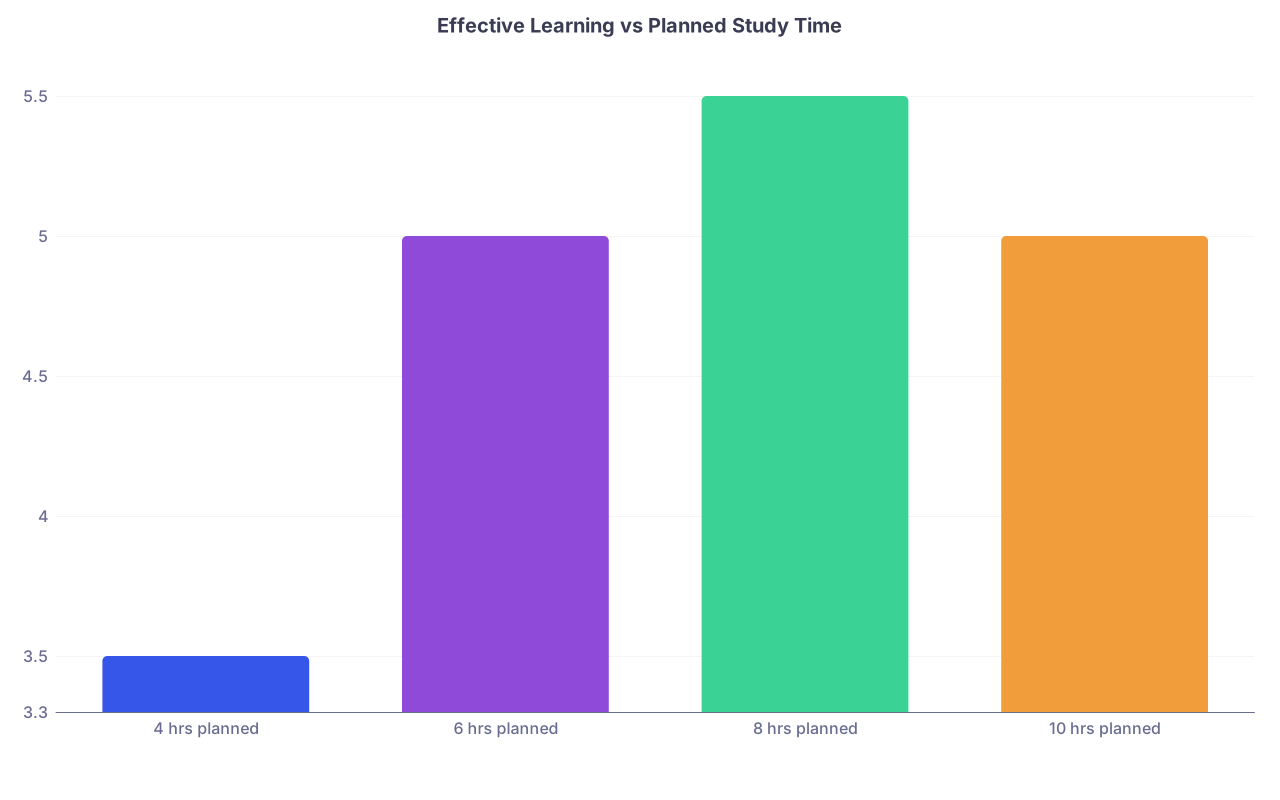
| Category | Value |
|---|---|
| 4 hrs planned | 3.5 |
| 6 hrs planned | 5 |
| 8 hrs planned | 5.5 |
| 10 hrs planned | 5 |
As you stretch the planned day, the fraction of those hours that are actually effective shrinks. Beyond a certain point, increasing planned time does almost nothing for net learning.
And this is exactly what students see in their full‑length performance: big jumps early on with reasonable study days, then a plateau or even regression when they crank the hours instead of improving the method.
Who Actually Needs Higher Daily Hours?
There is one group that sometimes has to flirt with 7–8+ hour days: people who wasted time earlier in the cycle and are now cornered by test dates and application timelines.
Let me be very clear: that is not a strategy. That’s damage control.
If you’re 5–6 weeks out, sitting at a 503, and trying to hit a 515 for this year’s cycle, yes, you may choose to have some brutally long days. But you should also be very honest about the odds and whether postponing is smarter.
Everyone else? You do not earn extra points for suffering.
The Real Flex: Sustainable, Boring Consistency
I’ve watched more students get 515–525 scores from 4–6 disciplined hours per day across several months than I’ve ever seen blast their way there on 10–12 hour marathons.
The pattern that wins is not glamorous:
- Decide on a realistic number of effective hours you can deliver on most days.
- Protect that time like it’s a job.
- Use it for active work: practice, review, recall.
- Take rest seriously—full days off every 1–2 weeks, lighter days when your brain is clearly fried.
- Adjust weekly based on your full‑length scores and error patterns, not your anxiety.
One more thing: the emotional side matters. If you build a schedule you secretly hate, you will subconsciously sabotage it. You’ll procrastinate, doomscroll, and then try to “rescue” the day by extending it into a fake 10‑hour session.
Better to commit to 4–5 real hours you respect than 10 fake ones you resent.
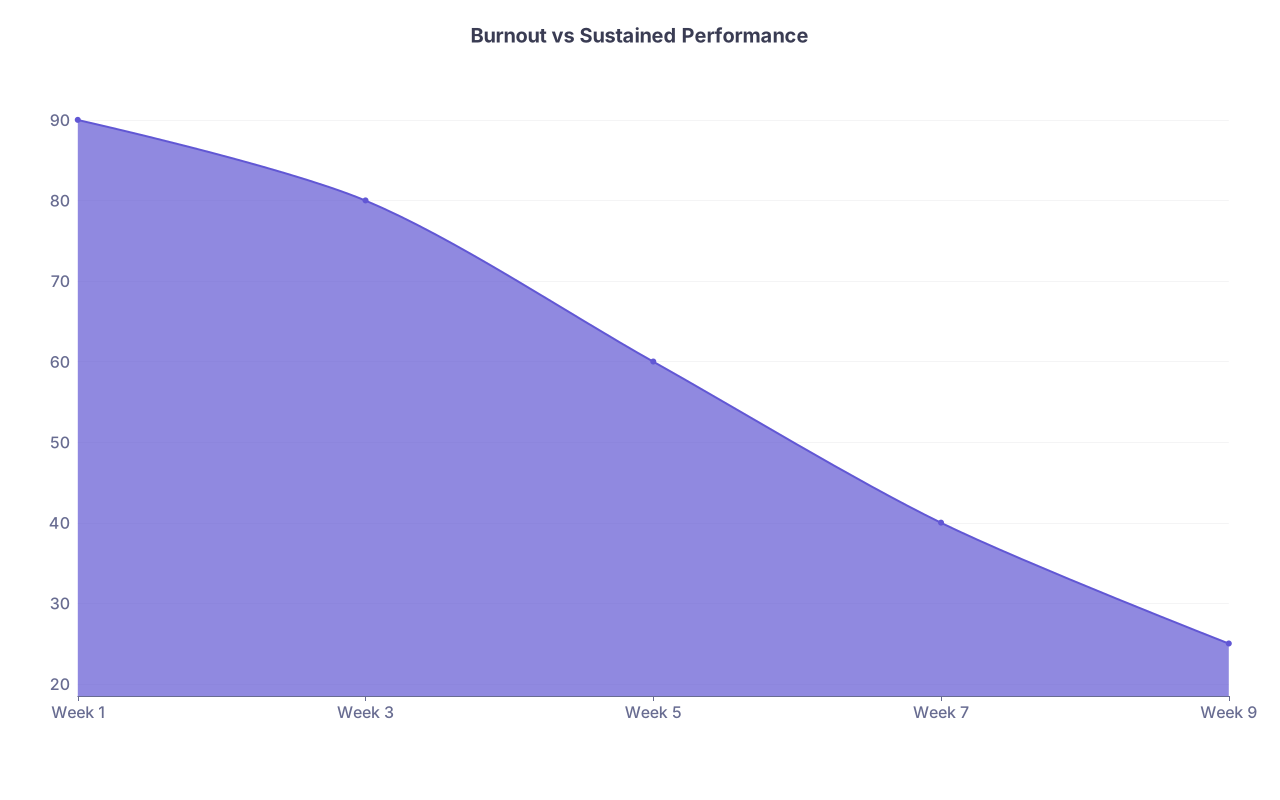
| Category | Value |
|---|---|
| Week 1 | 90 |
| Week 3 | 80 |
| Week 5 | 60 |
| Week 7 | 40 |
| Week 9 | 25 |
That curve is what I see in students chasing the 10‑hour myth. High motivation early, then a progressive collapse. Avoid it.
Bottom Line: How Many Hours Should You Study?
If you want a blunt rule of thumb tied to outcome, here it is:
- Below ~3 effective hours/day on average: you’ll probably see small, incremental gains unless your baseline is already high.
- Around 4–6 effective hours/day, 5–6 days/week, for 3–5 months: this is the sweet spot for most 510–520+ outcomes.
- Regularly pushing 8–10+ hours/day: usually a sign of poor planning, poor strategy, or panic. Occasionally necessary for short bursts, rarely optimal long‑term.
The “10 hours a day” MCAT grind is not a badge of honor. It’s usually evidence that someone is optimizing for suffering, not for scores.
If you care about the score, not the story you tell about how hard you worked, then remember:
- Outcomes scale with total high‑quality hours and smart spacing, not brute daily maximums.
- Past ~6 hours of real focus, your learning returns fall off hard—even if your guilt doesn’t.
- Consistency beats intensity. The student who quietly puts in 4–6 effective hours most days will almost always beat the one who flames out on 10‑hour marathons.
That’s how you beat the myth. And the curve.