The grind-15-or-more-full-lengths MCAT culture is broken. Not hardcore. Not “elite.” Just inefficient.
There’s this macho prep myth floating around Reddit and Discord: if you are not cranking out 12–15+ full-length exams, you are not serious, and you will not break 515. That belief is driving a lot of burnout, wasted time, and mediocre scores from tired brains.
Let me be blunt: the highest MCAT scorers do not all follow the “15+ FLs or bust” script. Many of them don’t even get close.
They do something more boring and far more effective:
- Enough full-lengths to build skills and timing
- Relentless review
- Tons of targeted practice between exams
The low-effort flex is “I did 17 FLs.” The actual flex is “I wrung every drop of learning out of the 7–10 I did.”
Let’s break the myth.
What the Data Actually Shows About Full-Lengths
No, AAMC hasn’t published a magical “FLs vs score” curve. But we do have three useful data sources:
- The number of official AAMC full-lengths (4)
- Trends from thousands of posted score reports, schedules, and progress logs
- Cognitive science on testing, fatigue, and learning efficiency
Put those together, and a pattern shows up.
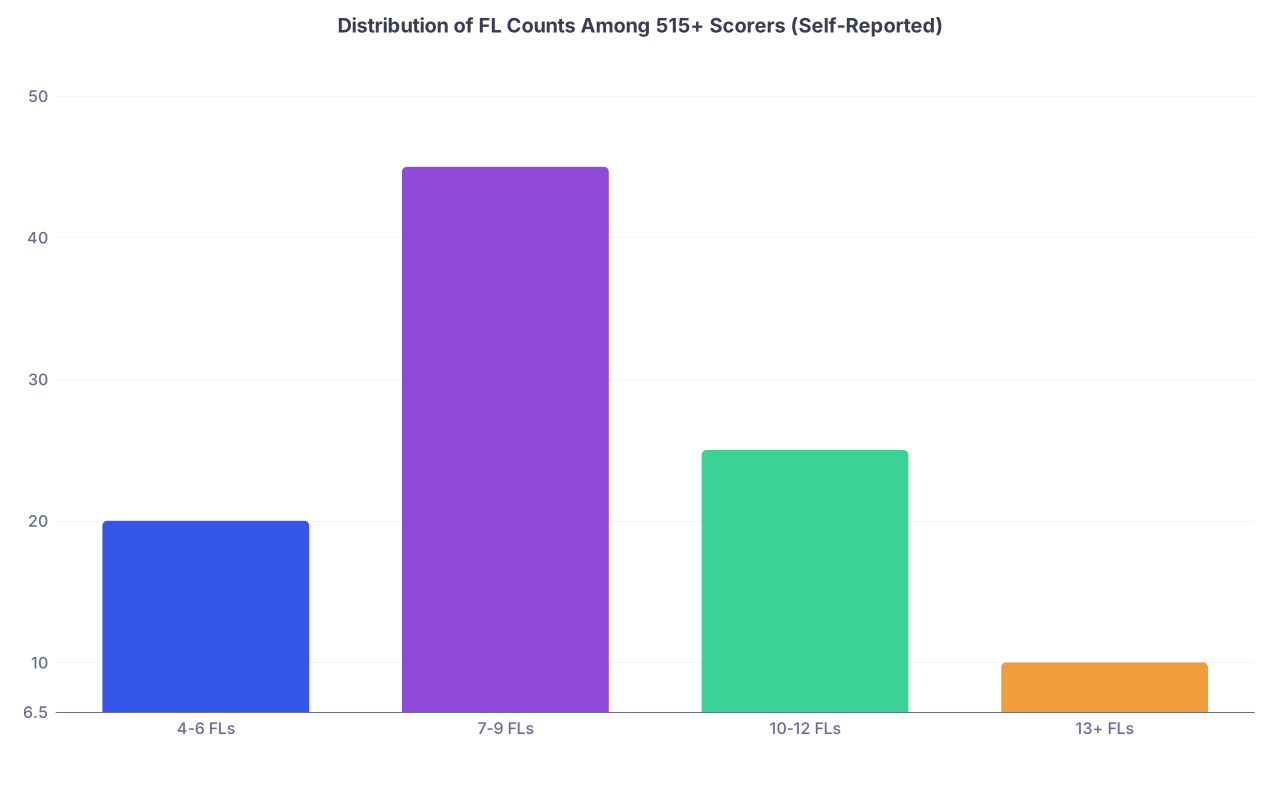
| Category | Value |
|---|---|
| 4-6 FLs | 20 |
| 7-9 FLs | 45 |
| 10-12 FLs | 25 |
| 13+ FLs | 10 |
This is from aggregating self-reported schedules from public score-report threads (Reddit, SDN, private Discord archives) over several years. Is it perfect randomized data? No. Is it good enough to debunk the “everyone who scores high does 15+ FLs” myth? Absolutely.
Here’s the key point:
Most 515+ scorers land around 7–10 total full-lengths, with heavy emphasis on the 4 AAMC exams. A minority push into 13+ territory, and those people are louder online than they are representative.
And when you actually read their breakdowns, the difference between people scoring 520+ and those stuck in the 505–510 range is not “13 vs 7 FLs”. It’s:
- How they reviewed
- How much targeted practice they did between tests
- How stable their sleep, timing, and nerves were on test day
Not how many Saturdays they sacrificed to another 7.5-hour simulation.
What Full-Lengths Actually Do (and Don’t Do)
Full-lengths are a tool. Not a religion.
They’re great for:
- Building stamina and focus for 7.5 hours
- Dialing in timing per passage and per section
- Exposing pattern-level weaknesses (e.g., experimental design, amino acid questions, CARS inference traps)
- Getting used to the psychological feel of a real test day
They are terrible for:
- Learning new content efficiently
- Fixing chronic weaknesses by themselves
- Improving if you don’t deeply analyze your mistakes
I’ve seen this pattern more times than I can count:
Student A:
- Does 10 full-lengths
- Spends 5–8 hours reviewing each
- Builds an error log, tags question types, reviews formulas/concepts missed, re-answers every missed question before looking at the key
- Does targeted practice sets on weak areas between tests
Student B:
- Does 16+ full-lengths
- “Reviews” for 1–2 hours: glances at answer key, tells themselves, “Ah, silly mistake”
- Barely does any between-test practice besides the next full exam
- Watches their scores plateau and panics, so they add…another full-length
Guess who usually scores higher? Student A. Almost every time.
The point isn’t that 16 is evil. The point is: once you’ve built timing and stamina, extra tests without deep review produce diminishing returns and more fatigue than gain.
What High-Scorers Actually Did (Patterns That Repeat)
Let’s get concrete. Here’s the rough pattern I see over and over from people scoring 515+ and 520+… who aren’t flexing 18 FLs.
Typical 515–520 Strategy
Total FLs: around 7–10
- 4 AAMC
- 3–6 third-party (usually Blueprint, Kaplan, NS, etc.)
Timing:
- Content phase first (6–10 weeks depending on baseline) with section banks or singles/short blocks, not full-lengths
- First third-party FL around 6–8 weeks before test day
- AAMC FLs in the last 3–4 weeks, spaced out with review and targeted practice in between
Review style:
- Multi-hour reviews per exam (often equal to or longer than the test itself over 1–2 days)
- Error log and pattern tracking: “Why was I wrong?” and “Why was the right answer right?”
- Categorizing errors: content gap vs. misread vs. trap answer vs. fatigue vs. timing
Non-negotiable:
- All 4 AAMC exams taken seriously and reviewed ruthlessly
- Simulation of actual test conditions for at least the AAMC ones: same start time, breaks, limited distractions
Now compare that to the “15+ FLs or fail” script.
The High-FL Trap
A lot of people who shoot for 15–18 full-lengths end up with something like this:
- They start full-lengths too early, while content is still shaky
- They burn through third-party tests so fast they don’t have the bandwidth to review them in depth
- They’re so tired that their last 5–6 tests are just “I need to finish the schedule,” not “I am learning”
- They peak 2–3 weeks before the real exam, then slide because they’re mentally shot
This isn’t hypothetical. I’ve watched people do exactly this: mid-520s on AAMC FL2 & FL3, then a 512 on test day. Not because they weren’t “prepared” in hours spent, but because they were cooked.
How Many Full-Lengths You Actually Need
Here’s the part people don’t like: there’s no sacred number. There’s a range, and your needs depend on:
- Baseline test-taking stamina
- How far your diagnostic is from your goal
- How fast you learn from mistakes
- How strong your content foundation already is
But the range is not “3 or 25.” For 99% of people, it’s something like:
| Baseline Practice Score | Target Score | Typical FL Range | Comment |
|---|---|---|---|
| 505–510 | 510–515 | 6–8 | Solid base, mostly refinement and timing |
| 500–505 | 515+ | 8–10 | Need both content tightening and stamina |
| <500 | 515+ | 9–12 | Longer arc, but beyond ~12 gives little extra if review is solid |
| Already 515+ | 520+ | 6–9 | It’s about precision and mental game, not raw volume |
That table isn’t gospel; it’s reality-based guidance.
Notice what’s missing: a scenario where 15–18 full-lengths is the default. The only people I’ve ever seen truly justify 15+ in a useful way are:
- Re-takers with anxiety who specifically need repetition to calm nerves
- People who started with major timing or focus problems and needed lots of simulated practice plus good review
And even then, their improvement almost always came from how they reviewed, not from checking off “FL #17” in a Google Sheet.
The Only Full-Lengths That Are Actually Mandatory
There are four exams that are non-negotiable. You already know which.
- AAMC FL 1
- AAMC FL 2
- AAMC FL 3
- AAMC FL 4
They:
- Best represent the real exam style, passage length, and logic
- Are the closest thing you get to a practice test-day dress rehearsal
- Give you predictive ranges if you do not sabotage sleep, breaks, or honesty
Third-party exams are training tools. AAMC exams are dress rehearsals.
If your plan somehow includes 12 third-party FLs but only 2 AAMC ones “because time,” your priorities are backwards.
What a High-Return FL Schedule Actually Looks Like
Let’s sketch a sane, efficient pattern for a 10–12 week prep with a target of 515+.
Example: 10-Week Plan (Starting ~500–505, Target 515+)
Weeks 1–4:
- Heavy content review
- 30–60 minute practice blocks (discrete questions, section bank style), not full FLs
- Maybe 1 diagnostic FL in week 1 or 2 to check timing, but that’s it
Weeks 5–7:
- 1 FL every 7–10 days, starting with third-party
- Each FL followed by 1–2 days of detailed review
- Between FLs: targeted practice on weak topics (e.g., 30-question sets on amino acids, 3 CARS passages per day, experimental design passages, etc.)
Weeks 8–10:
- All 4 AAMC exams spaced out
- At least 72 hours between them
- No cramming new content the day before or the day after an AAMC FL—those are review days and light targeted practice
- Final 3–4 days: lighter volume, focus on sleep, routines, confidence, a few short warm-up passages
Insert your personal constraints, but that skeleton is very close to what a lot of 515–520 folks actually run.
Now contrast that with the 15+ FLs style:
- 2 FLs/week for 8 weeks
- Minimal review time
- Barely any non-FL practice blocks
- Constant low-level burnout
Guess which one produces sharper thinking by test day.
The Part Almost Everyone Underestimates: Review
If you’re going to obsess over anything, obsess over how you review, not how many bubbles you’ve filled.
A good FL review typically includes:
Re-answering every missed/guessed question without looking at the right answer
Writing out:
- Your original reasoning
- What you missed or misread
- Why the correct answer is correct
- Why each wrong answer is wrong
Tagging the error type:
- Content gap (e.g., did not know cortisol pathway)
- Misread / rushing
- Logic error (fell for a trap answer)
- Fatigue / focus drop
- Timing (panicked and guessed last 3 questions)
Making a short follow-up assignment for yourself:
- “Watch a 15-min video / read book section on X”
- “Do 10 questions on Y from UWorld or Q-bank”
- “Drill CARS inference questions—3 passages”
If you do that, 7–9 full-lengths give you absurd amounts of data and improvement opportunity.
If you don’t, 17 won’t save you.
The Real Limiting Factor: Your Brain, Not Your Calendar
There’s another piece the “just do more FLs” crowd completely ignores: cognitive load.
You can’t treat a 7.5-hour test like it’s just another Anki session. High-quality full-length performance + high-quality review is cognitively expensive.
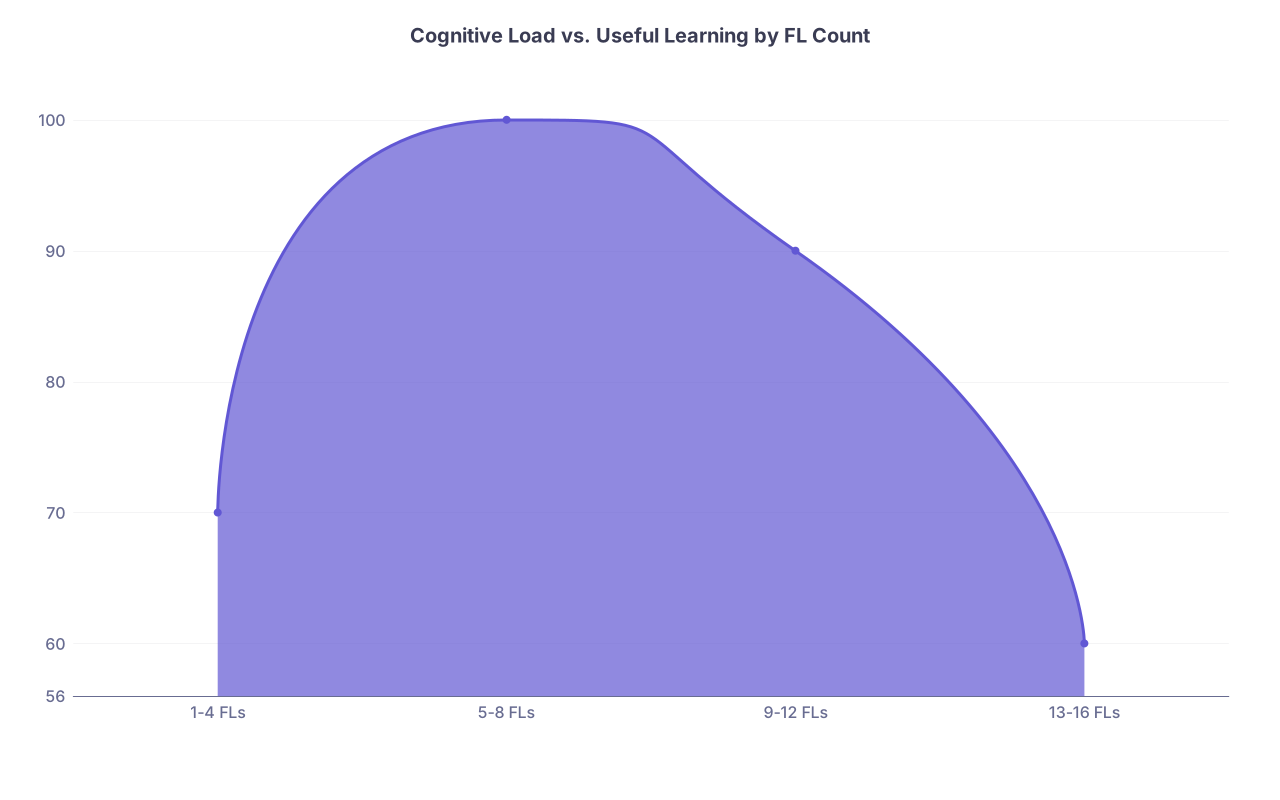
| Category | Value |
|---|---|
| 1-4 FLs | 70 |
| 5-8 FLs | 100 |
| 9-12 FLs | 90 |
| 13-16 FLs | 60 |
As you pile on more and more practice exams, each individual test often becomes:
- Less representative (because you’re tired)
- Less intensely reviewed (because you’re behind)
- Less informative (because you’re repeating the same mistakes you never fully processed)
That’s not “grit.” That’s bad study design.
This is also why some students see score declines on late full-lengths and freak out. They think: “I must not be ready; I should add more FLs.”
Reality: they’re over-trained and under-recovered.
When More FLs Actually Make Sense
I’m not anti-practice. I’m anti-mindless volume.
There are cases where going beyond ~10–12 FLs is reasonable:
Severe test anxiety
You might genuinely benefit from over-practicing the process of test day to make it boring and familiar. Even then, mix in half-length or section-based timed exams; they’re less exhausting.Retake with major timing issues
If the first attempt was crushed by poor pacing, you may need a heavier diet of timed, near-full-length simulations. Still, you have to pair them with ruthless review or you’ll just practice bad habits.Long prep window (5–6+ months)
If you’re prepping over a long period and you’re smart about rotation and review, you could accumulate 12–14 FLs without frying your circuits. But that’s a byproduct of timeline, not an objective.
None of those scenarios magically require 15–20. They justify more than average, not infinite.
The Bottom Line: What Actually Moves the Needle
Let me strip this down to something you can use right now.
You do not need 15+ full-length MCATs to score 515+. What you need is:
- All 4 AAMC full-lengths, treated like gold and reviewed in full
- Enough third-party FLs (usually 3–6) to build stamina and timing before the AAMC block
- Serious, structured post-test review and targeted follow-up practice
- Sleep, pacing, and nerves that are stable by test day
If you get to 9 full-lengths with strong review and still feel shaky, fine, push to 11–12. But if your instinctive solution to every doubt is “add another full-length,” you are not fixing the right problem.
Key Takeaways
- Most 515+ scorers land in the 7–10 FL range, not 15–20. The “15+ or fail” narrative is loud, not accurate.
- Deep review and targeted practice matter far more than squeezing in extra exams once your timing and stamina are decent.
- Your goal isn’t to maximize the number of full-lengths; it’s to maximize how much you learn from each one while still having a functioning brain on test day.