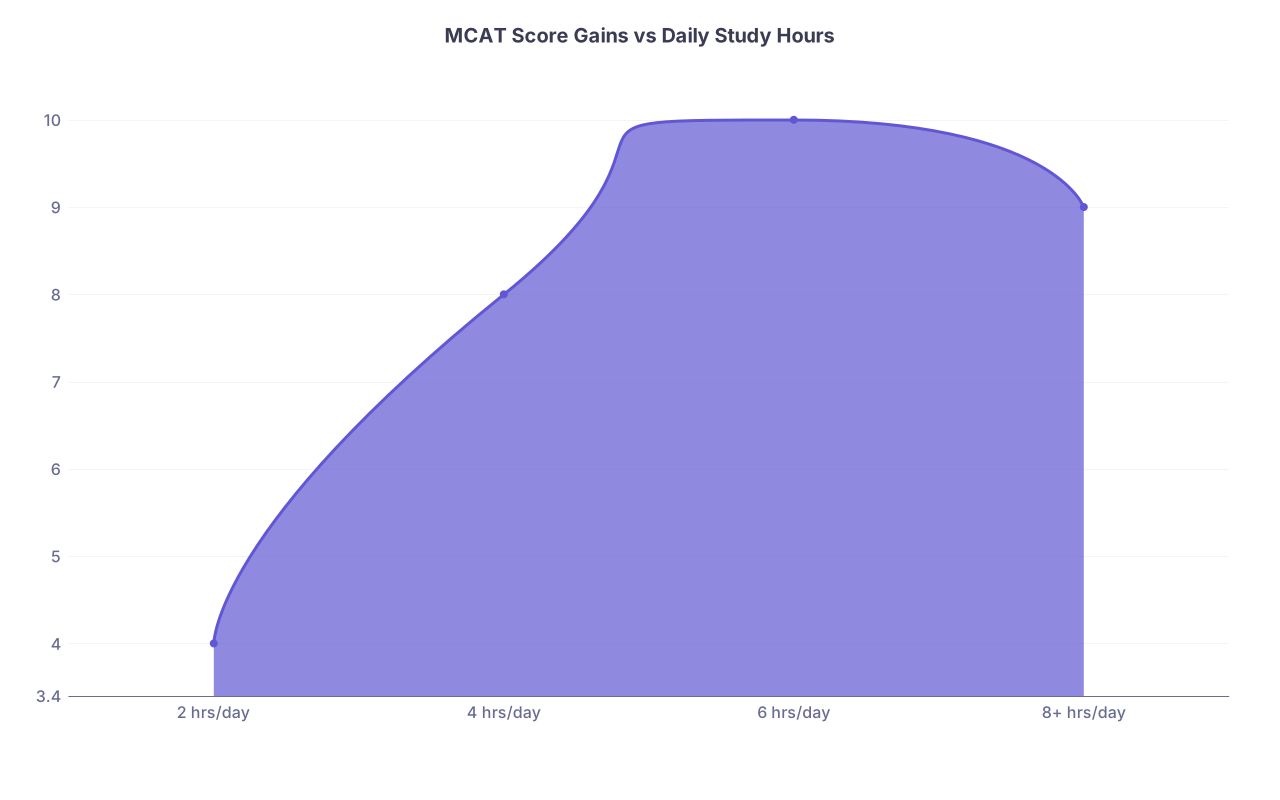
Your MCAT prep strategy is the first thing that quietly tells physicians whether they can trust your judgment.
Everyone pretends the MCAT is just a test of content and endurance. It is not. Behind closed doors, adcoms and physicians use it as an x-ray of how you think, how you plan, and whether you’re the kind of person they want in a code situation at 3 a.m.
I’ve sat in rooms where faculty scanned an application and said, “This kid took the MCAT three times, same score band every time. That’s a judgment issue, not an intelligence issue.” Nobody writes that on their website. But they say it. A lot.
Let me walk you through how your choices around MCAT prep are being interpreted, even if nobody says it to your face.
What Your MCAT Timeline Really Says About You
The score isn’t the only thing they’re reading. The timeline tells a story. And some of those stories are ugly.
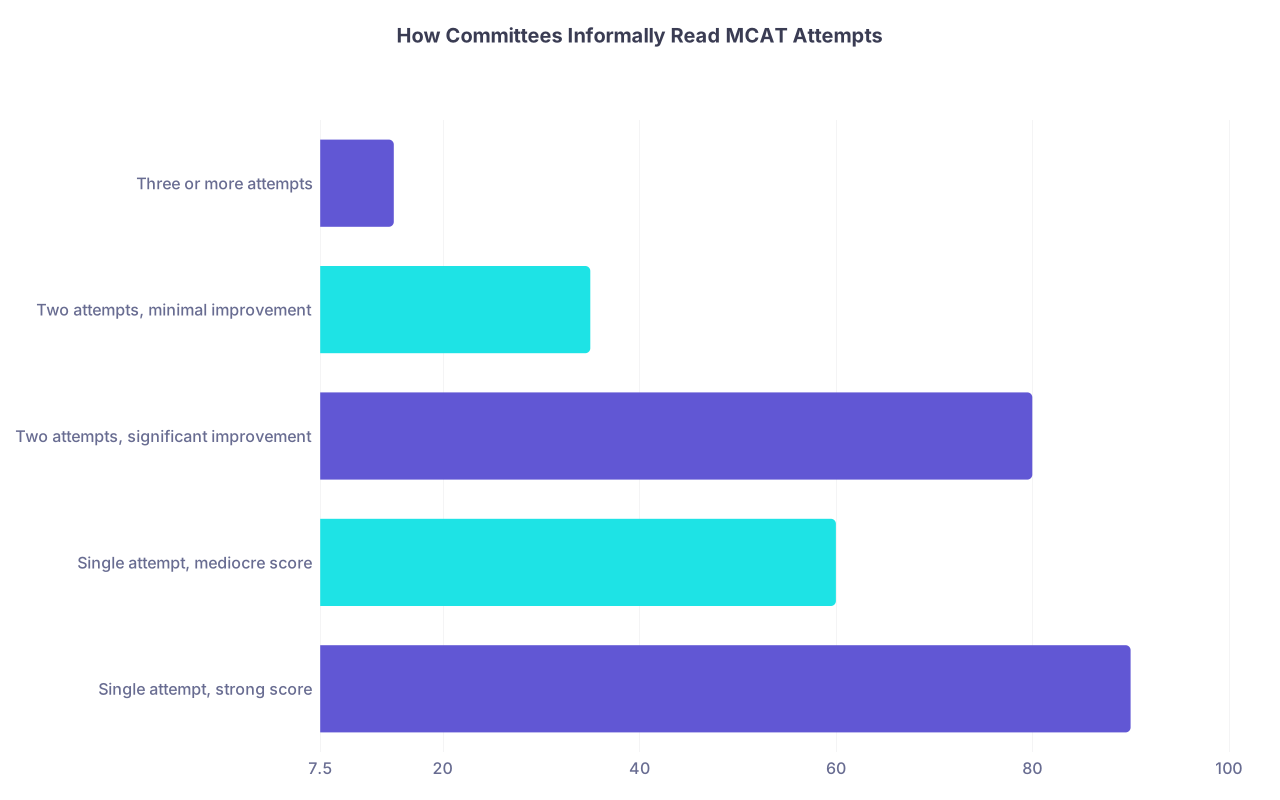
Here’s what program directors and adcoms quietly infer when they see your MCAT history.
| Category | Value |
|---|---|
| Single attempt, strong score | 90 |
| Single attempt, mediocre score | 60 |
| Two attempts, significant improvement | 80 |
| Two attempts, minimal improvement | 35 |
| Three or more attempts | 15 |
That chart isn’t from some published study. It reflects the kind of “gut feel” scale people use in those selection meetings. Nobody writes it down. Everybody uses it.
One-and-done with a solid score
You took it once, got, say, a 513–519. Not perfect. But good.
Off the record, that reads as:
- You plan.
- You respect the test enough to prep seriously.
- You know how to execute under pressure.
There’s a reason so many faculty children end up in this bucket. They were told early: “You get one shot. Treat it that way.”
One low-ish score, no retake
The 503–507 one-and-done crowd always sparks a little side conversation.
Someone will say: “Why didn’t they retake? Were they maxed out? Or did they decide to move on?” The difference matters.
If the rest of your app is strong—rigorous coursework, upward trend, research, good letters—a single modest score can be interpreted as: realistic, self-aware, not obsessed with numbers. Some adcoms like that more than you’d think.
But if you clearly underprepared and then shrugged and applied broadly anyway? That reads as: poor calibration. You didn’t understand (or didn’t care) how the game is played.
Two attempts with real improvement
First attempt: 504. Second: 515.
Every committee has a couple of clinicians who love this story. I’ve literally heard: “That’s someone who can take feedback and fix things. They’ll be fine in residency.”
What they see:
- You misjudged the first time (not ideal), but…
- You responded like an adult: analyzed, adjusted, executed.
- You didn’t get locked into ego or denial.
That’s not about content. That’s judgment under failure. They care about that a lot more than you realize.
Two attempts, basically flat
First: 505. Second: 506.
Behind closed doors, this is where the eyebrows go up.
If your explanation (in behavior, not in essays) is: “I changed nothing meaningful about my prep, just took it again and hoped” — then what they see is magical thinking. Which is exactly what kills patients: repeating the same plan and expecting a different outcome.
People won’t phrase it that bluntly. But that’s the subtext.
Three or more attempts
Here’s the part nobody wants to say publicly: by the third attempt, the conversation shifts from “maybe they can do better” to “why didn’t they stop?”
A third attempt with a clear injury/illness/personal crisis context can be understood. Life happens.
But the chronic test‑repeater, bumping from 502 to 505 to 506, is signaling something else:
- Poor self-assessment.
- Inability to make hard calls.
- Difficulty accepting limits and changing strategy.
In medicine, that combination is dangerous.
Your Prep Materials: What They Reveal About How You Think
Everybody obsesses over which company is “best.” That’s the wrong question.
What matters more is how you choose your resources—and what that says about your judgment.
The quick-fix shopper vs. the systems thinker
I’ve seen students burn through:
- One overpriced big-name course
- Then add another Qbank
- Then buy five more full-length packages
- Then switch to a different content series
all within 3–4 months.
On paper, this looks like “dedicated” students who “used many resources.” On the inside, attendings see that pattern for what it is: flailing. No coherent plan. A belief that more stuff equals more progress.
The students who impress us?
They pick a limited core:
- One primary content resource (could be Kaplan, TBR, or the free AAMC outline + Anki and textbooks)
- One main Qbank
- AAMC materials as the anchor
Then they commit. They modify how they use the materials instead of constantly replacing them.
Good physicians don’t order every test in the hospital. They pick the right ones, interpret them well, and adjust the plan as results come in. Your MCAT resource choices are a rehearsal for that.
Following hype vs. following data
I’ve watched entire premed clubs swing to whatever resource the loudest upperclassman swore by. “Everyone at my school uses X course, it’s the best.” No tracking of outcomes. No analysis. Just social proof.
Here’s what stronger judgment looks like:
- You ask successful high scorers what they did, but then you probe: what was your baseline? how many hours/week? what was weak/strong?
- You look at your own starting point (diagnostic scores, science background) and adapt.
- You pick resources that match your needs, not your fear.
On admissions committees, people can smell herd behavior in how you talk about your prep. If your personal statement or interview answer sounds like a brochure (“I chose [Big Brand] because they’re the most trusted…”), you sound passive, not strategic.
How You Structure Your Study Schedule Signals Clinical Maturity
This one gets underestimated.
Your study schedule is a dry run of how you’ll handle residency call schedules, clinic days, and board prep all at once. And yes, people do mentally project your MCAT habits into future behavior.
The “all-or-nothing” student
Some students decide: “I’ll take 3 months off everything, study 10 hours/day, that’s the only way to score high.”
Sometimes it works. Often it backfires.
Behind closed doors we see it as:
- Poor risk management. You put too many eggs in one basket.
- Limited ability to balance multiple responsibilities.
- Short-term brute forcing instead of sustainable systems.
Medicine rarely lets you clear your plate. You study for boards while on wards, with admissions happening all night. People who only perform well in vacuum conditions worry attendings.
The “I’ll fit it in somehow” student
On the other end, there’s the fantasy-schedule student:
- Full-time job or 18 credit hours
- Volunteering, research, leadership
- “I’ll squeeze MCAT studying into evenings and weekends”
No other restructuring. No tradeoffs. Just vibes.
When that student bombs their exam and then retakes in the same pattern, that’s a red flag. Not for intelligence—for judgment.
What we trust more is the student who says:
“I work 30 hours/week. To prep properly, I dropped one shift and paused two extracurriculars, built a 5-month timeline, and committed to 15 focused hours/week, non-negotiable.”
That’s how residents think when boards come around. Not “I’ll just sleep less and grind.” But “What do I cut so the important thing gets done well?”
Practice Tests: How You Interpret Data Is the Real Exam
Here’s the dirty secret: your reaction to your practice exams is more predictive of your future as a physician than any raw score.
Medical training is one long feedback loop of bad news and small improvements. If your instinct is to avoid, deny, or overreact, people notice.
The “score-chaser” mindset
Typical pattern:
- Takes a practice test every 5–7 days.
- Obsessively tracks score trends.
- Does superficial review—checks answers, reads explanations once, moves on.
- Panics at any score dip, changes resources or schedule again.
On paper, they’re “hardworking.” In reality, they’re terrible at data interpretation. They mistake noise in the system for signal, then throw their whole plan out every week.
That’s the intern who changes antibiotics every 6 hours based on every tiny lab shift. Dangerous.
The “post-call note” style review
The students who impress clinicians treat FL review like post-call chart review:
- They take fewer exams, but squeeze each for everything it’s worth.
- They write down not just what they missed, but why:
- Misread question?
- Rushed?
- Concept gap?
- Got seduced by a distractor?
- They look for patterns over 2–3 tests, not one:
- CARS timing consistently off in passage 5–7.
- Psych/Soc questions fine when discrete, weaker with dense passages.
- Mismanaging breaks → last section drops 3 points.
Then they adjust one or two things at a time and re-test the change.
That is exactly the mindset you want in someone managing insulin regimens or titrating blood pressure meds. This is what physicians mean when they say “good clinical judgment.”
Overbuying, Overtesting, and the Insecurity Problem
Let’s be blunt: the MCAT prep industry makes a lot of money off your anxiety and poor judgment.
The people who end up spending $4–7k on prep usually aren’t the best-prepared. They’re the most insecure. They think safety lies in more courses, more materials, more more more.
From the physician side, that behavior reads as:
- Inability to tolerate uncertainty.
- Belief that protection lies in volume, not in understanding.
- Susceptibility to marketing and external pressure.
Residency programs do not want residents who order unnecessary CT scans “just to be safe.” They want people who can make uncertain calls with incomplete data, using judgment instead of panic.
If your MCAT story is: “I bought three different big courses, switched twice, took 12 practice tests, still didn’t analyze them deeply, and then hoped for the best,” you’ve basically modeled poor diagnostic behavior for a year.
If, instead, your story is:
“I couldn’t afford the big courses. I mapped the AAMC outline, used library-access textbooks, Anki, one Qbank, and every AAMC resource. I tracked my scores and only modified my plan after 2–3 points of consistent movement.”
That is a person a program director trusts.
Choosing Test Date and Retakes: Judgment on Display
The single clearest MCAT-related signal of your judgment? When you decide to sit for the real thing, and whether you decide to retake.
Scheduling too early, then “seeing how it goes”
If I had a dollar for every student who said, “I’ll just see what happens and retake if needed,” I could buy half of Kaplan.
On the back end, here’s how that looks:
- Poor risk-benefit analysis. This isn’t a quiz; every real score is permanent.
- Lack of respect for your own time, money, and record.
- A pattern of testing systems instead of preparing properly.
A stronger move is:
- Set a tentative test date.
- Tie it to objective checkpoints: “By 8 weeks out I need to be scoring at least X on FLs.”
- If you’re not in the range within a defined window, you push the test. Even if it hurts your timeline.
That hurts short term. It looks responsible long term.
Deciding to retake: ego vs. strategy
Adcoms can smell ego-driven retakes.
If you go from 513 to 517, fine. But if you go from 514 to 517 after a full reset, entire summer lost, slightly weakened extracurricular continuity—some faculty will quietly ask: “Why?”
If your app already cleared cutoffs for your target tier, a retake for vanity points reflects poorly. You chased numbers instead of optimizing the whole application.
The more mature choice often is:
- Keep the 513–515.
- Put your energy into meaningful clinical work, strong letters, and actual growth.
- Show you know when “good enough” really is good enough.
Physicians live in “good enough” decisions constantly. You rarely have perfect data. Students who can’t stop optimizing a single metric worry people. They get paralyzed in clinic.
How You Talk About Your MCAT in Interviews and Essays
This is where your judgment gets exposed directly.
Most poorly advised applicants either over-explain or under-own.
The over-explainer
They write half a page about their prep company, every schedule detail, every small disaster.
Faculty reaction: lack of prioritization. You don’t know what matters. You’re trying to litigate your own case instead of presenting a clear, concise narrative.
The denial artist
Other students pretend the MCAT story doesn’t exist.
Three attempts? Minimal improvement? They never mention it in secondaries, never bring it up unless asked directly, give vague, canned answers.
What we see: avoidance. Discomfort with honest self-assessment. That is terrifying in someone who will one day have to say “I missed something. Here’s how I’ll prevent it next time.”
The sweet spot:
- One or two clean sentences acknowledging what happened.
- A short, concrete explanation of how you changed your approach.
- A clear link to a broader pattern of growth in your life.
For example:
“My first MCAT attempt reflected poor planning more than ability; I kept a full extracurricular load and treated practice exams as a formality. Before my second attempt, I sat down with my mentor, cut back two activities, and built a written schedule with weekly review of practice-test data. That shift—treating feedback as something to act on, not fear—has carried over into how I approach research and clinical feedback now.”
That’s judgment. That’s what people want to hear.
The Quiet Reality: MCAT as a Proxy for Future Behavior
Here’s the part that stings: most attendings don’t care about potassium channels or Freud’s stages. They care about:
- Can you handle a large, ambiguous task over months?
- Do you adjust based on reality, not fantasy?
- Do you know when to push and when to pause?
- Can you extract meaning from data instead of reacting emotionally?
Your MCAT prep is a six-month simulation of how you’ll handle:
- USMLE/COMLEX
- In-service exams
- Board certification
- Lifelong CME and recertification
We do not care if you used Kaplan vs. Blueprint vs. homemade flashcards. We care about the story your choices tell.

| Step | Description |
|---|---|
| Step 1 | MCAT Prep Choices |
| Step 2 | Resource Selection |
| Step 3 | Study Structure |
| Step 4 | Practice Test Use |
| Step 5 | Test Date & Retake Decisions |
| Step 6 | Shows Planning & Independence |
| Step 7 | Shows Time Management |
| Step 8 | Shows Data Interpretation |
| Step 9 | Shows Risk Assessment |
| Step 10 | Perceived Judgment |
That’s the real game.
Quick Reality Check Table
To make this concrete, here’s how typical MCAT prep patterns are quietly read on the back end:
| Prep Pattern | How Committees Informally Read It |
|---|---|
| Single attempt, balanced prep, solid score | Planned well, realistic, reliable judgment |
| Two attempts with major score jump | Learns from mistakes, resilient, coachable |
| Multiple attempts, minimal improvement | Poor self-assessment, weak strategic adjustment |
| Constantly switching resources and plans | Impulsive, driven by anxiety, not by data |
| Clear decision to delay exam when not ready | Mature risk assessment, long-term thinker |

FAQ: Off-the-Record Answers
1. Is taking the MCAT three times always a red flag?
Not always. But by the third attempt, people start asking “why didn’t this person change course sooner?” If there’s a clear, genuine reason (illness, family crisis, a documented learning disability that was finally addressed) and a clear change in strategy that produced a real score jump, you can neutralize the concern. Without that, it usually reads as poor judgment.
2. Does using a big-name prep course look better than self-studying?
No. Nobody gives you bonus points for paying $2,000. What matters is whether you used whatever you chose well. In interviews, if you can articulate your own plan, your own adjustments, and your own analysis of what worked, you look strong—regardless of brand. Blindly following a course schedule without self-reflection actually looks worse.
3. How low is “too low” to not bother retaking?
The real question is: “Too low for what given your goals and profile?” A 506 might be fine if you have a 3.9 in hard sciences, stellar clinical work, and you’re targeting less selective schools. It’s a problem if you’re sitting on a 3.5 and gunning for top-20 MD programs. The judgment piece is whether you honestly assess where that score positions you and make a deliberate, defensible choice.
4. Do committees actually see how I studied, or just the score and attempts?
They primarily see scores and dates. But your behavior leaks out: in how many attempts you have, in your timelines, in how you talk about your prep in essays and interviews, and in whether your performance trends match your story. They infer a lot from patterns, even with limited explicit data. Your job is to make those patterns look intentional, not accidental.
5. If I bombed a first attempt from bad planning, can I recover that impression?
Yes—if the second act is undeniably different. That means: a well-structured, documented plan; clear score improvement; and a concise, honest explanation of what changed in your approach. One messy run followed by a disciplined, strategic second attempt can actually leave a better impression than a single modest score, because you’ve demonstrated real growth in judgment.
If you remember nothing else:
- Your MCAT prep is less about content and more about how you handle a long, complex, high-stakes problem.
- Committees quietly read your choices—timing, resources, retakes—as a proxy for clinical judgment.
- You cannot control everything about your score, but you can absolutely control the story your decisions tell. Make that story one a program director would trust at 3 a.m.