You’re staring at your MCAT score report on your laptop. Again.
510. Or 503. Or 518 with one ugly 124 section.
Your group chat is already buzzing.
“Should I retake?”
“My advisor says don’t.”
“Reddit says do.”
Meanwhile, the people who actually decide—admissions committee members, assistant deans, faculty reviewers—they’re not on Reddit explaining how they really look at MCAT retakes. They’re in conference rooms with printouts, saying things like:
“Why did this student take it three times?”
“Look at this upward trend, that’s interesting.”
“First attempt was 518 and they retook? Why…” (eye roll)
Let me walk you through what really happens in that room. What they secretly prefer. What makes them respect a retake—and what makes them quietly move on to the next file.
How Committees Actually See Multiple MCAT Attempts
Forget the premed folklore for a minute. Inside a real admissions committee meeting, the MCAT is not some mystical single number. It’s a pattern. A story.
Here’s what almost every school has: some combination of
- An automated sort using highest total or highest composite
- A faculty/committee culture about multiple attempts
- Internal guidelines for “too many attempts” or “no clear improvement”
Some schools truly do just take the highest overall score and ignore the rest formally. But the reviewers? The humans? They still look at the full history. Always.
I’ve watched this play out:
A student with a 507 → 515:
“Okay, they clearly figured it out. That’s a solid improvement.”A student with 502 → 503 → 503:
“They plateaued. I’m worried about ceiling.”A student with 518 → 521:
“Why did they retake at all? That’s bad judgment.”
So yes, the number matters. But the pattern matters just as much.
Here’s the dirty little secret:
Most committees aren’t “anti-retake.”
They’re anti–mindless retake.
They quietly love a disciplined, strategic retake that tells them something new about you. And they quietly dislike impulsive, anxious retakes that don’t.
The MCAT Retake Patterns That Help You (And The Ones That Hurt)
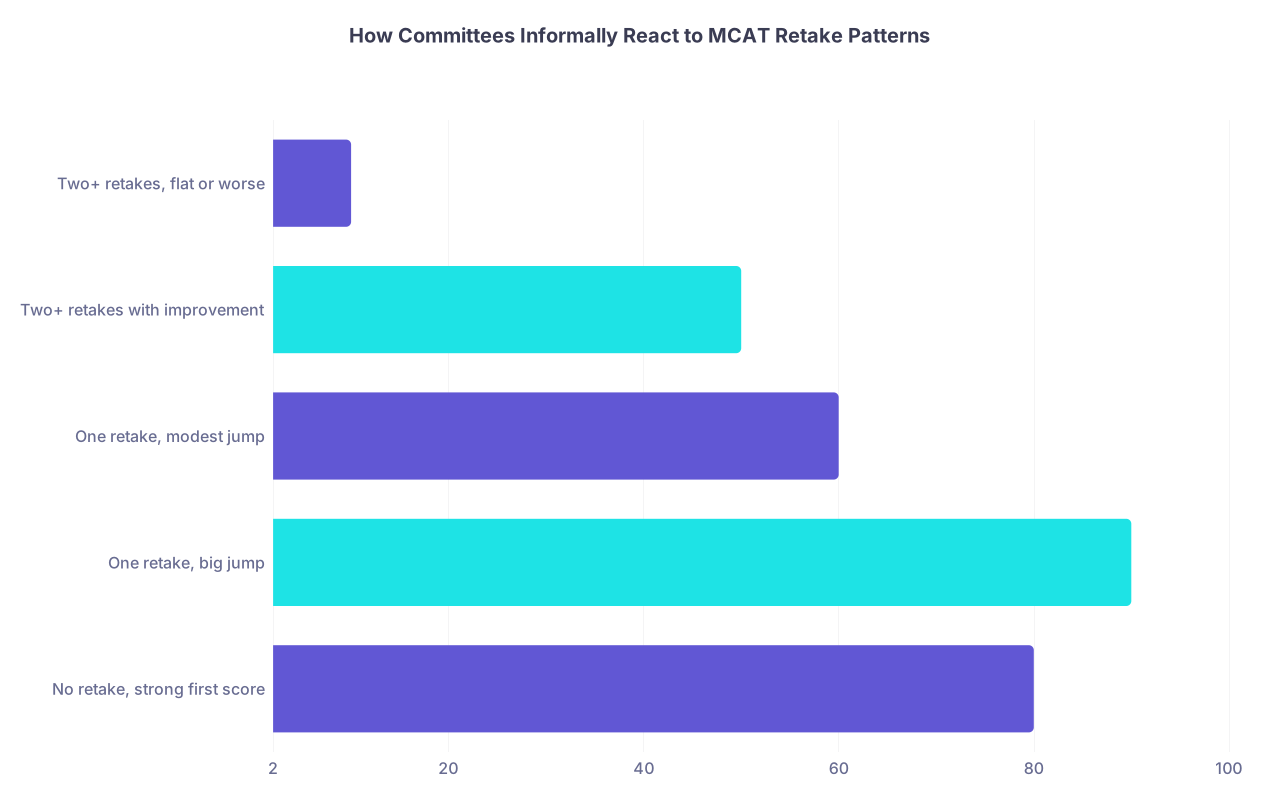
Let me be blunt. Admissions people have seen thousands of MCAT score histories. They mentally bucket you in seconds.
| Category | Value |
|---|---|
| No retake, strong first score | 80 |
| One retake, big jump | 90 |
| One retake, modest jump | 60 |
| Two+ retakes with improvement | 50 |
| Two+ retakes, flat or worse | 10 |
This is not exact science, but it’s very close to how things feel in the room.
Pattern 1: The Clean Hit (No Retake, Solid Score)
Example: 517 on first attempt. Or 511 with strong GPA and upward academic trend.
Committees love this. It’s simple. No drama. It signals:
- You prepare well
- You have good test judgment
- You likely won’t be a Step 1 or Step 2 liability later
If this is you and you’re thinking about retaking to go from 517 to 521 “for top-5 schools,” I’ll tell you what adcoms actually say:
“They already have a great score. Why didn’t they trust it? That worries me.”
They prefer: no retake.
Pattern 2: The Comeback (One Retake, Clear Jump)
Example: 503 → 511
Or 507 → 515
Or 509 → 518
This is the pattern committees secretly respect—more than you think.
Because that second score, with that size of jump, says:
- You learned from failure
- You can diagnose your weaknesses
- You can execute a focused plan under pressure
- Your first score might have been timing, anxiety, or poor strategy—not potential
I’ve literally heard faculty say:
“I like this. It shows resilience. The later score reflects them better.”
They prefer: one clear, well-timed retake with substantial improvement.
Pattern 3: Tiny Nudge Up (One Retake, Minimal Gain)
Example: 508 → 510
505 → 507
511 → 513
This one lives in the gray zone.
Some committee members shrug and just look at the higher score and move on. Others pause and think:
“Was this worth retaking? What was their judgment process?”
If your application is otherwise strong, this does not kill you. But it doesn’t impress anyone. At best it’s neutral. At worst, it hints at perfectionism and poor risk/benefit thinking.
They tolerate this. They don’t love it.
Pattern 4: The Grinder (Two or More Attempts With Improvement)
Example: 495 → 502 → 509
Or 500 → 504 → 510
This splits committees.
Some see grit. “They stuck with it, and it paid off.” Especially at mid-tier or mission-driven schools. If the final score is competitive and the narrative is coherent (late bloomer, first-gen, fixed structural issues), many will give you credit.
Others see a ceiling. “Why did it take three tries to get here?” If they’re swimming in 515+ first-timers, they won’t fight hard for this file.
Here’s the nuance: the higher your final score, and the clearer your upward story, the more they accept this pattern.
They prefer: two attempts max in most cases. Third only if the gain is dramatic and the context is compelling.
Pattern 5: The Flatline (Multiple Attempts, No Real Change)
Example: 502 → 503 → 501
Or 506 → 507 → 507
This is the pattern that quietly kills your file at many places.
It screams: “This might be their true cognitive ceiling for standardized tests.” And committees are, frankly, wary of that for USMLE/COMLEX reasons.
It’s not personal. It’s risk management.
They really do not prefer: multiple attempts with flat scores.
What Admissions Committees Secretly Prefer You Do Before Retaking
Here’s what you’re never told in advising offices because it sounds harsh:
Every additional attempt is a risk for schools, not just for you.
Why? Because they know if you struggle with tests now, you might struggle with USMLEs later. And that hits their board pass rates, which hits their accreditation and rankings. There’s self-preservation baked in.
So before they see a retake, what do they prefer you’ve done?
They want to see:
A truly different study plan
Not just “more Anki” or “another Qbank.” They want someone who recognized their old approach was flawed and rebuilt it.Evidence of realistic self-assessment
Your personal statement, secondaries, and timing should reflect you knew why you underperformed. Not vague hand-waving about “test anxiety” with nothing changed.Consistency with the rest of your academic record
If you had a rough freshman year but your GPA is now 3.8 with upper-level sciences, a low first MCAT makes sense. A retake that matches your recent performance fits the story.Respect for timing and application cycles
They hate seeing a May MCAT, a weak score in June, and then you reload for August and apply in the same cycle with a rushed retake. It looks like panic.
What they quietly like:
You take the MCAT once. If it underperforms relative to your practice and targets, you step back, fix your life and your study structure for 4–6 months, retake once, then apply with the stronger score. Clean story.
Score Cutoffs, “Too Many Attempts,” and What’s Actually Discussed
No committee will publicly post: “We hate three MCAT attempts.”
But behind closed doors? These conversations absolutely happen.
Most schools have some internal guardrails—formal or informal—about attempts:
| School Type | Typical View of Multiple Attempts |
|---|---|
| Top 20 MD | Prefer 1–2 attempts, 3rd is a red flag unless major jump |
| Mid-tier MD | 1–2 fine, 3rd considered if strong upward trend |
| Lower-tier MD | More flexible, 3rd can be okay with context |
| DO schools | Generally more open to 2–3 attempts if final score solid |
This is not written policy. It’s culture.
At a top-20 MD program I know well, an assistant dean literally said in a committee meeting:
“By the third MCAT, I want to see something dramatically different. Otherwise I’m worried we’re looking at their true limit.”
No, they don’t auto-reject. But are you starting behind applicants with a single 517? Absolutely.
Another thing they quietly track: time between attempts.
- 6 weeks between tests? That screams panic, not strategy.
- 4–6 months with a clear study overhaul? That looks deliberate.
- 9–12 months plus a better academic semester? That looks mature.
You won’t see this on a website, but it’s how they think.
When a Retake Is Smart Strategy vs Weak Judgment
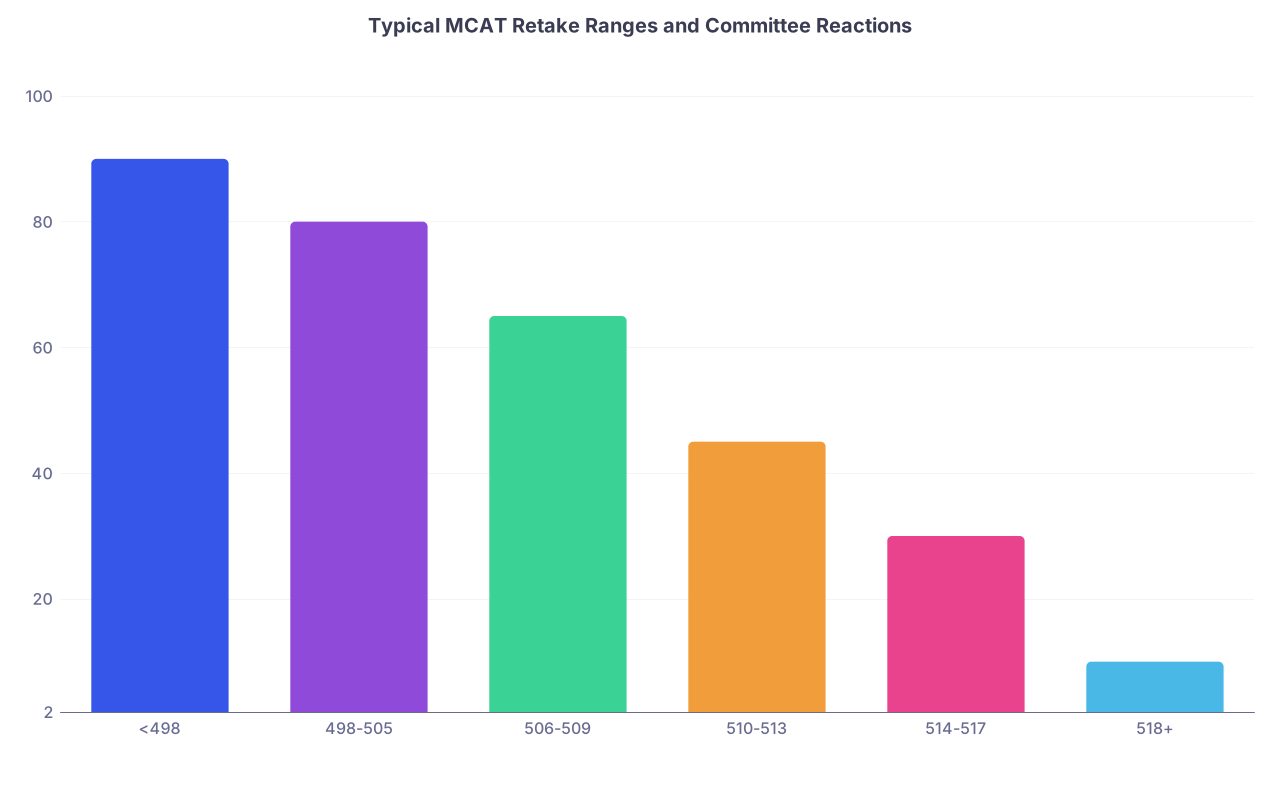
Let’s get specific. Because “should I retake?” is useless as a general question. The real question is: for someone with your stats and goals, what does a realistic adcom prefer you do?
| Category | Value |
|---|---|
| <498 | 90 |
| 498-505 | 80 |
| 506-509 | 65 |
| 510-513 | 45 |
| 514-517 | 30 |
| 518+ | 10 |
Those values loosely represent the percentage of applicants in each band for whom a retake often helps, not some official metric. Just how it plays out in real discussions.
Scenario 1: Sub-500 Score
Say you’re sitting at a 495–498.
Most MD schools won’t take that seriously unless there’s extraordinary context. DO schools will consider it, but you’re still on thin ice.
Here, committees actually expect a retake if you say you want MD. They’re thinking:
“If they can’t get above 500 even with a retake, MD might not be realistic. But we should at least see if this was a fluke.”
They prefer:
You do not apply widely with a 49x hoping for mercy. You step back. Take 6–9 months. Fix your foundations. Prove you can hit 505–510+ or you pivot your goals honestly.
Scenario 2: 500–505
Now you’re in the uncomfortable middle.
Some mid-tier and state MD schools might glance at you if your GPA is high, you’re in-state, and you fit their mission. DO programs will be more flexible.
What they actually prefer:
If your practice exams were consistently 508–510 and test day went off the rails—reset and retake once with a serious plan. Show them you’re not a 501 student; you’re a 508 student who had a bad day.
What they don’t love:
Three scores all living between 500 and 505. That reads like a hard ceiling.
Scenario 3: 506–509
This is where nuance really kicks in.
- Targeting MD only, especially competitive states? A retake might be worthwhile.
- Open to DO or less competitive MD? That’s a workable score already.
Committees here prefer that you think like they do: holistically.
If you have:
- 3.9 GPA in a hard major
- Strong research and clinical work
- Good state school with 510 median MCAT
A 508 with no retake is not killing you. You might not need to gamble.
But if you’re 3.4 GPA, from an oversubscribed state, gunning only for mid/high-tier MD? Then a strategic retake to get to 512+ may genuinely change how your file lands in the stack.
They prefer:
You calculate risk realistically and do not throw away a 508 chasing a 520 that your practice tests never supported.
Scenario 4: 510–513
This is where many of you mess up.
You have a good score. You don’t love it. You want “T20 insurance.” So you think, “I’ll retake. What’s the worst that can happen?”
Here’s what admissions people will say if you go 512 → 513:
“They risked a solid score for a 1-point bump. Why?”
Or if you go 512 → 509:
“Now we’re confused which score reflects them. And their judgment makes me nervous.”
They secretly prefer different things depending on your goals:
- Regional MD, realistic school list? Keep the 510–513 and move on.
- Genuinely T10-caliber rest of application (prestige research, publications, very high GPA)? Maybe. But even then, most committees would rather see you spend that time on publications, leadership, or meaningful work than chase 3 more points.
Scenario 5: 514–517
For almost all MD schools, you are competitive. Not guaranteed. But you’ve cleared the “can they handle the exam?” bar.
Most committee members quietly prefer: no retake.
Because when they see a 516 and then a 519, no one is giving you extra points for that. It’s just not how they think.
They’re asking:
“Could they have used that extra prep time to write a better personal statement or deepen their clinical work instead?”
And when they see a 516 and then a 512, some will lean toward the 516 as “true ability.” But the narrative is messier now, and messy rarely helps.
Scenario 6: 518+
If you retake this, adcoms will not say it out loud, but they will think it:
“What are you doing?”
They prefer—in fact they expect—you to be done. A 518+ is a clear signal: this exam is not going to limit you. Everything else in your file matters far more.
The Retake That Impresses Committees
So what, exactly, does a retake look like when they actually like it?
It looks like this:
- First score underperforms not just your hopes, but your documented pattern: strong course rigor, high GPA, solid practice test range.
- You do not immediately re-register for the next available test in 5 weeks. You take a breath. You analyze.
- Your second application year materials acknowledge growth. Not, “I bombed the MCAT,” but, “I reassessed my study process, identified weaknesses in X and Y, and made concrete changes.” Substantive, not dramatic.
- Then they see: 505 → 514. Or 499 → 508. Or 507 → 516. Upward, clean, credible.
And when your interviewer asks, “Tell me about your decision to retake the MCAT,” your answer is not:
“I just wanted a higher score.”
It’s:
“My original score did not match my practice tests or my academic record. I realized I’d been approaching the exam like a memorization test instead of an application test. I took 5 months, restructured my schedule, built endurance with full-lengths, and focused on my weakest sections. That experience actually changed how I study now.”
That’s the retake that makes faculty nod.
How To Decide: A Simple, Honest Framework
Strip away the noise and use this filter, which is very close to how many admissions folks would advise their own kids behind closed doors.
Ask yourself:
Is my current score clearly misaligned with my recent academic performance and practice tests?
If yes, a retake can make sense. If no, you might be asking the MCAT to magically turn you into someone you’re not—committees notice that.Do I have a concrete, different plan—not just more hours?
If you can’t articulate exactly what went wrong and exactly how you’ll fix it, adcoms would rather you not roll the dice again.What’s my realistic school list with my current score and GPA?
If you’d be clearly shut out of your target tier, a retake is rational. If you already have a workable path to MD/DO, you’re risking a lot for marginal gain.How many times have I already taken it?
First attempt underperformed → one retake is reasonable.
Two attempts already → a third is a very hard sell in most MD committees.What else will I sacrifice to prep again?
Adcoms quietly prefer stronger clinicals, better letters, and more mature experiences over you chasing a 3-point bump.
Years from now, you won’t remember the exact scaled score or your third AAMC practice percentile. You’ll remember the judgment calls you made when things didn’t go perfectly the first time.
Retaking the MCAT isn’t a moral failure or a badge of honor. It’s just a decision. The committees on the other side of your file aren’t looking for perfection. They’re looking for patterns—of judgment, growth, and realism.
If you can align your retake decision with what they quietly respect—honest self-assessment, strategic change, and restraint when enough is enough—you’ll stop playing defense with your score history and start using it as evidence of who you actually are.