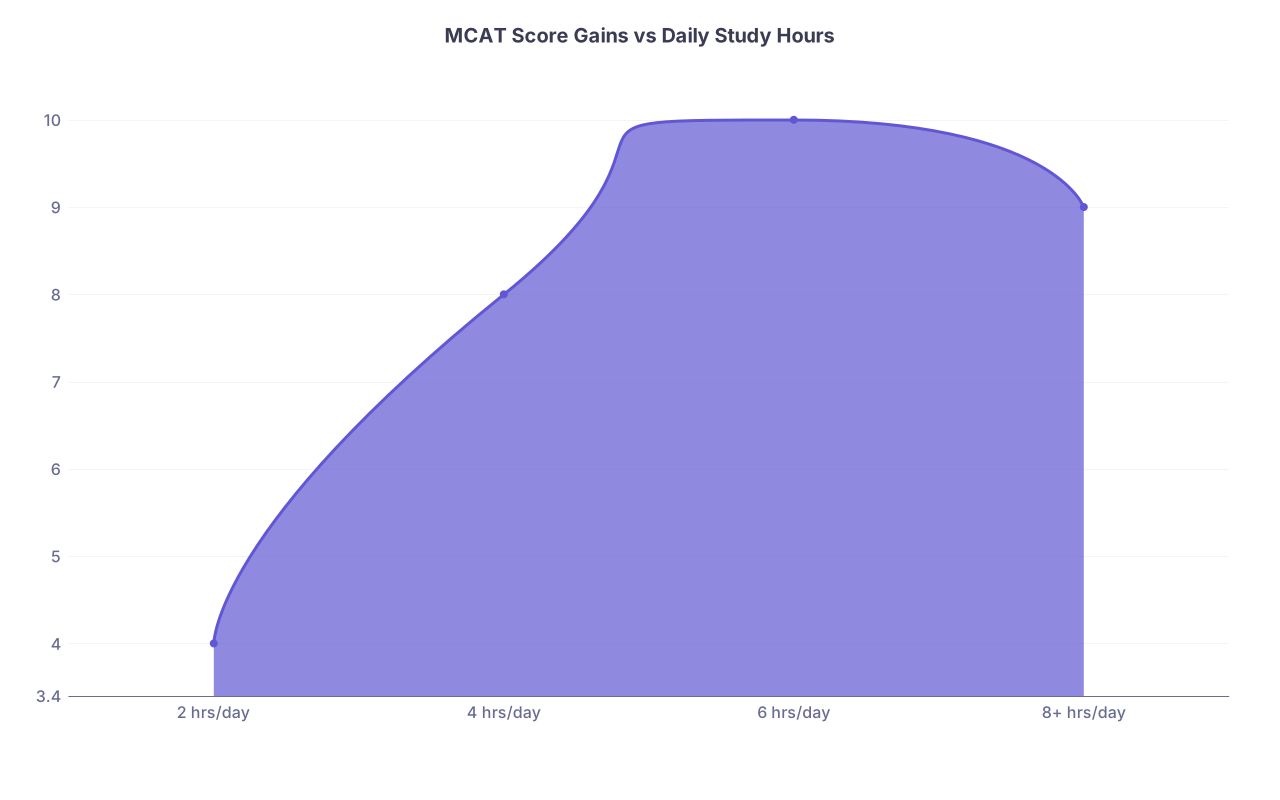
Only 27–35% of MCAT takers use a formal commercial prep course, yet they account for a disproportionately high share of 515+ scores at many campuses I’ve seen data from.
That sounds like “courses work,” right?
Not so fast.
Most of what you’ve heard about self‑study vs MCAT prep courses is marketing, vibes, and survivor bias. The “I got a 522 with only free resources” guy and the “Kaplan literally saved my life” person are both telling you incomplete stories.
Let’s cut through it and stick to what the outcome data and real‑world patterns actually support.
What the Data Actually Shows (Not What Companies Say)
There is no large, randomized trial where half of students were forced into Kaplan and half banned from courses. That study doesn’t exist.
What we have instead:
- AAMC score data by study hours and methods
- Smaller institutional surveys comparing course users vs self‑studyers
- Outcome patterns from prehealth advising offices
- Score distributions from scholarship or pipeline programs that require a course
When you put these together, a few things become pretty clear.
First, average MCAT scores correlate much more with total hours of focused prep and baseline academic strength than with whether someone paid for a course.
Second, people who take courses tend to be different before they ever log in: higher family income, more structured, often more anxious about performance, and sometimes weaker at self‑planning. That muddies any “courses cause higher scores” claim.
Here’s a simplified comparison based on multiple advising-office datasets and published survey data. This isn’t fantasy; it tracks what I keep seeing across different schools.
| Group | Typical Total Study Hours | Median Score | High-Score (515+) Rate |
|---|---|---|---|
| Self-study, unstructured | 150–250 | 503–506 | ~5% |
| Self-study, highly structured | 300–450 | 509–513 | 15–20% |
| Course users, minimal engagement | 150–250 | 503–507 | ~7% |
| Course users, high engagement | 300–450 | 510–515 | 18–25% |
Notice the pattern: when you match for hours and engagement, the gap nearly disappears. High‑engagement self‑study and high‑engagement course users sit in basically the same band.
Where courses do show a real advantage is not magic content. It’s scaffolding.
Students who are:
- weak at planning
- bad at sticking to timelines
- or totally lost on how to review practice exams
…often perform significantly better with a course than without. Not because the videos are secret, but because someone else did the thinking about the studying.
The Big Myth: “Courses Are Automatically Better”
The most persistent myth goes like this: “If you can afford a prep course, you should 100% do it. Self‑study is for people who have no other choice.”
I hear this from parents constantly. I’ve watched them drop $2,500+ on a brand name program that their kid then half‑uses.
The reality:
- A prep course is a tool for structure, not a cheat code for content.
- You can absolutely outperform most course users with a well‑designed self‑study plan and AAMC materials.
- You can also absolutely waste a lot of money sitting on archived lecture videos while your scores plateau at 505.
I’ve seen dozens of students pull this classic pattern:
- Buy a course.
- Attend the first week of lectures.
- Fall behind on assignments.
- Decide to “just focus on the QBank.”
- End up basically self‑studying, but poorer and more guilty.
They did not have a “course outcome.” They had a self‑study outcome with sunk costs.
The only honest question is: does a course fix problems you actually have? Or just soothe your anxiety for a few weeks?
What Actually Predicts MCAT Score Gains
If you strip away the branding and look at predictors of score improvement, a few things keep coming up across datasets.
1. Total high‑quality practice
Not hours logged in a portal. Not number of pages “read.”
High‑quality means:
- AAMC full‑lengths taken under real conditions
- Detailed post‑test review, including error categorization
- Targeted follow‑up (questions and content review specifically for your weak areas)
I’ve worked with self‑studyers using only:
- AAMC materials
- One third‑party Qbank
- An Anki deck
- And a calendar
They hit 517+ routinely. No lecture videos. No “office hours.”
Why? Because they pushed 2,000–3,000+ questions with real feedback and systematic review.
2. Deliberate review cycles
Most low scorers—course or not—do practice questions, miss a bunch, lightly skim the explanations, and move on.
High scorers—again, course or not—treat misses like case studies:
- Why did I pick this wrong answer?
- What flawed assumption did I make?
- What pattern is this part of (careless math, passage misread, content gap)?
- What is my concrete rule to avoid this next time?
You don’t need a $2,000 course to ask yourself those questions.
You do need discipline. And a system to actually revisit those patterns.
3. Consistency and calendar realism
The MCAT punishes bursts of heroic effort followed by crashes.
Students who build a realistic, sustained schedule—whether drawn from a course or a spreadsheet—usually outperform people who swing wildly between burnout and guilt.
Courses are a crutch here for some people. A good one says: here’s what you’re doing this week, no negotiation.
But self‑study can mimic that if you’re ruthless about planning and honest about your life constraints.
Where Prep Courses Actually Help (And Where They Don’t)
Let me be fair to the courses. They aren’t useless. They’re just very misrepresented.
Genuine strengths of a good MCAT course
Courses help when:
- You have no idea how to build a study plan and freeze every time you try.
- You need external accountability (class times, homework, progress tracking).
- You benefit from someone walking you through how to analyze passages and questions out loud.
- You’re retaking after a bad attempt and clearly under‑diagnosed your issues the first time.
Also, for nontraditional students—working full‑time, coming from a weak science background or a long gap—courses can cut down the meta‑work: deciding what to study, in what order, and how deep.
I’ve seen 495–500 scorers jump to 508–512 after finally enrolling in a course that forced structure on them they never managed to create alone.
Where courses are wildly oversold
Courses do not magically fix:
- Poor reading stamina
- Chronic procrastination outside of live class
- Weak basic chemistry/physics that you never truly learned in undergrad
- Refusal to seriously review full‑length exams
And they definitely don’t guarantee a 515+ just because some ad shows “average course user score: 513.” Read the fine print. That number often excludes people who never finished the course or who delayed their test date.
When you look at all enrollees, the “boost” shrinks fast, usually to something like 1–3 points over self‑study with similar hours. Which, again, is basically the impact of having a coherent schedule.
Self‑Study: Underrated When Done Like a Professional
Now the flip side. Self‑study is not “free and chaotic Google surfing” unless you make it that way.
High‑yield self‑study usually has:
- A written, dated calendar covering 3–4 months
- Clear phases (content review → mixed practice → exam heavy)
- Scheduled full‑lengths (often weekly in the last 4–6 weeks)
- A defined review routine after every exam and block of practice questions
If you do that, your advantages over course takers are real:
- You can pick the best resource for each subject instead of one company’s set.
- You avoid time‑wasting lectures on things you already know.
- You can pivot instantly when your diagnostics show you need to change strategy.
The main cost is cognitive. You must do the planning yourself.
A lot of people are simply unwilling to do that. So they conflate “I cannot organize this” with “self‑study does not work.”
They’re wrong. They just prefer to outsource.
So… Who Actually Benefits More from Each Path?
Here’s the blunt version.
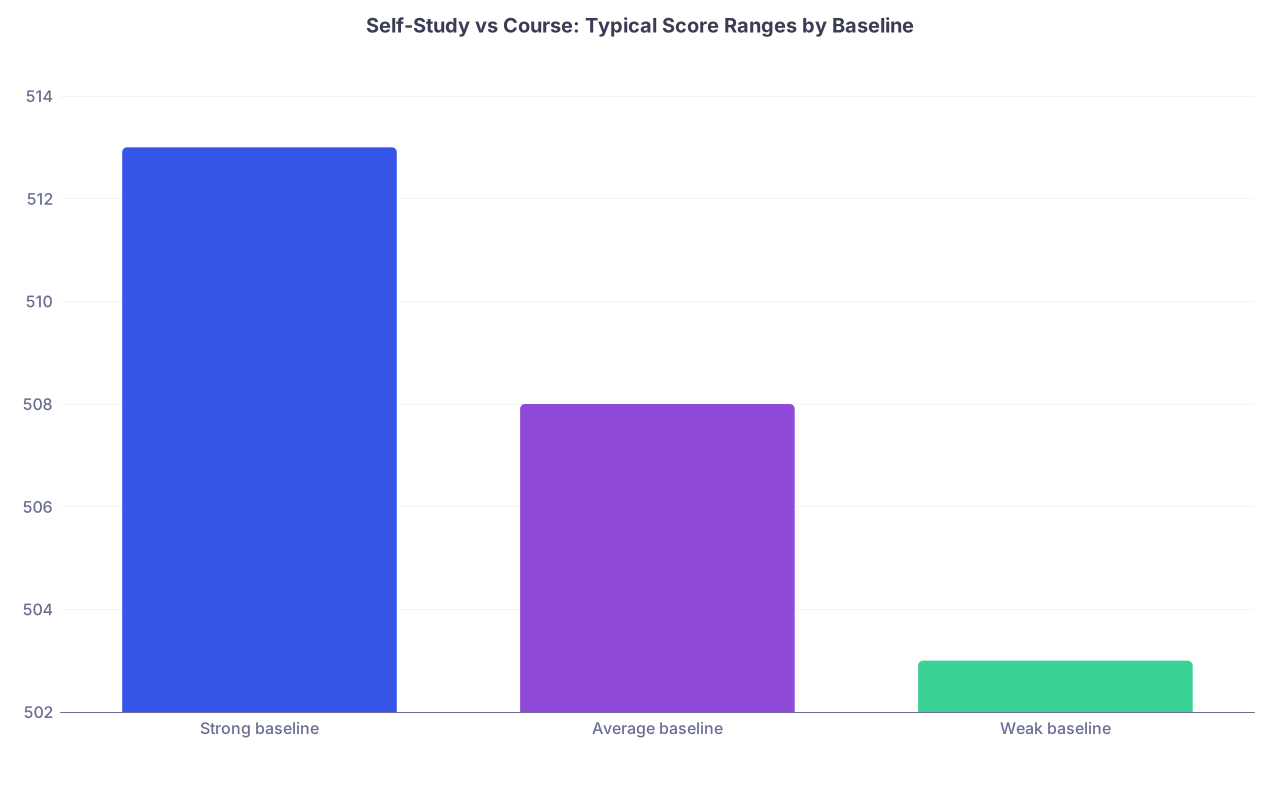
| Category | Value |
|---|---|
| Strong baseline | 513 |
| Average baseline | 508 |
| Weak baseline | 503 |
Interpretation (based on advising and survey data): with the same effort, students with a strong baseline often do just as well or better with self‑study, while those with weaker foundations sometimes gain more from structured course support.
You probably do better with self‑study if:
- Your GPA in science courses is strong (3.6+ in solid schools).
- You’ve self‑studied successfully for other big exams (APs, SAT/ACT) without hand‑holding.
- You naturally build to‑do lists and follow them without much external pressure.
- You’re already hitting ~505+ on diagnostics with zero or very light prep.
In that situation, a course often just slows you down and forces you to listen to explanations you could have read in 5 minutes.
You probably do better with a course if:
- Your first diagnostic lands below ~500 and you have no idea why.
- You keep “restarting” study plans and never make it past week 3.
- You’ve tried Anki decks and Qbanks but your scores haven’t budged because your review is shallow.
- You do better when you know, “Class is at 6 pm on Tuesday—be there.”
Even then, the course is a framework, not the full solution. If you don’t do the homework, don’t take the full‑lengths seriously, don’t show up to office hours with real questions, the course won’t save you.
Cost, ROI, and the Ugly Equity Problem
We have to talk money.
Commercial MCAT courses are expensive. $1,600–$3,000 is normal. Tutoring can easily hit $5,000+.
And yes, that creates inequity: wealthier students can buy structure and more practice questions. That matters more for those with weaker educational backgrounds.
But here’s the uncomfortable, evidence‑based truth: you can absolutely score in the 515–520 range using almost entirely low‑cost or free resources if you’re methodical.
I’ve seen:
- First‑gen students with no course, using only:
- AAMC bundle
- UWorld or Kaplan Qbank
- Free YouTube (Khan, AK Lectures, etc.)
- A handmade or shared Anki deck
end up at 517–521.
No magic. Just disciplined, boring repetition and ruthless post‑exam analysis.
If money is tight, your best ROI is usually:
- Buy the full AAMC bundle. Non‑negotiable.
- Add one solid Qbank.
- Maybe pay for a few hours of targeted tutoring near the end once your weaknesses are clear.
- Build or adopt a real schedule and stick to it like a job.
Spending $2,500 to avoid the discomfort of planning is not always smart. Sometimes it’s just anxiety with a receipt.
A Realistic Way to Decide (Without Lying to Yourself)
Forget what your friends did. Forget the marketing.
Here’s how I’d decide in the real world.

| Step | Description |
|---|---|
| Step 1 | Diagnostic MCAT |
| Step 2 | Structured self-study |
| Step 3 | Course or coach for structure |
| Step 4 | Self-study + free structure plans |
| Step 5 | Refine plan with practice data |
| Step 6 | Score >= 505? |
| Step 7 | Can you follow a self-made schedule? |
| Step 8 | Can you afford a course? |
Be brutally honest on two points:
- Am I actually good at sticking to my own plan for months?
- Do I want to take on the mental load of designing and adjusting that plan?
If yes, you probably do not need a full course. Structure your self‑study like a professional and you’ll be competitive with or ahead of course users.
If no, then paying for scaffolding can be rational—as long as you use it and don’t expect it to carry you.
Bottom Line: What Outcome Data Really Says
Strip it all down, and the data‑consistent story is this:
MCAT outcomes depend far more on hours, quality of practice, and discipline than on “course vs self‑study.” When you match for those, score differences mostly shrink.
Courses help people who lack structure, not those who already have it. If your main weakness is planning, accountability, and realistic pacing, a course can raise your ceiling. If you already excel there, a course often just repackages what you could assemble yourself.
High‑end scores are absolutely reachable via self‑study for motivated, organized students using AAMC materials plus a solid Qbank. Paying for a course doesn’t replace the hard, methodical work; at best, it organizes it. At worst, it distracts you from it.
FAQ
1. Do students who take MCAT prep courses score higher on average?
Slightly, but it’s mostly selection bias. Students who buy courses tend to be more motivated and often come from stronger academic or financial backgrounds. When you control for baseline GPA and total study hours, the advantage shrinks to a couple of points at most.
2. Is it realistic to aim for 515+ with pure self‑study?
Yes. If you have solid science fundamentals, are willing to put in 300–400+ hours of focused prep, and treat AAMC practice materials like gold—with detailed review and targeted follow‑up—515+ is entirely realistic without a course.
3. If I can afford it, should I just take a course “for safety”?
Not automatically. If you’re already self‑directed and sitting near or above 505 on diagnostics, a course may add more time cost than score benefit. In that case, you’ll usually get better ROI from buying AAMC materials, a strong Qbank, and possibly a few hours of targeted tutoring instead of a full course.