
Last cycle, a committee member tossed a file onto the table and said, “Another 522. If this kid isn’t a robot, they’re in.” Everyone laughed, but the decision wasn’t actually that simple. The score opened doors. The assumptions behind it did the real work.
You’re imagining that 520+ means they’ll love you on sight. That you become “auto-interview” or “auto-accept.” Let me tell you what actually happens behind those closed doors when faculty see that number on the screen.
The First 5 Seconds: What a 520+ Does (and Does Not) Do
Here’s the unpolished truth: a 520+ MCAT does not get you in.
What it does is stop the bleeding. It keeps your file out of the early reject pile and forces people to look at the rest of you.
At most schools, the first pass is brutal and fast. One faculty member with a spreadsheet or PDF list scrolls through applications and flags those worth deeper review. That first screen often looks like this:
- GPA
- MCAT
- State of residence / mission fit
- Obvious red flags (disciplinary actions, bizarre activities, etc.)
When they see 510–512, they squint and start cross-checking GPA. When they see 505, they’re asking, “Do we have a reason to keep this?” When they see 520+, something different happens: the burden of proof shifts.
Unspoken assumption: “This applicant can handle the academic side. I now have to find a reason not to invite them.”
At many mid-tier schools, a 520+ almost guarantees a careful read. At top-20 schools, it earns you a serious look—nothing more.
Now let’s pry open the assumptions that number triggers in the minds of faculty and admissions deans.
Assumption #1: “You’re very smart – so your weaknesses are now inexcusable.”
On paper, 520+ tells us this:
- You can process dense information quickly.
- You can tolerate high-pressure standardized testing.
- You had enough discipline to grind for months.
Faculty translate that into: “This person has the ability. So if I see sloppiness anywhere else, it’s not because they couldn’t do better. It’s because they didn’t care.”
This is where strong MCAT applicants get burned.
You think a 3.6 with an upward trend is “fine” because your score is stellar. On committees, I’ve heard:
- “If they can pull a 522, why are they getting Bs in upper-division bio?”
- “So they found discipline for the test, but not for actual coursework?”
They assume a gap between potential and performance is motivational, not intellectual. You don’t get the “maybe they had a hard semester” grace that a 505 applicant might get. Your score kills that excuse.
Let me be clear: a 520+ raises the standard for everything else:
- GPA inconsistency? Now it looks like laziness or poor judgment, not difficulty.
- Weak writing? Now it looks like you’re careless, not busy.
- Minimal leadership or community work? Now it looks like you made a deliberate choice to be one-dimensional.
When you’re “high stat,” they grade you harder, not softer. That surprises a lot of you.
Assumption #2: “You had advantages – prove us wrong.”
Nobody will say this into a microphone, but they say it in the committee room:
“522? Okay, who paid for their test prep?”
Fair? Not always. Real? Yes.
There’s an automatic mental association: 520+ → structured prep → resources. That might mean:
- Paid courses (Blueprint, Kaplan, Princeton Review, etc.)
- Access to private tutoring
- Ability to take several weeks/months off working to study
- Stable environment, quiet place, no major outside chaos
Does this hurt you outright? Not usually. But it changes the lens.
If your activities section looks like this:
- MCAT-focused gap periods
- Research with no clinical or service
- Minimal work history, no obvious financial responsibilities
Faculty start telling themselves a story: “This person has been optimized for metrics. How are they with real people? How do they handle adversity that isn’t academic?”
Here’s the part people don’t tell you: committees are not hunting for “genius.” They’re hunting for people who will not fall apart or become a problem in M3/M4 or residency. Emotional durability beats raw IQ every single time.
If you have a high score and a “protected” life story, readers will quietly look for:
- Sustained work in the real world (jobs that actually required showing up consistently)
- Evidence you’ve dealt with something harder than a Kaplan full-length
- Any hint that you can handle conflict, chaos, or failure without disintegrating
If everything in your file screams “carefully curated, never uncomfortable,” you’ll lose to a 514 with a more grounded track record more often than you think.
Assumption #3: “You’re gunning for prestige – so your school list will be risky.”
Here’s something ugly but true: faculty know high-MCAT applicants often make arrogant choices.
They’ve seen it year after year. The 522 who applied to 3 top-10s and 1 state school “for safety” and then ends up reapplying. The 520 who assumes the MCAT compensates for a thin service record and generic essays.
Faculty at “non-elite” schools actually assume this about you:
“You probably think we’re your backup. So if you come here, are you going to be toxic about it?”
If your secondary reads flat, generic, or clearly recycled, that assumption hardens:
- “They didn’t even bother to learn what makes this place different.”
- “They’re using us as insurance. Pass.”
Ironically, the higher your MCAT, the more they expect you to have options and the more suspicious they are that you actually want to be there.
You can counter that, but not with flattery. You counter it by:
- Referencing specific tracks, curricula, or community partnerships at that school that match your long-term goals
- Showing you understand the city, the patient population, the hospital system
- Making it clear—in plain language—that you would seriously attend if accepted
If you do that well, that 520+ flips from “flight risk” to “high-yield investment.” That’s when they start fighting for you.
Assumption #4: “You should be a strong test-taker forever – Step 1/2 included.”
Let me tell you what program directors actually care about, because med school faculty are already thinking like them.
They think: “Is this person going to protect or damage our Step score averages?”
Once you’ve shown them a 520+, they assume:
- You’ll pass exams the first time
- You’ll likely score well above average on Step 2
- If you don’t, something is seriously off
When a 520+ MCAT applicant later scores average or below on internal exams, faculty get nervous. That nervousness starts in admissions:
- “If they topped out on MCAT, will they plateau in med school?”
- “Did they over-prepare for one exam and burn out?”
- “Are they ‘good test-taker once’ or ‘sustainable performer’?”
Your narrative has to suggest sustainable performance, not a one-time stunt.
So, what signals “sustainable” to a faculty reader?
- A strong, consistent science GPA over several semesters, not one perfect 4.0 term
- Multiple demanding commitments balanced with good grades (e.g., 20 hrs/week of work plus full-time course load)
- Letters that explicitly say you manage high workload without drama
You want readers thinking: “This person has been operating at a high level for years, not months. We can count on them.”
Assumption #5: “You should understand the science – so we test your curiosity.”
Here’s a common debate around the table:
Faculty A: “Wow, 523. Bright kid.”
Faculty B: “Okay, but do they care about anything besides tests?”
At 520+, people no longer evaluate you on whether you can memorize glycolysis. They want to know what you do with that brain.
They expect to see one of two things, ideally both:
- Genuine intellectual curiosity
- Translation of knowledge into something useful
That means your file should not read like: “I got a 522 because I did 6,000 Anki cards and hid in a library for 8 months, full stop.”
They subconsciously look for proof that you think beyond the exam:
- Research where you can explain your actual contribution, not just the techniques or buzzwords
- Essays that talk about questions you wrestle with, not just outcomes you achieved
- Conversations (in secondaries or interviews) that show you can think from first principles, not just recite what Khan Academy told you
The fear with high scorers is always the same: “Is this person just a well-trained parrot?” If your writing sounds like Reddit posts stitched into paragraphs, you feed that fear.
Your MCAT score sets a bar. Your narrative must prove there’s a mind—and a human—above it.
Assumption #6: “You’ll be compared to other 520+ applicants – not to the whole pool.”
You’re not competing against the entire applicant pool. You’re competing most directly against the people who look like you on paper.
Faculty absolutely do mental comparisons:
“Okay, we’ve got three 521+ applicants from big-name universities. One did substantial community work, one has serious research, one has neither. Who do we spend our interview slot on?”
Among the 520+ crowd, the “extras” stop being optional. They’re differentiators.
Let me show you what I mean.
| Applicant Type | Committee Reaction |
|---|---|
| 521 + Strong service + Good research | "Rare, high priority" |
| 520 + Good GPA + Minimal service | "Replaceable, maybe interview" |
| 523 + Big-name school + Weak writing | "Suspicious, might screen out" |
| 520 + Non-traditional + Strong work history | "Interesting, worth discussion" |
You don’t get judged as “impressive compared to average applicants.” You get judged as “impressive compared to other 520s.”
The question in the room is rarely “Is this person qualified?” It’s “Is this person more compelling than the other high-stat applicants we could bring in instead?”
That changes how you should be building your application long before test day.
Assumption #7: “You’re at risk for being socially awkward or arrogant – prove us wrong.”
This one’s ugly but honest.
Plenty of committee members have scars from residents or med students who were incredible on paper and a disaster on the wards. They remember:
- The brilliant 260 Step scorer who couldn’t talk to patients like humans
- The “star” who went nuclear if they were not praised constantly
- The genius who melted down under feedback
So when they see 520+, some faculty immediately raise their defenses. The stereotype kicks in: smart, yes. Possibly arrogant, rigid, poor team player.
They go hunting for evidence either way.
Things that help you:
- Activities where you clearly worked within teams, not just as the “leader” of everything
- Letters that explicitly mention your humility, teachability, and interpersonal skills
- Essays where you admit to learning hard lessons without dramatizing or overselling the growth
Things that hurt you:
- Essays that sound like you’re above everyone else
- Activities framed as you “fixing” systems single-handedly with no acknowledgment of others
- A tone of entitlement—subtle, but obvious to experienced readers
When a faculty member says, “I like this applicant, they seem grounded,” that sentence carries a lot of weight in the final vote. Especially if your stats are high enough to trigger that initial suspicion.
What You Should Do Before You Ever Hit 520
You’re in MCAT prep mode, so let me drag this back to what you control now.
That score is a tool. It’s not your identity and it’s not your shield. If you’re aiming for 520+, you should be planning for the assumptions that will come with it, not just the number itself.
Here’s the mental model that works:
- Train like you’re trying to hit 520+
- Build an application like you assume 515
That means:
- Take your GPA dead seriously. A 3.5 with a 522 does not magically become a 3.8.
- Keep doing real-world things during MCAT prep if you can. Work, volunteer, stick with longitudinal commitments. Faculty love seeing you didn’t shut your life down completely for an exam.
- Invest in your writing. High scores with generic, clunky essays scream “test-taking machine.”
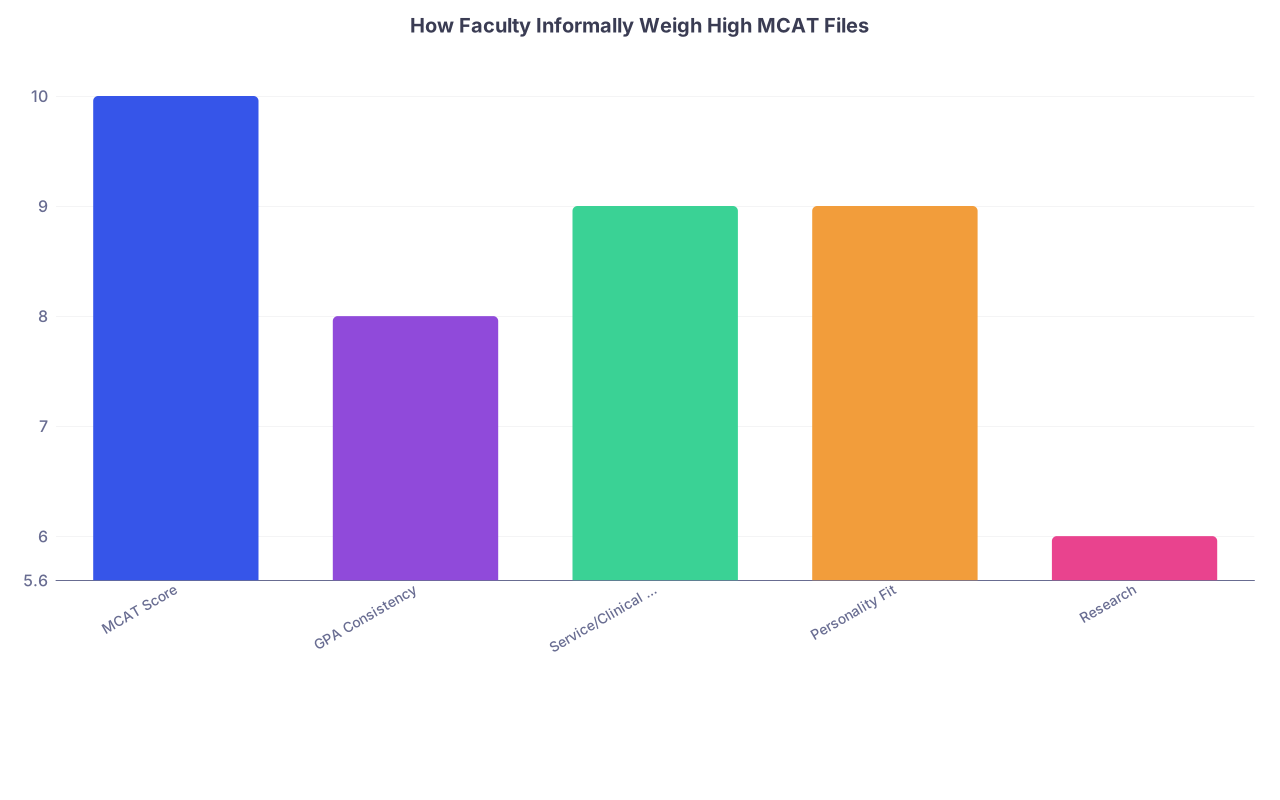
| Category | Value |
|---|---|
| MCAT Score | 10 |
| GPA Consistency | 8 |
| Service/Clinical Depth | 9 |
| Personality Fit | 9 |
| Research | 6 |
That chart isn’t from a policy document. It’s from watching discussions in real rooms. Once your MCAT clears a certain threshold, everything else starts to matter just as much—or more.
What Happens in the Room When They Debate You
Let me walk you through a composite case. This is very close to real conversations I’ve heard.
Applicant: 521 MCAT, 3.7 GPA, T20 undergrad, 1 year of bench research, some shadowing, limited sustained service, very polished but somewhat generic essays.
Faculty 1: “Stats look great. No concerns there.”
Faculty 2: “Yeah, but I don’t see much community engagement. Tutored other premeds and did a hospital volunteer gig for one semester. That’s it?”
Faculty 3: “Essays are fine but I don’t have a feel for who they are. Could interview, but they don’t jump off the page.”
Then they pull your file next to another applicant:
Applicant B: 515 MCAT, 3.9 GPA from a state school, 4 years working as a CNA, strong longitudinal free clinic involvement, thoughtful essays, LoRs rave about bedside manner.
Faculty 1: “Scores are lower, but this one feels like a slam dunk to succeed with patients.”
Faculty 2: “We already have plenty of 517–520s in the pool. I’d rather interview someone like this.”
Faculty 3: “If we have to pick one, I’d lean Applicant B. Safer bet for the kind of physician we want.”
You lose that head-to-head often. Not because 521 isn’t “good enough,” but because you didn’t give them a reason to care about you beyond the score.
FAQ (4 Questions)
1. Is there such a thing as “too high” of an MCAT score for some schools?
Not in the formal sense—no school is rejecting you because you scored 525. But some mid- and low-tier schools will assume you’re using them as backups and may be skeptical about yield. If your essays to those schools are lazy or generic, that suspicion gets confirmed and you slide down their priority list. A very high score without clear, sincere interest can absolutely work against you in terms of attention, even if they don’t say it out loud.
2. Will a 520+ compensate for a 3.4–3.5 GPA from a tough school?
Sometimes, but not reliably. At many schools, that combination triggers the “underperformed relative to ability” narrative. If you want this to work in your favor, the GPA needs an obvious upward trend, a plausible explanation, and strong evidence you’ve matured academically since those weaker terms. Post-bacc or SMP coursework with A-level performance helps more than just shrugging and pointing at the MCAT.
3. Do faculty care whether I used a commercial prep course to get my score?
They don’t care about which resource you used. They care more about what your file suggests about your environment and resilience. If your whole application screams “well-supported, well-resourced, but never tested outside academics,” that bothers some faculty. If you clearly held jobs, dealt with real responsibilities, and still scored 520+, that’s viewed far more positively. The presence or absence of a Kaplan receipt isn’t the issue—the life context is.
4. If I haven’t taken the MCAT yet, should I still aim for 520+ given all these assumptions?
Yes. The upside is still huge. It opens doors, earns serious reads, and can rescue you from some weaknesses. But you should be building out the rest of your application as if your score will be solid but not spectacular. Don’t pause life for a year just to chase a number. Grow the activities, relationships, and maturity that will let faculty look at a 520+ and think, “Strong mind, grounded person, worth investing in”—not “Another test-taking machine.”
In the end, faculty assume three things when they see a 520+ MCAT: you’re capable, you’ve had some advantages, and you should be exceptional across the board—not just on one exam. Use the score as a foundation, not a mask. If you pair that number with consistency, humility, and real human work, the same assumptions that can hurt you suddenly become your biggest asset.