
Last cycle, I sat in a conference room while an admissions committee quietly went through a spreadsheet of applicants. One column was highlighted bright yellow: “MCAT TOTAL.” You know what happened next. Files above an invisible number got discussion, nuance, second chances; files below it were never even opened.
Let me walk you through what actually goes on with MCAT cutoffs at top‑tier MD programs, not the polished nonsense they put on their websites.
The Lie of “No MCAT Cutoffs”
Every elite school says the same thing on their site: “We have no minimum MCAT requirement, we review applications holistically.”
Here’s the truth from inside the building: they do not call it a “cutoff.” They call it a “screen.” And it functions exactly like a cutoff.
Some internal realities:
- The volume is brutal. A top‑20 MD school might get 10,000–14,000 applications for 150–170 spots.
- Nobody is reading 14,000 full files. Not even close.
- The first pass is almost always numerical: MCAT and GPA.
I’ve watched the staff work through ERAS/AMP/Slate dashboards with filters like:
- “Show me applicants with MCAT ≥ 516 and GPA ≥ 3.7”
- Or “Flag any applicant with section below 125”
They still technically have no hard minimum, because if the Dean really wants to pull a 510 with a Rhodes Scholarship or Division I athlete record, they will. But for you, the normal applicant? There’s a line. And if you’re under it, your odds of being truly reviewed drop to near zero.
“Holistic” almost always happens after numerical screening. Not before.
The Real Number Ranges They Quietly Use
Let’s talk specifics. You want numbers, not slogans.
For top‑tier MD programs (think Harvard, UCSF, Penn, WashU, Columbia, Vanderbilt, Stanford, NYU), this is the unofficial landscape that admissions staff actually work with.
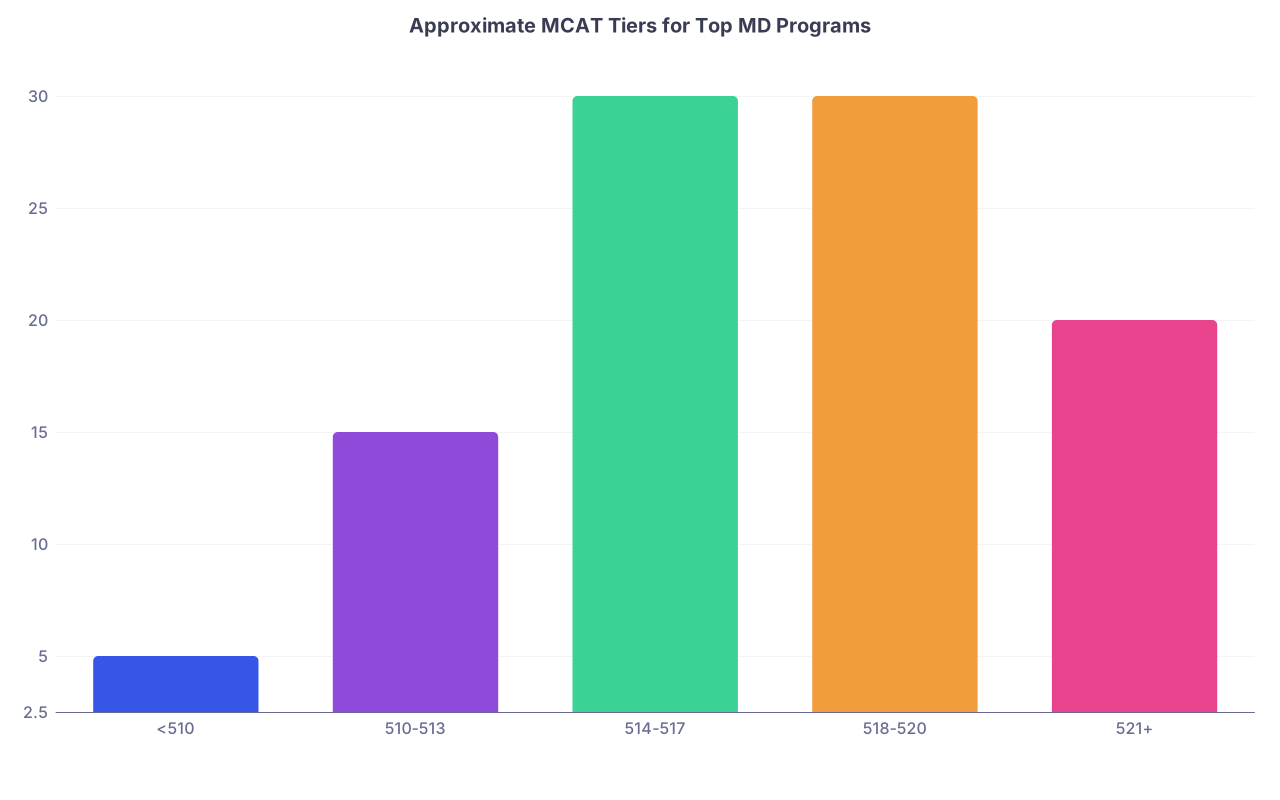
| Category | Value |
|---|---|
| <510 | 5 |
| 510-513 | 15 |
| 514-517 | 30 |
| 518-520 | 30 |
| 521+ | 20 |
Those percentages are a rough sense of how their interviewed/matriculated students cluster, not applicants. Now, here’s what those ranges usually mean behind closed doors:
Below 510: Essentially auto‑screened out unless you’re a very special institutional priority (recruited athlete, exceptional nontraditional with national recognition, etc.). For a typical applicant, this is dead in the water for top‑20 MD.
510–513: Strong for many mid‑tier MDs. At a top‑tier program, this range puts you into “only if the rest of the file is insane” territory—think published first‑author basic science, top‑tier institution, 3.9+ GPA, or very high‑value diversity or mission fit. And even then, it’s uphill.
514–517: This is the gray zone where “context” becomes everything. At many top‑20 schools, this tier gets real reads if your GPA and experiences are excellent and you fit something they need that year.
518–520: This is where they start to relax and actually read. You’re now solidly inside the typical band for top‑tier interviews if your GPA is ≥ 3.7 and your experiences are well‑developed.
521+: Now you’re in their comfort zone. This doesn’t guarantee anything, but on the back end, these are the app numbers that get starred during data summaries. Committees like to maintain or tick up their MCAT medians. You help them do that.
Do they ever take a 510 at an elite school? Yes. I’ve seen it. But it’s rare, and those applicants brought something explosive the school wanted badly.
Section Scores: The Quiet Deal‑Breakers
Here’s a mistake a lot of premeds make: they obsess over total score and ignore section imbalance. Admissions doesn’t.
I’ve sat in meetings where someone says, “Total is 519, but they have a 124 in CARS,” and the room shifts. Faces tighten. You can almost hear the mental red pen.
You need to understand that many top‑tier MDs have informal section expectations like:
| Component | Quiet Screen Threshold | Comfortable Range |
|---|---|---|
| Total | 513–515 | 518–522 |
| CARS | 125–126 | 127–129 |
| Chem/Phys | 125–126 | 127–129 |
| Bio/Biochem | 125–126 | 127–129 |
| Psych/Soc | 125–126 | 127–129 |
If any section is 124 or below, someone on the committee will bring it up. At some schools, anything under 124 in any section is flagged by the software and may keep you from even being reviewed unless someone advocates for you.
CARS especially gets extra scrutiny for a lot of top programs. Why?
Because they see CARS as a proxy for:
- Reading heavy, complex material
- USMLE vignette processing
- Clinical reasoning and communication
You could have a 522 with a 123 in CARS and be treated more skeptically than someone with a 517 and 128s across the board. I’ve watched it happen.
How Different “Top” Schools Quietly Treat MCATs
Not all top‑tier programs are identical. Their culture shapes how they use the MCAT.
Let me simplify some patterns I’ve seen repeatedly:
| School Type | Quiet MCAT Attitude | What They Secretly Prefer |
|---|---|---|
| Research Powerhouses (Harvard, UCSF, Penn, WashU) | Very numbers-conscious | 519+ with 3.8+, strong research |
| Prestige Clinical Giants (Columbia, NYU, Vanderbilt) | Slightly more flexible | 517+ if clinical/mission fit is superb |
| Public Flagships (UCLA, Michigan, UNC for in-state) | Two-tier screens (in/out-of-state) | In-state: okay with 513–515; OOS: 517+ |
| Mission-Driven (Einstein, Sinai, Pitt) | More holistic, still screened | 515+ if mission match is clear |
| B --> | Pass Screen | C[Staff Triage Read] |
| B --> | Fail Screen | D[Held or Auto-Hold] |
That first “Automated GPA/MCAT Screen” often looks like:
- Filter by total MCAT (e.g., ≥ 515 for out-of-state, ≥ 512 in-state)
- Filter by GPA (e.g., ≥ 3.5 overall, ≥ 3.4 BCPM)
- Flag any section below a threshold (e.g., 124)
If you fall below those, one of three things happens:
- You get auto‑sorted into a low‑priority queue that nobody meaningfully reads.
- You’re only looked at if you triggered a priority tag (URM, special program, institutional tie).
- Your file enters a “maybe if we need more applicants late in the cycle” pile — which they usually never get back to.
That’s the part premeds do not see. They think “I submitted, so someone reviewed my story.” Often, no. A filter saw your numbers; that was it.
Context: When a Lower MCAT Still Flies
Now let me not be lazy about this. There are consistent exceptions, but they follow patterns.
Here are the categories that most often break the quiet MCAT rules:
Exceptional Institutional Priorities
This includes things like:- Recruited athletes (yes, even for med school; you’d be surprised)
- MD/PhD applicants with staggering research and PI letters
- Children of high‑value donors or key faculty
- Pipeline program students promised consideration
Truly Extraordinary Stories with Proof
Not “I had a tough semester” level. I mean:- Refugees who supported families while working full time and still pulled a 510+
- Applicants with national‑level impact (real national advocacy, major startup, high-level publication)
- People who clearly faced structural barriers yet show sustained, documented excellence
In‑State or Regional Applicants at Public Powerhouses
A place like Michigan, UCLA, UNC, or UVA may drop MCAT expectations a bit for in‑state residents, especially those from underserved areas.
So a 512 from rural in‑state with great clinical work can be much more competitive than a 517 from out-of-state suburbia.
But here’s the harsh reality: most applicants think they belong in category 2. Very few actually do.
If your MCAT is clearly below a school’s median (say, 9+ points lower) and you cannot point to truly exceptional, documented reasons your performance underestimates your ability, you’re not an exception. You’re a long shot.
Using This Knowledge Strategically (Instead of Just Panicking)
Now for the part that matters: what you actually do with all this.
First, you need to understand your own risk profile relative to the silent cutoffs.
Look at it this way:
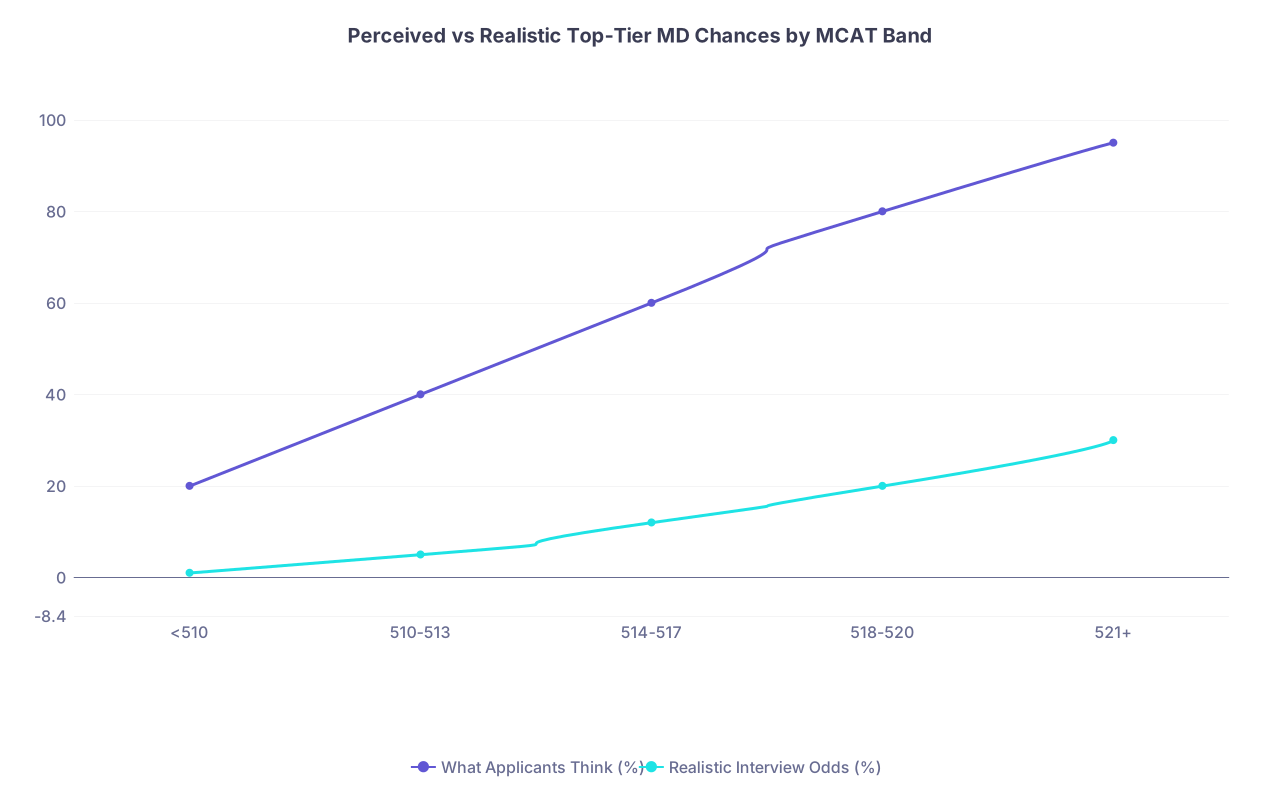
| Category | What Applicants Think (%) | Realistic Interview Odds (%) |
|---|---|---|
| <510 | 20 | 1 |
| 510-513 | 40 | 5 |
| 514-517 | 60 | 12 |
| 518-520 | 80 | 20 |
| 521+ | 95 | 30 |
People wildly overestimate their odds in the lower and mid ranges.
Here’s how to think like someone who has sat on the other side of the table:
If you’re below ~510: Do not waste applications on top‑20 MD programs. Spend your money on realistic targets and consider a retake if the rest of your profile is strong.
510–513: You can sprinkle 1–2 aspirational top‑tier apps if you have standout research or service, but your core list should be mid‑tier MD and some DO if GPA is weaker.
514–517: You’re in range where a smart application strategy matters hugely. Apply broadly to mid‑high MD, and only include top‑20 programs where your narrative strongly aligns with their mission and your GPA is strong (≥3.7, preferably higher).
518–520: Now you’re competitive for top‑tier with a solid application, but still not in “guaranteed review” territory. Application quality and school fit become the make‑or‑break.
521+: You’ve checked the admissions office’s favorite statistical box. Now the main risk is looking like a sterile numbers robot with nothing else going on.
MCAT Retake: What Committees Actually Think
I’ve heard this line from premed advisors too many times: “Don’t retake a 513, it’s good enough.” Sometimes that’s solid advice. Often it’s lazy.
Here’s what top‑tier committees actually say behind closed doors:
- “They went from 508 to 517. That’s a very different applicant.”
- “513 to 515? Eh. No real change.”
- “505 to 508 with the same weak sections — they probably maxed out.”
For top‑tier MDs, a retake only helps if it meaningfully changes the story. That usually means:
- An increase of 3–4+ total points and
- Elimination of any glaring section weakness (e.g., sub‑125 CARS up to 127)
If you’re sitting at a 511, 3.9 GPA, strong activities, and you know you underperformed on the MCAT — then yes, retaking with a realistic shot at 516+ could change your entire school list.
But if you’re at 515 with balanced sections and a 3.6 GPA, a retake to chase 520 is a vanity project. On our side of the table, we’re more likely to wonder why you didn’t spend that time improving the rest of your application.
Special Cases: MD/PhD, DO vs MD, and “Top-Tier or Bust” Thinking
You also need to understand where the MCAT bar moves depending on the track.
MD/PhD (MSTP) Programs
These places are MCAT‑conscious in a slightly different way. They’ll sometimes stretch for a 514–516 if the research is outlandishly strong and letters are glowing, but they also drool over 520+ with first‑author pubs.
If you’re aiming for fully funded MSTP at a place like WashU or Penn, a 510–512 is not a “strong” score, it’s a liability that forces them to justify you to the NIH and their own faculty.
DO vs MD
Blunt truth: a 507–510 that’s marginal for MD can be quite solid for DO, especially with a strong upward academic trend and good clinical work. If you’re lingering in the low 500s and spending $2,000 applying to top‑20 MDs, you’re not being “ambitious,” you’re setting money on fire.
“Top-Tier or Bust”
I’ve watched 512/3.8 applicants shut themselves out of MD entirely by applying to 12 reach programs and 0 realistic ones. A 512 won’t impress Harvard. It might be loved by a very solid state MD program that’ll train you well and get you anywhere you want.
Residency directors care much more about your performance in medical school and on Step exams than whether your diploma says “Top 10.” This obsession with rank is mostly premed neuroticism, not real‑world necessity.
How to Read a School’s MCAT Stats Like an Insider
Last piece of the puzzle: how you interpret the numbers schools do publish.
Here’s how the admissions office actually uses their class MCAT medians:
- They track how this year’s applicants compare to prior cycles.
- They monitor whether offered students will maintain or bump that median.
- They get twitchy about offering too many spots to people below that median early in the cycle.
So if a school reports:
- Median MCAT: 520
- 10th–90th percentile: 515–524
You need to understand: a 515 isn’t their “minimum.” It’s the bottom 10% of the people they already accepted, which likely includes special cases and high‑priority admits.
If you’re at 515 and otherwise average, you’re not “within their range” in any meaningful way. You’re at the edge of what they very selectively allowed in.
Same logic for a school with:
- Median 518, 10th–90th percentile 513–522
If your MCAT is 513 and you don’t bring something their Dean crowed about in a newsletter, you’re a technical, not practical, fit.