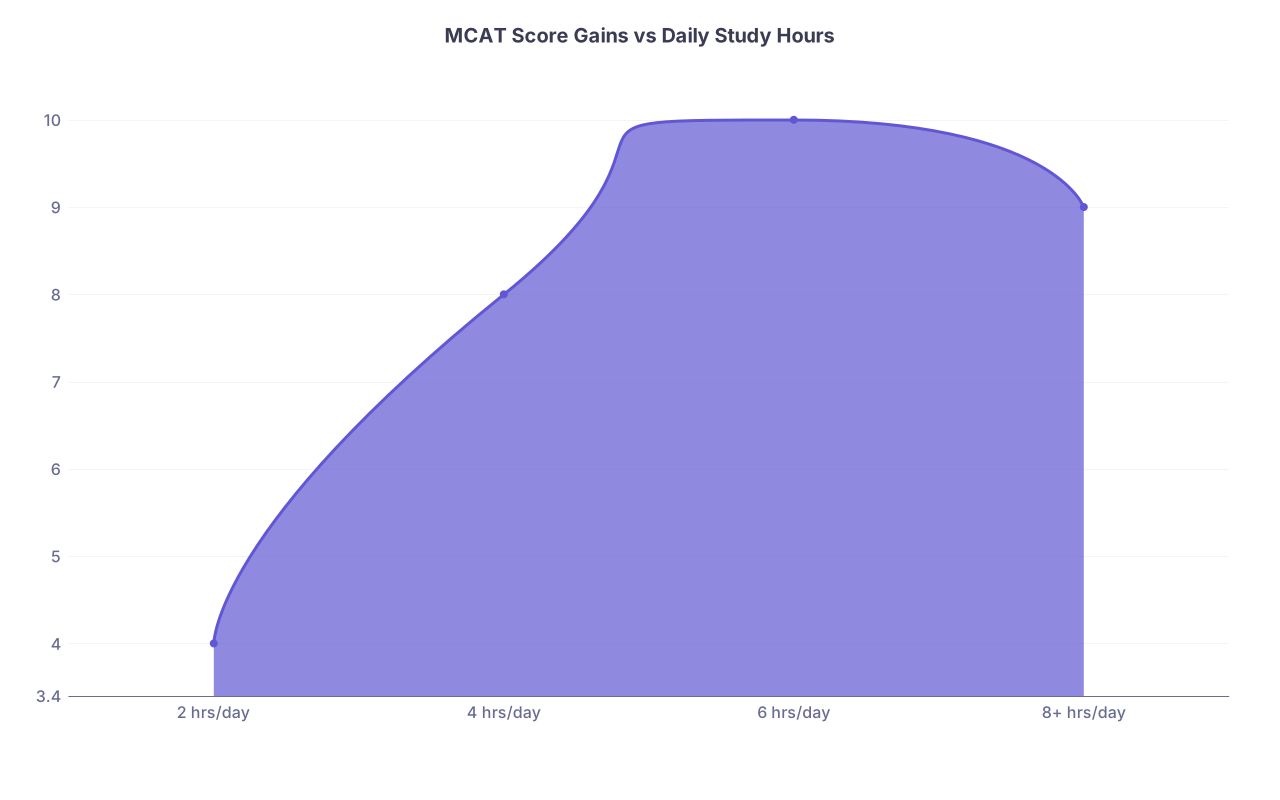
The way most students “annotate” MCAT passages is a waste of time.
They either underline everything, scribble random notes, or worse, read passively and then wonder why the questions feel like they came from a different passage. The MCAT’s dense science texts are engineered to punish unfocused reading.
You do not need generic “active reading.” You need a repeatable mapping system that turns any dense passage into a structured mental model you can query in seconds.
That is what passage mapping is for. And it is much more specific than “take notes.”
What MCAT Passage Mapping Actually Is (And Is Not)
Let me be precise.
Passage mapping = building a rapid, low-friction reference system while you read, so that:
- You know the big picture of what each paragraph is doing.
- You can locate details quickly without re-reading the entire passage.
- You maintain a mental model of relationships: cause/effect, variable interactions, experiments, and author’s argument.
It is not:
- Highlighting every “important sounding” word.
- Copying definitions and equations into the margin.
- Slowing down to make “pretty notes.”
On a timed exam, over-annotation is self-sabotage. The goal is to extract structure, not decoration.
For MCAT science passages (C/P and B/B), an effective mapping system must do four things, reliably:
- Identify the passage type quickly.
- Assign a role to each paragraph.
- Track variables, relationships, and experiments.
- Mark anchors so you can jump back to exact lines when a question hits.
Once you have that system, the passage stops being a wall of text. It becomes a blueprint.
Step 1: Classify the Passage Before You Dive In
You cannot map correctly if you do not know what you are mapping.
Spend 5–8 seconds at the top scanning for structure clues. Not reading every word. Scanning.
Look for:
- Figures and tables → experimental/ data-heavy
- Equations, variables, proportional language → mechanistic/quantitative
- Historical references, names of theories, debates → argumentative/theory
- Clinical case descriptions, patient data → applied/clinical scenario
Then tag it mentally (or with a tiny note at top of scratch).
Common science passage archetypes:
Mechanistic / Conceptual
- Focus: how a process works, relations between variables, pathways, mechanisms.
- Cues: “increases,” “decreases,” “proportional,” “inversely,” “mediated by,” “pathway,” “stepwise.”
-
- Focus: one or more experiments, methods, results, and interpretation.
- Cues: “We tested…,” “Subjects were…,” “Group A vs Group B,” “measured,” “control,” “randomly assigned.”
Hybrid Mechanism + Experiment
- Common in B/B: first half explains a pathway; second half runs an experiment on it.
Argument / Theory (more common in psych/soc but shows up in C/P/B/B)
- Focus: presenting and evaluating explanations, hypotheses, or models.
You do not annotate differently just to feel special. You annotate differently because the questions will target different things:
- Mechanistic passages → concept and relationship questions.
- Experimental passages → “What was the purpose of…”, “Which conclusion is supported…”.
- Hybrid → mix of both, often with a trap: changing one variable in context of both theory and data.
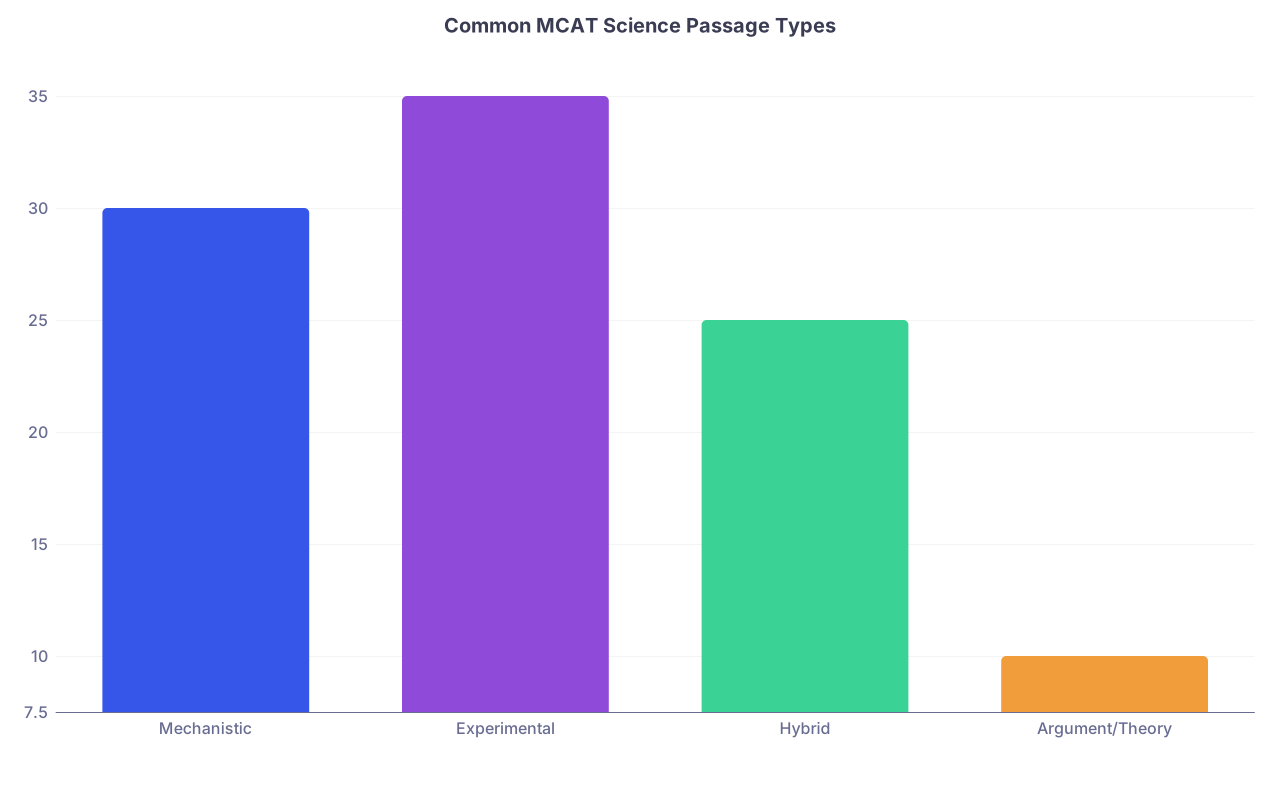
| Category | Value |
|---|---|
| Mechanistic | 30 |
| Experimental | 35 |
| Hybrid | 25 |
| Argument/Theory | 10 |
These percentages are approximate, but the pattern holds: if you cannot spot which kind you are in, you will misread what the test is actually asking.
Step 2: The Paragraph Role System (The Backbone of Mapping)
Every paragraph in a well-built MCAT passage is doing a job. Your passage map is basically a list of those jobs.
Forget complex symbols. You only need a small consistent set of paragraph role tags.
I like a 6–7 role system:
- BG – Background / context
- Q – Research question / hypothesis / problem statement
- M – Methods / design
- R – Results / data description
- INT – Interpretation / explanation of results
- MECH – Mechanism / process explanation (if distinct from simple background)
- APP – Application / implication / future direction
You are not writing these in full sentences. You are using tiny labels to the left of each paragraph in your scratch area, ideally with a line number or quick keyword.
Example scratch layout for a 5-paragraph experimental passage:
- P1 – BG: obesity + insulin resistance; known issues
- P2 – Q/MECH: propose gut hormone X involvement
- P3 – M(Exp1): mice, knockout vs wild-type, fasting glucose
- P4 – R(Exp1): KO → higher glucose; graph
- P5 – INT/APP: hormone X protective; human therapy?
This takes < 20 seconds as you read. And it changes everything when you hit the questions.
Why? Because most questions are about roles, not raw sentences.
- “Based on the experiment described in the third paragraph…” → you jump to M(Exp1).
- “Which of the following is the most reasonable explanation for…” → that is INT.
- “What is the primary claim of the author?” → BG + Q + INT/APP synthesis, not some random detail.
Let me be clear: if your current “strategy” is just underlining phrases and hoping your brain remembers structure, you are playing on hard mode.
Step 3: Sentence-Level Mapping – Minimal but Targeted
You do not have time to summarize every sentence. You also do not need to.
Inside each paragraph, you want to identify anchors:
- The topic sentence or controlling idea.
- Any key transitions: “however,” “in contrast,” “surprisingly,” “unlike,” “consistent with.”
- Any critical variables and their directionality: “as X increases, Y decreases.”
Your job while reading is:
- Mentally paraphrase the topic sentence in 3–5 words.
- Note any sharp turns (contrast, exceptions, surprising results).
- For experiments, tag:
- Independent variable (what was manipulated / grouped).
- Dependent variable (what was measured).
- Controls / comparison group.
You can jot ultra-short notes in your scratch:
- “P3 – Exp1: KO vs WT; IV: genotype; DV: fasting glu; 4wks HFD”
That looks dense on paper but in practice you abbreviate ruthlessly: “KO vs WT; glu; 4w HFD.”
What you absolutely do not do is try to write full explanations. The passage already has those. Your map exists to help you relocate and structure, not to duplicate.
Step 4: A Concrete Walkthrough – Mapping a Sample Science Passage
Let me walk you through what this looks like in real time.
Imagine a B/B passage roughly like this:
- P1: Discusses Alzheimer’s disease, amyloid-beta plaques, and current theories of neurodegeneration.
- P2: Introduces a new hypothesis that microglial activation contributes to neuronal loss and describes a proposed signaling pathway.
- P3: Describes Experiment 1: wild-type vs microglia-deficient mice injected with amyloid-beta; outcome = extent of neuronal loss after 4 weeks.
- P4: Describes Experiment 2: wild-type mice treated with a drug that blocks pathway receptor vs placebo; outcome = memory test performance.
- P5: Concludes that microglial signaling is necessary for full neuronal degeneration and suggests targeting this pathway therapeutically.
Here is how I would map it, paragraph by paragraph.
Before reading fully:
Quick scan: I see “Experiment 1,” “Experiment 2,” figures referenced, receptor names, outcomes. This is Hybrid: Mechanism + Experimental.
Now paragraph roles:
P1 – BG
Scratch: “P1 BG: AD, Aβ plaques, classical theories (direct tox).”Key idea: classical view = amyloid-beta directly toxic to neurons.
P2 – MECH + Q
Scratch: “P2 MECH/Q: microglia activation pathway; hyp: Aβ→microglia→degeneration.”Tag variables: amyloid-beta, microglia, receptor X, inflammatory mediators.
P3 – M (Exp1) + setup for R
Scratch: “P3 M(Exp1): WT vs microglia-deficient, inject Aβ, measure neuron loss (4w).”Identify IV = genotype (WT vs microglia-deficient). DV = neuronal loss.
Expectation: If microglia are needed, KO (deficient) mice → less neuronal loss.P4 – M+R (Exp2)
Scratch: “P4 M/R(Exp2): WT only; receptor blocker vs placebo; DV memory test; blocking improves performance.”Note the direction: drug → better memory → supports role of that pathway in pathology.
P5 – INT + APP
Scratch: “P5 INT/APP: microglial signaling necessary for full degeneration; therapy target.”
Five short lines. Under 30 seconds total if you are comfortable. Now watch how this pays out with typical questions.
Question 1: “Which of the following is the most likely purpose of Experiment 1?”
You already know P3 = M(Exp1). Purpose: test whether microglia are necessary for Aβ-induced neuronal loss. Easy.
Question 2: “The results of Experiment 2 support which of the following conclusions?”
You know P4 = M+R(Exp2). You do not reread the entire passage. You go straight to P4, skim results, connect them back to the hypothesis in P2, and answer.
Question 3: “Based on the passage, which of the following, if true, would most weaken the authors’ conclusion?”
You know this is about INT in P5. You look for answer choices that undermine the causal chain: maybe the drug has independent neuroprotective effects beyond microglia, or the receptor is expressed in neurons themselves and not just microglia.
Without the map, students flail around between P2–P5, reread huge chunks, and still get lured into trap answers.
With the map, you know exactly where each kind of information lives.
Step 5: Visual Anchors – How to Handle Figures and Tables
MCAT science passages love figures. Most students stare at them and then ignore half the information.
Your passage map must integrate figures into the structure. Not as an afterthought.
When you see a figure, you ask:
- Which experiment / concept does this belong to? (P3? P4?)
- What is on each axis? Units? Categories?
- What is the pattern direction? Up, down, no change, comparison.
Then, on scratch:
- “Fig1 – Exp1: KO < WT neuron loss”
- “Fig2 – Exp2: block > placebo memory score”
You do not redraw graphs. You annotate relationships.
For dense tables (e.g., multiple conditions, multiple variables), mark:
- What the rows represent.
- What the columns represent.
- Where the extremes are (highest/lowest).

Half the questions tied to figures are something like, “Compared to Condition A, Condition B shows…” – which is trivial if you already mentally tagged the pattern while reading.
Step 6: Timing, Pacing, and How Much Mapping Is Too Much
Let’s be blunt. If your mapping makes you run out of time, it is wrong.
A good target for science sections:
- Passage read + initial mapping: ~3–4 minutes.
- Questions: ~5–7 minutes.
- Total per passage set: ~9–11 minutes.
That seems tight, but once mapping becomes automatic, 3–4 minutes is realistic. Early in prep, you will be slower. That is fine. You are building the skill.
What kills timing?
- Writing full-sentence summaries.
- Over-highlighting.
- Drawing elaborate diagrams.
- Re-reading paragraphs three times during the first pass.
The map should feel lightweight:
- 1–2 words for paragraph role.
- One short line per paragraph with key nouns/variables.
- Tiny notes for each figure.
If your scratch looks like mini-essays, you are doing it wrong.
Here is a simple sanity test:
On a random science passage, cover the text. Look only at your scratch map. You should be able to say out loud, in 20–30 seconds:
- What the overall passage is about.
- What each paragraph does.
- What each experiment tested and measured.
- The rough direction of main results.
If you cannot, either your mapping is too vague, or you did not actually understand the passage.
Step 7: Section-Specific Tweaks (C/P vs B/B vs Psych/Soc)
The core system stays the same, but you adjust what you pay attention to.
Chemical and Physical Foundations (C/P)
C/P passages tend to be more equation- and relationship-heavy.
Your mapping focus:
- Identify core equation(s) or principle (e.g., Bernoulli, Ohm’s law, pKa, Sn1 vs Sn2).
- Pinpoint where qualitative comparisons live: “increasing radius,” “decreasing pressure,” “doubling concentration.”
- Note any limiting assumptions: “ideal gas,” “neglect friction,” “assume laminar flow.”
On scratch, you might add a small “EQ” section:
- “EQ: P1V1 = P2V2; laminar; Q ∝ r^4”
Then tie each experiment or scenario back to that relationship.
Biological and Biochemical Foundations (B/B)
B/B loves mechanisms and pathways.
Mapping focus:
- Pathway structure: A → B → C, with which step is regulated.
- Type of regulation: upregulation/downregulation, positive vs negative feedback.
- Experimental manipulations: knockout, overexpression, inhibitor, activator.
You can sketch extremely crude arrows:
- “P2: Pathway – ligand → receptor → kinase A → TF → gene X”
But do not draw a work of art. Just enough to not confuse A and B later.
Psych/Soc (for comparison)
Psych/Soc passages are more argumentative/theory heavy, but the same role system works:
- BG (context), Q (problem), MECH/THEORY, M/R/INT, APP.
Here, your “variables” are often constructs: SES, social capital, conformity, operant conditioning. You map how the author links them.
Step 8: Practicing Passage Mapping Deliberately (Not Randomly)
You cannot bolt this system on the week before your exam and expect it to work. The brain hates new workflows under pressure.
You need a short, deliberate practice phase where mapping is the focus, not your score.
Here is a concrete 2–3 week drill structure:
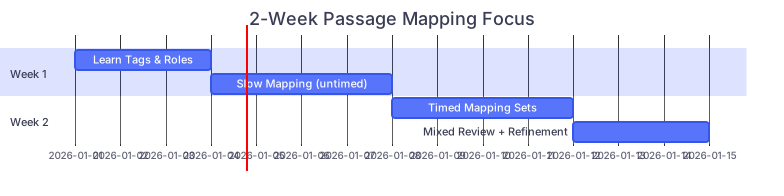
| Task | Details |
|---|---|
| Week 1: Learn Tags & Roles | a1, 2026-01-01, 3d |
| Week 1: Slow Mapping (untimed) | a2, 2026-01-04, 4d |
| Week 2: Timed Mapping Sets | a3, 2026-01-08, 4d |
| Week 2: Mixed Review + Refinement | a4, 2026-01-12, 3d |
Phase 1 (Days 1–3): Learn the role system
Take 3–5 random old passages (AAMC Section Bank, old FLs you are not using for score anymore). Ignore timing. Read, then:
- Label each paragraph with BG/Q/M/R/INT/MECH/APP.
- After finishing, check yourself: could any paragraphs be tagged more precisely?
Phase 2 (Days 4–7): Slow mapping, full detail
1–2 passages a day, still largely untimed, but aim for:
- Complete paragraph-role tagging.
- Short notes on IV/DV for each experiment.
- One-line figure annotations.
Do not care about your % correct yet. Care that your notes let you reconstruct the passage.
Phase 3 (Week 2): Timed mapping sets
Now you move to exam-like conditions:
- 2–3 passages per sitting, with real timing.
- Use the full mapping system, but force yourself to keep notes ultra-short.
- After each set, review:
- Did your map actually help you on questions?
- Where did you still feel lost?
- Are you over-writing anywhere?
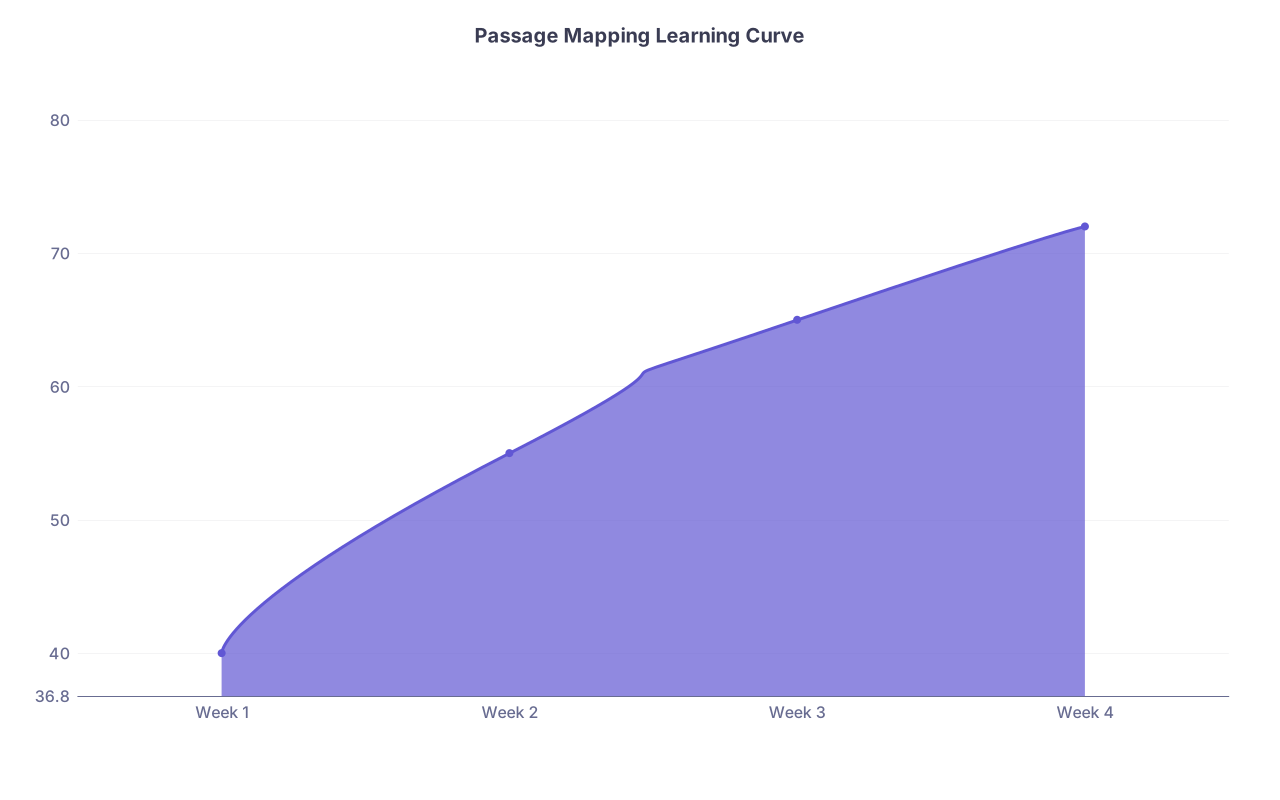
| Category | Value |
|---|---|
| Week 1 | 40 |
| Week 2 | 55 |
| Week 3 | 65 |
| Week 4 | 72 |
That “score” here is not your MCAT scaled score, but your percentage of questions where you explicitly used your map to answer confidently. You want that going up.
Once mapping is baked in, you stop thinking “now I will map this passage.” You just do it.
Step 9: Adapting the System to Digital-Only AAMC Interface
One more reality check: the actual MCAT is on a screen. No marking up the passage itself. You get laminated sheets and a marker.
So practice the way you will play.
On your scratch, you can use a standard template for each new passage:
- Top line: Passage #, Type (Mec/Exp/Hybrid), Section (C/P or B/B).
- Down the left side: P1–P6 with roles and 3–5 word notes.
- Bottom corner: tiny space for key equations/pathway arrows.
Something like:
Psg 3 – Hybrid – B/B
P1 BG: AD, Aβ, classical theory
P2 MECH/Q: microglia path hyp
P3 M: Exp1 – WT vs KO; neuron loss
P4 M/R: Exp2 – block vs placebo; memory
P5 INT/APP: microglia needed; therapy
You are not replicating the screen. You are building a lookup index.

Train with that exact structure repeatedly. On test day, it should feel routine, not experimental.
Step 10: Common Mapping Mistakes That Tank Performance
Let me call out the most frequent self-sabotaging habits I see.
The Highlighter Addict
They highlight half the passage, color-code by “importance,” but have no idea which paragraph did what. This is not mapping. This is decoration.The Transcriber
Writes long, pretty notes line-by-line. Ends up re-writing the passage on scratch and still misses the main idea. The MCAT is timed. You are not in a literature class.The Structure-Denier
Reads everything equally, never asks “why is this paragraph here?”
These students are perpetually surprised by questions that refer to “the author’s main hypothesis” because they never tagged it.The Over-Engineer
Creates a system with 20 symbols, five colors, and special marks for every concept type. It collapses under real conditions. Keep it brutally simple: roles, variables, experiments, results.The No-Review Practitioner
“Practices” mapping but never compares notes to performance. If you are not checking which parts of your map you actually used, you are just going through motions.
A Simple Comparison: Random Reading vs Structured Mapping
| Aspect | Random Reading | Structured Passage Mapping |
|---|---|---|
| Paragraph awareness | Vague or none | Clear role for each paragraph |
| Figure use | Superficial or skipped | Labeled, tied to specific experiments |
| Question return time | Long (re-reading whole passage) | Short (jump to mapped paragraph/figure) |
| Cognitive load | High, chaotic | Organized, predictable |
| Consistency across sets | Variable | High once system is internalized |
If your current approach looks like the left column, you are leaking points you do not need to lose.
Where This Fits in Your Overall MCAT Prep
Passage mapping is not a magic trick. It is infrastructure.
It supports:
- Content recall: by giving new information a clear “home” in your mental model.
- Question strategy: by making it obvious what information type you should use for each question.
- Timing control: by reducing re-reading and random scanning.
You still need content knowledge. You still need to drill question types. But without a clean mapping system, your performance will be wildly inconsistent.
With it, even brutally dense science passages become something you can systematically break down.

You are not trying to “feel good” while reading. You are trying to interrogate the passage, label its parts, and build a map you can actually use.
Do that consistently over weeks, and your relationship with dense science texts will look very different.
FAQ (Exactly 5 Questions)
1. How many words should my passage map notes be per passage?
For most science passages, you want roughly 5–10 short lines on scratch total, not per paragraph. Each paragraph gets a role tag and a tiny 3–7 word summary. Figures get a 3–5 word relation note (e.g., “KO < WT glucose”). If you are writing more than that regularly, you are overdoing it and will feel time pressure.
2. Should I ever skim or skip mapping on “easy” passages to save time?
No. The danger is not that the passage is easy. The danger is that you misjudge it. The mapping system is lightweight enough that it should apply to every passage. What changes is your depth of engagement: on simpler passages, your map might be extremely minimal (just roles + 1 word each), but you keep the structure consistent so you do not have to decide on the fly when to use it.
3. How do I handle passages with 7+ paragraphs where roles seem to repeat?
In longer passages, roles often stack: you might get BG → MECH → MECH → M(Exp1) → R(Exp1) → M(Exp2) → R(Exp2) → INT. When roles repeat (e.g., two methods paragraphs), distinguish them with subscripts or keywords: “M1: in vitro; M2: in vivo.” The goal is that when a question references “the second experiment,” you know exactly which P# and which scratch line to look at.
4. What if I feel mapping is slowing me down and I am running out of time?
Early in learning, it will slow you down. That is normal. Measure two things during practice sets: 1) time per passage and 2) how often your map directly helps you answer questions quickly. If your map is long but rarely used, cut it down. If it helps often but you are slow, keep using it; speed will rise as the process becomes automatic. Do not judge the method based on the first week of clumsy execution.
5. Which resources are best for practicing passage mapping specifically?
Use high-fidelity, dense passages. The AAMC Section Bank (especially C/P and B/B) is brutal but ideal. Older AAMC full-lengths are excellent too. Some third-party resources (e.g., the denser Kaplan or Blueprint passages) can be useful for volume, but always cross-check: if their passage style is too far from AAMC, prioritize official material for refining your mapping under realistic language and structure.
With this mapping system in place, your next step is to integrate it into full-section practice and then full-length exams, so it operates under real fatigue and time pressure. That is where you see whether your blueprint holds under stress. The transition from isolated passages to integrated test-day performance—that is the next layer.