What if I told you the guy who went from 124 to 129 on CARS in eight weeks didn’t “become smarter” — he just stopped doing what most people do?
Let’s tear this apart properly. Because the myth that CARS is some mystical, innate talent has probably sabotaged more MCAT scores than any other belief.
You hear it constantly:
- “I’ve always been bad at reading.”
- “CARS is pure instinct — you either have it or you don’t.”
- “You can’t really study for CARS, just do more passages.”
That’s not just wrong. It’s lazy. And it gives you an excuse to quit.
What the Research Actually Says About Reading Ability
Start with the core claim: “CARS is innate, you can’t train it.”
CARS is basically a test of three things:
- Reading comprehension of complex, often unfamiliar texts
- Reasoning about arguments, evidence, and tone
- Working memory and attention under time pressure
Now, look at what decades of cognitive science and education research show.
1. Reading comprehension is trainable — even in adults
You’re not a blank slate, and you’re not fixed either. Multiple studies show adults do improve with targeted, deliberate practice.
- The National Reading Panel (classic work in literacy research) showed that explicit instruction in comprehension strategies significantly improves performance — even in older students, not just kids.
- Meta-analyses on “strategic reading instruction” find medium-to-large effect sizes for teaching people how to:
- identify main ideas
- track argument structure
- monitor their own comprehension
- infer what’s implied but not stated
That’s exactly what CARS is testing.
In other words: the core cognitive skills behind CARS are highly trainable.
2. Working memory and reasoning can be improved — indirectly
No, you’re not going to double your IQ in three months. But reasoning performance on specific tasks? Very improvable.
- Training in argument analysis (think LSAT-style logic or philosophy courses) has been shown to improve critical thinking tests scores. Not because people got “smarter,” but because they learned patterns of reasoning and what to look for.
- When people are trained to chunk information — grouping bits into larger, meaningful units — their effective working memory on that task increases. On CARS, that means chunking paragraph ideas and argument steps.
Again: that’s trainable.
3. “Innate verbal ability” does matter — but less than people think
There are baseline differences:
- Kids who read more growing up build stronger vocab, background knowledge, and “reading stamina.”
- People with stronger early verbal scores tend to start higher on tests like CARS, LSAT, GRE Verbal.
But here’s where people twist the data. Yes, verbal aptitude predicts where you start. It doesn’t set a hard limit on where you can end up with focused practice.
If you’re starting at 122 on CARS, you’re not doomed. You’re just further behind on skills you were never taught properly.
Why CARS Feels Innate (And Why That Feeling Is Misleading)
I’ve watched this play out in study groups, office hours, and online forums. The students who insist “CARS is innate” almost always have three things in common:
- They treat CARS like content, not a skill.
- They only “practice” by doing more passages, not by analyzing their thinking.
- They confuse plateaus with limits.
Let’s break those.
Treating CARS like content is a trap
You can’t memorize your way through CARS. There’s no Anki deck that gives you “Main Idea Recognition +3.”
If your “CARS studying” looks like this:
- Doing 3–4 passages
- Checking answers
- Reading explanations
- Moving on
…you’re not training a skill. You’re doing drills with no coaching.
Skill training looks different:
- Slowing down to reconstruct: “What exactly is the author arguing? How do I know?”
- Tracking: “Why did I pick this answer? What was my chain of thought?”
- Labeling errors: “Was this a misread, a logic problem, or a time-pressure panic?”
Most people never do that. Then they declare: “See? I just don’t have it.”
“More passages” is not the same as deliberate practice
The research on skill acquisition — in music, chess, athletics, you name it — is brutal on this point.
- Mindless repetition has weak effects.
- Deliberate practice, with feedback and error-focused review, drives most of the improvement.
CARS is no exception. I’ve seen people do 500+ passages and barely move. I’ve also seen others do 120 passages with ruthless review and jump 4–5 points.
The variable wasn’t talent. It was how they practiced.
Plateaus are typical, not proof of a ceiling
Skill learning is usually stepwise, not linear. Plateau. Jump. Plateau. Jump.
This is true for:
- Piano sight-reading
- Running speed
- Language fluency
- And yes, reading dense, abstract passages under time pressure
You hit a plateau → your brain consolidates → you suddenly “get” something deeper about argument structure or wrong-answer patterns → your performance jumps.
People who think CARS is innate hit their first plateau and assume that’s their ceiling. So they stop doing the only thing that would break the plateau: targeted adjustment.
What CARS Is Actually Measuring (Beyond the Buzzwords)
CARS is not a magical “verbal reasoning aura” test. It’s a structured exam with predictable cognitive demands.
Let’s name them:
Macro-comprehension:
Can you summarize the passage in 1–2 sentences? Can you say what the author really cares about?Micro-comprehension:
Do you track sentence-level logic? When the author says “however,” do you actually register the shift?Argument structure detection:
Can you separate:- claims
- reasons
- evidence
- counterarguments
- concessions
Inference and implication:
Can you answer, “Given what the author believes, what would they probably say about X?”Author attitude and tone:
Is this approving, skeptical, sarcastic, neutral, cautiously supportive?Task understanding:
Are you actually answering the question asked, not the one you wish they asked?
All of these can be trained. Ideally with passage work, but you can strengthen them outside the MCAT too — with philosophy texts, editorials, essays, LSAT-style problems.
What the Data from Real Test-Takers Shows
Program directors and prep companies that track thousands of students aren’t going to publish all their raw data, but there are consistent patterns people inside this world see over and over.
Here’s the rough distribution I’ve seen from multiple large cohorts (and it matches what tutors quietly talk about):
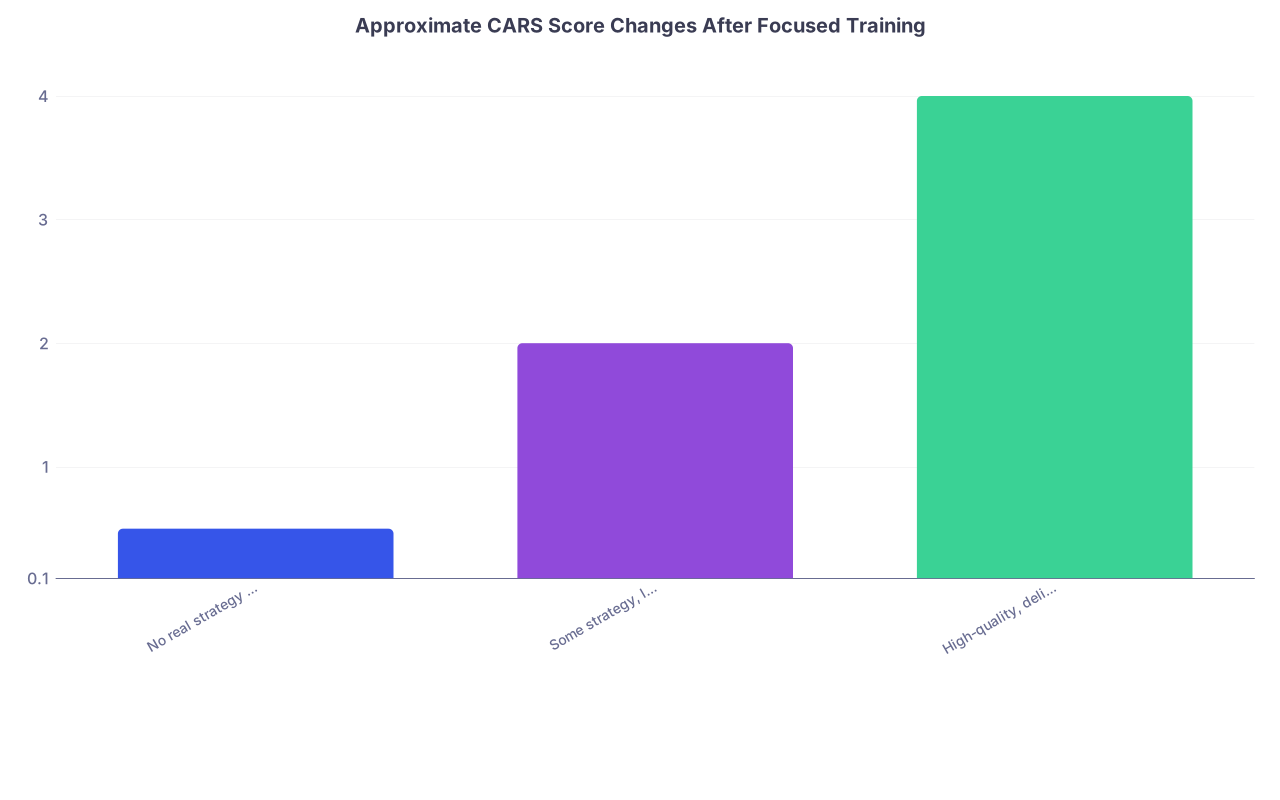
| Category | Value |
|---|---|
| No real strategy change | 0.5 |
| Some strategy, low-quality review | 2 |
| High-quality, deliberate practice | 4 |
Interpretation in plain English:
- People who “just do more passages” often bump ~0–1 point at most.
- People who add some strategy but still rush the review might gain ~1–3 points.
- People who train CARS as a skill — slow, analytical review; error categorization; timed + untimed practice — routinely gain 3–5 points, sometimes more.
Is that a randomized controlled trial? No. But it lines up perfectly with what cognitive science predicts and what skilled tutors repeatedly see.
You don’t need a PhD to read this pattern: practice quality > practice quantity > “innate talent.”
Trainable Components of CARS, One by One
Let’s be concrete about what you can actually change.
1. Passage comprehension strategy
Bad CARS readers usually do one of two things:
- Skim too fast, then get lost in questions.
- Read too slowly, trying to memorize, and run out of time.
Trainable fixes:
- Learn to read “for structure,” not detail. Track:
- What’s the main claim?
- How is each paragraph serving that claim? (example, contrast, criticism, extension)
- Practice writing a 1-sentence summary after each paragraph. Yes, literally out loud or on paper at first. You’re rewiring how you read.
Give this 20–30 passages with strict discipline and your brain will start doing it automatically.
2. Argument and tone recognition
You can train your brain to see argument patterns the way a chess player sees openings.
- Take any passage. Highlight:
- The thesis
- Supporting examples
- Counterarguments
- Author’s response
- Then add a label: is the author enthusiastic, cautiously supportive, neutral, critical, or dismissive?
You’re building a library of templates. MCAT writers recycle these patterns over and over.
3. Wrong-answer pattern detection
This is one of the most underused, high-yield trainable skills.
Over hundreds of passages, wrong answers fall into recurring buckets:
- Too extreme relative to the passage
- True but irrelevant
- Reversing the relationship (cause/effect, support/conclusion)
- Outside scope — introduces new claims the passage never implied
- Subtle tone mismatch (too harsh, too positive)
After each passage, do this:
- For each missed question, label the type of error.
- For each tempting wrong answer you almost picked, label the trap type.
You’re not just “learning content.” You’re learning the enemy’s favorite tricks.
That’s skill training.
4. Time management and pacing
Timing isn’t just “go faster.” It’s about what you speed up and what you slow down.
Trainable components:
- Decide in advance: Are you a “read slightly slower, answer faster” person, or “read faster, spend more time comparing answers”? One will work better for you.
- Do timed sections with built-in pauses after every 3 passages to briefly reflect:
- Am I rushing the passage?
- Am I over-investing in one brutal question?
- Occasionally do passages untimed, focusing 100% on process. Then gradually reintroduce the clock.
I’ve watched people salvage 2–3 CARS points just by unf***ing their timing.
So Why Does the “Innate CARS” Myth Survive?
Because it’s comfortable.
If CARS is innate, then:
- You’re not responsible for your score.
- You don’t have to change your reading habits.
- You don’t have to confront the possibility that your “grind” has been unfocused and inefficient.
It also survives because a lot of CARS advice is garbage. Vague, feel-good, and operationally useless:
- “Just read more.” (What? How? With what feedback?)
- “Trust your gut.” (Fantastic, if your gut is well-trained. Otherwise it’s guessing.)
- “You can’t really improve CARS much anyway.” (Usually said by someone who never tried properly, or never had to.)
There’s also survivorship bias. People who were reading The Economist and philosophy essays in high school walk into CARS already trained — they just don’t realize it was years of practice. So they shrug and say, “I don’t know, I just read.”
That doesn’t make the skill innate. It just means they spent a decade unknowingly preparing.
What Actually Moves the Needle (If You’re Serious)
You want the non-fluffy, data-aligned version of “Can I get better at CARS?” Here it is:
- Yes, you can improve. Many people gain 3–5 points with correct training.
- No, it’s not quick. Real change usually takes 6–10 weeks of focused effort.
- No, there’s no hack. It’s skill-building + feedback + uncomfortable reflection.
A realistic high-yield approach looks like this:
| Weeks | Primary Focus | Secondary Focus |
|---|---|---|
| 1–2 | Passage structure & summary | Tone and author attitude |
| 3–4 | Question types & traps | Timing experiments |
| 5–6 | Full-section simulation | Error-type pattern tracking |
And yes, your improvement might be lumpy. Some people sit flat for three weeks, then jump 2 points after something finally clicks about structure or tone.
That’s how skill development actually behaves.
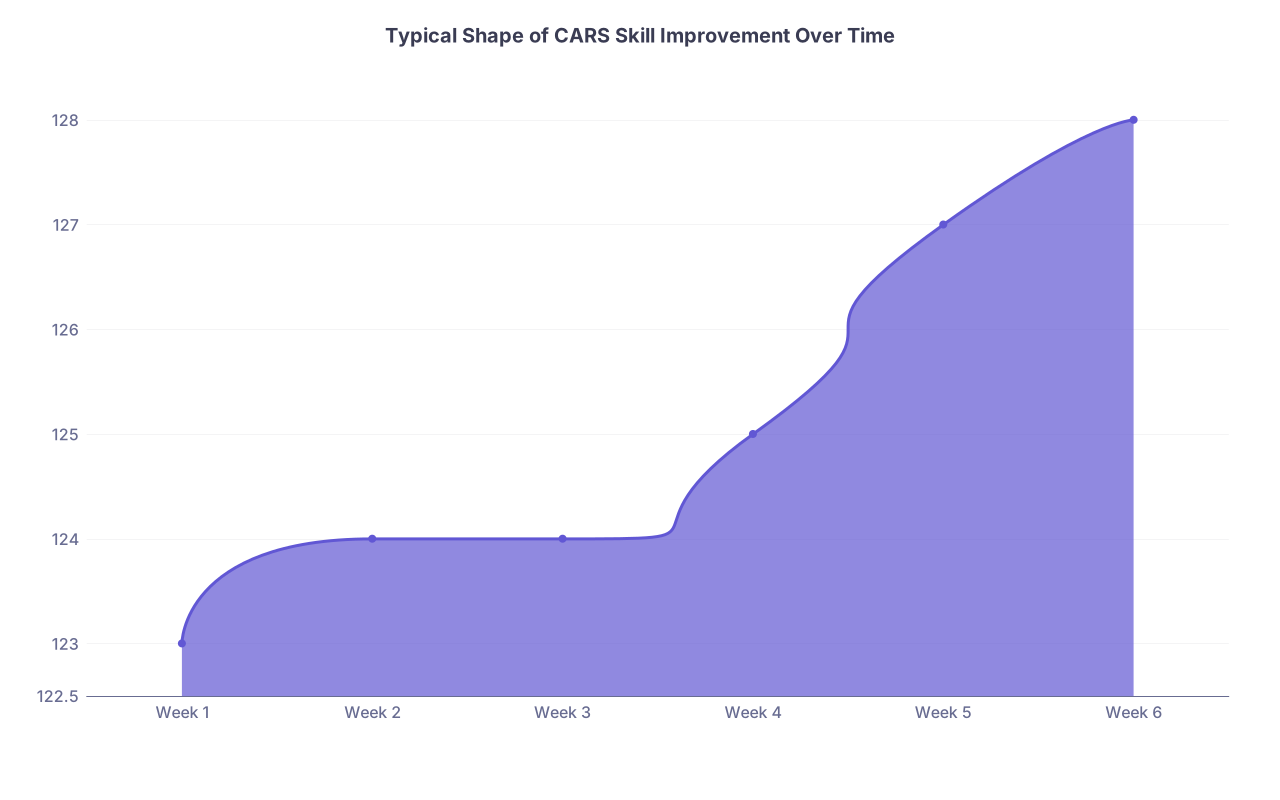
| Category | Value |
|---|---|
| Week 1 | 123 |
| Week 2 | 124 |
| Week 3 | 124 |
| Week 4 | 125 |
| Week 5 | 127 |
| Week 6 | 128 |
Flat, flat, small bump, big bump. This is normal. People who believe in “innate CARS” quit before the big bump.
The Bottom Line: Is CARS an “Innate” Skill?
No. CARS is not an innate, binary talent. It’s a cluster of trainable skills sitting on top of whatever baseline verbal ability and reading history you bring in.
Three things to walk away with:
- CARS performance is meaningfully trainable through deliberate, analyzed practice — not just grinding more passages.
- Plateaus do not equal limits; they’re standard in skill learning. The people who keep adjusting and reviewing process are the ones who jump.
- Blaming “innate ability” is usually a smokescreen for poor strategy, low-quality review, or quitting early. You can’t control your starting point, but you have far more control over your trajectory than the myth allows.
Treat CARS like a serious skill — not a personality trait — and your score will start behaving like one.