Last week, someone showed me their MCAT score report with shaking hands. Third attempt. Still below their target. They whispered the thing most of us only say in our heads: “What if I just never get the score I need? Does that mean this is over?”
If that’s where your brain lives right now—refreshing score calculators, secretly Googling “doctor careers without MCAT” at 2 a.m.—you’re not being dramatic. You’re scared. And honestly? It makes sense.
Let’s walk through this like you and I are sitting in the library, and you just said, “Okay, worst case. What if I never hit my target MCAT score?”
Because we both know that’s the question keeping you up.
First: Are Your “Targets” Even Realistic?
Let me be blunt: a lot of premeds pick MCAT targets that are fantasy numbers, not actual goals.
You see:
– Reddit threads with 520+ scores
– Med school websites listing “average MCAT: 517”
– People in your class bragging: “I’ll retake unless I get 520+”
So you set 515 or 518 as your line in the sand. And anything below that starts to feel like failure. But here’s what I’ve actually seen:
| School Type | Competitive MCAT Range |
|---|---|
| Top 20 MD (research) | 515–522+ |
| Mid-tier MD | 508–514 |
| Newer / community MD | 503–509 |
| DO programs | 498–506 |
| Canadian MD (very tough) | 512–520+ |
If your “target” is 520 because some chart said that’s “excellent,” but your practice scores hover at 505–509, your problem might not be your ability. It might be that your target is disconnected from reality and from your actual school list.
So before you go down the “what if I never get there” rabbit hole, define what “there” actually needs to be:
- What’s the minimum score that would still give you a real shot at some MD programs, or a strong chance at DO?
- Are you chasing a number that fits your ego, or one that fits your application profile + school strategy?
Because if your realistic target for your situation should be 508 and you’re sitting at 505, that’s a completely different conversation than “I’ll never break 520, I’m doomed.”
When Do You Stop Chasing a Higher Score?
This is the part no one wants to say out loud: at some point, more retakes stop helping and start hurting.
I’ve watched this cycle way too many times:
- First score comes back below dream goal. Panic. “I’ll just retake.”
- Second attempt: slightly higher… still not “good enough” in your mind.
- Third attempt: same range or lower. Confidence completely wrecked.
- Now you’re older, tired, and scared to even open another MCAT book.
There is a point where you’re not “one more try” away from a miracle score; you’re in a pattern. And patterns tell programs something.
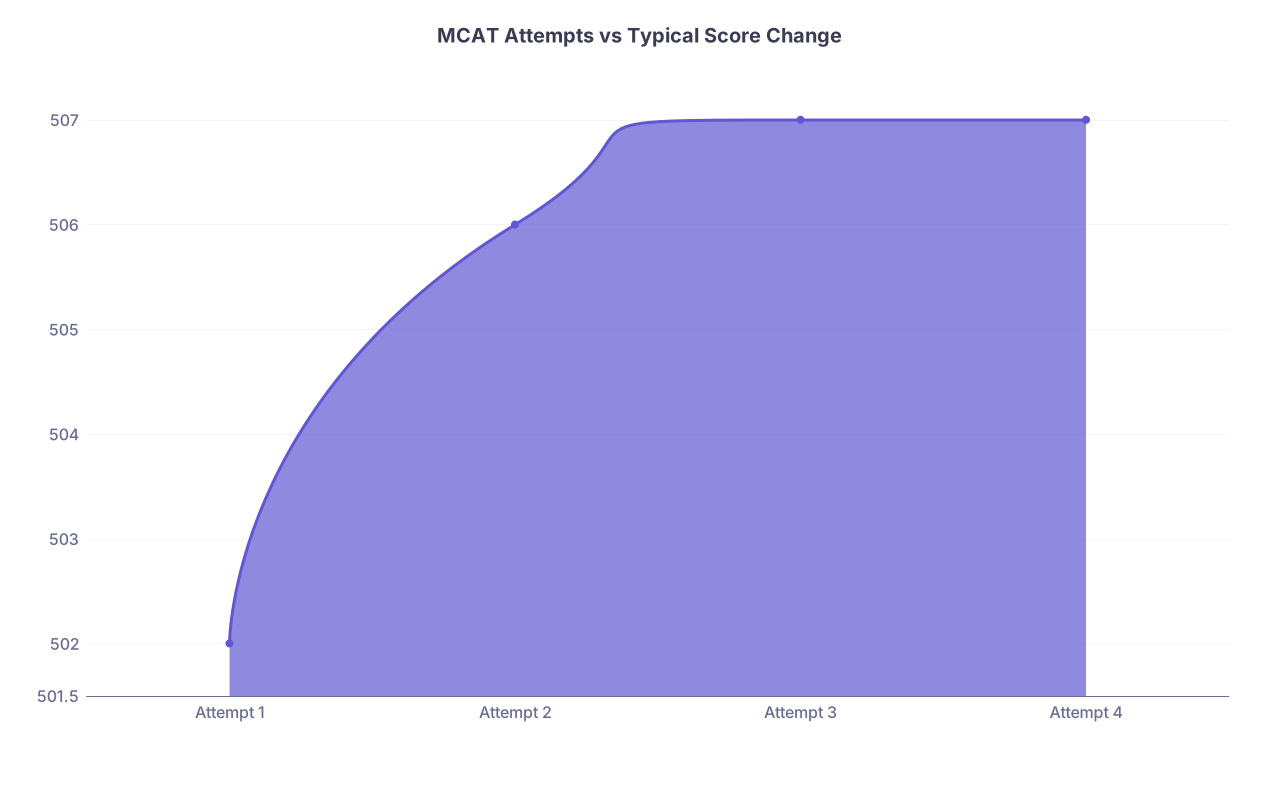
| Category | Value |
|---|---|
| Attempt 1 | 502 |
| Attempt 2 | 506 |
| Attempt 3 | 507 |
| Attempt 4 | 507 |
That kind of plateau is common. Improvement usually slows after 2 serious attempts. Not always, but often.
So when do you stop? My honest rule of thumb:
- If you’ve done 2–3 truly structured attempts
(as in: full content plan, consistent practice, multiple FLs, not just “I kinda studied between classes”)
and your scores live in the same narrow band, you don’t keep retaking forever “just in case.”
That doesn’t mean “give up on being a doctor.”
It means “stop throwing time and money at the same wall and expect a different result.”
At that point, the question shifts from “How do I get a 515?” to “What realistic lives are possible for me with a 502, or a 506, or a 509?”
That’s a very different—way more useful—conversation.
What Can You Do If You Plateau Below Your Dream Score?
Let’s say it’s happened. You’ve taken it 2–3 times. You’re stuck-ish. Not a horrible score, but not your dream. Now what?
You’ve got more options than your brain is letting you see right now.

| Step | Description |
|---|---|
| Step 1 | MCAT Plateau |
| Step 2 | Rebuild School List |
| Step 3 | Consider DO + Broad MD |
| Step 4 | Post-bacc/SMP or Alternative Paths |
| Step 5 | Apply with Strengthened ECs |
| Step 6 | Reassess Timeline and Goals |
| Step 7 | Score >= 510? |
| Step 8 | Score >= 500? |
1. You’re in the 510-ish range, just not “top tier”
If you’re, say, 509–512 and devastated because your dream is “Harvard or nothing,” I’ll be blunt:
The problem is not your ability to be a doctor. It’s your attachment to prestige.
People matching into competitive specialties come from “no-name” schools every year. I’ve seen students from mid-tier MDs match derm, ortho, ENT. Not because their school name screamed “elite,” but because they:
- Crushed step exams (when they were still scored),
- Built strong clinical and research relationships,
- Showed up like serious, dependable humans for four years.
A 511 doesn’t close the door on MD. It closes the door on some (not all) top-20 schools. Those are not the only schools that make good doctors.
2. You’re in the high 490s–500s
This is where the anxiety really spikes. You’re not at the “comfortably MD competitive” level, but you’re not in the “no chance anywhere” range either.
Here’s what’s actually on the table:
- DO programs: Many accept scores in the high 490s–500s range, especially if your GPA is strong, you have clinical exposure, and you’re not a jerk in your personal statement.
- Some MD programs, especially new ones or mission-focused ones, if:
- Your GPA is solid (3.6+ helps a lot),
- You’re in-state for them,
- Your story/experiences line up with their mission (rural health, underserved communities, etc.).
Weird truth nobody tells you early enough:
A 501 + 3.8 GPA + 2 gap years of strong clinical work + killer letters will absolutely get looks from certain schools. You won’t have a “flex anywhere” outcome, but you won’t be universally shut out either.
3. You’re below 498
Here’s where I see the harshest self-talk:
“I’m too dumb for this.”
“I should’ve known I wasn’t cut out for medicine.”
“Everyone else can do it. What’s wrong with me?”
You’re not stupid. You might be:
- Underprepared in test strategy,
- Dragging through burnout,
- Trying to study while working 30 hours a week + taking classes,
- Or just not a good standardized test taker in this phase of your life.
But below ~498, especially after multiple attempts, med schools will start to wonder if you can handle their exams. That doesn’t mean it’s over. It means:
- You likely need time away from the MCAT to seriously build your academic foundation,
or - You decide medicine through MD/DO in the U.S. may not be the only—or best—path to a meaningful career in healthcare for you.
That’s not failure. That’s course correction.
What Other Real Medical Paths Actually Exist?
“Alternative paths” gets tossed around like a consolation prize: “You can always be a PA or NP.”
But those are real careers. Not backup props.

Let’s lay out what’s realistically on the table if the MCAT keeps blocking your way.
| Path | MCAT Required? | Typical Degree Level |
|---|---|---|
| Physician Assistant (PA) | No | Master's |
| Nurse Practitioner (NP) | No | Master's/DNP |
| Clinical Psychologist | No | PhD/PsyD |
| Pharmacist (PharmD) | Some schools | Doctorate |
| Physical Therapist (PT) | No | Doctorate |
A few straight facts:
- PA school: No MCAT required for most. CASPA is its own nightmare, yes, but the testing barrier is different.
- NP: You’d go through nursing first (BSN or accelerated), then grad school. Very hands-on, very patient-facing.
- Pharmacy / PT / OT / Clinical psych: Different admissions tests (sometimes GRE, sometimes nothing now), different timelines.
Here’s the thing nobody says when they’re stuck in MCAT hell:
You’re allowed to change the end goal without that meaning “I failed.” You’re allowed to say, “I want to practice medicine in a way that doesn’t require this specific test destroying my mental health for 3 years.”
That’s not quitting. That’s choosing a life you can actually live.
If You Do Decide to Keep Going: Make It Strategic, Not Emotional
Sometimes you’re not done. You know you’ve never actually given the MCAT a fully structured, best-version-of-you chance. Fair.
But then you have to stop doing that panicky, vague, “study harder” thing.
You need an actual plan that includes:
- A honest baseline (recent full-length, timed, no cheating)
- A timeline you can actually sustain (not 12 hours/day while taking orgo + physics)
- A content strategy that fixes your specific weak points
(not rewatching all of Khan Academy for the third time because it feels safe) - A hard stop rule:
“If by [date] my practice scores aren’t averaging at least [X], I pivot to other plans.”
This sounds cold, but it saves you from sinking 3–4 years into “maybe next attempt.” You deserve better than that kind of limbo.
The Emotional Part: Grieving the Score You Wanted
Nobody talks about the grief part. But it’s there.
You imagined yourself opening a score report and seeing 515+. Maybe you imagined posting it. Telling your family. Proving to yourself you could.
When that doesn’t happen—once, twice, maybe three times—you don’t just lose a number. You lose that entire mental picture. And it hurts. Of course it does.
Please don’t gaslight yourself with “other people have it worse.” You’re allowed to be upset that reality didn’t match how you hoped this would go.
But then—after you scream into a pillow, cry, vent, journal, whatever—you have to do the harder thing:
Ask, “Okay. Given this version of reality, what future is still possible?”
Because there are many. They just might not look like the fantasy you built as a 19-year-old premed.
Hard Truths That Weirdly Make This Easier
Let me say some things out loud that almost no advisor will say directly:
- You don’t need a 520 to be a good doctor. You just don’t.
- If you never hit your original target, that is not a moral failure. It’s a number on a test taken on a few specific days of your life.
- There are schools and careers that will take you seriously with the score you have now.
- Continuing to retake the MCAT indefinitely because you’re scared of changing your dream is a good way to waste your twenties.
- Walking away from the MCAT at some point—even permanently—doesn’t erase your desire to help people or make you any less caring or capable.
You’re not your score. You’re how you respond to where you are right now.
What You Can Do Today If You’re Stuck in the “What If I Never…” Loop
Not in a month. Not “after this semester.” Today.
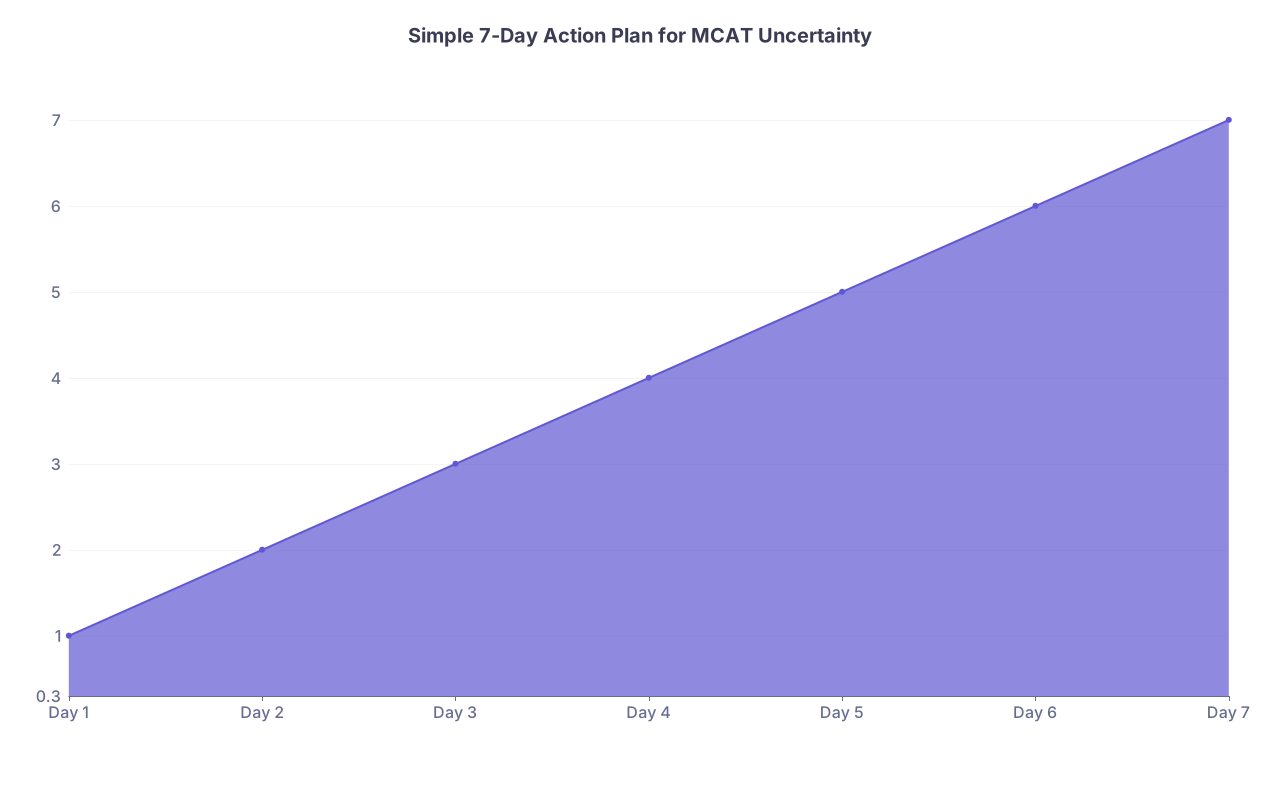
| Category | Value |
|---|---|
| Day 1 | 1 |
| Day 2 | 2 |
| Day 3 | 3 |
| Day 4 | 4 |
| Day 5 | 5 |
| Day 6 | 6 |
| Day 7 | 7 |
One week. One tiny step each day:
- Day 1 – Pull up your last 3 full-length scores. Average them. That’s your real current level, not the one in your head.
- Day 2 – Write down three paths: “MD-focused,” “DO + broad MD,” “alternate healthcare careers.” Just names. Don’t commit to anything yet.
- Day 3 – Pick 5–10 schools in each path and glance at their stats + missions. Are there places where your current numbers aren’t automatic dealbreakers?
- Day 4 – Have one brutally honest conversation—with an advisor, tutor, or attending/resident you trust—show them your scores and ask, “What would you do in my shoes?”
- Day 5 – Decide: one more structured attempt, or pivoting efforts toward applications / alternative paths. No more vague “maybe someday.”
- Day 6 – If you’re attempting again: build a written, week-by-week plan. If you’re pivoting: map prereqs/timelines for the new path.
- Day 7 – Do one concrete action: sign up for a FL, email a PA/NP to shadow, talk to your family about your real timeline. Something that lives in the actual world, not in your head.
You don’t have to fix your whole life today. You just have to stop spinning in place.

FAQ (You’re Definitely Thinking These)
1. “If I don’t get at least a 515, should I even bother applying MD?”
Yes—if your school list and profile match your score. A 507 with a 3.7 GPA, strong clinical work, and realistic school targeting can absolutely get MD interviews. Will you be a competitive applicant for top-20 research monsters? Probably not. But states schools, mission-focused MDs, and newer programs? Still very much in play. The trap is applying like a 520 candidate when you’re not. That’s how people waste money and conclude “no one will ever take me.”
2. “Do med schools secretly hate multiple MCAT attempts?”
They don’t love a string of five similar scores, no. But 2–3 attempts with upward movement is common and not fatal. The red flag isn’t attempts; it’s a pattern that suggests you hit your ceiling early and kept swinging anyway with no change in strategy. That’s where you look stubborn rather than resilient. If you’re going to retake, it needs to be clearly different: new resources, more time, or better conditions—not just “try again, hope for better.”
3. “If I switch to PA/NP/another path, will I regret not forcing the MD route?”
Some people do. Usually the ones who changed paths purely out of fear, without really exploring what they actually want their day-to-day life to look like. But I’ve also seen plenty of people breathe out for the first time in years when they commit to PA or NP school. Less time in training, earlier stable income, still deep patient relationships. Regret usually comes from not making an active choice—just passively sliding away from medicine because of shame. If you pick a path on purpose, regret goes way down.
4. “How do I know I’m not just ‘giving up too early’?”
You ask yourself two questions:
- “Have I ever given the MCAT a fully serious, structured, months-long effort with a real plan?”
- “If I keep doing exactly what I’ve been doing for another year, what actually changes?”
If the honest answer to #1 is “no,” you may owe yourself one real shot. If the answer to #2 is “nothing except losing another year and more of my mental health,” then you’re not giving up early—you’re choosing not to stay stuck. Those aren’t the same thing.
Open your score report right now—practice or official—and write the number at the top of a blank page. Then underneath it, write three possible futures that are still open to you with that exact score. Not the one you wanted. The one you actually have.
That’s where your real path starts.