The myth that “burnout only happens in med school and residency” is flat-out wrong.
You can absolutely burn out before you ever sit for the MCAT. I’ve watched people crash months before their exam date and then just… limp to test day. Or postpone endlessly. Or quit on the whole idea of medicine because they thought their exhaustion meant they “weren’t cut out for it.”
That’s the part that scares me. Not the hard work. The silent burnout creeping in while we’re all pretending everything’s fine because “this is just what grinding looks like,” right?
Let’s talk honestly about the early warning signs before the MCAT. The stuff you feel but keep dismissing as “I just need a better schedule” or “once this week is over, I’ll be fine.”
Because sometimes you’re not fine. And if you catch it early, you don’t have to hit a wall.
What MCAT Burnout Actually Looks Like (Not the Instagram Version)
Burnout before the MCAT isn’t always dramatic. It doesn’t always look like someone crying over a Kaplan book at 3 a.m. Sometimes it’s quieter and way more sneaky.
It looks like this:
You sit down to do practice questions and your brain just… refuses. You reread the first paragraph of a passage three times and none of it sticks. You start thinking, “Maybe I’m actually getting dumber the more I study.”
You used to care about your score goal. Now all you feel is dread. No excitement. Just this heavy, suffocating “I can’t keep doing this for three more months.”
And the worst part? You keep telling yourself it’s a discipline problem instead of a burnout problem.
Let me be blunt: no amount of “motivational quotes” is going to fix real burnout. You can’t “grind harder” your way out of a brain that’s fried.
So if you’re scared that you’re already heading down that path—you might be right. But that’s actually good news. Because early warning signs are fixable.
Early Warning Sign #1: You’re Studying More and Retaining Less
This is one of the biggest red flags, and people write it off constantly.
You start upping your study hours because you’re anxious. Maybe you see other people on Reddit posting about their “10-hour days” and you feel behind. So you push. You cut sleep. You cut breaks. You “optimize.”
And then your performance starts doing this:
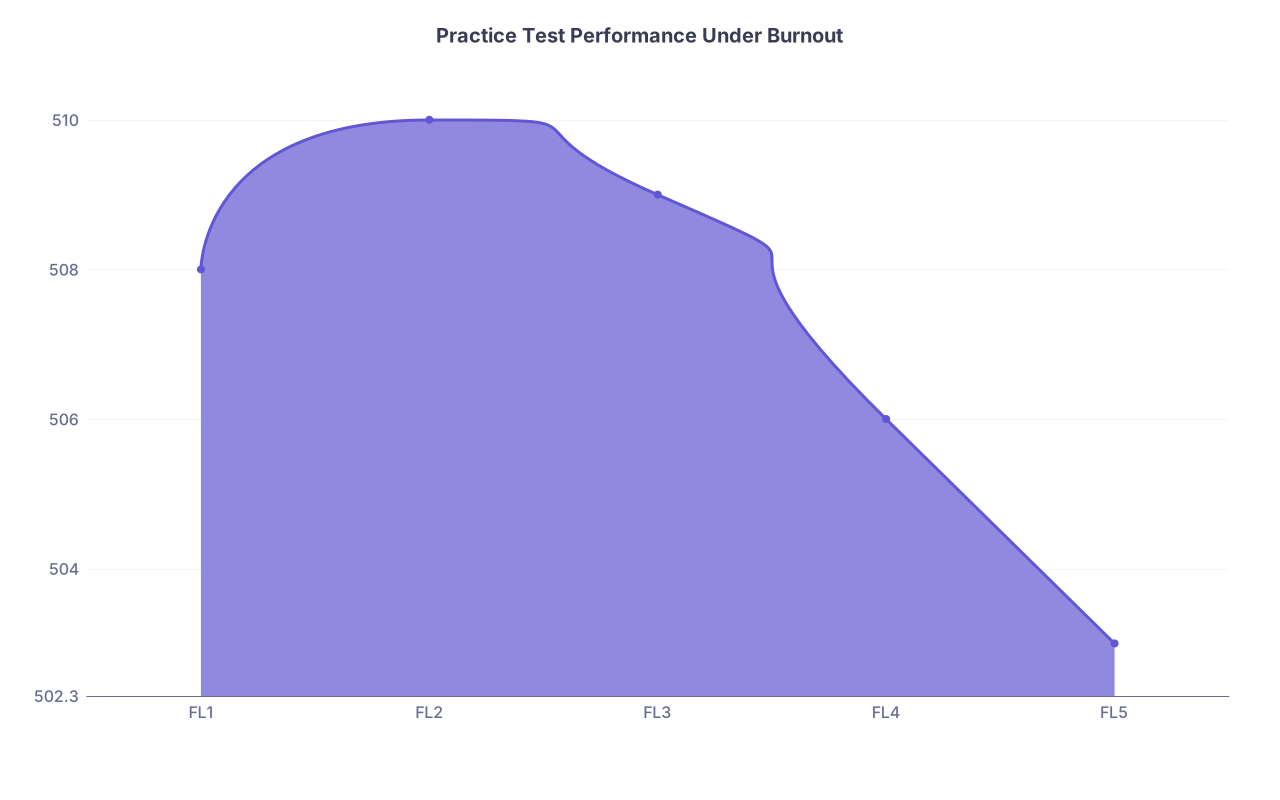
| Category | Value |
|---|---|
| FL1 | 508 |
| FL2 | 510 |
| FL3 | 509 |
| FL4 | 506 |
| FL5 | 503 |
You’re putting in more time and getting worse results. Or stuck. Or weirdly inconsistent.
Common thoughts at this stage:
- “I swear I knew this last week—why does it feel new again?”
- “How did I miss that question? I just reviewed that content.”
- “My Anki reviews keep piling up and I can’t keep up without sacrificing everything else.”
If you feel like your brain is becoming a sieve, it’s not because you’re lazy. It’s usually because your cognitive load is maxed. Chronic stress does that. It screws with memory and focus.
Early fix move here: instead of adding more hours, you make your hours lighter. Shorter blocks. Real breaks. Sleep that isn’t optional. I know that feels backward when you’re behind, but burning your brain more when it’s already smoking just gives you ashes, not scores.
Early Warning Sign #2: MCAT Thoughts Invade Every Corner of Your Life
There’s “I’m taking this seriously” and then there’s “I can’t watch a show without thinking about amino acids.”
If your brain won’t shut up about the MCAT even when you’re not studying, that’s not dedication. That’s anxiety owning you.
A few examples I’ve seen (and lived):
- You go out with friends and spend half the time doing mental math about how many hours you’re “losing.”
- You feel guilty watching a 20-minute YouTube video that has nothing to do with biochem.
- You’re scrolling Instagram and instead of relaxing you feel crushed by everyone else’s “I got a 520!” posts.
- You’re in the shower planning your CARS strategy. Again.
This constant mental MCAT noise is exhausting. Your brain never gets real off-time, which means it never really recovers. That’s pre-burnout fuel.
And here’s the nasty twist: when you finally do sit down to study, you’re already tired before you start.
Early Warning Sign #3: Emotional Whiplash Around Every Practice Score
The swings are brutal.
One half-decent score: “Maybe I can actually do this. Maybe I’m not a complete disaster.”
Next exam drops a few points: “I’m stupid. I knew it. I should just quit now and save everyone the trouble.”
Your self-worth starts to hinge on every FL score. Or worse, every section score.
You know it’s irrational, but it still hits you in the stomach every time that number isn’t where you want it.
I’ve seen people literally cancel their whole day’s plan after a bad CARS section because they “ruined the day anyway.” That’s burnout edge territory—where you can’t emotionally regulate around normal exam variability anymore.
You’re not a stock chart. But burnout will make you feel like one.
Early Warning Sign #4: You’re Starting to Hate Everything Medicine-Related
This one feels scary because it makes you question your entire identity.
You used to get excited about watching surgical videos or reading cool case reports. Now? You see anything medical and your first reaction is, “Ugh, I don’t want to think about this.”
You catch yourself thinking:
- “If this is what it takes to be a doctor, maybe I don’t want it.”
- “Do real doctors just live like this forever? Constantly exhausted and behind?”
- “If I’m burning out now, I’ll never survive residency.”
The worst fear: “Maybe I’m not cut out for this.”
But here’s the thing—burnout makes everything look darker. It doesn’t mean your dream is fake. It means your current system is unsustainable.
There’s a huge difference between:
- “I don’t want to be a doctor.” and
- “I don’t want to live like this anymore while trying to become a doctor.”
Those are not the same sentence. Even though they start to feel like they are.
Early Warning Sign #5: Your Life Has Collapsed into a Single Dimension
MCAT. That’s it. That’s your whole personality now.
You used to work out, cook real meals, pretend to have hobbies. Now it’s coffee, DoorDash, staring at a screen, and maybe doomscrolling MCAT forums until 1 a.m.
And because I know how the brain works, you’re telling yourself: “This is temporary. Once I get through this, I’ll be normal again.”
Except the more you narrow your life to one thing, the more fragile you become. One bad FL. One rough week. One illness. And you break. Because there’s nothing else holding you up.
Real talk: people with slightly less intense study schedules but actual balance tend to last longer and perform better than the ones trying to live like a monk for 3–6 months.

| Step | Description |
|---|---|
| Step 1 | Start MCAT Prep |
| Step 2 | Cut sleep, no hobbies |
| Step 3 | Structured 4-6hr blocks |
| Step 4 | Early score gains |
| Step 5 | Plateau & exhaustion |
| Step 6 | Burnout, possible delay |
| Step 7 | Steady progress |
| Step 8 | Less stress, better retention |
| Step 9 | Arrive at test day with gas left |
| Step 10 | All-in 10hr days? |
You don’t get bonus points from medical schools for being the most miserable.
Early Warning Sign #6: Physical Symptoms You Keep Ignoring
Burnout isn’t just in your head.
Sleep is wrecked. Either you can’t fall asleep because your brain is replaying questions, or you wake up at 3 a.m. with your heart pounding over nothing in particular.
Headaches show up more. Or that tight chest feeling. Or random stomach issues that conveniently started when hardcore studying did.
You tell yourself it’s fine. You drink more caffeine. You keep going.
But your body is basically standing there waving a giant red flag and you’re like, “I’ll deal with you after test day.”
Except if you ignore those signals, your body will eventually shut down on its own schedule, not yours.
Here’s a rough contrast of typical “healthy-ish grind” vs “burnout slide” life:
| Aspect | Balanced Prep | Burnout Pattern |
|---|---|---|
| Sleep | 7–8 hrs most nights | 4–6 hrs, inconsistent |
| Study blocks | 3–5 focused chunks | 1 long blurry marathon |
| Days off | 1 real day/week | Zero guilt-free days |
| Mood | Stressed but hopeful | Numb, irritable, hopeless |
| Retention | Gradual improvement | Plateau or decline |
If you’re living in the right column and calling it “dedication,” I’m telling you plainly: that’s not sustainable.
How to Pull Back Before You Break
Let me assume the worst-case scenario with you: you’re already seeing multiple signs above and your test date is not some distant dot on the horizon. What now?
Here’s the fear:
“If I slow down, I’ll fall behind and do worse. If I keep going like this, I might burn out. So either way I lose.”
That’s the trap. It makes you feel like there’s no good move, so you just keep suffering.
But the reality is more like this:
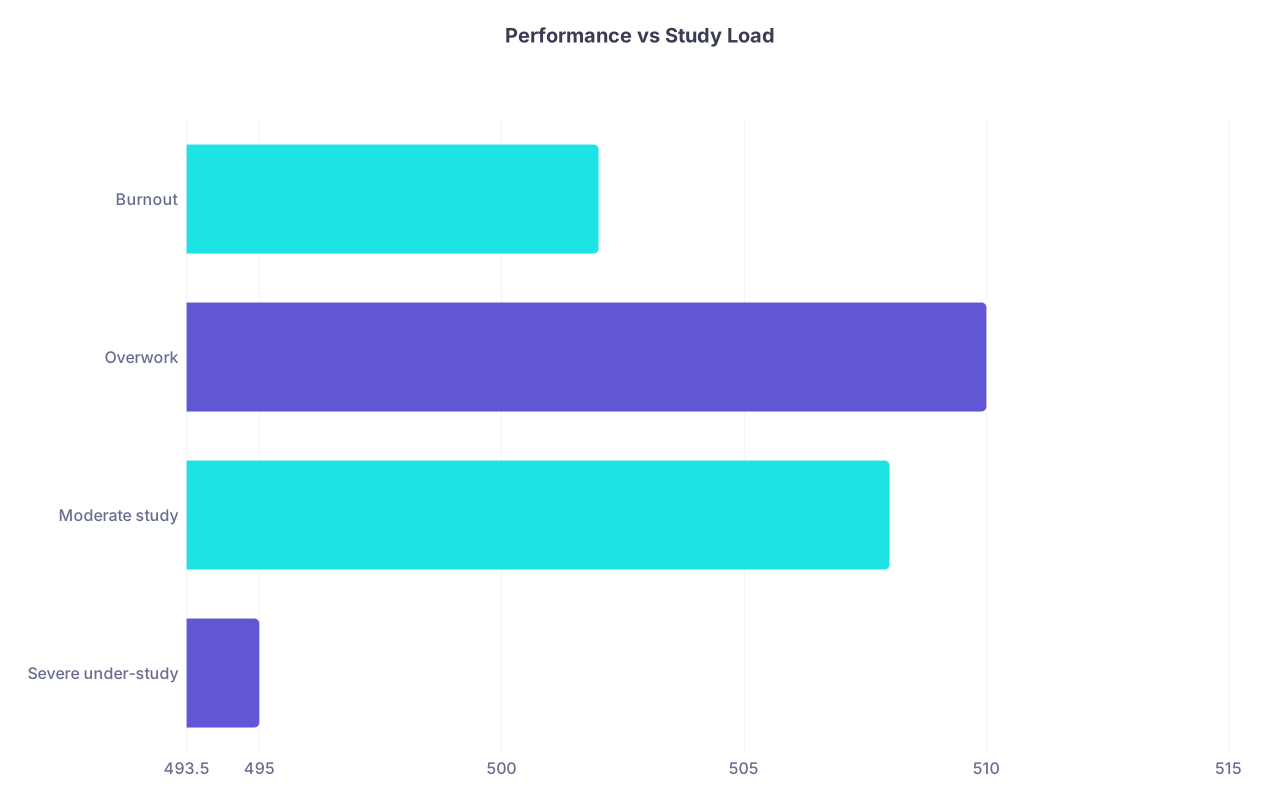
| Category | Value |
|---|---|
| Severe under-study | 495 |
| Moderate study | 508 |
| Overwork | 510 |
| Burnout | 502 |
Light effort obviously won’t cut it. But there is a sweet spot where you’re working hard and not destroying yourself. Once you cross that and head toward burnout, performance drops again.
So backing off from burnout isn’t self-sabotage. It’s course correction.
Concrete things you can do this week
Not a full life overhaul. Just moves that help quickly.
Pick one non-MCAT thing you’ll do every single day.
Walk. Ten-minute stretch. Cooking one real meal. Talking to a friend on the phone. Doesn’t matter—just something that reminds your brain you are a person, not a test-taker robot.Protect your sleep like it’s another exam section.
No “just one more passage” at 1 a.m. Your hippocampus (the memory piece of your brain) needs sleep to consolidate all that content you’re killing yourself to review. You are literally wasting study time by cutting sleep.Do at least one honest, non-panicked check-in.
Ask yourself: “If I kept living this exact schedule and mental state for 8 more weeks, what happens?”
If your body tenses up just imagining that, you already know the answer.Schedule breaks the same way you schedule FLs.
Not “I’ll rest if I get everything done.” You won’t. Pick a cut-off time at night. Pick at least one partial or full light day each week.Talk to a real human about how you’re feeling.
Not just Reddit. Someone who knows you. If they say, “You sound miserable,” don’t wave that away. That’s data.
None of this is fluffy “self-care” talk. This is performance maintenance. Athletes periodize their training. If you try to sprint all training, you peak way before race day. Same idea.
When You Should Seriously Consider Moving Your Test Date
This is the nuclear fear for a lot of us: that we’ll have to delay. It feels like failure. Like you “wasted” months.
You should at least consider moving your MCAT if:
- You’re consistently scoring far below your target with only a few weeks left AND
- You feel mentally and physically wrecked, not just “a little nervous”
Or more bluntly: if the thought of another full-length makes you want to cry, you shouldn’t be forcing three more into the next month.
What people don’t tell you: taking the MCAT once when you’re ready is almost always better than taking it early in a semi-burned-out state, getting a number you hate, and having to walk around with that score while planning a retake.
Taking longer doesn’t make you weak. It makes you someone who protects their future self.
You’re Not Broken. You’re Overloaded.
Burnout whispers that your exhaustion is proof you “don’t have what it takes.” That’s a lie.
Medicine is full of systems that push people to breaking points and then act shocked when they break. It starts in premed culture: glorifying suffering, mocking balance, treating sleep like optional DLC content.
You feeling drained doesn’t mean you’re not cut out for this. It means you’re doing an inhuman thing in an inhuman way.
If you spot these early warning signs, the answer is not “try harder.” It’s “try differently.”
You are allowed to want this badly and also refuse to destroy yourself getting there. Both can be true.

FAQ: MCAT Burnout Fears, Answered
1. How do I tell the difference between normal MCAT stress and actual burnout?
Normal stress feels like, “This is a lot, but I can still push.” You might be tired, but you still have some curiosity, some ability to focus, and you bounce back after a day off. Burnout feels like being emotionally flat or constantly on edge. You don’t recover after rest anymore. You’re cynical, detached, and your performance is sliding even as you work more. If you feel like you’re running on fumes all the time and you’re starting to hate everything about this process, that’s not just “normal stress.”
2. If I cut back my study hours, won’t I destroy my score potential?
Not if you’re already over the line. There’s a point past which more hours just give you worse focus, brain fog, and shallow learning. You don’t want maximum hours; you want maximum effective hours. I’ve seen people go from 9–10 hour zombie days to 5–6 hour focused days and actually see their FL scores go up. Quality over sheer volume isn’t motivational poster nonsense—it’s how your brain actually works.
3. Is it better to push through burnout and take the test, or postpone?
If you’re mildly burned out but still functional and your practice scores are near your goal, you can sometimes coast in and then collapse afterward. Not ideal, but survivable. If you’re severely burned out—crying over FLs, tanking scores, physical symptoms flaring—the risk is you walk into test day already defeated. Then you get a score you know doesn’t reflect your potential and you’re stuck planning a retake. In that scenario, postponing is usually the smarter long-term move, even though it stings in the short term.
4. What if taking breaks makes my anxiety worse because I feel guilty?
Yeah, that’s a fun one. The first few breaks might feel terrible. Your brain’s used to panic as the default setting. But here’s the hard truth: if you can’t tolerate taking a 30–60 minute break without spiraling, that’s a sign your relationship with this exam is already not healthy. Start small—5–10 minutes where you deliberately don’t touch anything MCAT-related—and work up. The goal is to retrain your brain that rest is allowed and doesn’t mean danger.
5. Does early burnout mean I’ll never survive med school or residency?
No. It means that when you push yourself with no guardrails, you hit walls. That’s… human. People who learn to recognize their own red flags now are actually better positioned for med school, because they know when to pull back, ask for help, or change their system before things explode. The people who scare me are the ones who say, “I never burn out, I just grind harder.” Those are the ones I’ve watched crash hardest later.
Key points: burnout can hit before the MCAT, it often shows up as worse retention and rising misery (not just laziness), and backing off from destructive patterns isn’t quitting—it’s what keeps you in the game long enough to actually become the doctor you’re trying so hard to be.