If your CARS score has been stuck for weeks, your current approach is not “almost there.” It is wrong.
The good news: CARS is fixable. But not with vague advice like “just read more” or “do more passages.” You need a tight, repeatable, 45‑minute daily routine that rewires how you read, not just how many questions you grind through.
That is what I am going to give you: a concrete, clock-based protocol you can run every single day. No fluff. No “see what works for you.” Do this for 3–4 weeks and your reading will feel different. Your score will move.
The Real Reason Your CARS Score Is Stuck
Your problem is not that you are “bad at reading” or “just not a humanities person.” I have watched engineers, biochem majors, and ESL students climb from 123–124 to 128–129. They did not magically become literature experts. They changed three things:
- How they use the first 3–4 minutes of each passage
- How they test their understanding before reading answer choices
- How they review every single question they miss
If any of this sounds like you, you are sabotaging yourself:
- You read the passage “carefully,” then go straight to answer choices.
- You highlight half the passage in bright yellow.
- You cannot summarize the author’s main point in one sentence if I stop you mid‑way.
- Your review is “oh, I misread that” and then you move on.
This is not reading. This is eyeballs moving across text.
Your 45‑minute plan will fix that by forcing you to:
- Read with a job: Find structure, voice, and argument.
- Lock in the main point before touching the questions.
- Diagnose exactly why you missed each question.
The 45-Minute Daily CARS Fix: Overview
Here is the exact breakdown. Set a timer. Stick to it.
| Block | Duration | Focus |
|---|---|---|
| 1 | 5 minutes | Warm-up: mental “gear shift” + micro-reading |
| 2 | 12 minutes | Passage #1 timed (9 min) + 3-min self-check |
| 3 | 8 minutes | Deep review of Passage #1 |
| 4 | 12 minutes | Passage #2 timed (9 min) + 3-min self-check |
| 5 | 8 minutes | Deep review of Passage #2 |
That is it. Two passages. Done correctly. Every day.
If your first reaction is “only two passages?” that tells me why your score is stuck. You are chasing quantity, not quality. You do not get points for number of passages. You get points for picking the right answer consistently.
Now let us break each block down and make it plug-and-play.
Block 1 (5 Minutes): Warm-Up That Actually Targets CARS
Most people start CARS cold. They come from Anki, physics, TikTok, then suddenly expect to read Victorian philosophy at full speed. Not going to happen.
You need a quick “gear shift” to humanities mode.
Step-by-step (5 minutes)
Minute 0–2: Micro-passage scan
- Take a short paragraph from:
- A CARS passage you already did, or
- A source like The Atlantic, Aeon, London Review of Books, or New Yorker longform.
- Read it once.
- Ask yourself out loud or in writing:
- “What is the author doing here?”
- “Positive, negative, or neutral toward the subject?”
- “If I had to title this paragraph in 3–5 words, what would it be?”
This forces you to look for intent and tone, not just content.
Minute 2–5: One-sentence summary drills
- Read another short paragraph.
- Force yourself to write exactly one sentence summarizing it.
- Not details. Not examples. The point.
- If your sentence is:
- Too detailed → You are stuck in the weeds.
- Too vague → You are not tracking the argument.
Do this daily and you start training the exact muscle CARS demands: compressing complex text into its core idea quickly.
Block 2 (12 Minutes): Timed Passage #1 – With a Twist
You will spend 9 minutes on the passage + questions. Then 3 minutes on a no-answers check.
Use official-style CARS passages (AAMC, Jack Westin style, UWorld CARS, etc.). Not random blog posts. The question quality matters.
Minute 0–3: Targeted reading, not highlighting
- No highlighting. No underlining. Pen and scratch paper only.
- As you read each paragraph, jot one short phrase on your paper:
- P1: “Critiques traditional education”
- P2: “Gives historical example”
- P3: “Counters common objection”
- After the final paragraph, pause and answer these from memory:
- “What is the author’s overall main point?”
- “What is the author’s attitude?” (supportive / skeptical / critical / cautious / mixed)
If you cannot answer these cleanly, that is why your answers feel like guessing.
Minute 3–9: Questions, but with structure in mind
- Go to the questions.
- For each question:
- Before looking at choices, restate what the question is asking:
- “Asks for main point.”
- “Asks why author mentioned X.”
- “Asks to infer attitude about Y.”
- Predict a general answer in your head before choices.
- Then read choices and try to match your prediction.
- Before looking at choices, restate what the question is asking:
You will feel slower at first. Good. That means you are actually thinking.
Minute 9–12: 3-minute “no-answers” check
Before checking answer keys:
- On scratch paper, write:
- Your main point for the passage in one sentence.
- The role of each paragraph in 3–6 words each.
- Circle any questions where:
- You had zero prediction before seeing answer choices.
- You changed your answer last minute.
These are often the questions that show up red later. You want to predict your own weak spots before the key tells you.
Block 3 (8 Minutes): Deep Review of Passage #1
This is where you actually improve. Most students rush this. Then stay stuck.
Here is the rule: Spend at least as much time reviewing as you did answering questions. For this plan, you get 8 minutes. Use them.
Step 1: Check answers quickly (1–2 minutes)
- Mark:
- ✔ if correct with high confidence.
- ○ if correct but you were unsure / guessed.
- ✖ if incorrect.
Do not spend time yet reading explanations in detail. Just label.
Step 2: Autopsy each “○” and “✖” (5–6 minutes)
For every questionable or wrong question, answer four things in writing:
What type of question was this?
- Main idea / detail / inference / function / tone / application.
- If you do not categorize, you cannot see patterns over time.
Where did my reasoning go wrong?
- Examples of common errors:
- “I picked something that sounded sophisticated instead of matching the passage.”
- “I got seduced by a true statement that was not actually answering the question.”
- “I ignored a small contrast word (‘however’, ‘although’) that flipped the meaning.”
- “I imported outside knowledge from my own beliefs.”
- Examples of common errors:
What was the key phrase or idea in the passage that should have guided me?
- Highlight or circle it.
- This builds your “anchor” sense: exactly which part of the passage controls the answer.
What is my new rule to avoid this mistake next time?
- Concrete, short, and behavioral:
- “For main idea questions, I will reread my one-sentence summary before touching choices.”
- “For inference questions, I will not pick anything that contradicts a line in the text, even if it feels ‘reasonable’.”
- “If an answer feels emotionally satisfying but I cannot point to text, I will distrust it.”
- Concrete, short, and behavioral:
Write these rules in a dedicated “CARS mistake log.” This log is gold over weeks.
Step 3: Quick main point re-check (1 minute)
- Re-state the main point again after reviewing.
- Compare to what you wrote at minute 9–12.
- If they differ a lot, you misread the passage structure the first time. That matters more than any one missed question.
Block 4 (12 Minutes): Timed Passage #2 – Same Structure, Slight Twist
You repeat the process, but this time I want you slightly tighter on time: 8 minutes instead of 9 if you are already close to target score. If you are sub‑125, stay at 9 minutes for now.
Minute 0–3: Structural notes as you go
Same as Passage #1, but add one extra step:
- After each paragraph, force yourself to say (quietly or in your head):
- “So what? Why did the author include this?”
- Then paraphrase in 5–7 words.
You are building purpose awareness. CARS is not testing if you can summarize sentences. It is testing if you can see why each part is there.
Minute 3–9 (or 3–8): Questions with prediction
Same drill:
- Identify question type.
- Predict.
- Then match.
If you find yourself skipping prediction “to save time,” be honest: your “time savings” are costing you points. Sloppy reading feels fast. High scores come from disciplined thinking that initially feels slow.
Minute 9–12: 3-minute quick self-check again
Same as with Passage #1:
- One-sentence main point.
- Role of each paragraph in a phrase.
- Circle questions you felt shaky on.
Block 5 (8 Minutes): Deep Review of Passage #2
Repeat the autopsy structure:
- Label ✔ / ○ / ✖.
- For each ○ or ✖: question type, reasoning error, key text, new rule.
- Update your mistake log.
At the end of this block, quickly scan your log from the last week. Ask:
- “What 1–2 mistake patterns are constant?”
- Always falling for extreme language?
- Always misreading tone?
- Always missing contrast words?
Then pick one pattern to actively watch for in tomorrow’s passages.
Weekly Layer: Tracking Progress So You Do Not Fool Yourself
You will not feel day-to-day improvement. That does not mean it is not working.
Once per week (15–20 additional minutes, separate from the 45-minute routine):
- Review your mistake log
- Tally question types that cause most issues.
- Tally “reasoning errors” you wrote.
- Do 1 mini mixed set (3–4 passages, 36–40 minutes)
- Pure exam conditions.
- No pause, no review mid‑set.
- Compare:
- Are your misses more concentrated in one type (inference, tone, etc.) rather than “everything”?
- Are you making fewer “I rushed / misread” mistakes and more genuinely hard judgment calls?
That shift alone is progress.
Here is what a simple tracking table might look like:
| Week | Main Issue | Worst Question Type | Average Misses per Passage |
|---|---|---|---|
| 1 | Rushing, misreads | Inference | 4–5 |
| 2 | Tone confusion | Tone/attitude | 3–4 |
| 3 | Overvaluing details | Main idea | 3 |
| 4 | Edge cases only | Mixed | 2–3 |
You want to see the type of errors narrowing and the count slowly dropping. That is how real improvement looks.
Fixing Specific CARS Problems Inside the 45-Minute Plan
Different students stall for different reasons. Here is how to tweak the same daily structure for your particular weakness without blowing it up.
If you read too slowly
Symptoms:
- You rarely finish all questions.
- You feel you “must” reread paragraphs multiple times.
Inside the 45-minute plan:
Impose a hard 3-minute ceiling on passage reading.
- Even if you are not fully comfortable, move to questions.
- This will feel reckless. It is not. It trains you to accept good enough comprehension instead of hunting for certainty you will never get.
In your 3-minute self-check block, note exactly where you bogged down.
- Was it dense language? Philosophy? Long sentences?
- Write: “Got stuck on P2 sentence 3—re-read 3x.”
During review, re-read just that sentence or paragraph and rewrite it in simpler language.
- You are building a personal translation habit you will use automatically under time.
If timed reading is your main issue, keep each passage at 9 minutes until your accuracy improves, then compress to 8.
If you finish fast but miss a lot
Symptoms:
- You finish passages with minutes to spare.
- You misinterpret main ideas and tones often.
Inside the 45-minute plan:
Force yourself to use the full 3 minutes at the start on passage structure.
- No racing. If you finish reading in 2 minutes, spend the third minute writing the main point and paragraph roles before touching questions.
Add a “why is this wrong?” step during review, not just “why is the right one right?”
- For every wrong choice you considered, write one specific reason it is wrong:
- Too broad / too narrow
- Out of scope
- Contradicts passage
- Extreme language
- For every wrong choice you considered, write one specific reason it is wrong:
Set a personal rule: You will not choose an answer unless you can give a 3–5 word justification from the passage.
Your goal is not speed. It is disciplined justification.
If you struggle with humanities / philosophy style passages
Symptoms:
- Science or social science feels okay; abstract or arts passages crush you.
Inside the 45-minute plan:
For 2–3 weeks, bias your practice toward the hardest genres.
- For both daily passages, deliberately pick:
- Moral philosophy
- Art criticism
- Literary analysis
- Stop “saving” these for later. They are what is killing your score now.
- For both daily passages, deliberately pick:
During the 3-minute self-check, add one more question:
- “What is the debate or tension in this passage?”
- Old vs new
- Tradition vs innovation
- Objective vs subjective
- Philosophy especially is built around tensions. Name them.
- “What is the debate or tension in this passage?”
During review, write the author’s core claim in simple, conversational language.
- Example:
- Passage: “The postmodern critique of authorial intent destabilizes the hierarchy between reader and text.”
- Your rewrite: “The author is saying that in modern thinking, the reader’s interpretation matters as much as what the writer meant.”
- Example:
Do that repeatedly and “scary” passages lose their mystique.
If anxiety and second-guessing kill you
Symptoms:
- You often switch from right to wrong answers.
- You feel tense and doubt every choice.
Inside the 45-minute plan:
Track answer changes explicitly.
- During questions, lightly mark any question where you changed your answer (e.g., add a tiny “C” next to that number).
- In review, see how many of those changes were right → wrong vs wrong → right.
Implement a “one re-think only” rule.
- You get exactly one intentional re-evaluation per question.
- After that, you must accept the choice that:
- Best matches the passage, and
- You can justify in 5–7 words using text.
Add a 30-second breathing reset before each passage.
- Close eyes.
- Slow inhale 4 seconds, hold 2, exhale 4.
- Tell yourself: “My job is not to be certain. My job is to be text‑loyal.”
Your anxiety will not vanish. But your behavior will be controlled in spite of it.
Why This 45-Minute Plan Works (And Random “More Practice” Does Not)
CARS is not about memorizing content. It is about building habits of:
- Active reading for structure and tone.
- Deliberate question interpretation.
- Ruthless post‑hoc analysis of your thinking patterns.
This daily plan:
- Separates reading from question answering.
- Forces you to predict before you see traps.
- Demands written reflection on your errors.
It is systematic. That is why it works. Randomly doing 4–6 passages a day without structured review just trains your current bad habits faster.
How to Scale This as Test Day Approaches
You might be thinking, “But my exam is in six weeks. I need full-length stamina.”
Fine. Here is how to scale the same method:
- Weeks 1–2: Daily 45-minute routine, 2 passages per day, plus 1 mixed set (3–4 passages) once a week.
- Weeks 3–4:
- 3 days per week: 3 passages back-to-back using the same structure, but shorten review to ~5 minutes per passage.
- 2 days per week: stick with the 45-minute, high-quality review version.
- Weeks 5–6:
- 1–2 full CARS sections per week (9 passages), with deep review across 2 days.
- Non‑FL days: 45-minute routine to keep the skills sharp.
You never drop the core pattern: structured reading → prediction → mistake autopsy.
Here is what a simple 4-week ramp could look like:
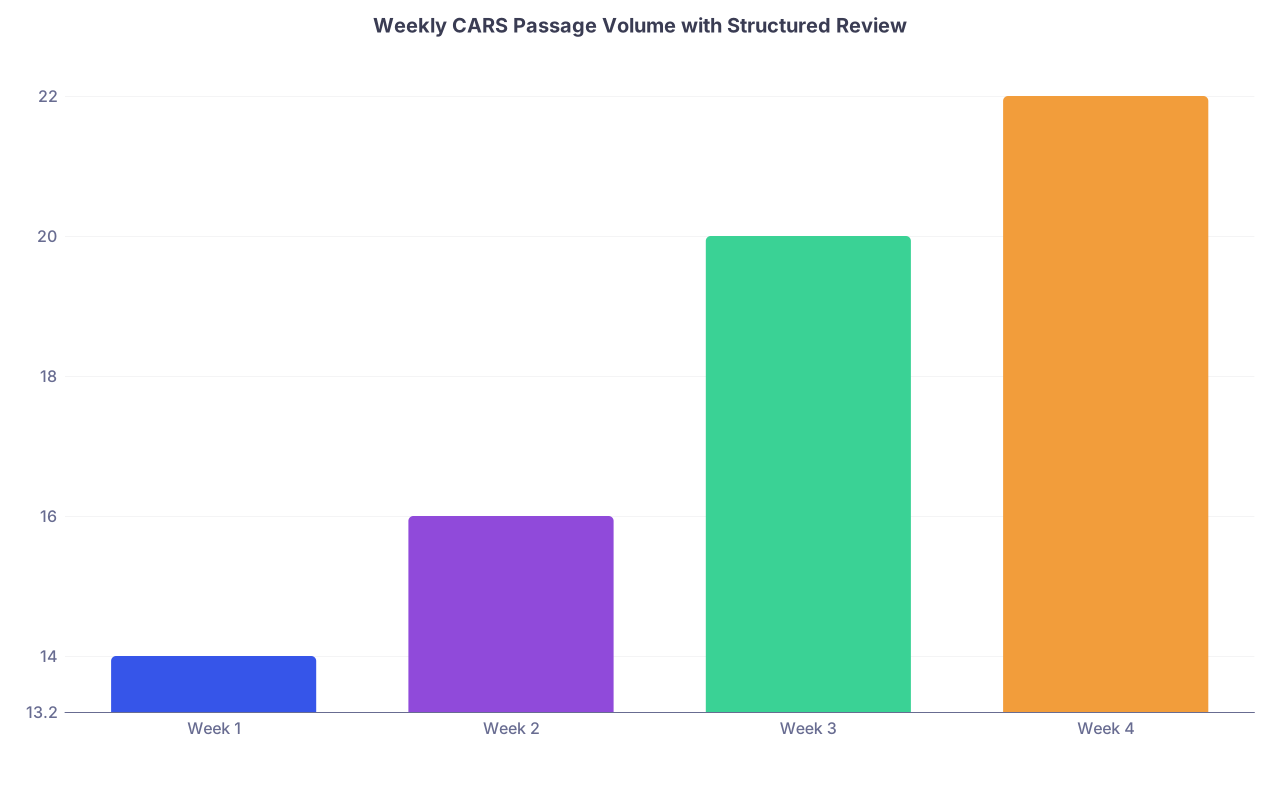
| Category | Value |
|---|---|
| Week 1 | 14 |
| Week 2 | 16 |
| Week 3 | 20 |
| Week 4 | 22 |
Notice you are not doing 40 passages a week. You do enough with high quality.
Example: Running One Full 45-Minute Session
Let me walk through a condensed, realistic example so you can see this in action.
- You sit down at 7:00 PM. Timer set to 45 minutes.
7:00–7:05 (Warm-up)
You grab a paragraph from Aeon about “the ethics of memory deletion.”
- You read it.
- You write: “Author is skeptical about deleting memories; worried about identity.”
- One-sentence summary: “The author argues that erasing painful memories could undermine personal identity and moral growth.”
Brain is now in argument‑mode, not TikTok‑mode.
7:05–7:17 (Passage #1)
Humanities passage from an AAMC-style resource.
- 0–3 min: Read, jot:
- P1: “Intro: traditional view of art.”
- P2: “Challenges ‘art as representation’ idea.”
- P3: “Offers new definition: art as experience.”
- Main point: “Author argues we should treat art as an experiential process, not just representation.”
- 3–9 min: Answer questions, predict before choices.
- 9–12 min: Write main point, paragraph roles again. Circle Q3 and Q6 as “shaky.”
7:17–7:25 (Review #1)
Check answers. You missed Q3, Q6, and guessed but got right on Q4.
- Q3 (inference): You wrote:
- Type: Inference.
- Error: Picked answer that “sounded smart” but introduced idea about economics not in passage.
- Key phrase: P2 line 3, where author only talks about emotional response, not money.
- New rule: “No answer that brings in new domains (money, politics, etc.) unless hinted.”
Already you are clearer on your own nonsense.
7:25–7:37 (Passage #2)
Philosophy passage about “free will and determinism.”
- 0–3 min: After each paragraph, you say in your head, “So what?” and jot:
- P1: “Sets up classic free will vs determinism.”
- P2: “Gives compatibilist solution.”
- P3: “Addresses common objection.”
- Main point: “Compatibilism rescues responsibility even in a determined world.”
- 3–9 min: Questions with prediction.
- 9–12 min: Main point again, roles, circle Q2 and Q5 as “iffy.”
7:37–7:45 (Review #2)
You missed Q2 only, but had 2 “○” questions.
- You log:
- Q2: Tone question. You picked “enthusiastic,” right answer was “measured support.”
- Error: Ignored hedging words like “perhaps,” “it might be said.”
- New rule: “Tone: look for hedges before labeling as ‘enthusiastic’ or ‘strongly supportive’.”
You close the notebook at 7:45 PM. You did 2 passages. But you learned more about your brain in 45 minutes than in your last 2 weeks of 5‑passages‑a‑day mindless grinding.
Visualizing the Daily Workflow
Here is your daily process at a glance:

| Step | Description |
|---|---|
| Step 1 | Start 45-min session |
| Step 2 | 5-min warm-up |
| Step 3 | Passage 1: 9-min timed |
| Step 4 | Passage 1: 3-min self-check |
| Step 5 | Passage 1: 8-min deep review |
| Step 6 | Passage 2: 9-min timed |
| Step 7 | Passage 2: 3-min self-check |
| Step 8 | Passage 2: 8-min deep review |
| Step 9 | Update mistake log & stop |
Print that. Tape it above your desk. Follow it.
Your Move: Start One Session, Today
Do not “plan to start this next week.” That is how people stay stuck at 124–125 forever.
Here is your very next step:
Before you close this window, schedule one 45‑minute block in the next 24 hours.
When that time comes:
- Grab two CARS passages in advance.
- Set a 45‑minute timer.
- Follow the exact blocks: 5 + 12 + 8 + 12 + 8.
- Start a fresh “CARS mistake log” in a notebook or document and write down every new rule you discover.
Then repeat tomorrow. And the next day.
Your CARS score is not stuck because you are “not a good reader.” It is stuck because your process is sloppy and unstructured. This 45‑minute plan fixes that. Run it daily and your reading habits—and your score—will catch up.