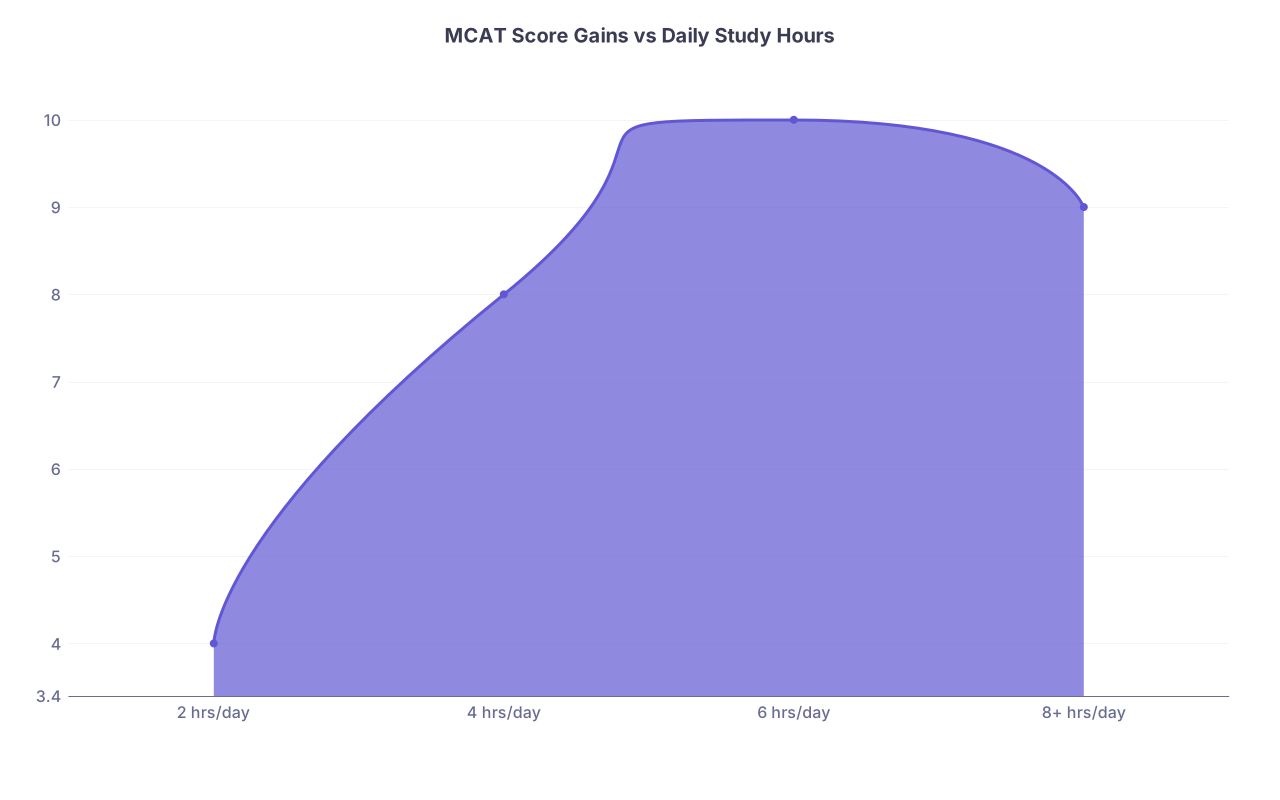
The way most premeds deal with MCAT passage anxiety is backwards. They keep buying new resources, but never fix the actual problem: their brain goes into fight‑or‑flight every time a passage loads.
You do not need more content. You need a protocol.
What follows is exactly that: a stepwise, testable plan to turn “heart racing, eyes skimming, nothing sticking” into calm, mechanical reading you can trust on test day.
This is not theory. This is what I have seen work for anxious high‑scorers who thought they were “just bad at passages” until they trained their nervous system and process, not just their knowledge.
Step 1: Diagnose Your Exact Version of Passage Anxiety
“Passage anxiety” is not one thing. If you do not nail down your flavor, you will keep treating the wrong problem.
Here is what I see over and over:
Visual Freeze
- You see a dense science passage and your brain blanks.
- You read the same sentence 3 times and still could not say what it meant.
- Timer awareness makes it worse.
Compulsive Rushing
- You skim everything because “I do not have time.”
- You hit questions half‑understanding the passage.
- Miss easy inference questions, then feel stupid.
Perfectionist Over‑Reading
- You try to fully master every detail in the passage.
- You over‑annotate, overthink.
- Run out of time with 3–6 questions left in the section.
Timer Panic
- You start each passage by checking the clock.
- You recheck time every 1–2 questions.
- Your working memory collapses under the stress.
Content Triggers
- Certain topics (circuits, genetics, experimental design, philosophy in CARS) spike your anxiety.
- You mentally label them as “my weakness” and your performance collapses before you even start.
You probably recognize more than one. Good. That gives you more entry points.
Do this tonight:
- Take 2 recent practice sections.
- For each passage, write one word to describe your state: “frozen,” “rushing,” “fine,” “lost,” “overthinking,” etc.
- Circle your most common pattern.
Your plan will keep coming back to that pattern. The goal is not “feel less nervous” in some vague way. The goal is “I do not freeze on dense passages anymore” or “I stop rereading and actually move on.”
Step 2: Build a 20‑Second Pre‑Passage Reset Ritual
You cannot read calmly if you start each passage in full sympathetic overdrive. You need a hard reset. Not a cute idea. A concrete ritual.
You will use this ritual before every single passage for the next month of practice. No exceptions.
The 20‑Second Reset
Eyes Off the Screen (3 seconds)
- Take your eyes off the passage.
- Look at the desk or the wall, not the timer.
- This breaks the “panic as soon as the text appears” loop.
4‑4‑6 Breath (10–12 seconds)
- Inhale through the nose for 4 seconds.
- Hold for 4 seconds.
- Exhale slowly for 6 seconds through the mouth.
- One deep cycle is enough; two cycles if you are really amped.
One‑Sentence Intent (3–5 seconds) Whisper to yourself (in your head on test day, out loud in practice):
- For C/P & B/B: “My job is to track the main idea and key relationships.”
- For CARS: “My job is to understand what the author believes and why.”
- For P/S: “My job is to link this to known psych/soc concepts.”
No pep talks. No positive affirmations. You are not doing therapy. You are flipping your brain from “threat” to “task.”
Run this ritual in timed practice until it feels automatic. It will “waste” 15–20 seconds per passage. You will earn back minutes in reduced rereading and cleaner decision‑making.
Step 3: Use a Simple, Non‑Negotiable Reading Template
Most anxious readers improvise. Improvisation under stress is chaos.
You need a template for reading that stays the same no matter what the passage is about. That stability is what calms your brain.
Here is a stripped‑down template that actually works under time pressure.
Science Passages (C/P and B/B)
Goal: Capture structure and relationships, not every detail.
First Sentence of Each Paragraph = Job Description As you read the first sentence, silently ask:
- “Why is this paragraph here?”
- Label it in 2–4 words in your head: background, hypothesis, methods, results, explanation, limitation.
That is it. No underlining half the screen.
Circle (mentally or lightly) Only Three Things On scratch paper or in your head (practice both):
- Variables (X, Y, hormone A, receptor B)
- Direction of relationships (↑, ↓, inhibits, activates)
- Unfamiliar terms you might need to reference
If you are highlighting five different colors, stop. You are decorating, not reading.
Math/Eqns: Name Them, Do Not Solve Yet When you see an equation or relationship:
- Say out loud in practice: “Pressure is proportional to 1 over volume.” Or “Velocity is proportional to square root of height.”
- Write the bare‑bones version on scratch:
P ∝ 1/V,v ∝ √h.
Your only job during reading is: what depends on what, and how.
End of Passage: 5‑Second Recap Before touching the questions, force yourself to think:
- “One‑line summary of passage.”
- “What was measured/manipulated?”
- “Any big picture conclusion?”
If you cannot do this, you read too fast or zoned out. Adjust on the next passage. Not this one—you move on.
CARS Passages
You do not have time to annotate like a literature PhD. You need a lean system.
First Paragraph: Lock the Frame Answer in your head:
- Who is speaking? (philosopher, critic, historian)
- About what? (art, ethics, economy)
- General vibe? (pro, con, skeptical, conflicted)
Every Paragraph: Track Movement After each paragraph, in 3 words or less:
- “Example of X”
- “Counterargument”
- “New view”
- “History of idea”
That is it. No detailed notes.
Flag Strong Opinions When the author shows their hand—strong adjectives, “clearly,” “of course,” “it is mistaken to assume”—mentally bold those. That is where inference questions live.
No Back‑Reading Before Questions You finish the passage, then go to questions. You are allowed to scroll back only during questions, and only with a purpose (“Where did they mention Kant?”) not aimless hunting.
Psych/Soc Passages
Psych/Soc anxiety is usually content panic plus overconfidence mixing badly.
Use the same structure as science:
- Paragraph job.
- Key variables/constructs.
- How they relate.
Then explicitly link:
- “This is operant conditioning versus classical.”
- “This is groupthink versus group polarization.”
Do not trust your gut; label the concept before moving on. This stops that horrible “I knew this but I clicked the wrong one” feeling.
Step 4: Put the Timer Back in Its Place with a Hard Pacing Rule
People with passage anxiety either stare at the clock constantly or avoid it entirely. Both are bad.
You need scheduled timer checks that you obey like protocol.
A basic pacing structure:
| Section | Total Time | # of Passages | Time per Passage (incl. Qs) |
|---|---|---|---|
| C/P | 95 min | 10 | ~9 min 30 sec |
| CARS | 90 min | 9 | ~10 min |
| B/B | 95 min | 10 | ~9 min 30 sec |
| P/S | 95 min | 10 | ~9 min 30 sec |
You are not going to hit these exactly per passage, and you do not need to. But you must have checkpoints.
The 3‑Checkpoint Rule
For each section, check the clock only at:
- After Passage 3
- After Passage 6
- After Passage 9 (or last)
Your targets:
- At P3 — you want to be around 65–70 minutes left in C/P/B/B and ~63–66 in CARS.
- At P6 — around 35–40 minutes left.
- At P9 — 5–10 minutes left for final passage(s).
If you are:
- Ahead: Do not “reward” yourself by rereading everything. Keep your process the same.
- Behind by 5+ minutes: Commit on the spot: the next passage, you will move on faster. That means:
- Less rereading.
- Earlier elimination and guessing when stuck.
Timer anxiety is often really decision anxiety. You waste time on unsalvageable questions. Which leads to the next step.
Step 5: Create a Personal “Bail‑Out Protocol” for Bad Questions
A single ugly question can hijack your nervous system for an entire passage. You need pre‑decided rules for quitting.
Here is a bail‑out protocol I give almost every anxious test taker:
Bail‑Out Rule 1: The 45‑Second Wall
If, after ~45 seconds:
- You still do not understand what the question is asking, or
- You are staring at the answers hoping one “feels right,”
Then you:
- Eliminate any obviously wrong choices.
- Pick from the remaining 2–3 based on any logical rationale.
- Mark and move on.
You do not earn extra points for beating one monster question. You absolutely lose points by letting it wreck the rest of the passage.
Bail‑Out Rule 2: The Second Read Cap
You are allowed to re‑read one specific sentence in the passage for a question.
If you find yourself:
- Jumping back and rereading a whole paragraph, or
- Reading the same line more than twice,
You must:
- Make the best call you can with what you have.
- Accept potential loss on this question.
- Move on.
Most anxious students bleed 6–10 minutes per section on exactly this pattern.
Bail‑Out Rule 3: One “Sacrificial” Passage per Section (Optional but Powerful)
In practice:
- Choose one passage per section that feels particularly miserable.
- Force yourself to give it less attention: slightly faster reading, more aggressive guessing on hard questions.
- Prove to yourself that your score does not collapse when you “under‑invest” in one passage.
On test day:
- You are allowed to mentally label one passage as “low investment” if things go south.
- This gives you psychological permission not to get stuck in the quicksand.
Step 6: Daily 20–30 Minute Anxiety‑Targeted Practice (Not Full Tests)
You do not fix passage anxiety by repeatedly taking full‑length exams and hoping to “get used to it.” That is endurance training, not skills training.
You need short, high‑quality drills that hit the anxiety circuits directly.
Drill Block Structure (20–30 Minutes)
4 passages only:
- 1 C/P or B/B science passage
- 1 CARS passage
- 1 B/B or C/P (whichever you did not pick)
- 1 P/S passage
For each passage:
- Run your 20‑second reset ritual.
- Read using the template. No skipping steps.
- Time yourself aggressively.
- For science and P/S: 8 minutes per passage, max.
- For CARS: 9 minutes per passage, max.
- Immediately after finishing the questions, do a 60‑second debrief:
- Was I freezing, rushing, or over‑reading?
- Did I bail out on any bad questions, or did I get sucked in?
- Did I obey the second‑read cap?
Write answers in one or two bullet points. This is not journaling. It is data collection.
Do this 5–6 days per week for 2–3 weeks, and your relationship with passages will change far more than grinding yet another QBank randomly.
Step 7: Simulate Worst‑Case Scenarios on Purpose
Anxiety loves surprises. So your job is to pre‑expose yourself to the worst cases until they are boring.
Pick 2–3 of these and build them into your study week.
Simulation Ideas
The “Disaster Passage” Drill
- Intentionally pick a brutal passage (awful topic or dense experimental design).
- Your only goal: execute your process without emotionally reacting.
- Score does not matter. Process does.
“Start Behind on the Clock” Drill
- For a practice section, manually subtract 5–10 minutes from your available time.
- You will start slightly “late.”
- Your job: obey your pacing and bail‑out rules anyway, no panicking.
“One Bad Passage Already Happened” Drill
- Do one passage first that you intentionally bomb (random guessing).
- Then do 3 regular passages.
- Goal: Do not let the first disaster affect your behavior or speed on the rest.
On exam day, when you do hit a miserable passage, your brain will say, “Oh, this. We trained for this,” instead of, “Everything is over.”
Step 8: Anchor Confidence in Process, Not Score
The fastest way to stay anxious forever is to only measure “Did I get a 5xx+ on this practice test?”
You need process metrics that you can win daily, even when scores fluctuate.
Here are the metrics I actually care about when someone has passage anxiety:
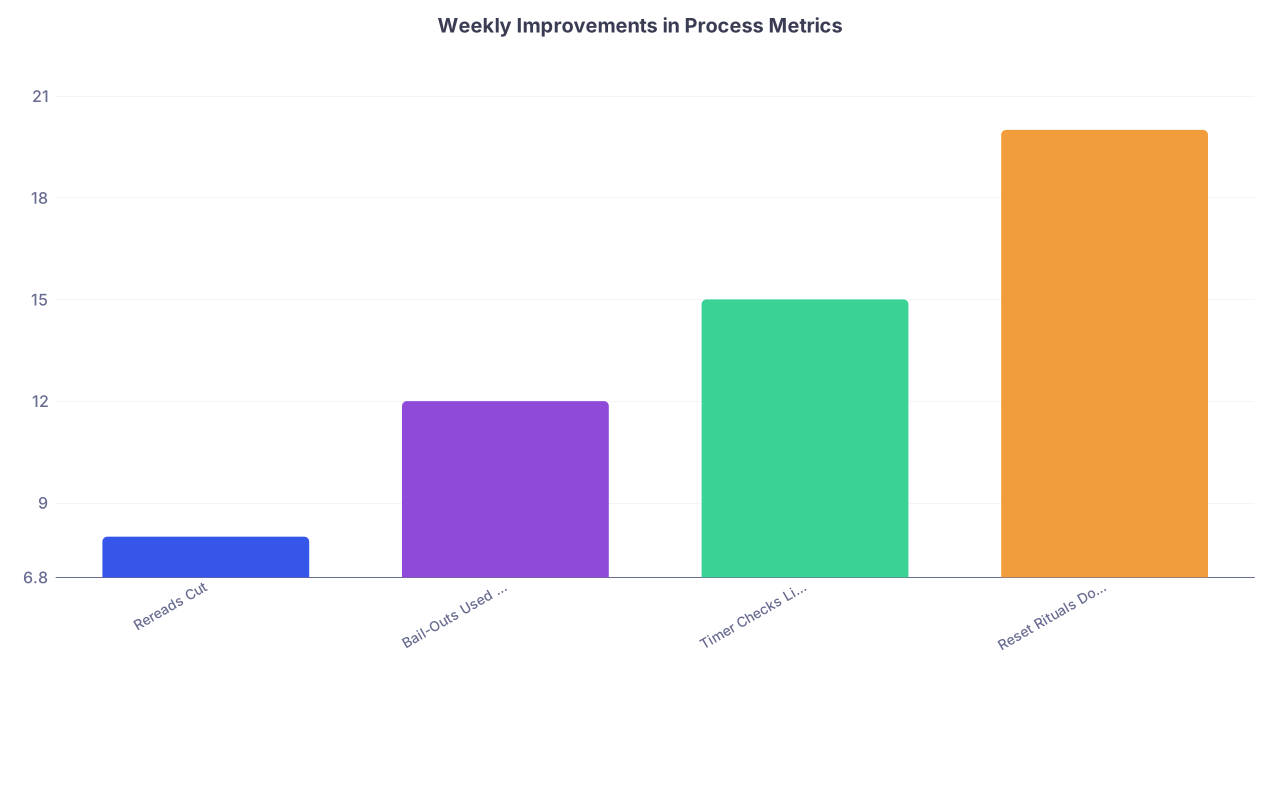
| Category | Value |
|---|---|
| Rereads Cut | 8 |
| Bail-Outs Used Correctly | 12 |
| Timer Checks Limited | 15 |
| Reset Rituals Done | 20 |
Track, per section:
- How many times did I reread paragraphs more than once? (You want this trending down.)
- How many questions did I bail out on appropriately instead of getting stuck?
- Did I limit timer checks to my 3 checkpoints?
- Did I use the reset ritual before every passage?
At the end of each day, answer these two questions in writing:
- “What part of my process improved today?”
- “Where did I break my own rules?”
This keeps your brain focused on controllable behavior instead of obsessing over every 1–2 point score swing.
Step 9: A Test‑Day‑Ready Passage Anxiety Game Plan
Let us stitch this into something you can actually use on the real MCAT.
Night Before
- Review:
- Your 20‑second reset ritual.
- Your reading template (bullet points only, not textbooks).
- Your three bail‑out rules.
- Do 2–3 light passages max, at 70–80% speed.
- Not a full section.
- The goal is to feel your system working, not to “cram.”
Morning Of
- No new content.
- Maybe 1 easy passage just to warm up your brain, if you are that type. If that tends to spike your anxiety, skip it.
During Each Section
For each passage:
- Pause + Reset (eyes off screen + 4‑4‑6 breath + 1‑sentence intent).
- Read with template (paragraph job, key relationships, quick mental summary).
- Questions with bail‑out rules enforced.
- After Passage 3/6/9: quick clock check against your pacing landmarks. Adjust slightly, do not spiral.
If you feel a panic wave hit mid‑section:
- Look away briefly.
- One 4‑4‑6 breath.
- Tell yourself (in your own words): “Next question only.” Then act like the last one did not exist.
You are not running a feelings contest. You are running protocols under varying levels of discomfort.