
The usual way people “study” for Psych/Soc is exactly why their scores stay weak. Too much highlighting and Anki, not enough targeted question-driven repair.
You can fix a weak Psych/Soc section in one focused month. But you must treat it like a surgical problem set, not a vocabulary marathon.
Below is a concrete, four‑week repair plan for someone who:
- Is within 4–8 weeks of their MCAT,
- Has Psych/Soc as their lowest section (often 123–126 range on practice),
- Has basic content exposure but keeps missing questions or second‑guessing.
If your Psych/Soc is a total mystery (never studied it at all), this still works. You will just need to push the first 10 days harder.
Step 1: Diagnose Why Your Psych/Soc Is Weak (2 Days, Max)
You cannot fix what you have not measured. And most students misdiagnose this section.
1.1 Do a 59‑Question Autopsy
Pull a full Psych/Soc section from one of these:
- AAMC Sample or scored FL
- Blueprint/Altius/NextStep if you are out of AAMC exams
Then:
Take it timed. No pausing, no checking. Standard 95 minutes.
Immediately score it. Write down:
- Raw score and scaled if available.
- Number wrong by passage vs discrete.
Create a simple error log (use a spreadsheet or notebook):
Columns:
- Question #
- Topic (e.g., “conditioning,” “research methods,” “demographics”)
- Error type (content gap / misread question / overthinking / time pressure)
- Your chosen answer vs correct
- Short why: 1–2 lines only
Most people discover patterns fast:
- 70–80% of errors from 5–8 recurring topics
- Surprise cluster of misses in research/design and statistics
- Weird tendency to miss “easy” definition questions because of sloppy reading
That pattern determines your month.
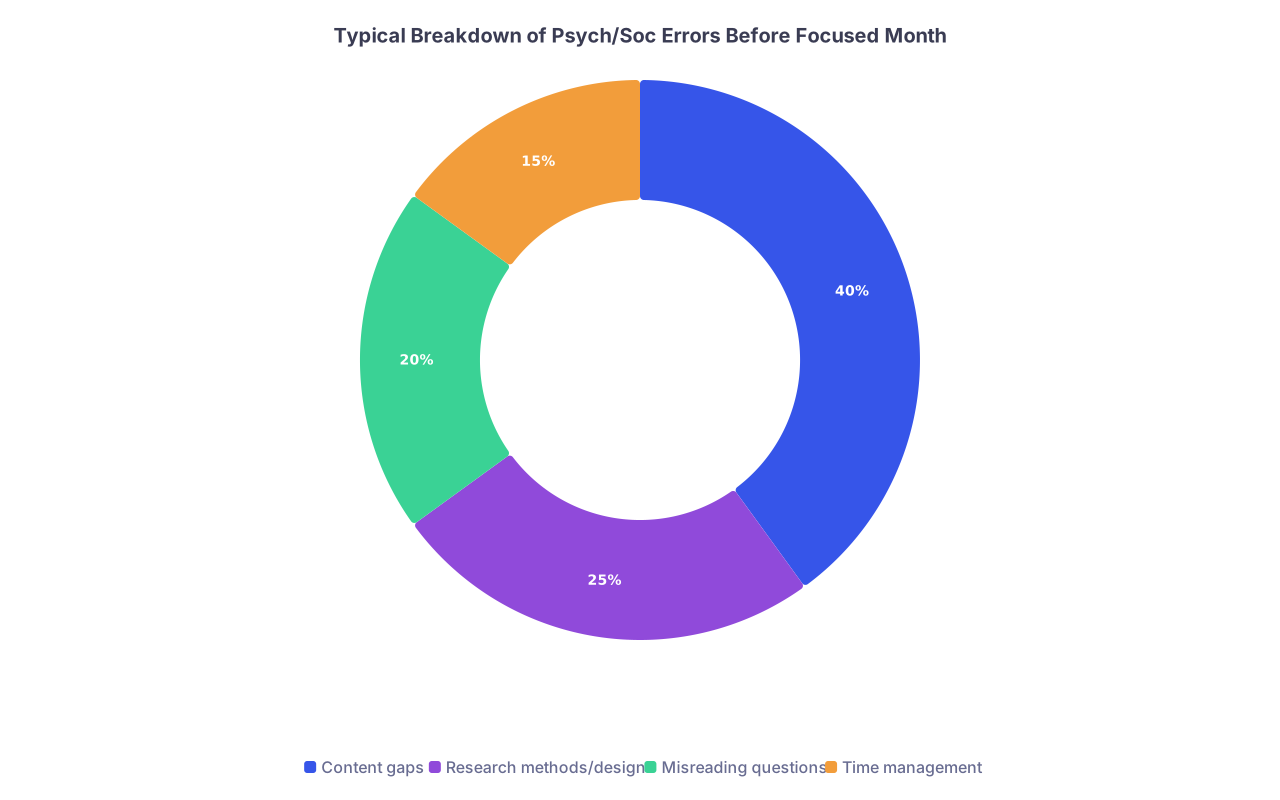
| Category | Value |
|---|---|
| Content gaps | 40 |
| Research methods/design | 25 |
| Misreading questions | 20 |
| Time management | 15 |
Step 2: Build a One‑Month Study Framework
You get one month. Treat it like a short rotation.
Here is the structure first, then we will walk through each week.
| Week | Primary Focus | Daily Time (approx) |
|---|---|---|
| 1 | Core content rebuild + error log | 1.5–2 hours |
| 2 | High-yield topics + heavy Q-bank | 2 hours |
| 3 | AAMC focus + exam-style reasoning | 2–2.5 hours |
| 4 | Refinement, timed sets, pattern drilling | 1.5–2 hours |
Non‑negotiables for the whole month:
- Every day: At least 20–30 Psych/Soc questions.
- Every question: Fully reviewed with “why did I miss this?” written down.
- Two days a week: Timed mini-blocks (18 or 30 questions).
Psych/Soc rewards repeated exposure and pattern recognition, not heroic 8‑hour cram days once a week.
Step 3: Week 1 – Core Content, But Ruthlessly Targeted
Goal: Move from “I sort of remember that term” to “I can define and apply it in a sentence.”
Time: 7 days, 1.5–2 hours per day.
3.1 Use One Primary Resource, Not Five
Pick one main content source and commit:
- Khan Academy Psych/Soc videos + notes (still gold for AAMC‑style wording)
- Or Anki deck that closely follows the AAMC content list (Milesdown or similar)
- Or Blueprint / Kaplan Psych/Soc book if you genuinely learn better from text
You do not need three resources. You need one you will actually finish.
3.2 Build a Short High‑Yield Topic List
From your diagnostic and the AAMC content outline, identify the top 8–10 areas you are weak on.
Typical offenders:
- Classical vs operant conditioning, reinforcement schedules
- Types of norms, sanctions, deviance, labeling theory
- Socialization, agents of socialization
- Theories: functionalism, conflict, symbolic interactionism, social constructionism, exchange-rational choice
- Prejudice, discrimination, stereotyping, stigma
- Social mobility, absolute vs relative poverty, social reproduction
- Demographics: age, gender, race, ethnicity, migration, birth/death rates
- Research methods: independent vs dependent variable, types of studies, validity, reliability, bias
Write them down. Put the list where you study. That is your hit list.
3.3 Daily Plan for Week 1
Approx 90–120 minutes:
45–60 minutes: Focused content blocks
- Pick 2–3 topics from your list.
- Watch Khan videos or read targeted section of your resource.
- For each key term: write a one‑sentence definition + one example in your own words.
- Example: Confirmation bias – focusing on evidence that supports my prior belief; e.g., a physician who only remembers successful uses of a treatment and ignores failures.
30–40 minutes: 20–30 mixed questions
- Use UWorld, Blueprint, or another Q-bank.
- Do them timed, in 10–15 question chunks.
- Tag wrongs by topic in your error log.
10–15 minutes: Error log review
- Re‑write 3–5 “weak” terms from today’s misses with new examples.
- If a concept shows up twice in one day, it becomes a priority for tomorrow’s content.
By the end of Week 1, you should feel:
- Less “I have never heard of this.”
- More “I know what this is, but I still mess up on tricky answer choices.”
Good. That means you are ready to switch from pure content to exam behavior.
Step 4: Week 2 – Question-Driven Learning and Pattern Recognition
Goal: Turn content into test performance. Psych/Soc is mostly pattern, not brute force memorization.
Time: 7 days, 2 hours per day.
4.1 Double Down on Questions
You are now shifting to about 40–60 questions/day.
Use:
- UWorld Psych/Soc (preferred for explanation quality),
- Or Blueprint, Kaplan, etc., if that is what you have.
Daily structure:
- Set 1: 18 questions timed (passage + discretes) – 35 minutes
- Review Set 1: 40–45 minutes
- For each wrong or guessed question:
- Label: content vs reasoning vs misread.
- Write down: “The trap was ___, the correct reasoning is ___.”
- For each wrong or guessed question:
- Set 2: 15–20 questions untimed – 25–30 minutes
- Review Set 2: 20–25 minutes
4.2 Learn the Common Wrong-Answer Traps
I see the same failures over and over. If you do not name them, you will keep falling for them.
Common traps in Psych/Soc:
- Too broad / too narrow
- Example: Question wants “confirmation bias,” but you pick “schemas” because it sounds fancier.
- Matching one word from the passage
- E.g., passage mentions “groupthink”; you pick groupthink even when the question stem is asking about conformity.
- Swapping cause and effect
- Causal errors in epidemiology style questions and research design.
- Mixing similar pairs
- Prejudice vs discrimination, role conflict vs role strain, Mead’s “I” vs “me,” stereotype threat vs self-fulfilling prophecy.
Every time you miss one of these, tag it explicitly in your log:
“Picked ‘social facilitation’ but stem described social loafing – confused direction of performance change.”
That is how you prevent repeat mistakes.
Step 5: Week 3 – AAMC‑Style Mastery
Goal: Align with AAMC language and exam expectations. Third‑party questions are good for training; AAMC is the gold standard for calibration.
Time: 7 days, 2–2.5 hours per day.
5.1 Move to Mostly AAMC Material
Sequence for Week 3:
- AAMC Question Packs (Psych/Soc)
- Do in 20–30 question chunks.
- AAMC Section Bank Psych/Soc – if available
- These are harder. Good. They reveal your weak logic.
Aim for:
- 150–200 AAMC Psych/Soc questions total this week.
5.2 AAMC‑Specific Review Method
For AAMC questions, the review process matters more than the number of questions.
For each set:
First pass:
- Note your confidence level per question (low / medium / high) next to your answer.
- After scoring, mark:
- Wrong + high confidence = dangerous misconception
- Right + low confidence = guess (you still do not really own it)
Second pass: Build a mini‑deck
- For each dangerous misconception, write a Q/A card:
- Q: “What is the difference between stereotype threat and self-fulfilling prophecy?”
- A: Short, clear distinction + example for each.
Keep this deck small (20–40 items). Review daily.
- For each dangerous misconception, write a Q/A card:
Third pass: Passage‑level insights
- For each passage you struggled with, ask:
- “What was the main point?”
- “Which question stem wording tricked me?” (e.g., asking about function vs definition, or most likely vs least likely).
- For each passage you struggled with, ask:
This is tedious. It is also exactly why scores jump in this section.
Step 6: Week 4 – Refinement, Speed, and Exam Simulation
Goal: Stabilize mid‑ to high‑120s Psych/Soc into consistent 128+ performance.
Time: 7 days, 1.5–2 hours per day (more if your test is in week 5 and you are doing full FLs).
6.1 Timed Mini‑Sections
Twice this week (ideally days 2 and 5):
- Do a full 59‑question Psych/Soc section timed under close‑to‑exam conditions:
- 95 minutes
- No phone, no pausing
- Simulate break/sequence like real test if possible
Use:
- Any remaining AAMC FL sections you have not used
- Or highest‑quality third‑party if AAMC is exhausted
Then do a brutal review:
- Tag every wrong and every low‑confidence guess in your error log.
- Identify:
- Top 3 content weaknesses that still show up
- Top 2 reasoning/reading patterns that still cost you points (e.g., misreading “NOT,” panicking on research questions)
6.2 The “Five Mistakes Per Day” Rule
Each of the remaining days:
- Pick 5 previous mistakes from your error log.
- For each, write:
- The original question ID
- Why you missed it
- The correct rule or concept, in one clear sentence
- One new example you invent yourself
Example:
- Mistake: chose “social facilitation” when the question described decreased performance in a group.
- Rule: social facilitation = improved performance on simple tasks with audience; social loafing = decreased effort when in a group.
- New example: A student works harder during solo practice than in group rehearsal = social loafing.
This step is where you convert random fixes into durable, exam‑day patterns.
6.3 Light Content Touch-Ups
If your review still reveals repeated weak concepts (e.g., specific theories, demographics, or statistical terms), schedule 2–3 short, 20‑minute content bursts this week:
- One on research methods/statistics
- One on sociological theories
- One on demographics and social stratification
Do not re‑read whole books. You are spot‑treating.
Step 7: Topic‑By‑Topic Fixes for the Usual Psych/Soc Nightmares
Here is how I would quickly patch the most common weak areas.

7.1 Conditioning and Learning
You must be automatic here. No hesitation.
Classical conditioning
- Focus on: UCS, UCR, CS, CR, extinction, spontaneous recovery, generalization, discrimination.
- Fix: Draw 3–4 simple conditioning scenarios and label them. Pavlov's dog, fear of dogs after a bite, etc.
Operant conditioning
- Focus on: positive/negative reinforcement, punishment, reinforcement schedules.
- Fix: Make a 2x2 grid: positive/negative vs reinforcement/punishment. Fill with concrete examples from daily life.
Schedules of reinforcement
- Variable ratio, fixed ratio, variable interval, fixed interval.
- Fix: One memorable example per schedule (e.g., slot machines for variable ratio).
7.2 Research Methods and Stats
Students chronically underestimate how much Psych/Soc losses come from here.
Core concepts:
- Independent vs dependent variable
- Operational definition
- Types of studies: cohort, cross-sectional, case-control, experimental
- Validity (internal vs external), reliability, bias, confounding, mediators, moderators
Repair protocol:
- Take 15–20 research‑focused questions in a row.
- For each question, explicitly label:
- IV, DV
- Study design
- Any bias/confounder mentioned
- Build a one‑page “research sheet” with:
- Most common study types + 1–line definition + 1 example
- Common biases (selection, recall, social desirability)
Review that page every other day for the month. It pays off.
7.3 Sociological Theories
Theories blend together. AAMC expects you to separate them fast, with function and level of analysis in mind.
Quick framework:
- Functionalism – parts of society work together to maintain stability.
- Conflict theory – groups compete over resources and power.
- Symbolic interactionism – micro-level meaning from interaction and symbols.
- Social constructionism – reality is created through shared meanings and agreements.
- Rational choice / exchange theory – individuals act based on cost–benefit and rewards/punishments.
Fix:
- Make a 5‑row comparison table: theory / level (micro vs macro) / key idea / 1 example.
- Do 10–15 questions focusing only on theories.
- For every miss, update your table.
Step 8: Time and Pace – Stop Bleeding Points From Rushing
Even strong students lose 2–4 points in Psych/Soc just from sloppy timing.
Ideal pacing:
- 59 questions / 95 minutes → about 1.6 minutes per question.
- Target:
- Discretes: ~60–75 seconds
- Passage questions: 80–100 seconds
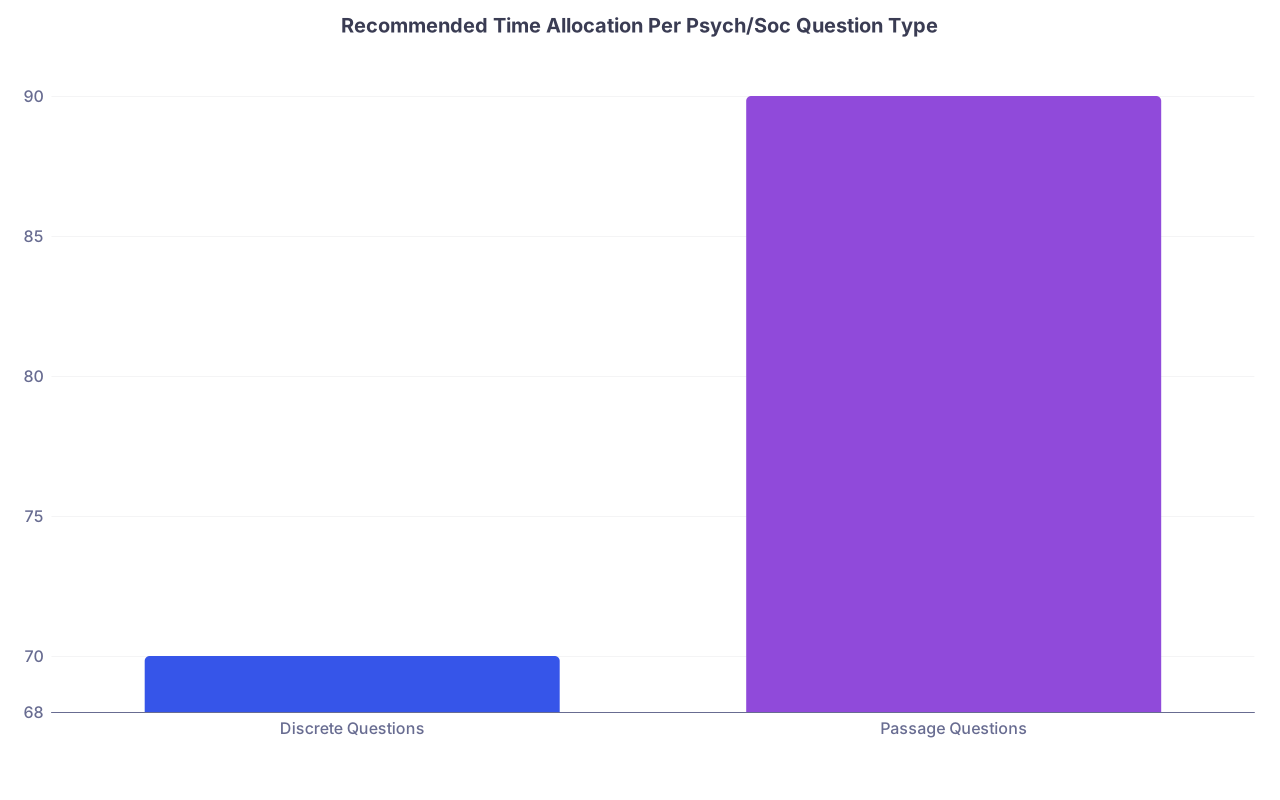
| Category | Value |
|---|---|
| Discrete Questions | 70 |
| Passage Questions | 90 |
Practical fixes:
- Read the question stem first, then the relevant passage lines. Many Psych/Soc questions are barely tied to the passage.
- If you are stuck at 1:30 with no clear choice, make the best elimination you can and move on. Do not spend 3 minutes on a single question.
- Mark questions where you:
- Rushed and misread words like “NOT,” “EXCEPT,” “LEAST.”
- Changed a right answer to a wrong one last‑minute without new evidence.
If you catch yourself changing answers just because you got nervous, build a rule:
“I only change answers if I find explicit evidence in the passage or stem that contradicts my first choice.”
Step 9: Integrate Psych/Soc Into Your Full MCAT Prep
Big mistake: treating Psych/Soc as an afterthought once a week.
You want small, daily contact.
9.1 Minimal Daily Baseline
Even on heavy C/P or B/B days, commit to:
- 20 Psych/Soc questions
- 5–10 minutes reviewing 5 old mistakes from your log
That is it. But it keeps the neural pathways “warm.”
9.2 Weekly Structure With Full Lengths
If your exam is close, you may be doing 1 FL per week. A simple integration model:
- FL Day: Focus on test. Later or next day, do a targeted review of only the Psych/Soc section (60–90 minutes).
- Next 2–3 days: Fold Psych/Soc weak topics from that FL into your daily practice sets.
- Later in week: One timed mini-section (30–40 questions) focusing on those categories.
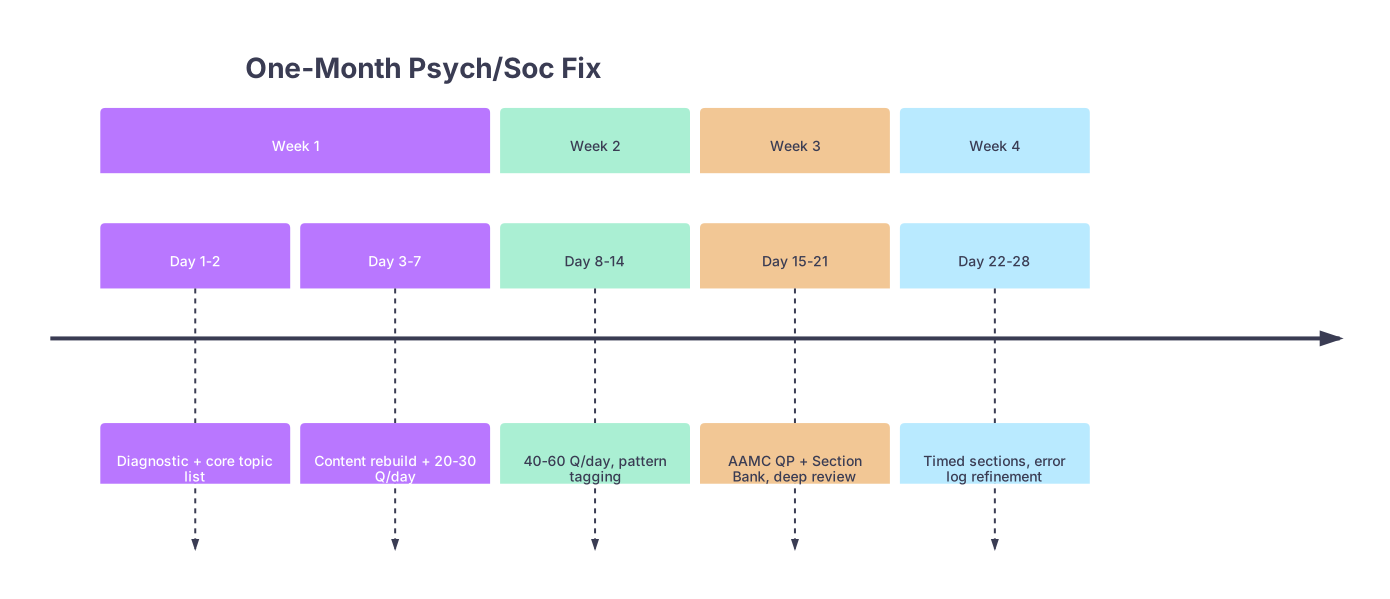
| Period | Event |
|---|---|
| Week 1 - Day 1-2 | Diagnostic + core topic list |
| Week 1 - Day 3-7 | Content rebuild + 20-30 Q/day |
| Week 2 - Day 8-14 | 40-60 Q/day, pattern tagging |
| Week 3 - Day 15-21 | AAMC QP + Section Bank, deep review |
| Week 4 - Day 22-28 | Timed sections, error log refinement |
Step 10: How to Know If the Plan Is Working
You do not want to realize two days before the exam that nothing changed.
Set clear checkpoints:
End of Week 1
- Q‑bank performance: at least 5–10% improvement over diagnostic.
- Subjective: you recognize most terms and can define them in plain English.
End of Week 2
- Q‑bank averaged over 3–4 sessions: trending into 75–80% correct range.
- Your error log shows fewer content gaps and more reasoning errors (this is good, because reasoning is easier to fix late).
End of Week 3
- On AAMC Question Packs: your percentage correct is much closer to your target score band.
- Your misses feel predictable; you can say, “Yep, I still rush statistics questions,” rather than “I have no idea what went wrong.”
Week 4 Timed Section
- Scaled or estimated Psych/Soc score is within 1–2 points of your target for at least one full section.
If you are not seeing movement:
- You are likely:
- Skipping detailed review,
- Not keeping a real error log,
- Or spreading yourself thin with too many resources.
Fix that first. Not more hours. Better hours.
Quick Example: Turning a 124 into a 128 in One Month
I will give you a realistic scenario I have seen:
Initial:
- AAMC FL Psych/Soc: 124
- Complaints: “I recognize terms but always pick the wrong answer.”
Plan:
- Week 1: 1.5 hours/day content + 20–30 UWorld Q/day.
- Week 2: 40–50 Q/day, error log, heavy operant conditioning + theories focus.
- Week 3: AAMC Question Pack 1 + 2, ~150 questions total.
- Week 4: 2 timed Psych/Soc sections, intense review of errors, plus 20 Q/day in between.
Result (very typical when the plan is actually followed):
- End of Week 3 AAMC QP accuracy around 80–85%.
- Next AAMC FL Psych/Soc: 128.
The difference is never “I suddenly became brilliant at psychology.” The difference is structured repetition, error logging, and alignment with AAMC wording.

Tools and Resources: What Actually Helps (and What Does Not)
Worth using:
- Khan Academy Psych/Soc videos and notes
- UWorld Psych/Soc Q-bank
- AAMC Question Packs + Section Bank + FLs
- A concise Anki deck aligned to AAMC (if you actually review daily)
Usually a waste in the last month:
- Reading entire psych textbooks “for understanding”
- Watching random YouTube videos with no connection to your error log
- Cramming hundreds of new flashcards you will never revisit
Pick 2–3 good tools and work them hard. Depth beats breadth here.

Final Tight Summary
Three big points and you are done:
- Stop guessing why your Psych/Soc is weak. Do a serious diagnostic, log every error, and identify the 5–8 topics that are actually killing your score.
- Make questions the center of your month. Every day: 20–60 questions, full review, and a living error log. Use Week 3 to pivot hard into AAMC‑style material.
- Refine, do not cram, in the last week. Timed sections, pattern‑based review of old mistakes, and targeted spot‑fixes for research methods, theories, and conditioning will move you more than any last‑minute content binge.
Follow this for one focused month and your Psych/Soc score will not be your weakest section anymore.