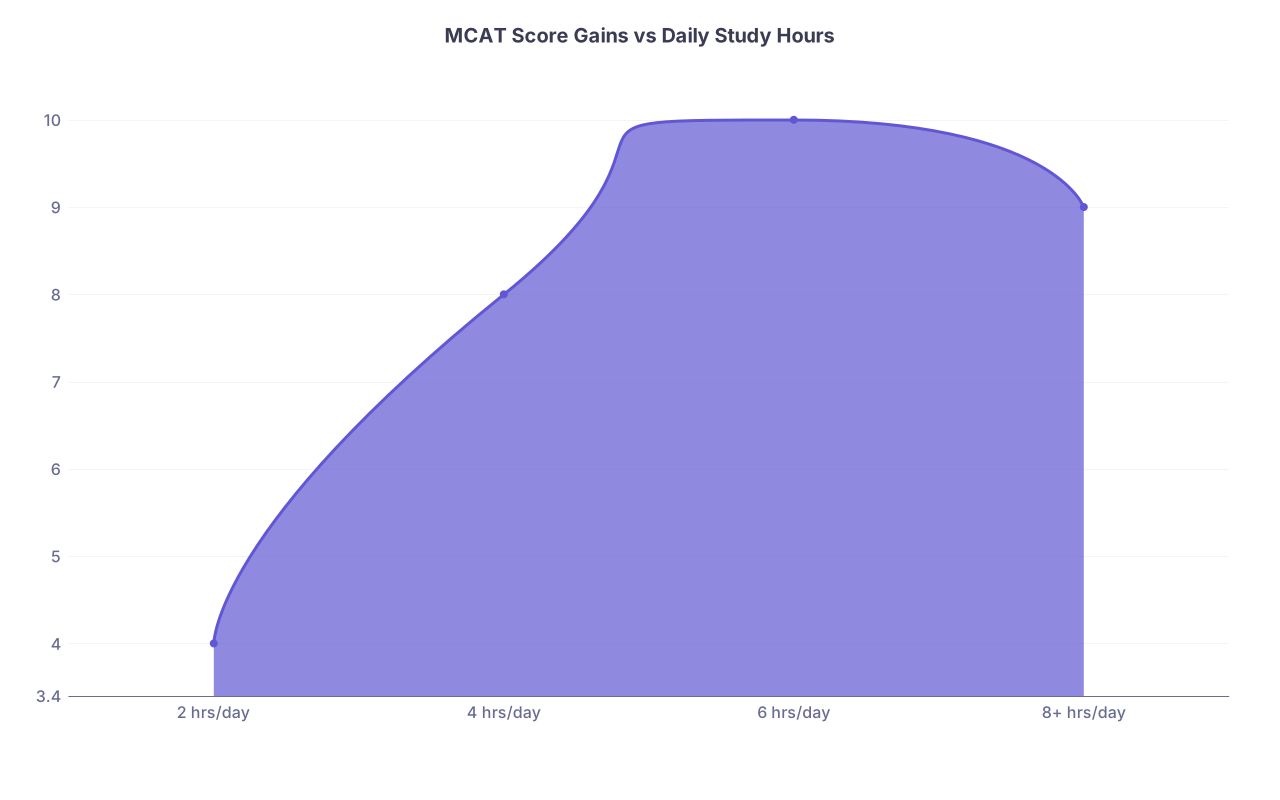
The way most students study amino acids for the MCAT is wildly inefficient. You do not need to “memorize 20 structures.” You need to recognize a handful of patterns that the AAMC recycles over and over.
Let me break this down specifically.
The Real Amino Acid Skill Set the MCAT Tests
Most students think: “If I can draw all 20 amino acids from memory, I am safe.” Wrong. That is overkill in some places and dangerously underprepared in others.
The MCAT repeatedly tests:
- Side-chain chemistry (charge, polarity, acid/base behavior, aromaticity).
- pKa logic and protonation states at given pH.
- Interactions: hydrogen bonding, ionic, hydrophobic, disulfide, π-π interactions.
- Mutation consequences: conservative vs non-conservative substitutions.
- Enzyme mechanics: catalytic residues, active sites, specificity (e.g., chymotrypsin liking aromatics).
- Reading and using amino acid tables quickly under time pressure.
You need to aim at those skills, not generic “memorization.”
The Minimum Amino Acid Facts You Must Own Cold
If you do not know the following from memory, you will bleed points on every FL.
- 3-letter and 1-letter codes.
- Side-chain category (nonpolar, polar uncharged, acidic, basic, aromatic, sulfur-containing).
- Side-chain charge at physiologic pH (~7.4).
- Approximate pKa’s of ionizable groups (side chains + terminal groups).
| Group | Approximate pKa |
|---|---|
| α-COOH (backbone) | ~2 |
| α-NH3⁺ (backbone) | ~9–10 |
| Asp/Glu side chain | ~4 |
| His side chain | ~6 |
| Cys side chain | ~8–8.5 |
| Tyr side chain | ~10–10.5 |
| Lys side chain | ~10.5 |
| Arg side chain | ~12.5 |
You do not need 2-decimal precision. You need relative order and whether a group will be protonated or deprotonated at a specific pH.
Side-Chain Categories: The Only Grouping That Matters
Memorize them by pattern, not by 20 separate brute-force facts.
Nonpolar, hydrophobic (mostly interior of proteins):
- Glycine (Gly, G)
- Alanine (Ala, A)
- Valine (Val, V)
- Leucine (Leu, L)
- Isoleucine (Ile, I)
- Methionine (Met, M)
- Proline (Pro, P)
- Phenylalanine (Phe, F)
- Tryptophan (Trp, W)
Polar, uncharged:
- Serine (Ser, S)
- Threonine (Thr, T)
- Asparagine (Asn, N)
- Glutamine (Gln, Q)
- Tyrosine (Tyr, Y)
- Cysteine (Cys, C)
Acidic (negatively charged at pH 7.4):
- Aspartate (Asp, D)
- Glutamate (Glu, E)
Basic (positively charged at pH 7.4):
- Lysine (Lys, K)
- Arginine (Arg, R)
- Histidine (His, H) — special case, more on this later.
If you cannot recite those by heart, you are not ready for high-yield AA questions.
High-Yield Pattern #1: Charge and Protonation Without Panicking
A huge chunk of amino acid questions reduce to this: “At pH X, what is the net charge of [peptide/side chain/protein region]?”
Students freeze here because they try to do first-principles Henderson–Hasselbalch. You do not have time for that on the MCAT.
Shortcut: The pH vs pKa Rule of Thumb
Use the 1-unit rule:
- If pH is more than 1 unit below pKa → group is mostly protonated.
- If pH is more than 1 unit above pKa → group is mostly deprotonated.
- If pH is within ±1 unit of pKa → mixture, but pick the “dominant” form based on which side pH is on if you must choose.
Then combine this with what “protonated” and “deprotonated” mean for each functional group.
Carboxylic acid (–COOH / –COO⁻):
- Protonated: COOH (neutral)
- Deprotonated: COO⁻ (–1)
Amine (–NH3⁺ / –NH2):
- Protonated: –NH3⁺ (+1)
- Deprotonated: –NH2 (neutral)
Example:
“At pH 7.4, what is the charge on the side chain of glutamate?”
Side chain is a carboxylic acid; pKa ~4. pH 7.4 is >3 units above pKa. So deprotonated. COO⁻ → −1.
Shortcut: Physiologic Default Charges
Memorize these. They come up constantly.
At pH ~7.4:
- Asp, Glu: −1 each
- Lys, Arg: +1 each
- His: ~10% protonated, but simplistically often treated as “can buffer near physiologic pH” / “partially positive”
- N-terminus: typically +1
- C-terminus: typically −1
Everything else: 0 (side-chain wise).
So for an isolated amino acid at pH 7:
- Net charge is usually around 0 for “neutral” amino acids, +1 for basic (because N-term + side chain), or −1 for acidic (because C-term + side chain), depending on exact structure, but the MCAT usually keeps it conceptual.
Real Question Pattern
AAMC-style stem:
“The enzyme active site contains Lys, Asp, and His residues. At physiological pH, which residue is most likely to act as a proton donor?”
Fast thinking:
- Lys: side-chain pKa ~10.5, protonated (+1) at pH 7.4 → good proton donor? Not really; it holds its proton tightly; more often a positive charge stabilizer.
- Asp: pKa ~4, deprotonated (−1) at pH 7.4 → better proton acceptor.
- His: pKa ~6, at 7.4 it is near transition, can easily gain or lose proton → great proton donor/acceptor, classic catalytic residue.
Answer: Histidine.
Histidine is a classic test favorite. Commit that.
High-Yield Pattern #2: Zwitterions, Isoelectric Points, and Trick Peptide Questions
MCAT does not love full-on “calculate the pI of this 7-residue peptide” with full titration curves. But they absolutely love one- or two-residue examples, especially with charged side chains.
Shortcut: pI of Simple Amino Acids
For non-ionizable side chain amino acids:
- pI ≈ (pKa of α-COOH + pKa of α-NH3⁺) / 2 ≈ (2 + 9–10)/2 → ~5.5–6
For acidic amino acids (Asp, Glu):
- pI ≈ average of the two acidic pKa values (the two that produce the neutral species)
- Roughly around pH 3
For basic amino acids (Lys, Arg, His):
- pI ≈ average of the two high pKa values (near where net charge goes from +1 to 0)
- Higher: often around 9–11, depending on the amino acid
You just need directionality:
Acidic amino acids: low pI
Neutral amino acids: mid pI
Basic amino acids: high pI
Real Question Pattern
“Which of the following amino acids would migrate toward the cathode during isoelectric focusing at pH 6?”
Cathode = negatively charged electrode. Cations (net positive) migrate there.
At pH 6:
- Neutral amino acids → roughly neutral.
- Basic amino acids → net positive (pI > 6, so at a pH below pI, they are protonated and positively charged).
- Acidic amino acids → net negative (pI < 6, so at a pH above pI, they are deprotonated and negative).
So: basic amino acids (Lys, Arg, maybe His) move towards the cathode.
High-Yield Pattern #3: Mutation Questions – Conservative vs Catastrophic
Exam writers love “Ala to Val” vs “Glu to Lys” type questions. This is where side-chain grouping pays off.
Shortcut: Same Group = Conservative; Different Group = Disruptive
If a mutation stays within the same category:
- Nonpolar → nonpolar (e.g., Leu to Ile).
- Polar uncharged → polar uncharged (Ser to Thr).
- Acidic → acidic (Asp to Glu).
- Basic → basic (Lys to Arg).
That is usually conservative → often minimal structural/functional change.
Crossing categories:
- Nonpolar → charged (Val to Lys).
- Acidic → basic (Glu to Lys).
- Aromatic → small polar (Trp to Ser).
That is usually non-conservative → can disrupt folding, binding sites, or active sites.
Aromatic Side Chains: High-Yield Special Case
Aromatics: Phe, Tyr, Trp.
Why MCAT loves them:
- Protein–protein interactions (π-π stacking).
- Chymotrypsin cleavage specificity: cleaves on the carboxyl side of Phe, Tyr, Trp (and sometimes large hydrophobics).
- UV absorbance at 280 nm: mostly Trp, then Tyr. Phe contributes weakly.
So a Phe → Ala mutation often:
- Reduces hydrophobic/aromatic interactions.
- Can reduce UV absorbance.
- Can alter protease cleavage patterns.
You do not have to memorize chymotrypsin’s entire cleavage specificity list, but at least know its preference for aromatics.
Real Question Pattern
“A single point mutation replaces a glutamate with lysine in the transmembrane region of a receptor. Which of the following is the most likely consequence?”
Transmembrane region = hydrophobic environment. Glutamate is acidic and usually deprotonated/negative at pH 7.4. That is already somewhat unusual; often transmembrane segments are hydrophobic residues like Leu, Ile, Val, Phe.
But Glu to Lys:
- Negative → positive.
- Both are charged; both hydrophilic.
- In a hydrophobic membrane, this is highly unfavorable, likely disrupts proper insertion or stability.
So likely consequence: misfolding, altered membrane insertion, or loss of function.
High-Yield Pattern #4: Enzyme Active Sites and Catalytic Residues
Certain amino acids are “favorite” catalytic residues because of their side-chain chemistry.
Core players:
- Serine: nucleophile in serine proteases (serine’s hydroxyl group).
- Histidine: general acid/base, part of catalytic triad.
- Aspartate/Glutamate: acidic residues assisting catalysis or stabilizing positive charges.
- Cysteine: nucleophile in cysteine proteases, forms covalent intermediates.
- Lysine/Arginine: stabilize negative charges (phosphate groups, transition states), or act as bases.
The Ser-His-Asp Triad
Serine proteases (chymotrypsin, trypsin, elastase) use:
- Ser (nucleophile).
- His (acid/base).
- Asp (stabilizes His).
If a question gives you a catalytic triad and mutates one residue, think:
- Ser → Ala: nucleophile gone → catalytic activity drops dramatically.
- His → Ala: acid/base component gone → impaired catalysis.
- Asp → Asn: charge lost → histidine no longer stabilized → decreased activity.
Shortcut: Match Chemistry to Function
Given a reaction mechanism, ask:
- Where do you need a nucleophile? → Ser, Cys, sometimes Tyr.
- Where do you need to stabilize a negative charge (e.g., binding ATP or phosphate)? → Lys, Arg.
- Where do you need acid/base at near physiological pH? → His.
- Where do you need redox or disulfide chemistry? → Cys.
Real Question Pattern
“The replacement of the active-site serine with alanine in an enzyme that forms a covalent intermediate with its substrate will most likely affect the enzyme by:”
Ser → Ala:
- You lose the OH group. Alanine is nonpolar, no nucleophilic oxygen.
- So you lose the covalent intermediate formation.
Answer: greatly reduce or abolish catalytic activity; inability to form covalent intermediate.
High-Yield Pattern #5: Peptide Bonds, Cleavage Sites, and Backbone Chemistry
MCAT expects you to be fluent with:
- Peptide bond formation (condensation between α-carboxyl of one AA and α-amino of the next).
- Peptide bond is planar with partial double-bond character; trans configuration favored.
- N-terminus vs C-terminus labeling.
- Protease specificity: trypsin, chymotrypsin, etc.
Simple Protease Specificities (MCAT Level)
You do not need a biochem textbook. You do need the basics.
- Trypsin: cleaves on the carboxyl side of Lys (K) and Arg (R).
- Chymotrypsin: cleaves on the carboxyl side of aromatic residues (Phe, Tyr, Trp).
If a sequence is:
…–Ala–Lys–Gly–Trp–Ser–Arg–Leu–…
Trypsin cuts after Lys and Arg:
- Ala–Lys | Gly–Trp–Ser–Arg | Leu
Chymotrypsin cuts after Phe/Tyr/Trp:
- Ala–Lys–Gly–Trp | Ser–Arg–Leu
They love to ask: “How many fragments will be produced?” or “Which fragment contains residue X?”
Shortcut: Always Visualize the Bond
When in doubt, physically mark the cleavage after the target residue’s backbone carbonyl. Do not overthink orientation; MCAT diagrams are usually straightforward.
High-Yield Pattern #6: Hydrophobic vs Hydrophilic Environments
This is where your nonpolar vs polar categorization really pays off.
Patterns:
- Transmembrane helices: mostly hydrophobic (Leu, Ile, Val, Phe, etc.).
- Interior of globular proteins: hydrophobic residues.
- Surface of proteins in cytosol: polar/charged residues.
- Binding sites for charged substrates: often use opposite charges and hydrogen bond donors/acceptors.
Shortcut: Mutation in a Membrane-Spanning Segment
- Hydrophobic → hydrophilic or charged: destabilizing.
- Hydrophilic → hydrophobic: sometimes improves membrane association but can mess with function if the residue was catalytic or part of a channel.
Example pattern: “A mutation substituting valine with aspartate in a transmembrane α-helix would most likely:”
Val (nonpolar) → Asp (negative, polar). Hydrophobic region now has a charged group. This is energetically bad. Likely:
- Disrupts helix insertion.
- Alters channel gating or ion selectivity.
- Reduces stability.
High-Yield Pattern #7: Post-Translational Modifications and AA Targets
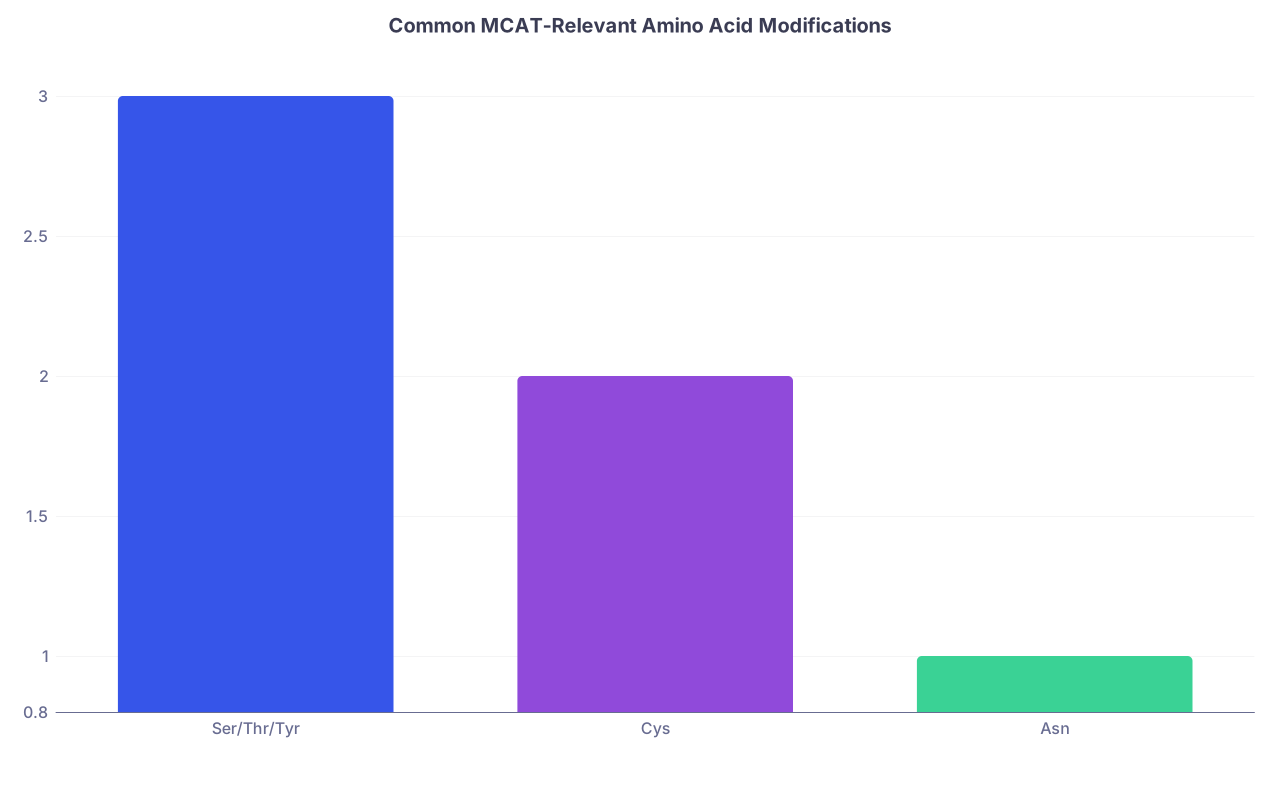
You are not expected to list every obscure modification, but you should know the big three:
Phosphorylation
- Targets: Ser, Thr, Tyr (all have –OH groups).
- Adds negative charge.
- Regulates activity, localization, signaling.
Disulfide bonds
- Target: Cysteine (–SH).
- Occur in oxidizing environments (ER, extracellular space).
- Stabilize tertiary and quaternary structure.
Glycosylation
- Commonly: Asn (N-linked), Ser/Thr (O-linked).
- Localization: secreted proteins, membrane proteins, lysosomal enzymes.
| Category | Value |
|---|---|
| Ser/Thr/Tyr | 3 |
| Cys | 2 |
| Asn | 1 |
If a question asks “Which residue substitution would most directly disrupt phosphorylation-based regulation of this protein?” obvious answer: replacing Ser/Thr/Tyr with a residue that lacks hydroxyl (e.g., Ser → Ala).
High-Yield Pattern #8: Reading Amino Acid Tables Efficiently
The MCAT gives you an amino acid table on test day. Students either ignore it or waste time scanning it blindly.
Here is how to actually use it:
- Quickly verify pKa relationships when a passage uses strange pH conditions (pH 2, pH 11, etc.).
- Confirm whether an unfamiliar residue (if mentioned, often non-standard or modified) has an ionizable group.
- Compare relative pI’s when they explicitly give them (e.g., analyzing isoelectric focusing patterns).
Shortcut: Don’t Look Unless You Have a Question
You should not need the table for:
- Basic polar/nonpolar classification.
- Which are acidic vs basic.
- 1-letter codes for the standard 20.
If you are relying on the table just to recall “E is Glu,” your prep has holes.
Study Strategy: How to Actually Learn This in a Week
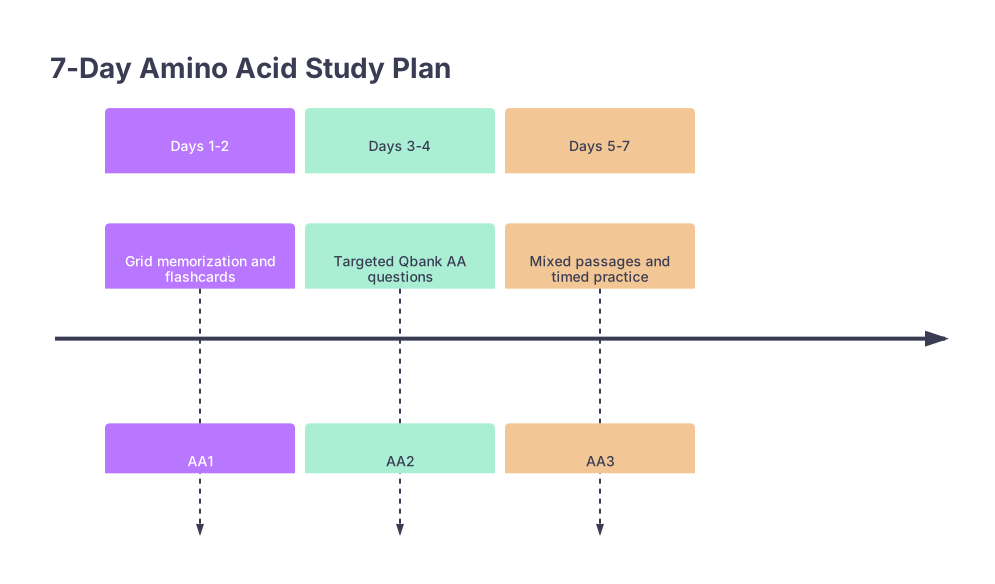
You can get amino acids to “automatic” in 5–7 days if you study correctly.
Day 1–2: Core Memorization
- Handwrite a 4x5 grid of all 20 amino acids.
- For each: name, 3-letter, 1-letter, category, any special property (aromatic, sulfur, pKa if ionizable).
- Use a blank sheet drill: write down all categories from memory, then fill in each AA.
Day 3–4: Targeted Practice
- Do only amino-acid-related questions from a Qbank (UWorld, Kaplan, etc.).
- After each question, classify which pattern it used:
- Charge/protonation
- Mutation type
- Enzyme active site
- Protease cleavage
- pI/migration
- Keep a running tally; you will start seeing the same tricks.
Day 5–7: Mixed Passage Practice
- Work through full passages where amino acids are embedded in enzyme kinetics, molecular biology, and genetics.
- Focus on speed: can you interpret a mutation (e.g., D → N) in under 5 seconds with the correct “story” (acidic → polar uncharged, negative → neutral, likely loss of salt bridge)?
| Period | Event |
|---|---|
| Days 1-2 - Grid memorization and flashcards | AA1 |
| Days 3-4 - Targeted Qbank AA questions | AA2 |
| Days 5-7 - Mixed passages and timed practice | AA3 |
Common Traps and How to Outsmart Them
I have seen the same dumb mistakes repeatedly.
Trap 1: Treating Histidine as Either Always Positive or Always Neutral
Reality:
- pKa ≈ 6.
- At pH 7.4, it is partially protonated.
- The MCAT uses it as a buffer and as a catalytic acid/base.
So:
- In active sites, think “tunable” side chain.
- In pH questions, do not lump it with Lys/Arg or with uncharged residues blindly. It sits in between.
Trap 2: Forgetting That Tyrosine Is Both Aromatic and Polar
Tyrosine:
- Has an aromatic ring (like Phe).
- Has a phenolic –OH (like a polar residue; can be phosphorylated).
- pKa ~10 for that OH group.
So Tyr:
- Can participate in hydrophobic/aromatic interactions.
- Can form hydrogen bonds.
- Can be phosphorylated.
Exam-writers love to ask: “Which residue substitution would eliminate a key aromatic stacking interaction but still allow hydrogen bonding?”
Tyr → Ser:
- Loses aromatic ring (no stacking).
- Keeps an –OH group (still can H-bond).
Trap 3: Confusing Asn vs Asp, Gln vs Glu
You cannot afford to mix these up.
- Asparagine (Asn, N): amide, polar uncharged.
- Aspartate (Asp, D): carboxylate, acidic, −1.
- Glutamine (Gln, Q): amide, polar uncharged.
- Glutamate (Glu, E): carboxylate, acidic, −1.
Mnemonic that actually works:
- “N” and “Q” have “N” in the name → amides, neutral.
- “D” and “E” are left over → acidic, “electronegative.”
Trap 4: Overcomplicating Charge Calculations for Peptides
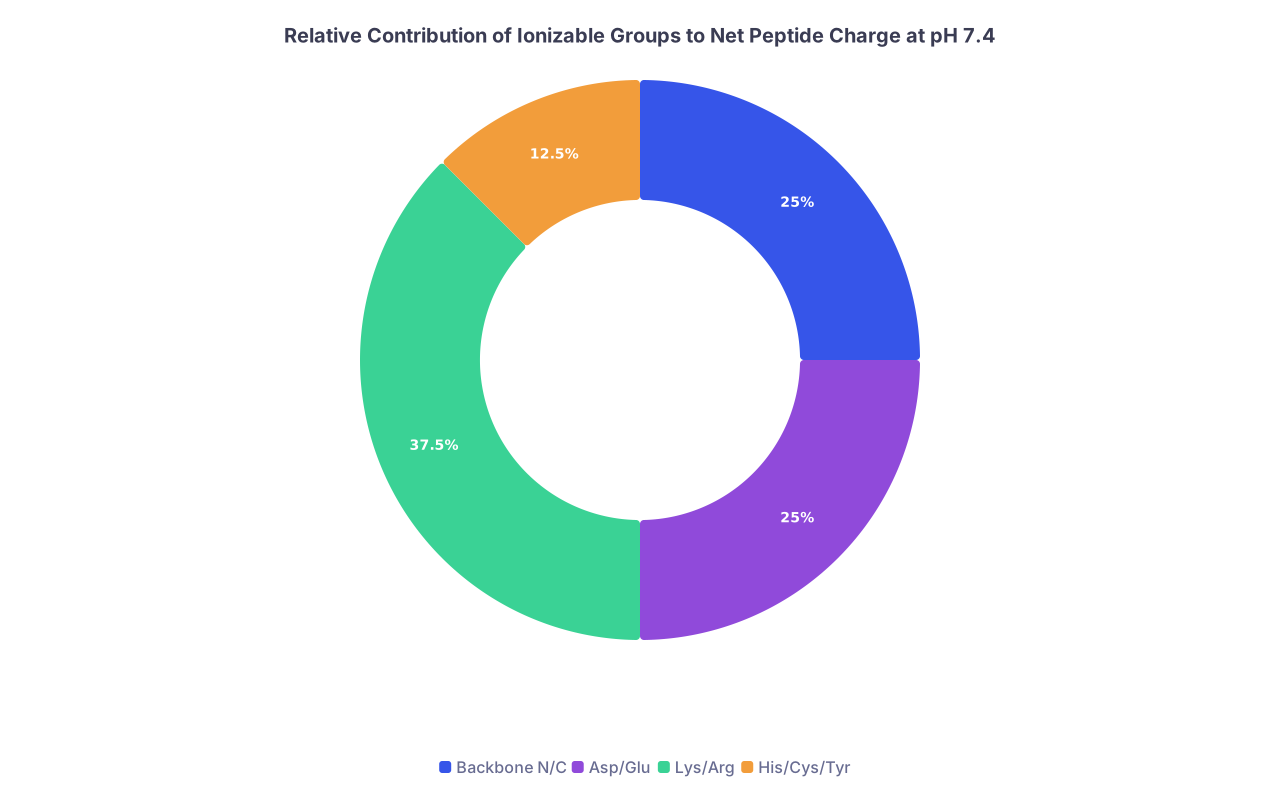
You do not need to calculate every protonation microstate. You need:
- Major contributors: N-terminus, C-terminus, side chains of Asp, Glu, His, Lys, Arg (and sometimes Cys, Tyr).
- At pH 7, assume:
- Asp/Glu: −1
- Lys/Arg: +1
- N-term: +1
- C-term: −1
- His: ~0 to +0.1; conceptually can be treated as “can buffer,” not the dominant charge unless question clearly focuses on it.
Fast example:
Peptide: Lys–Glu–Ala–His–Arg
At pH 7.4:
- N-term (Lys) = +1
- Lys side chain = +1
- Glu side chain = −1
- His side chain = ~0 (partial + but often treated “neutral” unless question explicit)
- Arg side chain = +1
- C-term = −1
Net ~ (+1 +1 −1 +0 +1 −1) = +1
Good enough for almost any MCAT item.
| Category | Value |
|---|---|
| Backbone N/C | 2 |
| Asp/Glu | 2 |
| Lys/Arg | 3 |
| His/Cys/Tyr | 1 |
FAQs
1. Do I really need to draw all 20 amino acid structures from memory?
No. You should recognize general side-chain shapes and functional groups, but the MCAT does not ask you to draw them from scratch. You must, however, know:
- Which have hydroxyl (Ser, Thr, Tyr).
- Which have amides (Asn, Gln).
- Which have carboxylates (Asp, Glu).
- Which have basic nitrogens (Lys, Arg, His).
- Which are aromatic (Phe, Tyr, Trp).
- Which contain sulfur (Cys, Met).
If you can sketch simple versions of the side chains for those categories, you are fine.
2. How fast should I be at amino acid questions on the MCAT?
For stand-alone AA questions: 30–60 seconds.
For passage-based ones: they should not be the bottleneck. If it takes you more than 20–30 seconds to interpret a mutation (e.g., R → Q) and its likely effect, you need more practice on pattern recognition. Amino acid reasoning should feel almost reflexive.
3. Is Anki enough to master amino acids?
Anki is a tool, not a solution. Flashcards help with brute-force memorization (names, codes, categories), but they do not build:
- Speed on mutation interpretation.
- Comfort with pKa and charge logic in context.
- Intuition about active sites and binding pockets.
Use Anki for the first 2–3 days. Then transition to question-based drills where you apply amino acid facts to real MCAT-style scenarios.
4. How often does the MCAT actually test amino acid knowledge?
Frequently, but indirectly. You might only see 1–2 explicit “what is the charge of lysine at pH 7” type questions. However, amino acid understanding is embedded in:
- Enzyme kinetics passages.
- Molecular genetics (missense vs nonsense mutations, etc.).
- Protein structure/biochemistry.
- Signal transduction and receptor questions.
Realistically, amino acids influence at least 5–10 questions per exam. Done right, this is one of the highest ROI topics in MCAT biology/biochem.
Key points:
- Stop brute-forcing “20 structures” and instead master side-chain categories, pKa patterns, and charge logic.
- Train yourself to interpret mutations, active-site residues, and environmental context (membrane vs aqueous) in seconds, not minutes.
- Use your amino acid knowledge dynamically inside passages; that is where most of the hidden points are.