You are at your desk, AAMC Section Bank open, and you hit yet another passage with a pH vs volume graph. The stem says, “The titration curve shown in Figure 1 corresponds to…” and you feel that tiny spike of dread. Weak acid? Weak base? Half‑equivalence? pKa? Buffer region? You know this stuff vaguely, but not fast. And the MCAT punishes “vague but slow.”
Let me fix that.
This is one of those topics that looks messy until you see the patterns. Once the patterns click, you stop “calculating” and start just reading the curve like a sentence. That is the level you need for the MCAT.
Core MCAT Acid–Base Logic: What They Actually Care About
The MCAT does not care if you can do back‑of‑the‑envelope Henderson–Hasselbalch derivations under pressure. It cares about three things:
Can you look at a titration curve and:
- identify the type of acid/base,
- locate pKa(s),
- identify the equivalence point(s)?
Can you connect pKa values to:
- acid strength,
- protonation state at physiological pH,
- which form is more soluble / membrane permeable?
Can you quickly reason about buffers:
- what pH they resist change at,
- how adding strong acid/base perturbs the system,
- why biological systems care?
If you can do those three, you are functionally “fluent” for MCAT level acid–base.
The Four Big Titration Curve Shapes You Must Recognize
Forget every weird edge case from your gen chem professor. The MCAT lives on a small number of canonical shapes. Get these down cold.
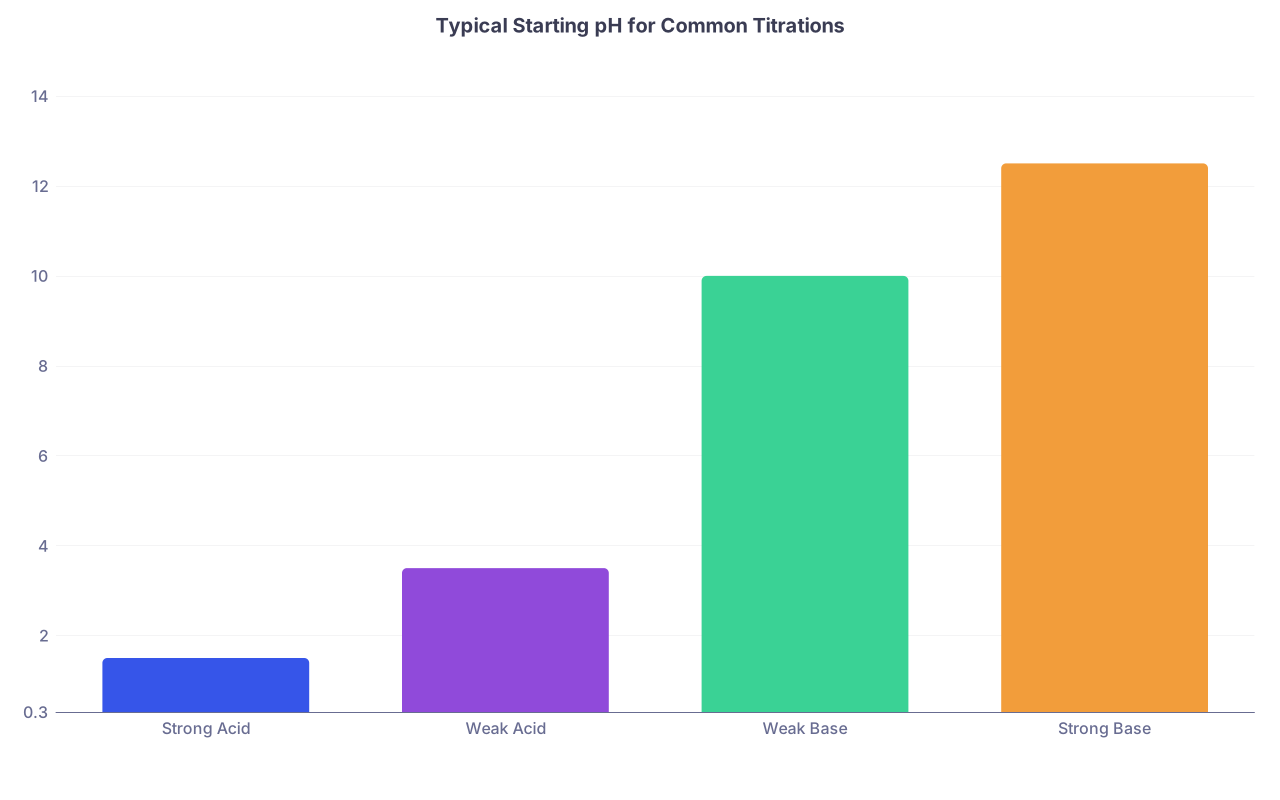
| Category | Value |
|---|---|
| Strong Acid | 1.5 |
| Weak Acid | 3.5 |
| Weak Base | 10 |
| Strong Base | 12.5 |
1. Strong Acid + Strong Base (or Strong Base + Strong Acid)
Cleanest curve, high‑yield anchor.
Key features:
- Very low starting pH (about 1–2 for strong acid).
- Very sharp vertical jump in pH near equivalence.
- Equivalence point pH ≈ 7.
Example: 0.1 M HCl titrated with 0.1 M NaOH.
What the MCAT will do with this:
- Ask you to identify titration type from equivalence pH:
- pH = 7 → strong acid + strong base.
- Ask you where pH changes fastest (midpoint of vertical region).
- Embed a conceptual question: “At the equivalence point, the solution consists predominantly of…”
Answer: neutral salt (e.g., NaCl) and water.
Pattern to memorize:
Strong + strong → equivalence at pH 7, steep, symmetric curve around that point.
2. Weak Acid + Strong Base
This one dominates MCAT passages.
Key features:
- Starting pH: acidic but not extreme (around 3–6, depending on Ka and concentration).
- Initial buffer region: pH changes gradually as base is added.
- “Plateau-ish” region (buffer) before the big vertical climb.
- Equivalence point pH > 7 (basic), because conjugate base of the weak acid hydrolyzes water to OH⁻.
- pH at half‑equivalence point = pKa of the weak acid. This is the money fact.
Example: Acetic acid (CH₃COOH) titrated with NaOH.
You must be able to:
- See the initial pH is not super low → likely weak acid.
- Identify half‑equivalence: middle of buffer region, where moles base added = ½ moles initial acid.
- Read pKa directly from curve: pH at half‑equivalence.
This is how they tie a graph to Henderson–Hasselbalch:
pH = pKa + log([A⁻]/[HA])
At half‑equivalence, [A⁻] = [HA] → log(1) = 0 → pH = pKa.
If you do not automatically see “pH = pKa at half‑equivalence,” you are handicapping yourself.
3. Weak Base + Strong Acid
Mirror image logic of the previous case.
Key features:
- Starting pH: basic, but not extreme (about 8–11).
- Buffer region early in the titration.
- Equivalence point pH < 7 (acidic), because conjugate acid of weak base hydrolyzes to give H₃O⁺.
- pH at half‑equivalence = pKa of the conjugate acid (pKa of BH⁺).
Example: NH₃ titrated with HCl.
You should notice:
- Curve starts above 7 but not at 13.
- Equivalence point dips below 7.
- Buffer region where adding acid does not change pH much.
Again, pH at half‑equivalence = pKa (of the conjugate acid). The underlying HH logic is the same; just make sure you are tracking the correct species.
4. Polyprotic Acid Titrations (trip‑up territory)
MCAT loves to give a graph with multiple “bumps” and equivalence points and ask about:
- how many ionizable protons,
- pKa values for each deprotonation,
- buffer regions.
Classic examples:
- Carbonic acid: H₂CO₃
- Phosphoric acid: H₃PO₄
- Amino acids (especially with R groups that titrate)
Key features of a polyprotic titration curve:
- One buffer region and one equivalence point per titratable proton.
- Each buffer region is centered at its own pKa.
- Flat-ish region (buffer), then vertical jump, then next flat-ish region, and so on.
For a diprotic acid (H₂A):
- 1st buffer region → pH ≈ pKa₁ at its midpoint (first half‑equivalence).
- 1st equivalence point: all H₂A converted to HA⁻.
- 2nd buffer region → pH ≈ pKa₂ at its midpoint.
- 2nd equivalence point: all HA⁻ converted to A²⁻.
You do not need to derive exact pH values. You need to:
- Count equivalence points = number of acidic protons.
- Identify pKa’s = pH at each half‑equivalence within each region.
How To Read a Titration Curve in Under 10 Seconds
When a graph pops up on test day, you do not “admire” it. You strip it down systematically. Same order every time.

| Step | Description |
|---|---|
| Step 1 | See pH vs Volume Graph |
| Step 2 | Check Starting pH |
| Step 3 | Locate Equivalence Point(s) |
| Step 4 | Is Equivalence pH 7, >7, or <7? |
| Step 5 | Identify Strong/Weak Acid or Base |
| Step 6 | Mark Half-Equivalence Point(s) |
| Step 7 | Read pKa from Half-Equivalence pH |
Step 1 – Starting pH:
- Very low (~1–2) → strong acid if being titrated with base.
- Moderately low (~3–6) → weak acid.
- Moderately high (~8–11) → weak base.
- Very high (~12–13) → strong base.
Step 2 – Equivalence point pH:
- Around pH 7 → strong + strong.
7 → weak acid + strong base.
- < 7 → weak base + strong acid.
Step 3 – Number of equivalence points:
- Single steep vertical region → monoprotic.
- Two or three major vertical steps → polyprotic (count protons).
Step 4 – Half‑equivalence:
- Locate the volume at equivalence point (V_eq).
- Half‑equivalence is at V_eq/2.
- pH at that volume = pKa for that step.
Do not guess by “eyeing” the middle of the curve if you can avoid it. Use the V_eq → V_eq/2 logic, even conceptually.
Step 5 – Buffer regions:
- Flat-ish parts where adding titrant does not change pH much.
- Each is centered around a pKa.
- MCAT might ask, “Which pH will this titration buffer most effectively?”
Answer: within ±1 pH unit of the pKa (or a plateau region on the graph).
Once you run those five steps, you should know:
- acid/base identity (strong vs weak),
- number of protons,
- approximate pKa’s,
- which region is buffered.
PKa Patterns You Need to Recognize Instantly
The MCAT loves giving you a table of pKa values and expecting you to:
- compare acidity,
- predict protonation at a given pH,
- infer which species crosses membranes or binds proteins.
Let me break the recurring patterns down.
| Functional Group | Typical pKa |
|---|---|
| Strong mineral acid (HCl) | < 0 |
| Carboxylic acid | 4–5 |
| Phenol | 9–10 |
| Ammonium (R–NH₃⁺) | 9–11 |
| Thiol (R–SH) | ~10–11 |
1. pKa and Acid Strength: Stop Overcomplicating This
One rule:
Lower pKa → stronger acid → more willing to give up its proton.
Examples:
- HCl: pKa ≈ –7 (very strong).
- Acetic acid: pKa ≈ 4.7 (weak, but definitely acidic).
- Ammonium ion (NH₄⁺): pKa ≈ 9.2 (very weak acid; most remains protonated at neutral pH).
If the MCAT asks:
- “Which conjugate base is most stable?” → the conjugate base of the acid with the lowest pKa.
- “Which compound will donate a proton most readily in water?” → again, the lowest pKa.
2. Henderson–Hasselbalch in One Mental Picture
You do not need to plug numbers every time, but you must internalize the logic:
pH = pKa + log([A⁻]/[HA])
famous ratios:
- pH = pKa → [A⁻]/[HA] = 1 → 50% deprotonated.
- pH = pKa + 1 → [A⁻]/[HA] = 10 → 90% deprotonated.
- pH = pKa – 1 → [A⁻]/[HA] = 0.1 → 10% deprotonated.
This gives you the “protonation intuition” that MCAT loves in passages about drugs and membranes.
Pattern:
- If pH >> pKa (a couple units): mostly deprotonated (A⁻ dominates).
- If pH << pKa: mostly protonated (HA dominates).
The exam does not need you to calculate 87.3%. It wants “mostly protonated or mostly deprotonated?” with one clean step of reasoning.
3. Biological pH and Protonation State
This is everywhere. Drug design, amino acid charge, transport across membranes, receptor binding.
Physiologic pH ≈ 7.4. Look at functional groups:
Carboxylic acids (pKa ~4–5):
- At pH 7.4 (>> pKa): mostly deprotonated → COO⁻.
Ammonium groups (R–NH₃⁺, pKa ~9–10):
- At pH 7.4 (pH < pKa): mostly protonated → positively charged NH₃⁺.
Phenols (pKa ~10):
- At pH 7.4: mostly protonated (neutral), not O⁻.
So a typical amino acid at pH 7.4:
- Carboxyl group: –COO⁻.
- Amino group: –NH₃⁺.
Net zwitterion.
MCAT twist: They might describe a weak acid drug with pKa 4.5 and ask which environment favors its absorption (stomach pH ~2 vs intestine pH ~8).
- At pH 2 (pH < pKa) → HA form → neutral → more membrane permeable.
- At pH 8 (pH > pKa) → A⁻ form → charged → less permeable.
Same story for weak base drugs, but reversed protonation logic.
4. Multiple pKa’s: Amino Acids, Polyprotic Systems
If a molecule has more than one titratable proton, it has multiple pKa values.
For amino acids without ionizable side chains (e.g., glycine):
- pKa₁ (COOH) ≈ 2–3.
- pKa₂ (NH₃⁺) ≈ 9–10.
- Isoelectric point (pI) ≈ average of pKa’s around the zwitterion:
- pI ≈ (pKa₁ + pKa₂)/2.
On the MCAT:
- They might give you a titration curve for an amino acid and ask which pH corresponds to its isoelectric point:
- Typically around the vertical segment where net charge is 0.
- Or they ask, “Which region of the titration corresponds to the amino acid existing predominantly as a zwitterion?”
Answer: between pKa₁ and pKa₂.
Polyprotic acids like H₃PO₄:
- pKa₁ ≈ 2.1 (H₃PO₄ → H₂PO₄⁻).
- pKa₂ ≈ 7.2 (H₂PO₄⁻ → HPO₄²⁻).
- pKa₃ ≈ 12.3 (HPO₄²⁻ → PO₄³⁻).
At pH 7.4:
- H₂PO₄⁻ and HPO₄²⁻ act as a buffer pair — exactly why biology uses phosphate as a buffer system.
MCAT likes to:
- Ask which species predominates at a given pH.
- Ask which pair acts as the best buffer near physiological pH (the pKa closest to 7.4).
Buffers on the MCAT: How They Tie Titration Curves and PKa Together
You cannot afford to be fuzzy on what a buffer actually is.
Definition you should have in your head:
- Buffer = mixture of a weak acid and its conjugate base (or weak base and its conjugate acid) that resists changes in pH.
Peak buffer capacity:
- pH ≈ pKa (where [A⁻] and [HA] are equal).
This is exactly the flat region in the titration curve around the half‑equivalence point.
Classic MCAT buffer scenarios
- “Which solution would best resist changes in pH when small amounts of strong acid are added?”
They give combinations like:
- 0.1 M HA + 0.1 M NaA at pH ≈ pKa
- 0.1 M HCl + 0.1 M NaCl
- 0.1 M NaA only
- Pure water
The real buffer is the weak acid–conjugate base pair (HA + A⁻), not strong acid + salt, not lone weak acid, not water.
- “If small amounts of strong base are added to the buffer, what happens to the ratio [A⁻]/[HA] and the pH?”
For a weak acid buffer:
- OH⁻ added → converts HA to A⁻.
- [A⁻]/[HA] ratio increases → pH increases slightly. But the increase is modest because the buffer “absorbs” the OH⁻.
- Passage about blood pH:
- CO₂ + H₂O ⇌ H₂CO₃ ⇌ H⁺ + HCO₃⁻.
- HCO₃⁻/H₂CO₃ buffer system, pKa ≈ 6.1 (with CO₂ partial pressure factored in).
- They may ask about the direction of the equilibrium shift if a patient hypoventilates (retains CO₂ → pH drops) or hyperventilates (loses CO₂ → pH rises).
You do not need “Step 1 acid–base” compensation formulas. You just need Le Châtelier + buffer logic.
How MCAT Passages Actually Use These Concepts
Let me walk through common passage structures. Once you see these templates, you will recognize them instantly in practice tests.
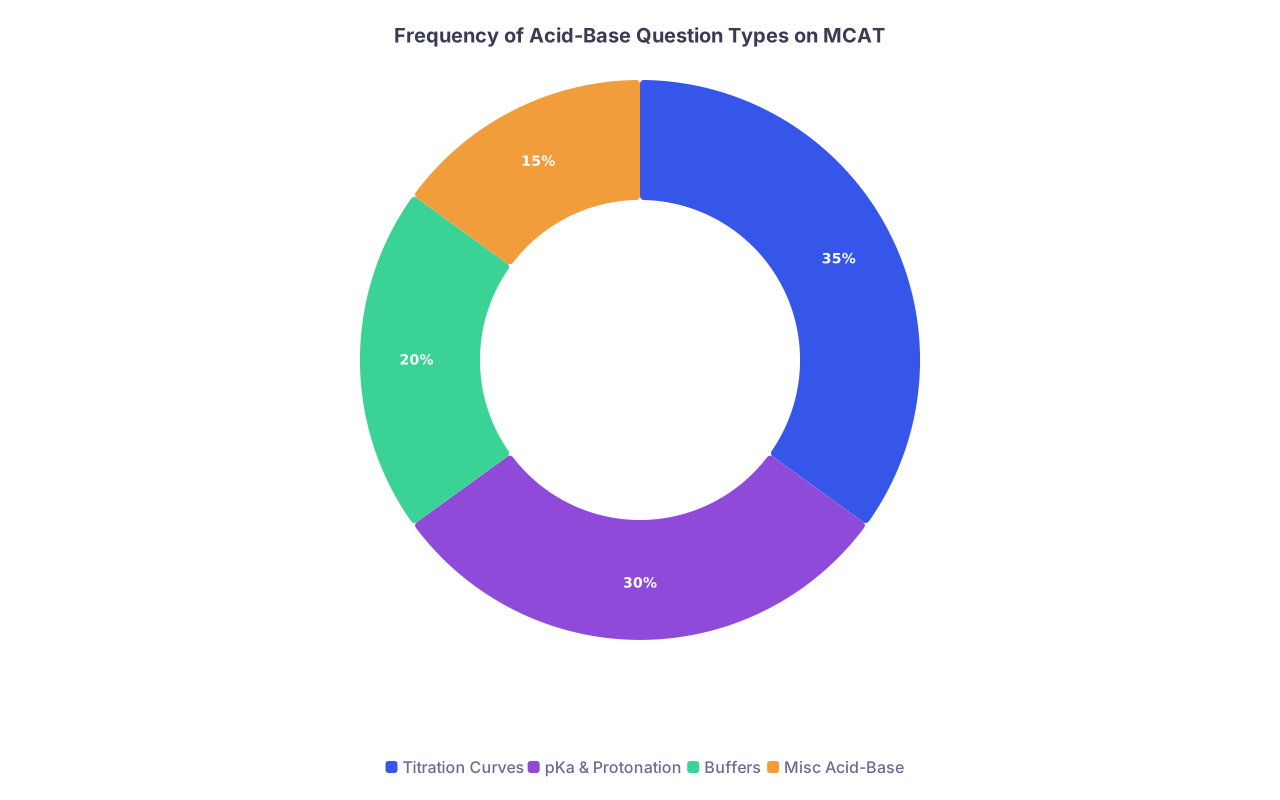
| Category | Value |
|---|---|
| Titration Curves | 35 |
| pKa & Protonation | 30 |
| Buffers | 20 |
| Misc Acid-Base | 15 |
Template 1: Pure Titration Graph Question
You open a discrete and see:
- A pH vs volume graph.
- Maybe a weak acid being titrated with NaOH.
Typical questions:
- “At which point is [HA] = [A⁻]?”
You pick the half‑equivalence point. - “Which statement best describes the solution at point B?”
Options mixture of HA and A⁻, buffer, equivalence, etc.
The trick: they are not asking for math. They are asking whether you understand where on the curve certain species dominate.
Template 2: Enzyme or Drug With a Given pKa
Passage describes:
- An enzyme with a histidine residue in the active site (pKa ~6).
- Or a drug with a carboxyl pKa of 4.2 and an amine pKa of 9.6.
Questions:
- “At physiological pH, this residue is most likely…” (protonated, deprotonated, neutral, charged).
- “Which form of the drug is more likely to cross the cell membrane?” (uncharged one).
- “What will be the predominant charge of the side chain at pH 5.0 vs pH 8.0?”
If you are flipping back and forth between equations instead of doing one‑step “pH relative to pKa” comparisons, you will burn time.
Template 3: Polyprotic / Amino Acid Titration Curve
Graph with:
- 2–3 equivalence points.
- pKa labels or at least pH values at buffer regions.
Questions:
- “How many ionizable groups does this amino acid have?” → count equivalence points.
- “At which pH is the amino acid zwitterionic?”
Typically between pKa values that border the zwitterion form. - “What is the approximate isoelectric point?”
Average the relevant pKa’s.
Template 4: Buffer + Strong Acid/Base Additions
They describe:
- A buffer at pH ~pKa.
- Then add some strong acid or base.
Questions:
- “What happens to [HA], [A⁻], and pH?”.
- “Which buffer composition will yield a pH closest to X?” (choose the one whose pKa is closest to X).
You use Henderson–Hasselbalch qualitatively:
- pH closest to pKa when [A⁻] ≈ [HA].
- If [A⁻] > [HA], pH > pKa.
- If [A⁻] < [HA], pH < pKa.
They might give several mixtures with the same total buffer concentration but different HA:A⁻ ratios; pick the one matching the target pH best.
How to Practice This Efficiently (Not Just “Do Problems”)
Let me be blunt: most students never actually train titration curves; they just hope osmosis from question banks suffices. That is why they freeze when the axis labels change.
Do this instead.
1. Build Your Own Minimal Curve Set
Take a blank sheet and, from memory, sketch:
- Strong acid + strong base titration:
- Starting pH low, equivalence at pH 7.
- Weak acid + strong base:
- Higher starting pH, buffer region, equivalence >7.
- Weak base + strong acid:
- Mirror logic, equivalence <7.
- Diprotic acid titration:
- Two buffer regions, two jumps, two pKa labels.
Label:
- Starting pH.
- Approximate equivalence point pH.
- Half‑equivalence points with pH ≈ pKa.
Do this a few times over a week. Spaced repetition. By the 3rd time, your brain treats these like alphabet letters.
2. Drill pH vs pKa Intuition
Pick a set of simple values:
- pKa = 4, 6, 8, 10.
For each, ask:
- At pH 2, 4, 6, 8, 10, 12 → mostly protonated or deprotonated?
You can even make a quick table and test yourself until it feels automatic.
3. On Q‑banks, Verbalize Curve Interpretation
When you do a titration question:
- Before looking at the stem, look at the graph and say (out loud if you can):
- “Starting pH ~3 → weak acid.”
- “Equivalence >7 → weak acid titrated with strong base.”
- “Half‑equivalence near pH 4.5 → pKa ≈ 4.5.” Once you force yourself to articulate that, you train the exact skill the MCAT expects you to use silently and quickly.
FAQs
1. Do I need to memorize exact pKa values for specific molecules?
No. You need patterns, not exact numbers. You should know rough ranges:
- Strong mineral acids: very low pKa (negative).
- Carboxylic acids: around 4–5.
- Ammonium groups: around 9–10.
- Phenols and thiols: around 9–11. If the MCAT cares about a specific exact pKa, they will give it in the passage or question stem.
2. Will the MCAT make me calculate pH from Ka using logs?
Rarely, and when they do, it is usually with very easy numbers or approximations. The more common task is qualitative:
- decide whether pH is above or below pKa,
- compare acid strengths via pKa,
- interpret titration curves.
You should know the Henderson–Hasselbalch equation and how to handle simple logs (log 10 = 1, log 0.1 = –1), but you are not doing multi‑step algebra every other question.
3. How do I quickly tell if a titration involves a weak acid or a strong acid?
Look at:
- Starting pH: strong acids start very low (around 1–2). Weak acids start higher (3–6).
- Equivalence point pH:
- ≈ 7 → strong acid with strong base.
7 → weak acid with strong base. Also, weak acid curves show a noticeable buffer region and a smoother, less abrupt vertical jump.
4. How many titration curves should I memorize for the MCAT?
Memorize four archetypes:
- Strong acid + strong base.
- Weak acid + strong base.
- Weak base + strong acid.
- Polyprotic acid (at least a diprotic example).
For each, know:
- relative starting pH,
- shape of curve,
- location and pH of equivalence point(s),
- where half‑equivalence points are and how they relate to pKa.
If you own those four, you can interpret almost any acid–base graph the MCAT throws at you.
Key points, then stop.
First, titration curves are pattern recognition, not calculus. Lock in the four archetypes and read them systematically: start pH, equivalence pH, number of steps, half‑equivalence = pKa.
Second, pKa is just a pivot point. pH relative to pKa tells you everything about protonation state, charge, and buffer behavior. You use this to reason about drugs, amino acids, and physiological buffers.
Get those two ideas automatic, and acid–base questions turn from landmines into freebies.