It’s late May. Your AMCAS portal is open on one tab. A half-finished personal statement on another. And in the back of your mind, a date is burned in: your MCAT is scheduled for July 13.
You keep telling yourself, “Plenty of people take July exams.” True. But here’s the part no one tells you clearly: by the time your score even exists, some schools have already built a mental picture of you. Your file already made a “first impression” — without your MCAT. And how that impression lands depends heavily on when you test.
I’m going to walk you through what actually happens on the admissions side with MCAT timing. Not the sanitized premed advisor version. The real thing.
How Committees Actually See MCAT Timing
Let me start with the blunt truth: your MCAT date is not “just another detail.” It changes how and when people engage with your file.
At most med schools, the application flow looks something like this:
- Primary verified by AMCAS
- Secondary sent
- Secondary completed
- File marked “complete”
- Screening for interview
Now layer MCAT timing onto that. Two very different realities:
- Applicant A: Tested in March, score in hand by May, submits early June, verified mid-June. By July, this person is fully complete, ready to be screened at many schools.
- Applicant B: Tests July 13, scores drop mid-August, submits before taking the MCAT “to be early.” On paper, they tried to be early. In practice, they’re not really in the game until late August or September.
Inside the admissions office, we see both. And we treat them differently.
Here’s the part your pre-health office tends to gloss over: being “complete” without a score is not actually complete at many schools. Files with no MCAT are often:
- Auto-held
- Soft-complete but not really considered
- Or thrown into a “wait for MCAT” bin that no one touches until scores drop
So when you ask, “Does July MCAT hurt me?” you’re asking the wrong question. The real question is: “When will I look like a finished applicant to the people who control interview invites?”
That’s why MCAT timing is all about first impression. Are you showing up as a fully formed, reviewable candidate when schools are still fresh and building their early interview lists? Or as someone they might get to when they have time?
The Unspoken Calendar: When MCAT Dates Really Land
Let me map this out the way program staff actually think about it. They don’t think “April vs May vs June” in isolation. They think in score release windows and review cycles.
| Test Month | Typical Score Release | When Schools First Really Use Your File | How It Feels On Their Side |
|---|---|---|---|
| January–March | March–May | June–July | You’re fully there at the opening bell |
| April | Late May–early June | Late June–July | Still early, totally fine |
| May | Late June–July | July–early August | Fine at most schools, borderline at the ultra-early ones |
| June | Late July–August | August–early September | You’ve missed the very earliest wave |
| July | Late August–September | September–October | Late-ish for rolling schools |
| August+ | September–October+ | October–November | You’re in the last waves, doors already partially closed |
That “When schools first really use your file” column is what matters. That’s when your complete file makes its actual debut in the screening process. That’s the first impression.
Now overlay that with how interview invites really get handed out.
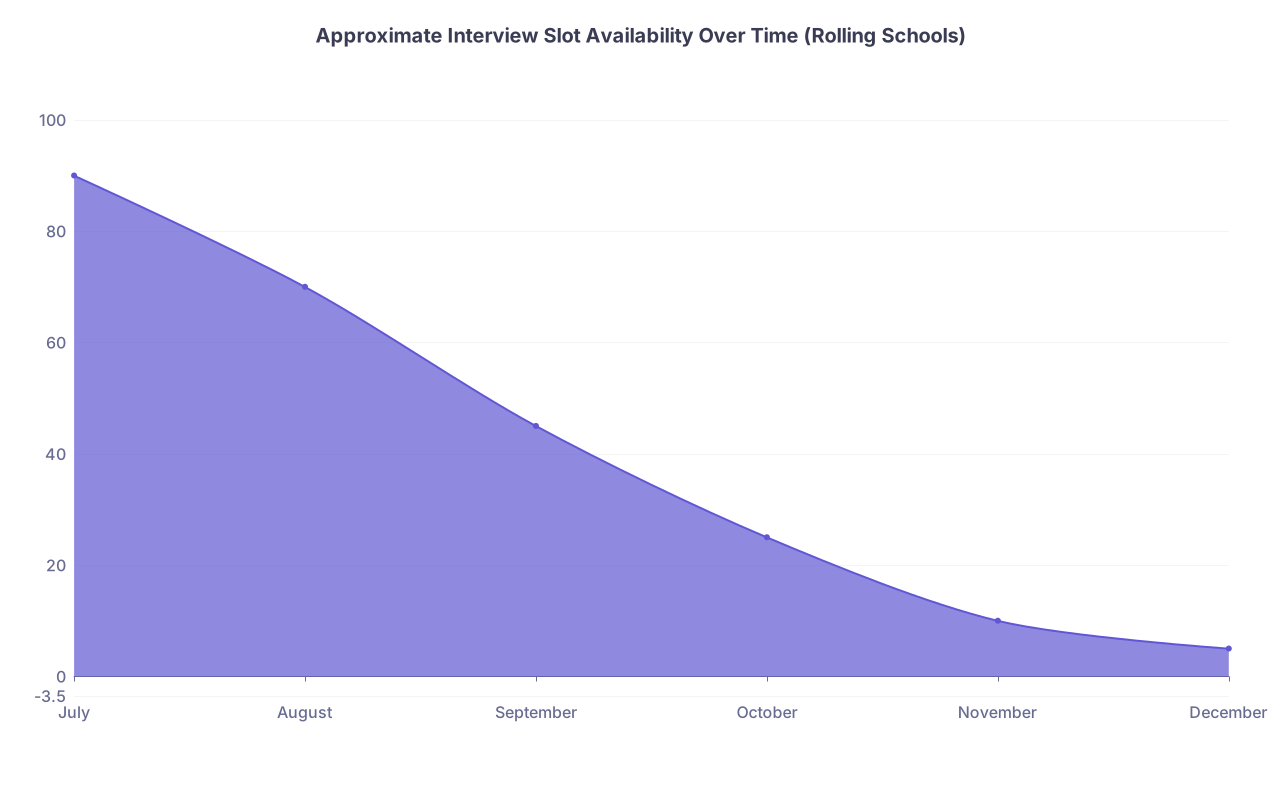
| Category | Value |
|---|---|
| July | 90 |
| August | 70 |
| September | 45 |
| October | 25 |
| November | 10 |
| December | 5 |
Is this exact? No. But it’s directionally true at many moderately to highly competitive schools:
- July/August: The majority of slots are still available
- September: A big chunk already allocated
- October onward: You’re fighting for the leftovers or cancellations
Now read those two visuals together. If your MCAT date pushes your true “first impression” to September, you are not walking into a neutral landscape. You’re walking into a room where half the chairs are already taken.
How Different MCAT Windows Signal Different Things
Here’s where the “insider” piece comes in. Timing isn’t just logistical. It sends signals about you, whether you like it or not.
January–March MCAT (the “planner” signal)
What we think when we see it:
- This person planned ahead.
- They left time to retake if needed.
- They probably had fewer excuses about “ran out of time.”
If your score is strong, this is the cleanest possible story. Committees can see your academics, MCAT, and trend lines all at once when we start building early interview pools.
The only way you mess this up is by sitting on your application and submitting in August anyway. Yes, people do that. And yes, we judge it.
April–May MCAT (the “still in the sweet spot” signal)
This is where a ton of applicants live.
Inside the committee room, April/May scores landing in June/early July are basically considered “on time.” Nobody rolls their eyes. Nobody says, “Too late.”
Schools with very aggressive early review (think some top-20s) might start screening in late June. With an April/early May MCAT, you’re still in that early mix.
Where you can get burned: if you take a May MCAT, then procrastinate on secondaries, and your complete date drifts into August. That’s when staff say, “They had everything they needed in July… and still finished late?”
That’s avoidable.
June–July MCAT (the “we’ll see how serious you are” signal)
Now we’re in the zone students think is fine but insiders know is… mixed.
A June MCAT with scores back in late July/early August is borderline but very workable — if:
- Your primary was submitted early June
- You turn around secondaries fast
- You’re not only targeting the most cutthroat schools
But a July MCAT? That’s where behavior on our side changes.
Behind the scenes, I’ve heard variations of:
- “We’ll wait for the MCAT, then decide if they’re worth a look.”
- “Flag this file for score release — don’t spend time screening yet.”
- “If they crush the MCAT, pull them up; if not, they’ll probably self-select out next year.”
Translation: your file is not “alive” yet. You’re in limbo. And by the time you’re fully alive, that interview availability chart you saw above is already sliding downward.
Do students still get in with July MCATs? Absolutely. Plenty. But you don’t get the benefit of that strong early first impression. You’re walking in later to the party and hoping your stats or story are strong enough to override timing.
August or later MCAT (the “probably reapplying next year” signal)
On our side of the table, when we see an August/September test date for the current cycle, the mental reaction is unfiltered:
- “They’re too late.”
- “We might keep them on a waitlist of sorts if they look great elsewhere, but we’ve already advanced so many candidates.”
This doesn’t mean automatic rejection. But it does mean your odds drop sharply, especially at rolling schools.
Non-rolling schools? Different story. We’ll get to that.
Rolling vs Non-Rolling: Two Completely Different Games
This is one of the biggest misunderstandings in premed lore. Not all schools treat MCAT timing equally, because not all schools treat time equally.
At Rolling Schools
Most MD schools are rolling, even if they don’t scream it on their websites. What that means in real terms:
- Files are read as they become complete
- Interview invitations go out in waves, starting early
- Early strong applicants set the “bar” for later ones
Your MCAT date in this system is basically your admission ticket to the early (or late) waves.
Let me tell you how we actually talk about it inside:
- “We’re already full through October interview dates; reserves for November and December only.”
- “We’ve hit our target number of interviews; new invites will be more selective from here.”
- “Later completes need a really compelling reason to be added.”
Now imagine your file first appearing to us complete in September. You’re not being appraised in a vacuum. You’re being compared against the already-invited cohort. That’s the part students ignore.
At Non-Rolling or Less-Rolling Schools
Some schools — especially a few very competitive ones — claim to be “closer to non-rolling.” They batch-review later. They’re not filling the class seat-by-seat from July onward.
Harvard, Yale, some state schools with committee-style late review — they’ll tell you timing is “less important.”
Behind closed doors, here’s the nuance:
- They may wait to issue acceptances, but they still often review earlier files earlier.
- First impressions still form earlier, in committee prep meetings and informal shortlists.
- A complete file in July has more calendar space to be pushed, re-evaluated, brought up in conversation than a file that lands in October.
Non-rolling doesn’t magically erase timing. It just blunts the edge a bit.
So, is a July MCAT less of a death sentence at a non-rolling place? Yes. But if you think “they’re non-rolling, so I can be late,” that attitude leaks into your whole application. And someone on that committee will notice.
Score Risk vs Timing Risk: The Tradeoff Committees Actually Respect
Here’s the part that trips people up: Sometimes delaying an MCAT is strategically correct. Even if it pushes you a bit later in the cycle.
Committees aren’t stupid. We know the difference between:
- Someone who lazily scheduled late because they dragged their feet
- Someone who moved their date from April to May to avoid walking into the exam half-prepared
The first reads as poor judgment. The second reads as maturity.
So how do we think about score vs timing?
If your practice scores are:
- Nowhere near where they need to be (e.g., targeting 515+, stuck at 502) — taking “on time” to be early is a bad move. We’d rather see you strong and “a bit later” than early and obviously undercooked.
- Close but not there (e.g., targeting 510, sitting around 505–507) — this is where the calculus gets messy. A small bump may or may not be worth a big timing hit.
You need to internalize this: a weak early score does not magically impress us because you were early. The actual reaction is: “They didn’t understand their own readiness.”
If you’re going to push your MCAT later, own it. Move decisively. Don’t cling to an early cycle and then show up to us late and mediocre.
How MCAT Timing Plays with the Rest of Your File
Another thing you won’t hear in the brochures: MCAT timing interacts with everything else.
A July MCAT is interpreted differently in:
- A 3.95 GPA, strong research, excellent letters file
- Versus a 3.3 upward trend, modest activities, no clear spike of excellence
In the first scenario, someone on the committee will advocate for you even if you’re a bit later. “Let’s make sure we see this person once their MCAT arrives.”
In the second scenario, late timing just blends you into the crowd of “fine but not urgent” files. That crowd can be huge.
Same story for reapplicants. If you’re reapplying and still taking a late MCAT?
We absolutely notice.
The thought process inside:
- “They’ve been through this once and still timed it poorly?”
- Or, more generously: “They’re trying to fix their MCAT, but they didn’t give themselves enough runway for this cycle.”
Better to take the extra year and apply with a clean, early, organized file than to force a reapplication with late MCAT and lukewarm upgrades.
Practical “Insider” Thresholds: When Timing Actually Hurts
Let me draw some sharper lines, because you need concrete thresholds, not vague platitudes.
If you’re aiming for MD, especially competitive or out-of-state heavy schools:
- MCAT by March–May: You’re in the comfortable, “this is what strong applicants do” zone.
- MCAT in June: Acceptable, but you’ve lost some early breathing room.
- MCAT in July: Increasingly late for rolling MD schools. Needs a strong overall app to offset.
- MCAT August or later: Mostly a “next cycle” setup for MD, aside from some less selective or non-rolling places.
For DO schools:
- They tend to be more forgiving on timing.
- A June or July MCAT is very workable.
- Even August can be fine, though still not desirable.
This is what staff actually say behind the scenes: “For DO, they’re okay.” For MD, that same timing often elicits a wince.
How to Use Timing Strategically (Without Sabotaging Yourself)
Here’s the playbook I wish more students followed:
Pick your ideal MCAT window first, then build everything else around it. Not the other way around. Decide: “I’m a March/April test-taker,” then plan your semester accordingly.
Back-calculate your real “first impression” date. Not just “when I test,” but “when my score hits + my secondaries are in.” Ask yourself: “When will I be truly complete at my target schools?”
If you’re forced later, adjust school list and expectations. A July MCAT + average stats + hyper-competitive MD list is magical thinking. Mix in more DO, more in-state, and schools known for less aggressive rolling.
If you must delay, delay with purpose. Change your study plan. Increase practice volume. Fix what made you weak. Don’t just kick the same mediocre prep from June to July and hope timing heroics will save you.
Do not half-apply. The “I’ll just throw in an app with a late MCAT and see what happens” approach rarely ends well. You risk burning your reapplicant status and giving schools a weak first impression that will sit in their system next year.
A Quick Visual of “First Impression Windows”
Let me wrap the timing idea into something simple. This is how many adcoms feel the application year flowing, especially at rolling MD programs.
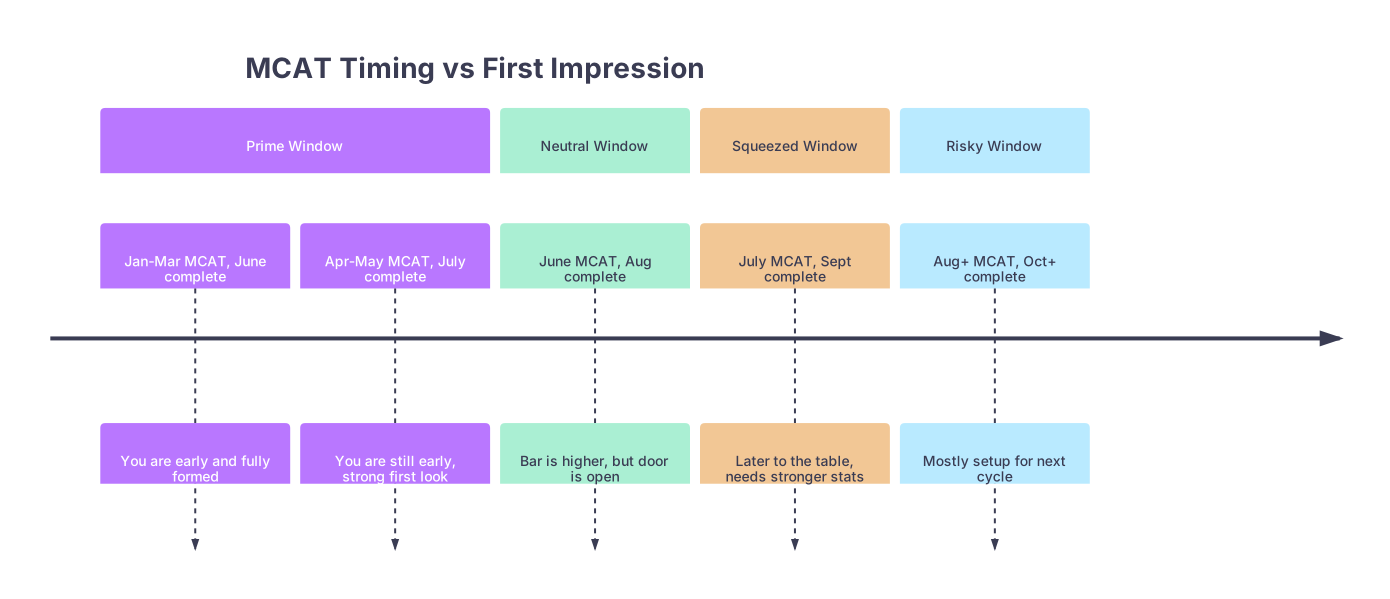
| Period | Event |
|---|---|
| Prime Window - Jan-Mar MCAT, June complete | You are early and fully formed |
| Prime Window - Apr-May MCAT, July complete | You are still early, strong first look |
| Neutral Window - June MCAT, Aug complete | Bar is higher, but door is open |
| Squeezed Window - July MCAT, Sept complete | Later to the table, needs stronger stats |
| Risky Window - Aug+ MCAT, Oct+ complete | Mostly setup for next cycle |
When I say “first impression,” I’m talking about that first moment your entire profile — stats, MCAT, experiences, letters, personal statement — sits on a screener’s screen and they’re deciding:
- Move you to “interview likely”
- Move you to “maybe later”
- Or quietly bury you in “no” or “hold”
If you internalize that this moment exists — and that MCAT timing directly controls when it happens — you’ll make smarter choices.
FAQs
1. Is it better to apply this year with a July MCAT or wait and apply early next year?
If your overall app is average or you’re counting on the MCAT to “save” a weaker GPA, I’d lean toward waiting and applying early next year with a fully polished file. If you already have a strong GPA, strong activities, and you’re confident your MCAT will be solid, a July date can still work — but don’t expect maximal options.
2. Do schools see my MCAT test date and judge me for it?
Yes, they see your test dates. Do they explicitly say “July MCAT = bad”? Not usually. But they absolutely feel the impact via when your file becomes complete, and seasoned reviewers do notice patterns like “chronic lateness” across your timeline. It all contributes to that first impression of your judgment and planning.
3. If I took an early MCAT and scored poorly, should I retake late or just reapply next year?
If your current score is flat-out non-competitive for your target schools, a thoughtful retake — even if it makes you late — is better than stubbornly applying with a doomed score. But if the retake timing pushes you into September/October, understand you’re probably using this cycle as a practice run and real shot will be next year.
4. Do non-rolling schools truly not care about MCAT timing?
They care less, but they don’t ignore it. Files completed earlier have more time to be discussed, flagged, and remembered. A stellar file complete in July at a non-rolling school feels very different to us than one showing up complete in November, even if official decisions all drop in March.
Key points to keep in your head:
- Your MCAT date controls when your real file — with a score — first hits a screener’s eyes. That’s your first impression, not your AMCAS submission date.
- March–May testing keeps you in the strongest position for MD. June is workable. July starts costing you leverage at rolling schools.
- When forced to choose, a strong score a bit later beats a weak score early — but if “a bit later” slides into September/October, you’re probably setting up your next cycle, whether anyone tells you that or not.