What if your “510” practice tests are the reason you score a 498 on the real MCAT?
That scenario is not rare. I have seen it too many times. Students walking into test day feeling “ready” because of how they’ve been using practice exams—then getting blindsided by a much lower score. Not because they are incapable. Because their practice test habits gave them fake confidence.
Let me be direct: you can absolutely misuse practice tests so badly that they become almost worse than not doing them at all. They turn into comfort blankets instead of diagnostic tools.
You want to avoid that.
This is a protection guide. MCAT-specific. Focused on the dumb but common ways smart people sabotage themselves with practice tests—and what to do instead.
Mistake #1: Treating Every Practice Test as a Performance, Not a Diagnosis
The most common error: using each full-length test as a “tryout” instead of as a medical chart of your weaknesses.
You sit down, white-knuckle your way through 7+ hours, stare at the score, maybe compare it to your last one, and then… move on. At best, you skim a few wrong answers. Then you schedule the next exam.
That is a performance mindset.
What you actually need is a diagnostic mindset. A performance mindset leads to fake confidence because:
- You over-focus on the composite score.
- You ignore patterns in your mistakes.
- You tell yourself stories about “bad test days” instead of confronting skill deficits.
A full-length exam is not a product. It is raw data.
If your “review” is:
- Checking the total score
- Checking each section score
- Reading the explanation for a few questions that annoyed you
…you are wasting 7 hours of effort. And setting yourself up to be shocked on test day.
What real diagnostic use looks like
On a diagnostic-focused review, you should be asking:
- Did I run out of time in any section? Where exactly?
- Are my wrong answers clustered by content type (e.g., optics, endocrine, experiment design)?
- Did I miss easy questions due to rushing or carelessness?
- Are there obvious reading-comprehension failures in CARS, not just “hard passages”?
And then you track that. In writing. Not in your head.
If you are not writing down trends and turning them into specific study tasks, you are turning practice tests into a confidence drug. Short-term high. Long-term crash.
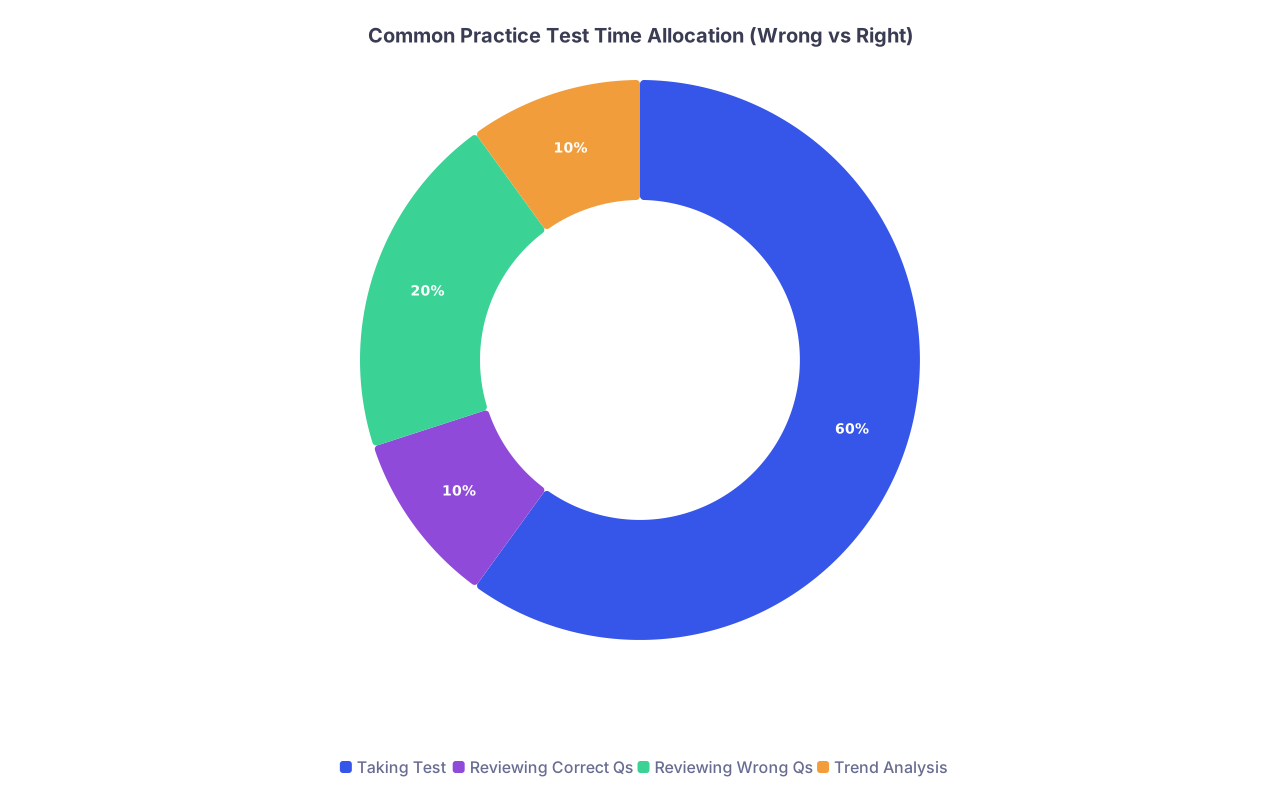
| Category | Value |
|---|---|
| Taking Test | 60 |
| Reviewing Correct Qs | 10 |
| Reviewing Wrong Qs | 20 |
| Trend Analysis | 10 |
Most students spend the majority of their time taking tests, not mining them for information. That ratio should be almost reversed.
Mistake #2: Chasing Scores Too Early and Too Often
Here is another trap: starting full-lengths way too early, then obsessively chasing score increases.
You know this pattern:
- Student has done only half of content review.
- Takes an AAMC or third-party full-length “just to see where I’m at.”
- Scores lower than hoped.
- Panics. Schedules another full-length a week later to “see improvement.”
- Still low. Panic intensifies.
- Ends up burned out, with weak content and shallow review.
You do not gain skill by repeatedly measuring your lack of skill.
Early in your prep, full-lengths should be sparse and surgical. Maybe one diagnostic to see broad weaknesses. Then a heavy period of content + passage-based practice. Then gradually increasing test frequency when you are closer to test-ready.
If you are running a full-length every weekend for 10+ weeks while still forgetting basic amino acids or Newton’s laws, you are confusing “training” with “testing.” You are collecting scores, not building competence.
When frequent full-lengths make sense—and when they absolutely do not
They make sense:
- Late in prep (last 4–6 weeks), when most content is reasonably solid.
- When you have time to review each exam thoroughly over 2–3 days.
- When you are still learning new things from each review.
They do not make sense:
- When you are still missing basic recall questions because you never learned the material.
- When your review is rushed because your schedule is packed with the next exam.
- When your mood for the week depends on a single number.
If your “study plan” is basically: “FL every 5–7 days until test day,” with no structured review and no targeted content blocks in between, you are building a very fragile, score-obsessed house of cards.
Mistake #3: Overreliance on Third-Party Scores as Reality
Another common source of fake confidence or fake panic: believing third-party scores are accurate reflections of AAMC performance.
Different test companies have different question styles, psychometrics, and curve assumptions. Some tend to under-predict, some over-predict, some are just noisy.
I have seen:
- Students consistently scoring 503–505 on third-party tests, then walking out with a 511 on the real thing.
- Others “living” in the 514–516 range on certain third-party exams and then hitting a 507 on the AAMC and the actual MCAT.
The mistake: treating these tests as oracles rather than rough tools.
| Source | Style Match to AAMC | Score Predictiveness | Best Use |
|---|---|---|---|
| AAMC FLs | Very High | High | Final score calibration |
| UWorld Passages | High | Indirect | Skill building, not scoring |
| Blueprint FLs | Moderate | Moderate | Early/mid-stage diagnostics |
| Kaplan FLs | Moderate | Variable | Stamina & exposure |
| Random Free FLs | Low | Poor | Avoid for score prediction |
The specific mistake here
Using third-party scores late in your prep as your primary confidence gauge.
If, in the final month, your emotional state is based more on your last Kaplan or Blueprint number than on your AAMC full-lengths, you are anchoring to the wrong metric. Third-party exams are training weights. The AAMC full-lengths are dress rehearsals.
You should absolutely use third-party tests. They are valuable for stamina, question exposure, and identifying gaps. But do not:
- Set a “target score” on them as your mental test-day goal.
- Assume a 510 on a third-party guarantees anything on the real exam.
- Assume a 498 means you must delay, if your AAMC practice is stronger.
Your real calibration should be based primarily on AAMC material, especially in the last 4–6 weeks.
Mistake #4: Ignoring Timing and Endurance Problems
Some of you are getting fake confidence from your “scores”… because you are breaking the rules of the exam.
I have watched students:
- Pause sections “briefly” or extend breaks “just this once.”
- Split a full-length over two days (“to focus better on each part”).
- Redo a section they felt went badly during the same day.
Then they proudly log the score as if it is equivalent to a strict 7.5-hour continuous test under realistic conditions. It is not.
That score is contaminated. It is lying to you.
If you routinely:
- Add extra minutes to a section.
- Take a 20-minute break instead of 10.
- Check your phone between sections.
- Stretch practice breaks to recover fully.
…you are training for a different exam. On the real MCAT, fatigue, attention decline, and stress are part of the test. You do not “accidentally” perform just as well under those conditions if you only ever tested in comfortable, modified conditions.
The endurance gap you are ignoring
A lot of students are mentally done by the last Chem/Phys or Bio/Biochem passages on the real exam. Their brain has never fully practiced that level of sustained effort. In practice, they always stopped when they got tired.
Then they are surprised when their final section score tanks on test day.
You want to see the ugly version of your performance in practice. Sloppy last section. Dumb mistakes. That is the data you need. If your practice conditions are too forgiving, the data is fake.
Mistake #5: Superficial Review That Teaches You Nothing
This one is brutal because it feels like work but does not move the needle.
The pattern:
- Finish full-length.
- Look at score: “Not great, but okay.”
- Go question by question.
- For each wrong answer, read the explanation and think, “Oh, that makes sense.”
- Maybe jot down a note like “review electrochemistry.”
- Done.
You have “reviewed” an exam. You have not changed your future performance.
The major errors here:
- You do not identify the cause of each mistake.
- You do not build a feedback loop to prevent repeat errors.
- You do not revisit the tested concept in a broader context.
You should be categorizing wrong answers, not just understanding them in isolation.
Ask yourself every time you miss a question:
- Was this a content gap?
- Was this a misread/misinterpretation of the question stem?
- Was this poor passage strategy (e.g., not mapping the experiment)?
- Was this timing-related (rushed, guessed, did not fully read options)?
- Was this a confidence / second-guessing issue?
Then track those categories. If you discover that 50% of your missed questions are “content I never learned,” your next move is not “another full-length.” It is “fix the content.”
If 60% are “I misread the question” problems, you have a reading and attention discipline problem, not a knowledge problem.
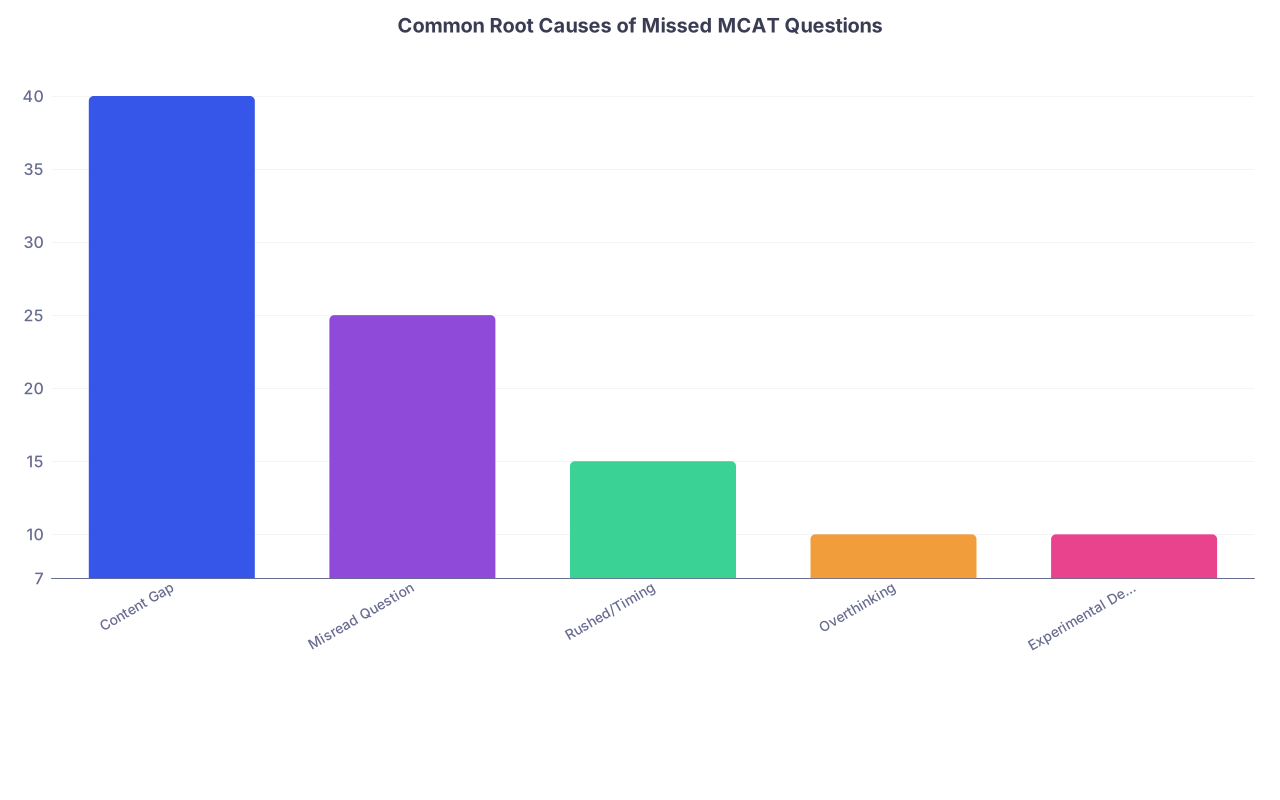
| Category | Value |
|---|---|
| Content Gap | 40 |
| Misread Question | 25 |
| Rushed/Timing | 15 |
| Overthinking | 10 |
| Experimental Design Confusion | 10 |
Superficial review hides patterns like these. You feel like you are learning because the explanation is clear—right after you see the answer. But being able to understand the correct answer after the fact is not the same skill as generating it under time pressure.
Mistake #6: Treating AAMC Practice as Infinite and Reusable
Let me be blunt. AAMC material is sacred. You do not burn it casually.
Two major mistakes:
- Doing AAMC full-lengths way too early in your prep.
- Redoing AAMC full-lengths and counting the score as “fresh” data.
The AAMC has a limited number of full-length exams. Once you have seen the questions, the data is compromised. Your second attempt is not an honest reflection of how you would do on unseen AAMC-style questions.
I have seen people “boost” their confidence by retaking AAMC FL1 or FL2 and getting a 515+ after previously scoring 503. Then they are stunned when their real test score is closer to 505. They knew too many of the questions. The score was inflated.
You want your AAMC full-lengths as late-stage tools:
- To simulate real test conditions strictly.
- To calibrate your score expectations.
- To identify final, high-yield weaknesses.
Blowing through them at the beginning of your prep, then trying to reuse them later, is like reading the answer key before the exam and then claiming you “improved.”
Use third-party for early and mid-phase testing. Guard AAMC like it is a finite, irreplaceable resource—because it is.
Mistake #7: Confusing Test-Taking Skill With Content Mastery (and Vice Versa)
Here is a subtle but destructive problem.
Some students have strong content but poor strategy. Others have decent strategy but massive gaps in core knowledge. Both groups can get trapped by misleading practice test scores.
Scenario 1: The Content Beast, Strategy-Weak
You know biochem pathways, physics formulas, psych theories. You crush Anki. But your CARS is inconsistent. You misinterpret experimental setups. You rush. Yet your overall scores on practice tests are “okay.” So you tell yourself you just need “more content review.”
No. Your ROI is in strategy, not additional memorization.
Scenario 2: The Test-Taker, Content-Weak
You are good at standardizing passages, guessing intelligently, eliminating answers. You have taken a million standardized tests. On mid-tier practice exams, you can sometimes pull off decent scores by pure test-taking skill. So you convince yourself your knowledge gaps are “fine.”
Then the MCAT hits you with layered reasoning on top of unfamiliar content, and your quick-elimination tricks crumble.
The mistake is using your composite score to override your gut impression about your weaknesses.
If you know you keep skipping physics, or freezing on orgo lab techniques, but your total is “not terrible,” do not let the number seduce you. Your confidence is floating on a shaky foundation.
Mistake #8: Not Aligning Practice Test Timing With Your Real Test Date
There is also a logistical way students create fake confidence: misaligning the timing and spacing of their practice tests relative to their scheduled exam.
Common patterns:
- Front-loading all full-lengths months before the real date, then barely testing in the final month.
- Cramming 3–4 AAMC full-lengths into the final 8–10 days “for one last push.”
- Having a 3–4 week gap with no full-lengths right before test day due to travel, school, or work.
If your last realistic full-length was 5 weeks before your real exam, your confidence is outdated. You are not the same test-taker you were then—good or bad. That data has decayed.
On the flip side, if you cram multiple full-lengths into the last 1–2 weeks, you are not giving yourself time to actually learn from them. The scores give you emotional swings but almost no structural improvement.
You want a cadence that lets you:
- Take a full-length.
- Spend 2–3 days deeply reviewing and remediating.
- Adjust your study plan based on that exam.
- Then test again once changes have had time to take effect.
Your practice test rhythm should serve your development, not your anxiety.
A Safer, Saner Way to Use Practice Tests
Let me give you a basic structure that avoids most of these traps. You can adapt it, but ignore the principles at your own risk.
Early Phase (Heavy Content + Section Practice)
- One diagnostic full-length (preferably third-party), under strict timing.
- Primary use: high-level map of weaknesses, not a predictor of your final score.
- Focus on content review, UWorld/Q-banks, and shorter passages.
- No more than 1 full-length every 3–4 weeks.
Mid Phase (Building Endurance and Strategy)
- Increase to 1 full-length every 2 weeks, mostly third-party.
- After each exam: 2+ days of structured review with error categorization and targeted remediation.
- Begin tracking timing patterns and fatigue clearly.
- Start reserving AAMC full-lengths for the final phase.
Final Phase (Calibration and Realism)
- Use AAMC FLs as main full-lengths, about 1 per week in the last 4–5 weeks.
- Mimic test-day conditions with ruthless honesty: timing, breaks, no phones, no pausing.
- Focus heavily on analyzing patterns across AAMC exams.
- Fill non-test days with targeted practice on repeated weak areas.
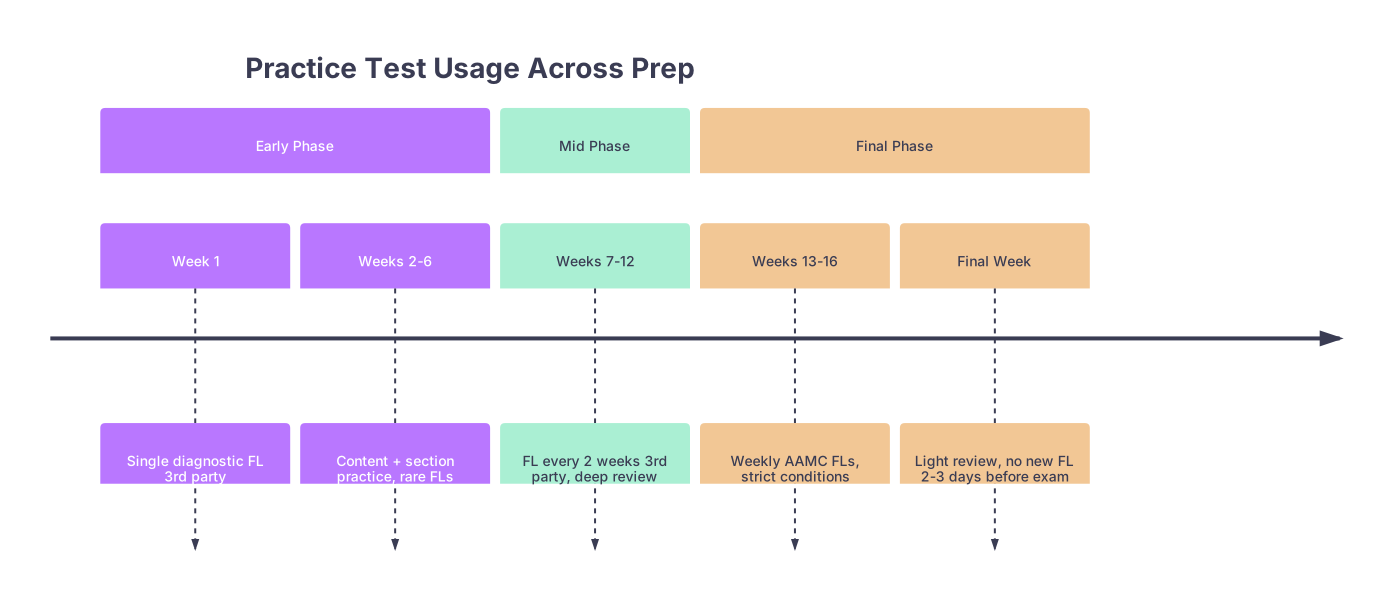
| Period | Event |
|---|---|
| Early Phase - Week 1 | Single diagnostic FL 3rd party |
| Early Phase - Weeks 2-6 | Content + section practice, rare FLs |
| Mid Phase - Weeks 7-12 | FL every 2 weeks 3rd party, deep review |
| Final Phase - Weeks 13-16 | Weekly AAMC FLs, strict conditions |
| Final Phase - Final Week | Light review, no new FL 2-3 days before exam |
This pattern does not guarantee a high score. Nothing does. But it does protect you from the illusion that high or gradually improving practice scores mean you are automatically ready.
FAQs
1. How many full-length practice tests should I take before the MCAT?
Generally, 6–10 total is a reasonable range for most students. That usually includes all AAMC full-lengths plus several third-party exams. Fewer than 5 and you risk walking into test day under-calibrated and under-conditioned. More than 12–14 and the marginal benefit usually collapses unless your review is insanely structured. The number is less important than what you actually learn from each one.
2. My third-party scores are rising, but my first AAMC full-length was much lower. What should I do?
Do not panic, but do not ignore it. Treat the AAMC result as the more reliable benchmark. Go back through that AAMC exam ruthlessly. Identify specific content and reasoning gaps. Then adjust your study plan to drill those areas using AAMC Section Bank, Question Packs, and high-quality third-party passages. Aim to take another AAMC full-length after 1–2 weeks of focused remediation to see if the gap narrows.
3. Is it ever okay to split a full-length over two days?
Only for very early stamina building, and you should not treat that as a true score. For example, in your first attempt at any full-length experience, you might do Chem/Phys + CARS one day, then Bio/Biochem + Psych/Soc the next, just to get used to the style and length. But in the 6 weeks leading into your real MCAT, your full-lengths need to be done exactly like the real exam. No splitting. No score logging from broken-up attempts.
4. How long should I spend reviewing each full-length test?
Plan on 1.5–2 full days of review per test, especially for AAMC exams. That does not mean 16 hours straight, but it does mean several focused blocks where you go through every question, categorize errors, and do targeted follow-up. If you “review” a full-length in 2–3 hours, you almost certainly skimmed the surface and left most of the learning behind.
5. My practice test scores are all over the place. Which ones should I trust?
Look at patterns, not isolated numbers. AAMC full-lengths, taken under strict conditions, deserve the most weight. Third-party exams are trend indicators, not verdicts. If AAMC FLs show a consistent cluster (for example, 507–510 across 3 exams), that cluster is much more telling than one random 515 or one random 500 from elsewhere. Use outliers as prompts to review what went differently that day, not as the basis of your self-worth or final expectations.
Key takeaways:
- Practice tests are diagnostic instruments, not ego boosters. Treat them like clinical data, not Instagram likes.
- AAMC material is finite and precious; save it for when it will actually calibrate you, and respect test-day conditions.
- Confidence based on sloppy test conditions, superficial review, or overinterpreted third-party scores is not confidence. It is a setup for a very painful score report.