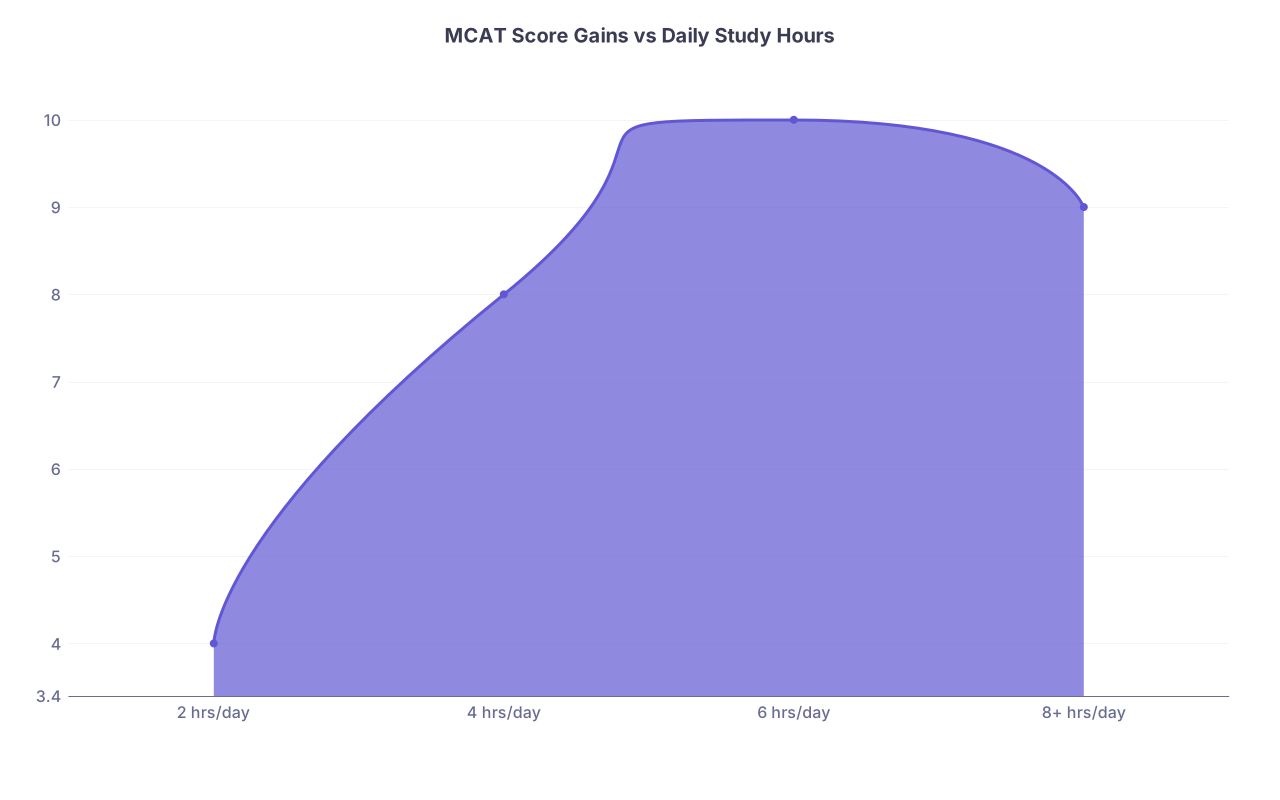
Only 18–20% of matriculants to U.S. MD schools have a 520+ MCAT. Yet if you listen to Reddit or certain “advisors,” you’d think anything under 520 is medical-school suicide.
Let me be blunt: the “520 or bust” culture is one of the most damaging — and statistically wrong — myths in premed land.
You do not need a 520+ to get into an MD program.
You need the right score for:
- your GPA
- your school list
- and your actual application quality
Let’s pull the curtain back and look at what the data actually shows.
What The Real Numbers Say About MCAT Scores and Acceptance
First, some grounding in reality. AAMC publishes detailed data every year on MCAT, GPA, and acceptance rates. Most people quoting “you need a 520” have never read those tables. They’re parroting flex culture, not evidence.
Here’s a simplified snapshot based on recent AAMC cycles (rounded ranges, not single-year, to keep this readable):
| MCAT Range | Approx. Acceptance Rate |
|---|---|
| 510–513 | ~45–50% |
| 514–517 | ~60–65% |
| 518–521 | ~70–75% |
| 522–525 | ~80%+ |
Notice the pattern? The curve is not “0% until 520, then suddenly you’re safe.”
The curve climbs steadily. It does not have a magical cliff at 520.
Now, look at the average MCAT for U.S. MD matriculants: roughly 512–513 in recent years. Not 520. Not 522. About 512–513.
So if the average matriculant is sitting around 512, what do you think everyone with 510–518 is doing? All getting rejected? Of course not. They’re filling the majority of seats.
Where do the 520+ people land? Yes, they tend to cluster in T20 and highly research-heavy programs. But they are not the baseline requirement for “any MD acceptance.”
The “520 or fail” crowd is confusing:
- what’s competitive for top-10 research powerhouses
with - what’s necessary for MD admission in general
Those are not the same game.
The 520+ Myth: Who’s Selling It and Why It’s Wrong
I see four main sources of the 520-obsession:
Online forums and group flexing
People with 519s get told, “Retake. You’re leaving top-10 schools on the table.” The loudest voices online are not representative. They’re either gunners, anxious overachievers, or people optimizing for prestige, not just admission.Commercial prep companies
“We helped 1,000 students score 520+!” is a great marketing line. It also quietly implies that’s what you should aim for. More anxiety → more course purchases. Shocking.Misinterpreted stats
People see “average MCAT at School X is 520” and conclude, “So I need 520+ to get in.” Wrong. That’s the average among those who were admitted — which includes plenty below that number, balanced by some very high scores.Prestige confusion
A student says, “I want MD.” Then spends two years acting like “I must go to a top-10 MD with an NIH funding flex.” Those are two different goals. Most U.S. MD schools are not Harvard or UCSF. Their numbers are different. Their expectations are different.
Let me be direct: if your goal is “any accredited U.S. MD school,” a 520+ is way above what you need. Useful? Sure. Required? Not even close.
The Real Determinant: MCAT + GPA, Not MCAT Alone
MCAT never lives in isolation. Committees look at MCAT with GPA. A solid MCAT can rescue a middling GPA. A strong GPA can save a slightly lower MCAT. It’s a balancing act.
Here’s a rough idea of how combinations play out:
| GPA Range | MCAT Range | General Competitiveness (U.S. MD) |
|---|---|---|
| 3.8–4.0 | 515–518 | Strong for many MDs, including mid-high tier |
| 3.7–3.8 | 512–515 | Solid for broad MD list, including some competitive |
| 3.5–3.7 | 510–513 | Reasonable shot at many MDs, strong DO safety |
| 3.3–3.5 | 508–511 | Some MDs possible (esp. in-state), DO very realistic |
A few straight truths:
- A 3.9 with a 514 is more attractive than a 3.4 with a 520 at many schools
- A 510 with a 3.8 will absolutely get MD interviews at a smartly chosen list
- A 520 does not magically erase a 3.2 GPA and five W’s and three C’s in core sciences
The obsession with a 520+ MCAT is often an attempt to brute-force fix a weak GPA or shaky app. That rarely works the way people fantasize. A 520 backed by mediocre coursework and thin clinical exposure is still a weak application.
How Much Does the MCAT Actually Move the Needle?
Let’s do some approximate math based on AAMC grid patterns.
Say you’re in the 3.6–3.79 GPA band:
- At MCAT 508–510, your acceptance odds might hover somewhere around 35–40%
- At 511–513, that might climb into the 45–55% range
- At 514–517, it jumps more solidly into “good chance” territory
- Going from 517 to 521? The boost is there, but it’s much smaller
So:
- Going from 505 → 512 can be life-changing
- Going from 512 → 518 is helpful, especially for reach schools
- Going from 518 → 522 is mostly about where you can go, not whether you’ll go
The score curve has diminishing returns.
There’s a point where chasing 1–2 extra points becomes more about ego and less about outcome. I’ve watched students burn an extra year and $2,000+ on retakes trying to go from 517 to 520+. They lose an entire application cycle for a statistically small marginal advantage.
That tradeoff is often terrible.
Who Actually Needs 520+?
Let me narrow this down.
You might reasonably target 520+ if:
- You have a very strong GPA (3.8–4.0)
- You’re aiming heavily at top-20 research institutions (Harvard, Penn, Hopkins, UCSF, Stanford, etc.)
- You already have substantial research output (posters, maybe a pub or two) and stronger-than-average ECs
- You’re prepared to accept that you still might not get in, because those schools reject tons of people with 520+
But needing 520+ is a very specific niche. You’re not “behind” with a 515 if you’re not chasing hyper-selective schools. You’re actually above average for most matriculants.
The painful irony: a lot of students with a 510–514 delay applying, retake three times, and torpedo their chances with red flags (multiple attempts, big score spreads, more time without clinical work) — all because they think “nobody gets in with less than 520.”
I’ve seen:
- A 513 (3.75 GPA) get multiple MD acceptances at mid-tier state and private schools
- A 514 (3.6 GPA, strong clinical, decent research) land at a T25 school
- A 509 (3.9 GPA, excellent narrative, strong in-state preference) get several MDs
The pattern is obvious once you’ve watched a few cycles up close. The 520 myth survives because people like clean, magical numbers. Admissions is messy and multivariate. People hate that.
The Hidden Cost of Chasing 520+
Let’s talk about what 520-chasing actually does to many students.
1. Unnecessary retakes
I’ve lost count of the number of students with:
- First attempt: 513 (balanced)
- Then they retake, drop a section, end up with 511 or 514 with a weird 124–125 in one section
Now they’ve got:
- multiple attempts
- an odd score profile
- and wasted time they could have used building clinical hours, research, or applying a year earlier
Admissions committees don’t love gratuitous retakes, especially when the first score was already clearly competitive for your likely school range.
2. Burnout that bleeds into everything else
Pursuing +3 more MCAT points often means:
- less energy for upper-level science courses → GPA suffers
- less time for clinical work → weaker experiences, weaker essays
- more anxiety → worse performance across the board
You can’t silo your life. If MCAT prep takes over, something else gives. And ironically, the thing that gives is often the part of your application that makes you stand out as a human being.
3. Delay in starting your actual career
If you take an extra gap year purely to push 515 → 520+ for ego or online-validation reasons, you’re giving up:
- one year of resident salary down the line
- one year of attending salary further down the line
- one year of your life doing the thing you actually want to do: medicine
That’s a bad ROI if your end goal is “be a physician,” not “post my MCAT score screenshot for karma.”
So What Score Should You Actually Aim For?
Here’s the part you probably came for.
A sane, data-aware target for most U.S. MD-hopefuls (not prestige-hunters):
- If GPA ≥ 3.8: Aim 512–518. Higher is nice, not mandatory.
- If GPA 3.6–3.79: Aim 510–515. A 512+ with this GPA and strong ECs is a very workable combo.
- If GPA 3.4–3.59: Aim at least 508–512. MD may be realistic with smart school list, DO as safety.
- If GPA < 3.4: Raising GPA trajectory and strengthening your story matters more than chasing 520+. A 518 with a 3.2 will not magically put you in the same lane as a 3.8/512.
And more important than some arbitrary ceiling is this question:
At what score will I apply without retaking?
For most people, that “apply and move on” threshold should be much lower than 520.
Here’s a simple “application decision” flow so you can stop torturing yourself:

| Step | Description |
|---|---|
| Step 1 | Get MCAT Score |
| Step 2 | Strongly consider retake after content review |
| Step 3 | Retake if GPA <= 3.6 or limited state options |
| Step 4 | Consider one retake with clear study plan |
| Step 5 | Stop. Apply this cycle with full effort |
| Step 6 | 510 or higher? |
| Step 7 | Below 500? |
| Step 8 | Within target for GPA & school list? |
Most students with 511–515 and decent GPAs belong in the H branch. Apply, don’t retake.
When a Retake Actually Makes Sense
Retakes are not evil. They’re just overused for ego reasons.
Reasonable cause to retake:
- You underperformed full-length practice by 3–4+ points due to nerves, illness, obvious prep gap
- Your score is clearly misaligned with your GPA (e.g., 3.9 GPA, 503 MCAT)
- You know exactly what went wrong, and your old study approach was obviously flawed or incomplete
- Your current score is sharply limiting even realistic in-state MD options (e.g., 502–505 with solid GPA)
Terrible reasons to retake:
- “Reddit says 514 isn’t competitive anywhere”
- “I want to be above average at every school I apply to”
- “My friend got a 522 and I feel dumb”
- “A T5 school lists a 520 median, so I must have at least that”
That second list is how people waste entire years of their life.
Where 520+ Actually Matters
I’m not pretending 520+ is useless. It’s powerful in the right context.
It especially helps if:
- You’re targeting multiple top-20 research schools
- You have truly strong research (multi-year, clear productivity) and want to match early into competitive academic specialties
- You’re an ORM (overrepresented in medicine) applicant with no particular hook, and you need a clean metric edge at very selective places
Here’s the nuance: in those lanes, 520+ is more like the price of admission to the interview pile. It does not guarantee anything. It just gets your file looked at with interest.
For a broad MD applicant not fixated on brand-name rankings, though? That level of score is icing, not cake.
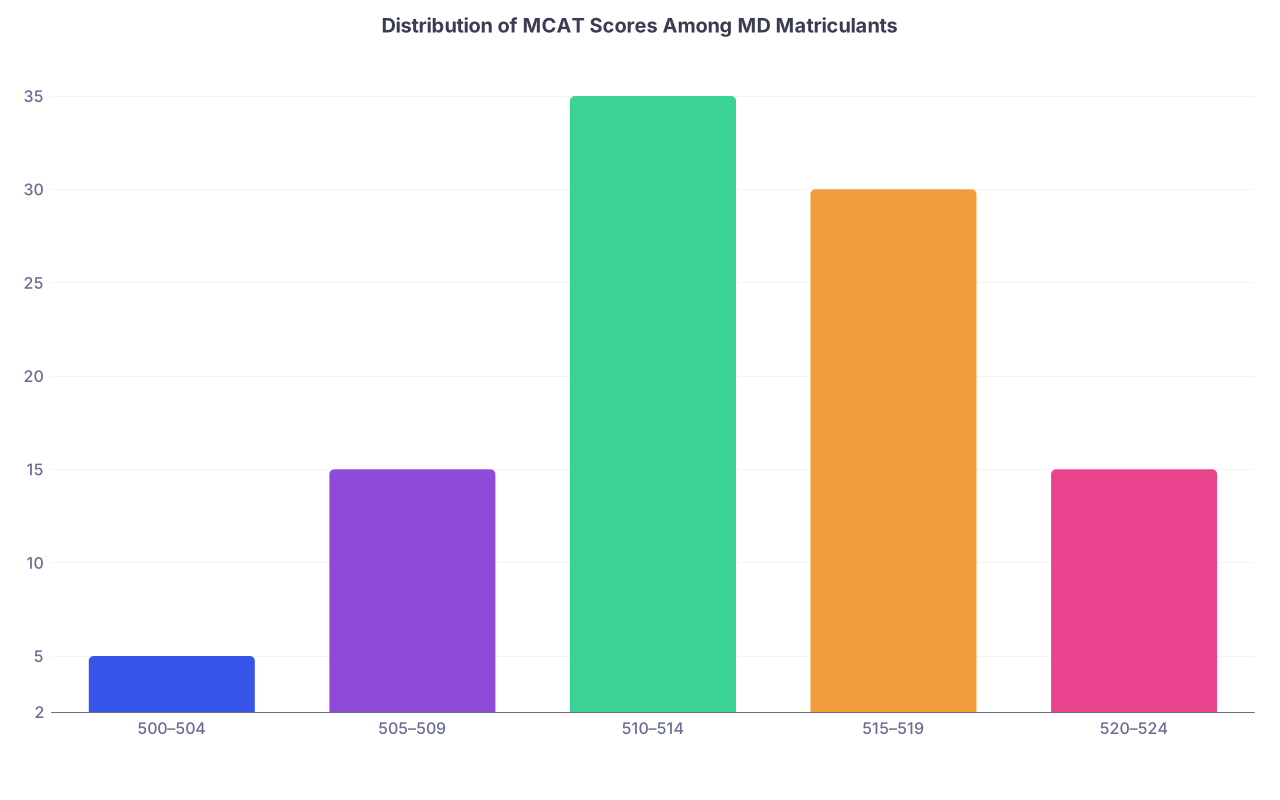
| Category | Value |
|---|---|
| 500–504 | 5 |
| 505–509 | 15 |
| 510–514 | 35 |
| 515–519 | 30 |
| 520–524 | 15 |
Look at that rough distribution: most seats are filled by people in the 510–519 band. Not 520–524. That high-end bucket is a minority, not the baseline.
The Actual Playbook: Evidence-Based, Not Ego-Based
Here’s how to approach this like an adult, not a message-board addict:
Know your GPA honestly.
Not what you wish it were. What it actually is, science and overall. That frames what MCAT range makes sense.Decide your real goal.
“Be a physician at an accredited U.S. school as soon as reasonably possible” is one goal.
“Roll the dice for a T10 even if it costs me extra years” is a different goal. Both valid. But different rules.Set a rational score floor.
For example, “If I get ≥512 with my 3.7 GPA, I will apply and not retake.” Write it down before you see your score. Otherwise, your brain will always move the goalposts.Build the rest of the application like it matters — because it does.
Clinical experience, letters, essays, and school list choices will do more for a 512 applicant than two extra MCAT points and mediocre everything else.
Bottom Line
You don’t need a 520+ MCAT for MD acceptance. Here’s the reality:
- The average MD matriculant sits around 512–513; only a minority crack 520+.
- MCAT works in context with GPA and the rest of your application — chasing 520+ can have lousy ROI if you already have a solid, balanced score.
- Use the data to set a sane “good enough” threshold, apply when you hit it, and stop worshipping a number that most successful physicians never achieved and never needed.