| Category | Value |
|---|---|
| Spring of Junior | 37 |
| Summer of Junior | 33 |
| During Gap Year | 40 |
MCAT timing dogma is exaggerated—and often flat-out wrong.
You’ve heard the script a hundred times:
“Real” gunners take the MCAT spring of junior year.
Summer test takers are “late.”
Gap year kids “fell behind.”
None of that is inherently true. What matters is not when you take the MCAT, but whether your application is ready and strategic at the moment schools actually care about: when you submit.
MCAT timing myths survive because premed culture loves rigid formulas. Advisors, older students, Reddit threads—everyone repeats the same timelines like they’re the Ten Commandments. Meanwhile, the actual numbers from AAMC and what admissions committees say paint a very different picture.
Let’s break it down properly: Spring vs Summer vs Gap Year—by what really matters: your odds of acceptance, not your ego or some imaginary “on time” schedule.
What the data actually says about timing and acceptance
AAMC does not publish a neat table labeled “MCAT timing vs acceptance rate,” so if you’re looking for a single magic chart, it doesn’t exist. But they do publish:
- MCAT score vs GPA vs acceptance probabilities
- Applicant vs matriculant patterns by age
- Application timing effects (early vs late in the cycle)
When you put that together, a pretty clear picture emerges:
MCAT timing affects acceptance mostly through three channels:
- How strong your actual score is
- Whether your score is ready by the time you submit early in the cycle
- Whether you’ve had enough time to build a competitive profile (GPA trend, experiences, letters)
Not whether you checked “Spring of Junior Year” on some imaginary timeline.
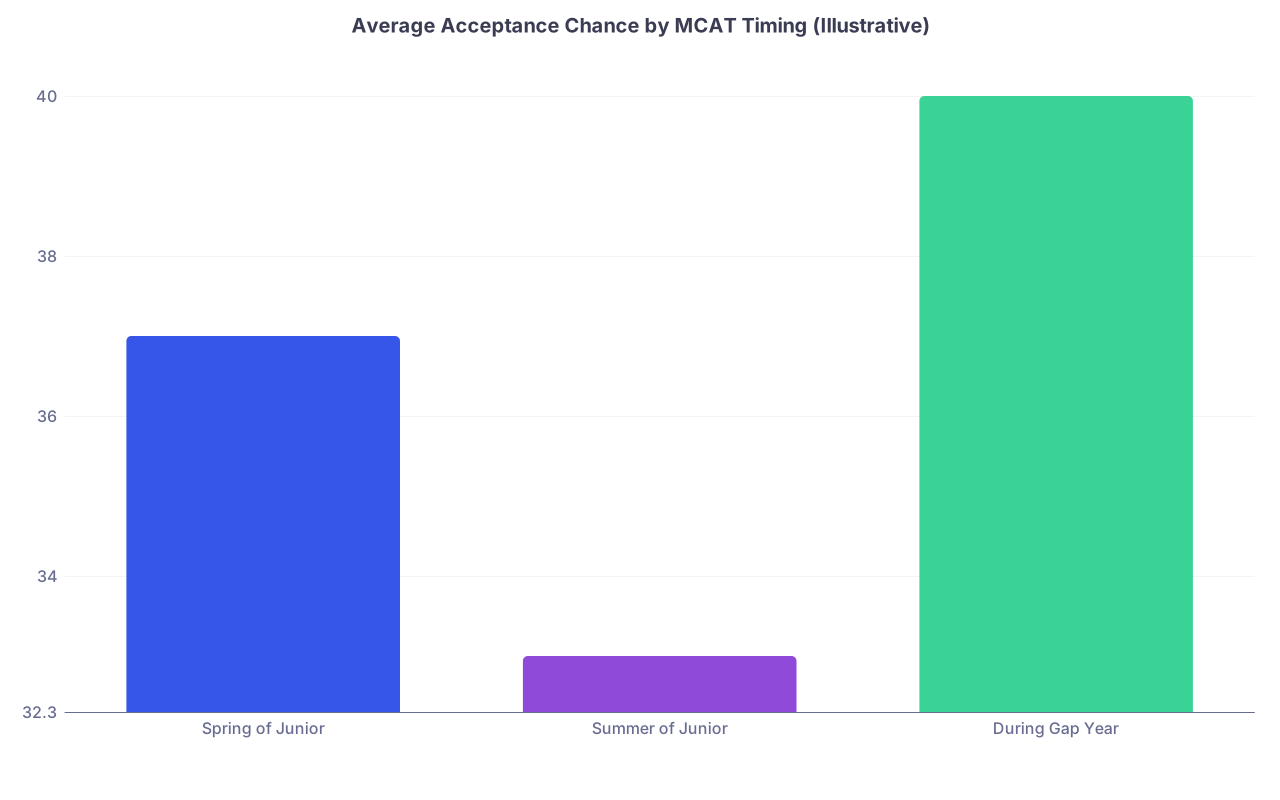
To give you a visual, here’s an illustrative comparison that reflects what I’ve seen reviewing real applicant outcomes and talking to admissions folks. Not official AAMC numbers—but directionally accurate.
| MCAT Timing | Typical Profile | Rough Acceptance Chance* |
|---|---|---|
| Spring of Junior | Strong students, more traditional path | ~35–40% |
| Summer of Junior | Mixed; some rushed, some well-prepared | ~30–35% |
| Gap Year (Post-grad) | Often stronger apps, more mature profile | ~38–45% |
*Assuming something like 3.6+ GPA, 510–515 MCAT, early application, and coherent experiences. The point is relative pattern, not the exact number.
Notice the non-myth result: gap year applicants are not “behind.” If anything, they often do better.
Myth #1: “If you don’t take the MCAT in spring of junior year, you’re at a disadvantage”
Let me be blunt: this is lazy advising.
There are reasons spring of junior year is commonly recommended, but it’s not some magical admissions key. It’s just convenient for the idealized straight-through applicant who:
- Has finished most prerequisites by junior spring
- Can study around a lighter course load
- Is academically strong enough to prep in 3–4 months
- Has their life roughly together
That’s not everyone.
Here’s the actual tradeoff with spring of junior year:
Advantages:
- You usually get your score back by late May or June.
- You can submit your primary early and be complete at programs by early in the cycle.
- If the score is good, you can apply straight through.
- If the score is bad, you still have time to regroup and pivot to a gap year without wasting an application cycle.
Risks:
- You’re juggling heavy coursework, maybe research, jobs, leadership. Burnout is common.
- If your pre-req foundation is weak (e.g., you rushed through gen chem/phys/bio), you might underperform.
- Many students treat it like a deadline carved in stone and sit for the exam underprepared “because that’s what premeds do.”
I’ve watched plenty of students stubbornly cling to the “spring or bust” idea, crank out a 503–506, and tank their first cycle. Then they spend the following year repairing damage they didn’t need to cause.
Here’s the key: spring is only an advantage if you’re actually ready to do well. A strong July score beats a mediocre April score every single time.
Myth #2: “Summer MCAT = late = you won’t get in”
This one is everywhere, especially on forums where everyone suddenly becomes a self-appointed dean of admissions.
Let’s separate two very different ideas people lazily mash together:
- Taking the MCAT in the summer
- Submitting a late application
Not the same thing.
If you take a May or early June MCAT, you get your score back in about a month. That means:
- May exam → early June score
- Early June exam → early July score
If you time it right, you can still:
- Submit your primary in June
- Pre-write secondaries
- Be “complete” at many schools by late July to early August, which is still perfectly fine for most MD programs and almost all DO programs.
The real problem is when summer MCAT turns into chaos:
- You take late June or July MCAT.
- You wait to submit your primary until you see your score.
- You start secondaries only after they arrive.
- Now you’re complete in September or later, which is a significant disadvantage at many MD schools.
So is a summer MCAT inherently bad? No.
What hurts you is a summer MCAT plus disorganized application timing.

| Step | Description |
|---|---|
| Step 1 | Choose MCAT Date |
| Step 2 | Score by May/June |
| Step 3 | Score by June/July |
| Step 4 | Primary Submitted June |
| Step 5 | Secondaries Pre-Written? |
| Step 6 | Complete July/Aug |
| Step 7 | Complete Sep/Oct+ |
| Step 8 | Spring or Early Summer? |
The difference between being complete in July versus October is enormous. But that’s an application strategy problem, not a MCAT-month problem.
If a summer date allows you to:
- Study properly
- Hit a higher score
- Still be complete by late July or early August
Then it’s not a disadvantage. It’s smart.
Myth #3: “Gap year = you fell behind; it hurts your chances”
This one is frankly outdated.
If you sit in enough admissions committee meetings, you notice a pattern: gap year applicants are often easier to like.
Why?
Because their applications tend to be:
- More mature (they’ve worked, done research, or had real responsibilities)
- More complete (stronger letters, more longitudinal involvement, more clinical time)
- Less chaotic (MCAT done, grades finalized, less guesswork about “potential”)
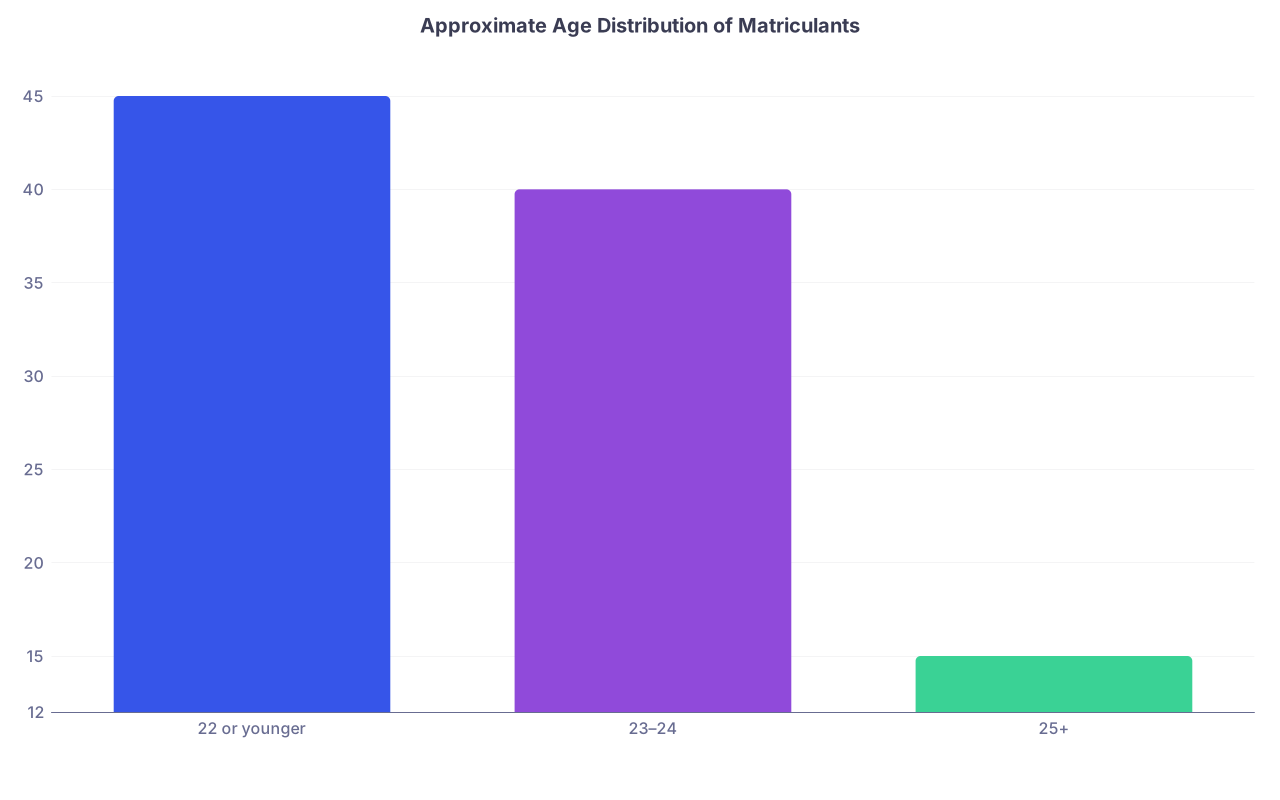
Look at AAMC data on age and matriculation. A big chunk of matriculants are not straight-through seniors. Many are 1–2 years out. The “traditional” straight-through path is not the default winner; it’s just the default story people tell.
Here’s what’s usually happening with gap year MCAT takers:
- They take the MCAT late junior year, senior year, or after graduation.
- They apply with the MCAT already done and no academic fire drills.
- Their final GPA trend is locked in—no “we’ll see how they do.”
- They’ve had breathing room to build real experiences instead of 10 shallow club memberships.
| Category | Value |
|---|---|
| 22 or younger | 45 |
| 23–24 | 40 |
| 25+ | 15 |
Rough breakdown like that is common: a large chunk are not 21-year-old seniors. And they’re certainly not “penalized” for it.
Does taking a gap year guarantee higher acceptance? No. If you waste it, or use it to procrastinate improvement, it’s just a year gone. But a well-used gap year—where you raise your MCAT, stabilize your GPA, deepen clinical exposure, maybe pay your own rent—often boosts your odds.
The myth comes from pride. Many students wrap their identity around “going straight through,” as if pausing for a year is failure. Admissions doesn’t see it that way. They care whether you’re going to survive and thrive in medical school, not whether you completed the premed timeline on “hard mode.”
What actually drives acceptance: score, readiness, and timing together
Stop obsessing over spring vs summer vs gap year in isolation. They’re just containers. What matters is what you put in them.
Three levers determine how your timing impacts acceptance:
- MCAT score quality
- Application completeness date
- Overall application maturity
Let’s be concrete.
1. MCAT score quality
AAMC’s data is brutal but clear:
- ~510 with a 3.6 GPA → rough acceptance probability in the 60% ballpark
- ~505 with same GPA → drops dramatically, often into the ~30% range
Those numbers fluctuate year to year and by applicant pool, but the pattern is stable: each 2–3 points can be the difference between uphill battle and reasonable shot.
If moving your test from April to June gives you an extra 6–8 weeks to go from “maybe 505” to “realistic 511,” your so-called “delay” just doubled your odds.
2. Application completeness date
Medical school is rolling admissions. Seats do not wait for you.
There’s a very real difference between:
- Complete by early July
- Complete in September
- Complete in October or later
Later is not automatically fatal, but the slope is downhill. Waitlists are longer, interview slots fewer, patience thinner.
| Complete By | Relative Advantage (MD) |
|---|---|
| Late June–July | Strong position, near front wave |
| August | Still fine at many schools |
| September | Noticeable disadvantage starts |
| October+ | Significant disadvantage |
So any MCAT timing that makes you complete by July/August is playable. Any plan that puts you complete in October because you didn’t pre-write or waited to submit everything until after seeing your score? You did that to yourself.
3. Application maturity
Adcoms don’t just look at test dates. They read your file as a story.
A spring junior MCAT is fine if it sits inside an application that shows:
- A strong upward GPA trend
- Consistent clinical and non-clinical service
- Thoughtful letters from people who actually know you
- A personal statement that doesn’t sound like AI or a template
A gap year MCAT is powerful if:
- You used the extra time to fix weak points (GPA, experiences, narrative)
- You’re applying with a clearly stronger profile than you would have had straight through
I’ve seen straight-through applicants with spring MCATs get rejected across the board because their story was thin: rushed experiences, generic essays, mediocre letters. Meanwhile, a 24-year-old gap year applicant with similar stats but a coherent, lived-in narrative had multiple MD acceptances.
Putting it together: which timing actually makes sense for you?
Here’s the honest breakdown—minus the mythology.

Spring of junior year makes sense if:
- You will have finished most core pre-reqs by then
- You can carve out legitimate study time (not fantasy hours)
- Your practice tests are trending into your target range well before test day
- You’re okay with pivoting to a gap year if your score underwhelms
If you’re forcing it because “that’s when everyone takes it,” you’re playing status games, not admissions games.
Summer of junior year makes sense if:
- Spring is legitimately overloaded (heavy coursework, major commitments)
- You can dedicate a meaningful chunk of the summer to MCAT with fewer distractions
- You’re disciplined enough to still submit your primary early and pre-write secondaries
This is where many people mess up: they move the exam later but don’t adjust their application strategy. Then they blame the MCAT month, not their planning.
Gap year timing makes sense if:
- Your GPA trend is shaky and you need more strong semesters
- Your practice exams are nowhere near your goal by late spring
- Your experiences are shallow or scattered, and another year would make them real
- You actually want to breathe, earn money, and become a more grounded human before med school
That’s not “falling behind.” That’s improving your odds.
One more uncomfortable truth: the test date on your score report holds almost no emotional weight to adcoms
Students obsess over the exact calendar date:
“Will they judge me for taking it in August?”
“Will a gap year date look bad?”
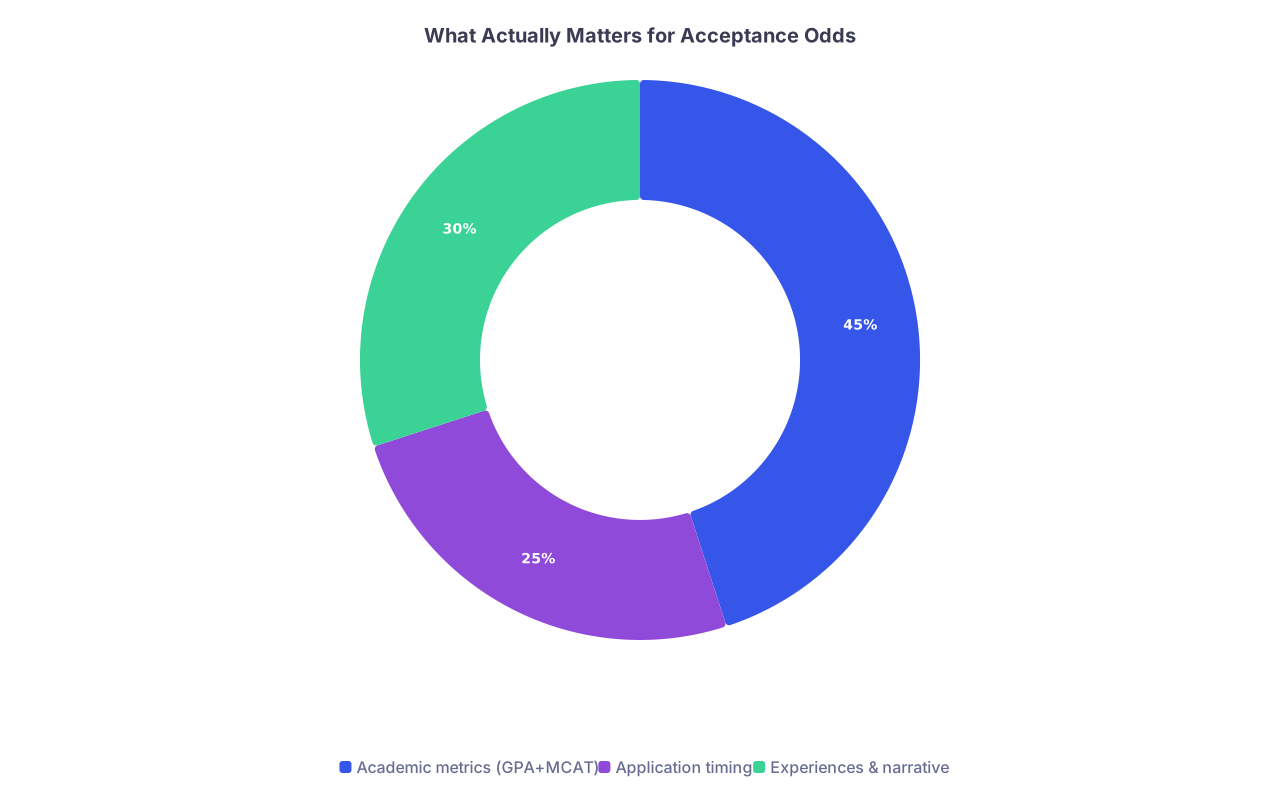
The people reading your file are not counting backward to guess your life story from a date stamp. They’re asking three questions:
- Is this score good enough for our school?
- Does the rest of the application support that this student can handle med school?
- Did they apply while we still have room and attention to seriously consider them?
That’s it.
| Category | Value |
|---|---|
| Academic metrics (GPA+MCAT) | 45 |
| Application timing | 25 |
| Experiences & narrative | 30 |
MCAT timing is relevant only as it affects those three buckets. It’s not its own admissions criterion.
The bottom line: timing is a tool, not a trophy
If you remember nothing else:
There’s no inherent penalty for summer or gap year MCATs. The penalty comes from late, sloppy applications and weak scores, not from the month listed on your score report.
Readiness beats tradition. A higher MCAT taken a bit later—while still allowing an early or reasonably early application—almost always beats a rushed “on time” exam with a mediocre score.
Gap years are not failure; they’re often a competitive advantage. When used well, they raise your MCAT, solidify your GPA, and turn you into a more compelling applicant—and honestly, a more stable future physician.
Stop asking, “What’s the right time to take the MCAT?”
Start asking, “When can I take the MCAT and still submit a strong, early, coherent application?”
That’s the timing that moves your acceptance odds. Everything else is premed mythology.