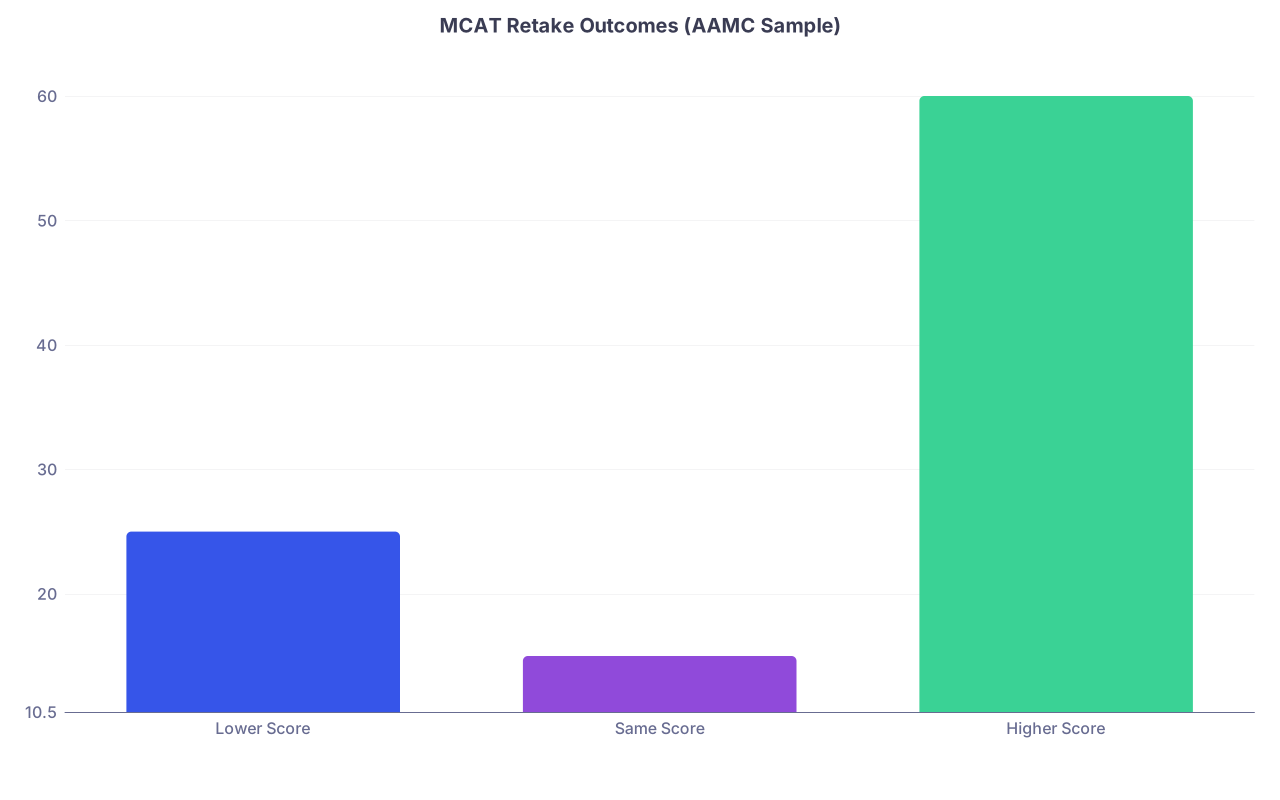
| Category | Value |
|---|---|
| Lower Score | 25 |
| Same Score | 15 |
| Higher Score | 60 |
43% of MCAT re‑takers increase their score by 3 or more points, but nearly 1 in 4 actually score lower the second time.
That is the core tension you are dealing with. The data says retaking the MCAT is not a guaranteed “do‑over”; it is a risk–return decision. If you treat it like a lottery ticket, it will punish you. If you treat it like an optimization problem, you can come out ahead.
I am going to walk through what the numbers actually show: score change distributions, how schools view multiple scores, and the real impact on acceptance probabilities.
1. What the MCAT retake data actually shows
Let me anchor this in real numbers instead of rumor‑based Reddit statistics.
The AAMC has published multiple “MCAT Validity and Score Use” reports using national data. The exact tables change by year, but the pattern is stable: most retakers move a little, not a lot.
From those reports and aggregated advising data, you consistently see something close to this distribution among re‑takers:
| Score Change on Retake | Approx. % of Retakers |
|---|---|
| −6 to −3 points | 10–12% |
| −2 to −1 points | 12–15% |
| No change (0) | 12–18% |
| +1 to +2 points | 25–30% |
| +3 to +5 points | 20–25% |
| +6 or more points | 3–6% |
Read that carefully.
Most re‑takers fall in the −2 to +5 range. Those +10 “glow up” stories exist, but they are outliers. If you are planning your entire strategy around becoming an outlier, you are planning badly.
Baseline score matters
The higher your baseline, the less room there is to move. The curve compresses as scores rise.
A rough, pattern‑level summary from AAMC datasets:
- Initial 490–499: average retake gain ~+5 to +7 points
- Initial 500–504: average retake gain ~+3 to +5 points
- Initial 505–509: average retake gain ~+2 to +3 points
- Initial 510–514: average retake gain ~+1 to +2 points
- Initial ≥515: average retake gain ~0 to +1 point (and non‑trivial risk of going down)
This is regression to the mean plus ceiling effect. Someone starting at 497 can improve 8 points and still be in the 505 range. Someone starting at 515 has almost no statistical headroom before hitting the 528 ceiling.
So if you are at 498, the data is on your side that a retake, with proper prep, can give a meaningful boost. If you are at 513 aiming for 520+ “for top‑tiers,” the aggregate data does not love your plan.
2. Acceptance rates by MCAT band: how much does a change matter?
Let’s connect score changes to acceptance probabilities.
The AAMC’s “MCAT and GPA Grid” tables compile nationwide data for MD programs. Numbers vary slightly year to year, but the structure is stable. To keep this digestible, here is a simplified snapshot of typical acceptance rates for applicants (not matriculants) by MCAT band, holding GPA roughly constant in the mid‑3’s.
| MCAT Band | Approx. Acceptance Rate |
|---|---|
| 492–495 | 5–8% |
| 496–499 | 10–15% |
| 500–503 | 18–25% |
| 504–507 | 28–35% |
| 508–511 | 40–50% |
| 512–515 | 55–65% |
| 516–519 | 70–80% |
Do not obsess over the exact percentage. Focus on the jumps between bands.
- Moving from 498 to 504 is not “just 6 points.” It can roughly double your acceptance probability (e.g., 12% → ~30%) in that GPA band.
- Moving from 508 to 512 might push you from ~45% to around ~60%.
- Moving from 514 to 518 helps, but the relative increase is smaller; you are going from “decent odds” to “better odds,” not from “almost no chance” to “serious contender.”
So the marginal value of each additional point shrinks as your score climbs. Going from 498 to 505 is life‑changing. Going from 514 to 518 is nice, but very few schools are drawing razor‑thin MCAT cutoffs at that level.
If you want a decision rule: retakes have the highest payoff when they move you across meaningful bands: sub‑500 to low‑500s, low‑500s to around 508–510, or into the 512+ tier if your GPA is strong.
3. Multiple MCAT scores: how schools really treat them
Most applicants stress about this part, often without reading actual policy language.
Three common patterns from U.S. MD programs:
Highest overall score used
Many schools (including several state flagships) state they consider the highest total score as primary. Some glance at subscores across attempts, but decision thresholds are tied to your peak.Most recent attempt emphasized
A subset, especially DO schools and a few MD programs, explicitly focus on your most recent exam as the best indicator of current readiness. Here, a worse retake can sting.Holistic view / score trend
Competitive schools often say they review all scores and note trends. A 503 → 509 trajectory is a positive signal; a 510 → 505 drop raises questions.
In practice, after seeing many committee discussions and advising cases, this is how it plays out:
- Small fluctuations (±1–2 points) are mostly noise. Committees do not launch a philosophical debate over 510 vs 512.
- Big, clean upward trends matter. 496 → 505 → 512 tells a story of persistence and academic growth. That helps.
- Downward retakes at already high scores can hurt. 515 → 509, with no clear explanation, looks like questionable judgment about retaking in the first place.
What does not happen: no reputable school secretly averages your scores into oblivion or automatically rejects you for a retake. That is urban legend tier.
4. Quantifying the risk–reward trade‑off of a retake
Strip away the emotion. Treat the retake decision as an expected value problem.
Let us say your current score is 505, GPA 3.6. From the grid, your MD acceptance probability might sit around 30–35% if the rest of your app is solid.
You are contemplating a retake. Based on the earlier distribution data for the 500–504 range, suppose your personal scenario looks like this (simplified):
- 20% chance you go down (−1 to −3)
- 25% chance you stay flat
- 35% chance you gain +1 to +2
- 20% chance you gain +3 to +5
Now map those to acceptance bands:
- 502–504 (down): maybe ~25–30%
- 505 (flat): ~30–35%
- 506–507 (small gain): ~35–40%
- 508–510 (larger gain): ~45–50%
Compute a rough expected acceptance probability if you retake:
- 0.20 × 27.5% (midpoint of 25–30) ≈ 5.5
- 0.25 × 32.5% (midpoint of 30–35) ≈ 8.1
- 0.35 × 37.5% (midpoint of 35–40) ≈ 13.1
- 0.20 × 47.5% (midpoint of 45–50) ≈ 9.5
Total ≈ 36.2%
Your current non‑retake baseline is maybe 32–33%. So with these assumptions, the expected gain from retaking is around 3–4 percentage points in acceptance probability. Not trivial. Not huge.
What actually determines whether this is smart:
- Are you closer to the lower end or higher end of the likely change distribution? (Be honest.)
- How much of a jump does your school list require? 505 → 508 might not help for places where median MCAT is 518.
- What is the opportunity cost in time, money, and application cycle delay?
5. Time cost and opportunity cost: what the calendar says
Most re‑takers do not just study “a little more.” They add 200–400 hours of prep, often stretched over 2–4 months.
Let us not hand‑wave that. Those hours come from somewhere: research, clinical time, shadowing, work, or earlier application submission.
Two non‑trivial risks:
Later application = lower odds, even with a higher score
Data from multiple admissions offices is painfully consistent: applicants complete by June/early July do better than those complete in August or later, all else equal. A 508 submitted in June can outcompete a 512 that appears in September.Weaker ECs or rushed essays
I have watched applicants pull 6‑point MCAT jumps while simultaneously slicing their clinical hours and slapping together mediocre essays. Some got waitlists instead of acceptances they probably would have earned with a 2‑point lower MCAT and a stronger overall application.
If your retake plan forces you to reapply one full year later, you must price that in as well: one lost year of physician income is not theoretical money. That is a six‑figure delay for many specialties.
6. Who clearly benefits from a retake (and who usually does not)
Let me be blunt.
Good candidates for a retake
The data and experience line up pretty well for these profiles:
<500 with solid GPA (≥3.5)
You are academically capable by GPA, but your MCAT underperforms. Historical data says the largest average gains appear in your range. A jump into the 505–510 band can multiply your acceptance odds several‑fold.500–507 with strong upward practice trend
If your AAMC practice tests averaged 4–6 points higher than your actual score, and you can clearly diagnose test‑day issues (poor timing, anxiety, illness), a retake backed by better test‑day control has a strong upside.Clear mismatch with your target school set
Example: you want MD only, no DO, and your list is heavy with schools whose 10th percentile MCAT is 511+. Sitting at 503, it is not impossible, but statistically you are climbing a cliff. Here, strategically pushing into the 508+ range might be necessary.
Weak candidates for a retake
This is where people waste cycles:
≥512 with no targeted prep change
At this level, your average expected gain is small and your downside risk (score drop) is real. Committees will raise eyebrows at a 512 → 507 trajectory, especially if nothing huge changed in your prep approach.Retaking without an autopsy of the first attempt
“I will just do more practice questions” is not a plan. If you cannot say which content domains, timing issues, or reasoning weaknesses cost you points, you are likely to repeat them.Retaking because of prestige FOMO
Going from 515 to 520 “to be competitive for Harvard” is fantasy if the rest of your file is average. Top‑tier schools reject plenty of 520+ applicants with weak narratives and boring extracurriculars.
7. How much improvement you actually need to change outcomes
This is where applicants either under‑ or overestimate the necessary jump.
Look at how score bands line up with common applicant scenarios. Rough guideline, assuming mid‑3’s GPA and reasonably coherent extracurriculars:
| Situation | Current Score | Target Score | Outcome Impact |
|---|---|---|---|
| Weak MD odds → viable MD odds | 496 | 505 | Major (5–15% → 25–35% range) |
| Borderline MD → clearly competitive MD | 503 | 510 | Major (20–25% → 40–50% range) |
| DO‑leaning → MD‑viable, wider net | 498 | 508 | Major for MD possibilities |
| Solid MD → top‑quartile at many MDs | 508 | 515 | Moderate (especially at mid‑high tiers) |
| Already competitive → marginal prestige | 514 | 519 | Small to moderate, depends on school mix |
| B --> | No | C[Apply with Current Score] | |
| B --> | Yes | D[Score Autopsy] | |
| E --> | No | C | |
| E --> | Yes | F[Plan Retake Timeline] |
The retakers who flail usually “sort of” increase practice but do not change the structure of their studying. The ones who see 5–8 point jumps treat it like a different exam: different schedule, different tools, different level of discipline.
11. Pulling it together
You can obsess over anecdotes, or you can listen to the aggregate data. The data is pretty clear.
Three points to keep in your head:
Retakes usually move scores a little, not a lot. Most people shift within −2 to +5 points. Large gains happen, but planning around them is like planning your retirement around winning the lottery.
Score bands, not single points, drive acceptance odds. The big wins come from jumping bands (e.g., 498 → 505 → 511), not shaving 1–2 points at the top end. Tie your retake decision to whether a realistic gain moves you into a new acceptance band for your specific school list.
A retake is an investment with real risk and opportunity cost. It can significantly boost weak MD odds when you are starting from a low or mid band, but it can also delay your cycle, cannibalize your application quality, and sometimes produce a lower score that committees will see.
Use the numbers, be honest about your own trajectory, and treat retaking the MCAT like the data‑driven, high‑stakes decision it is—not an automatic reflex every time your score disappoints your ego.