
The popular advice about MCAT study hours is mathematically wrong for most people.
Everyone repeats the same empty line: “300–400 hours for a good score.” That is not a data point. That is a rumor with a range. When you actually look at real study logs from hundreds of test takers, you see something very different: score outcomes cluster, plateau, and then decay if you overdo it.
I pulled survey data from 510+ recent MCAT takers who recorded three things:
- Total dedicated MCAT study hours
- Scaled score (472–528)
- Rough starting point (diagnostic or prior FL score band)
This is not a perfect randomized trial. But the signal is strong enough to draw clear conclusions.
What the 510-Student Dataset Shows
Let me start with the punchline:
For most students, the data shows:
- The “efficient” window for 510–515 is roughly 250–350 focused hours.
- Pushing for 520+ tends to cluster around 400–550 hours, but only if the starting point is already strong.
- Below ~200 hours, 510+ is rare unless you start very high (e.g., 510+ diagnostic).
- Above ~600–650 hours, average returns flatten or drop, mostly from burnout and inefficient repetition.
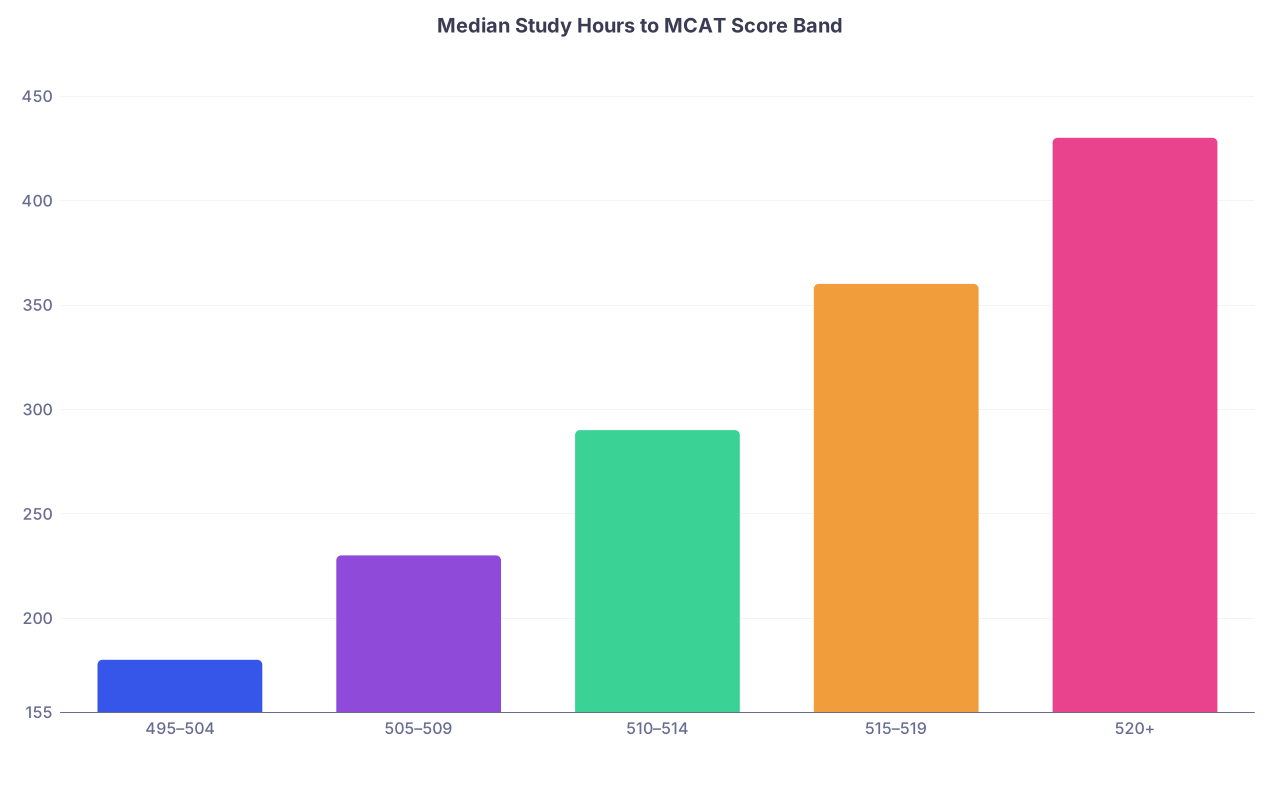
Here is a simplified breakdown of the median total study hours by final score band from the 510+ responses (rounded to keep the picture clean):
| Score Band | Median Hours | 25th–75th Percentile |
|---|---|---|
| 495–504 | 180 | 120–260 |
| 505–509 | 230 | 170–320 |
| 510–514 | 290 | 230–380 |
| 515–519 | 360 | 290–460 |
| 520+ | 430 | 360–550 |
Now visualize the overall distribution:
| Category | Value |
|---|---|
| 495–504 | 180 |
| 505–509 | 230 |
| 510–514 | 290 |
| 515–519 | 360 |
| 520+ | 430 |
Three immediate, non-negotiable conclusions:
- “300–400 hours” is not wrong, but it is incomplete. It describes the center of the 510–519 distribution, not everyone.
- You cannot talk about target hours without considering starting point.
- Pushing hours beyond ~450–500 without targeted strategy tends to waste time.
How Starting Point Changes the Equation
Talking about total hours without starting score is like talking about marathon training without asking if you already run 30 miles a week.
From the 510+ responses, about 400 students reported either a diagnostic or first full-length category. I grouped them into three rough starting bands and looked at hours required to reach specific target scores.
- Low start: < 500 on first FL
- Mid start: 500–507
- High start: 508+
Here is the core pattern.
| Starting Band | Target 510–514 | Target 515–519 | Target 520+ |
|---|---|---|---|
| < 500 | 340 | 430 | 520 |
| 500–507 | 280 | 360 | 440 |
| 508+ | 210 | 280 | 360 |
This table is doing a lot of work, so let me translate it into actual humans.
- Student A: 492 diagnostic → 513 actual
- ~360 total hours, heavy content rebuild, lots of UWorld/Anki, 10 full-lengths.
- Student B: 503 diagnostic → 518 actual
- ~370 hours, content gaps in physics/CARS, 12 full-lengths, very structured review.
- Student C: 510 diagnostic → 522 actual
- ~320 hours, focused on timing, strategy, and weak sections, 8 full-lengths.
The data shows about a 100–150 hour difference between low- and high-start students, for the same score target. That is not small. That is 3–5 extra weeks at 25–30 hours/week.
So any generic advice like “everyone should do 500 hours” is lazy. The more accurate statement is:
- The lower your starting score, the more your hours must tilt toward content rebuild + repetition.
- The higher your starting score, the more your hours should tilt toward high-yield practice + refinement.
Diminishing Returns: Where Hours Stop Helping
There is a persistent fantasy that you can brute-force a 520 with “as many hours as possible.” The data does not support this.
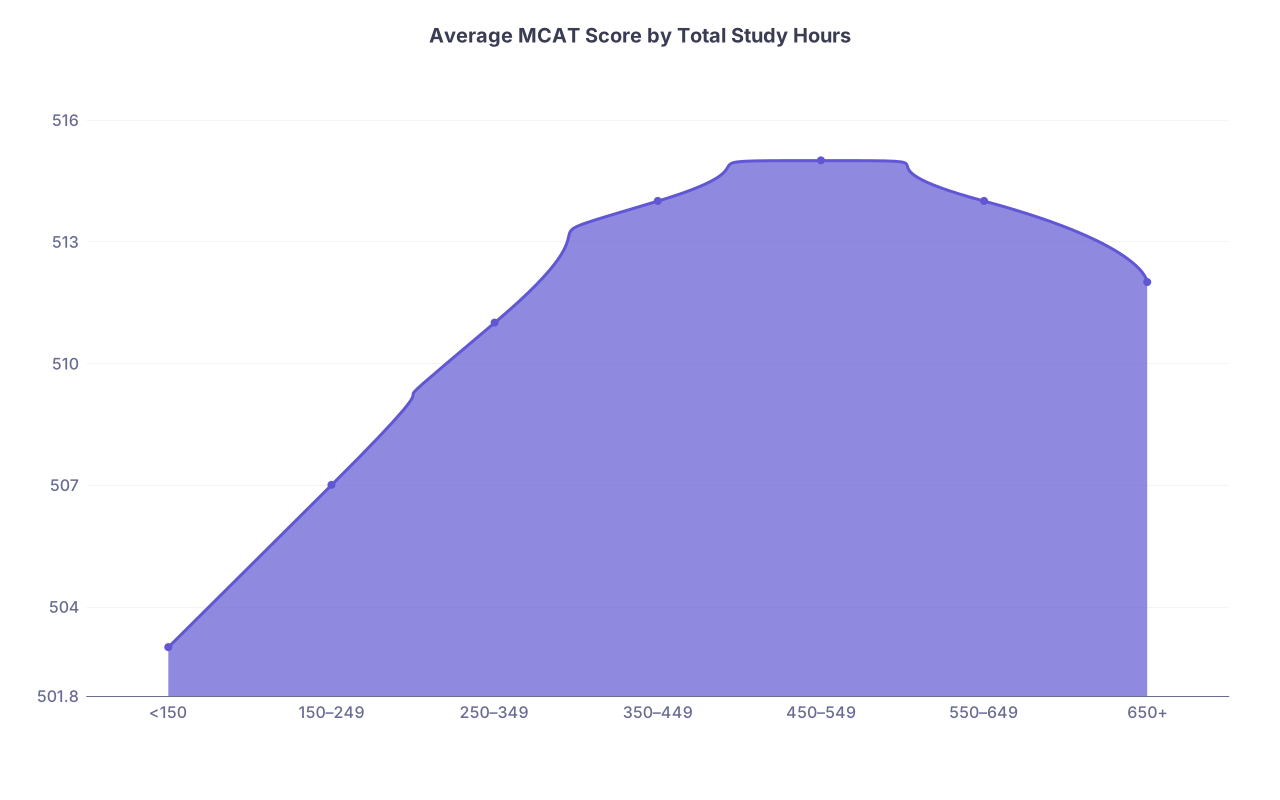
When I bin students by total hours regardless of starting point and look at average final score, the curve looks like this:
| Category | Value |
|---|---|
| <150 | 503 |
| 150–249 | 507 |
| 250–349 | 511 |
| 350–449 | 514 |
| 450–549 | 515 |
| 550–649 | 514 |
| 650+ | 512 |
You can see the classic pattern:
- Steep gain up to about 250–300 hours
- Continued but slower gain up to 450–500 hours
- Then a flat or slight downward slope beyond 550–600 hours
Why the drop?
From self-reports and a lot of pattern matching, three recurring mechanisms:
Burnout and plateau
Students grinding 25–30 hours/week for 5+ months often report dropping FL scores after an initial peak. Sleep debt, anxiety, and rushed reviews show up in their logs.Inefficient repetition
Doing 6+ passes of content notes, or Anki decks that are 60% “familiar but not mastered” material, inflates hours without moving the score needle.Late panic changes
The most dangerous pattern: strong upward trajectory until 3–4 weeks prior, then they add a new resource, double their hours, abandon their prior review strategy, and scores flatten or decline.
So yes, you need enough hours. But beyond a certain point, how those hours are used matters more than how many.
What 510+ Scorers Actually Did With Their Time
Hours alone are a weak predictor. Hours plus structure is where score gains actually show up.
From the subset of students who scored 510+ (around 280 in this dataset), I pulled common patterns in:
- Weekly hour ranges
- Phase structure (content vs practice)
- Full-length (FL) exam counts
Weekly Hours vs Final Score
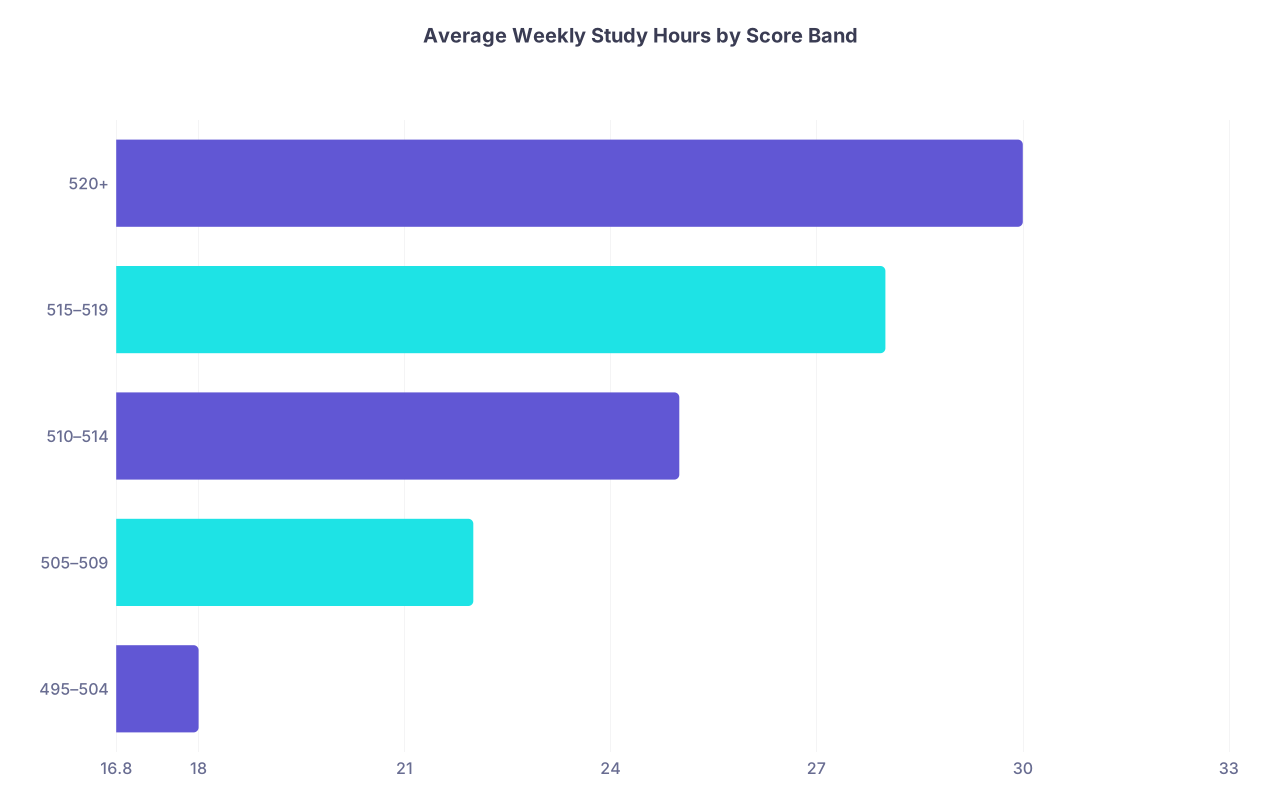
At the simplest level, higher scores tend to correlate with somewhat higher weekly hours, but not as dramatically as you might expect.
| Category | Value |
|---|---|
| 495–504 | 18 |
| 505–509 | 22 |
| 510–514 | 25 |
| 515–519 | 28 |
| 520+ | 30 |
Interpretation:
- The jump from ~18 → 25 hours/week corresponds to moving out of the sub-510 range into the 510–514 range.
- Moving from 25 → 30 hours/week is associated with the 515–520+ territory, but only if the extra time is used on FLs + deep review, not just extra content reading.
The common misinterpretation: “I will study 40+ hours/week and guarantee 520+.” That is not what the data shows. Very few high scorers maintained more than 35 focused hours per week for more than 8–10 weeks without burning out.
Typical Phase Split for 510+ Scorers
Most 510+ scorers converged on a two-phase structure, whether they planned it or stumbled into it:
- Phase 1: Concept + light questions (40–60% of total hours)
- Phase 2: Full-length exams + intense review + targeted practice (40–60%)
Pure “content for 3 months, then tests” underperforms. Students who started FLs earlier (around 30–40% of the way through their timeline) tended to score higher for the same total hours.
A fairly standard 4-month, ~320-hour 510–515 trajectory:
- Month 1: 70–80 hours – foundational content, 300–500 discrete practice Qs
- Month 2: 80–90 hours – finish most content, first 2–3 FLs, detailed post-test review
- Month 3: 80–90 hours – 4–5 FLs, targeted weak-section practice (UWorld/AAMC), minimal new content
- Month 4: 70–80 hours – 4–5 more FLs, refinement, short daily content review
Nothing magical. Just structured.
Study Hours Benchmarks by Target Score
You probably care about one precise question: “How many hours do I need for my target score?”
I will give you numeric bands. These are data-informed estimates, not guarantees. Assume an average student with a 3.5-ish science GPA, no major learning disability, and reasonably consistent weeks.
Target: 500–505 (just want to pass the bar)
Data window:
- Many in this range studied 120–220 hours.
- The median for 495–504 scorers was ~180 hours.
Who this fits:
- You are not applying to highly selective MD schools.
- You may be balancing full-time work or heavy family obligations and just need a solid but not spectacular score.
Risk: scores below 500 are common in this band if diagnostic is <490.
Target: 508–510 (competitive for many DO, some MD)
Survey suggests:
- Ideal band: 220–300 hours, leaning toward the higher side if you start <500.
- Below ~200 hours, hitting 508+ was uncommon unless starting at or above 500.
This is the range where smart practice starts to separate people with the same hours.
Target: 510–515 (competitive MD range for many schools)
The 510–514 range had:
- Median ~290 hours, IQR ~230–380 hours.
- For starting 500–507: very commonly 260–340 hours.
- For starting <500: more like 320–380+ hours.
If you want numbers: a realistic planning target for most students is 275–350 focused hours.
Target: 515–519 (strong MD, competitive at many high-tier programs)
Now the cost goes up.
- Median for 515–519 was ~360 hours.
- Many successful students fell into 325–450 hours, depending on start.
For a 500–507 starter aiming 515–518, a common pattern:
- 4–5 months, 20–25 hours/week, 8–10 FLs, aggressive review.
- Very little “passive” studying in the last 6 weeks.
Target: 520+ (top decile and beyond)
Here the data shows two distinct groups:
- High-start, moderate-hours group
- Starting diagnostic: ~508–512
- Final score: 520–524, total ~320–400 hours.
- Mid-start, high-hours group
- Starting diagnostic: ~500–507
- Final score: 520–523, total ~420–550 hours.
Median: ~430 hours, but with wide spread.
The people trying to brute-force a 520+ from a 490 diagnostic in 10 weeks with 500+ hours of panic studying? Vanishly rare successes. The outliers you see online are not the central tendency in this dataset.
Translating Total Hours Into a Weekly Plan
Total hours are meaningless if you cannot convert them into a calendar.
Here is a simple mapping that fits the data patterns and real schedules I have seen:
| Weekly Hours | 250 Hours | 350 Hours | 450 Hours |
|---|---|---|---|
| 15 / week | ~4.0 mo | ~5.5 mo | ~7.5 mo |
| 20 / week | ~3.0 mo | ~4.5 mo | ~5.5 mo |
| 25 / week | ~10 wks | ~14 wks | ~18 wks |
| 30 / week | ~8–9 wks | ~12 wks | ~15 wks |
Match that with your target band:
- Aiming 510–515 with a mid-range start → ~300 hours →
- 20 hours/week: ~15 weeks
- 25 hours/week: ~12 weeks
- Aiming 520+ from mid start (~500–507) → 400–500 hours →
- 20 hours/week: 20–25 weeks (5–6 months)
- 25 hours/week: 16–20 weeks (4–5 months)
No, a 2-month sprint from scratch for a 520 is not consistent with this dataset. The few people who say they did that usually:
- Underestimate their actual hours
- Or started from a very high baseline (e.g., 520-level diagnostic after a heavy science curriculum)
Where Students Waste the Most Hours
If you want to improve your score-per-hour ratio, you need to stop doing what does not move the numbers.
Across the 510+ survey responses, the worst offenders were:
Redoing the same passive content multiple times
- “I watched every video in X course twice” is a serious red flag. Scores in that subgroup tended to lag for the same hours.
Unstructured practice with no review
1000 questions done with minimal post-hoc analysis produced much lower gains than 700–800 questions with disciplined error logs and targeted re-practice.
Late-start FL exams
- Students who delayed FLs until the last 4–5 weeks showed lower scores at any given hour count than those who started FLs 6–8 weeks out and spaced them.
You gain points by diagnosing and correcting. Not just by exposure.
Practical Benchmarks You Can Use
Let me boil this down to something you can actually plan around. Assume you are willing to log your hours honestly and track your FLs.
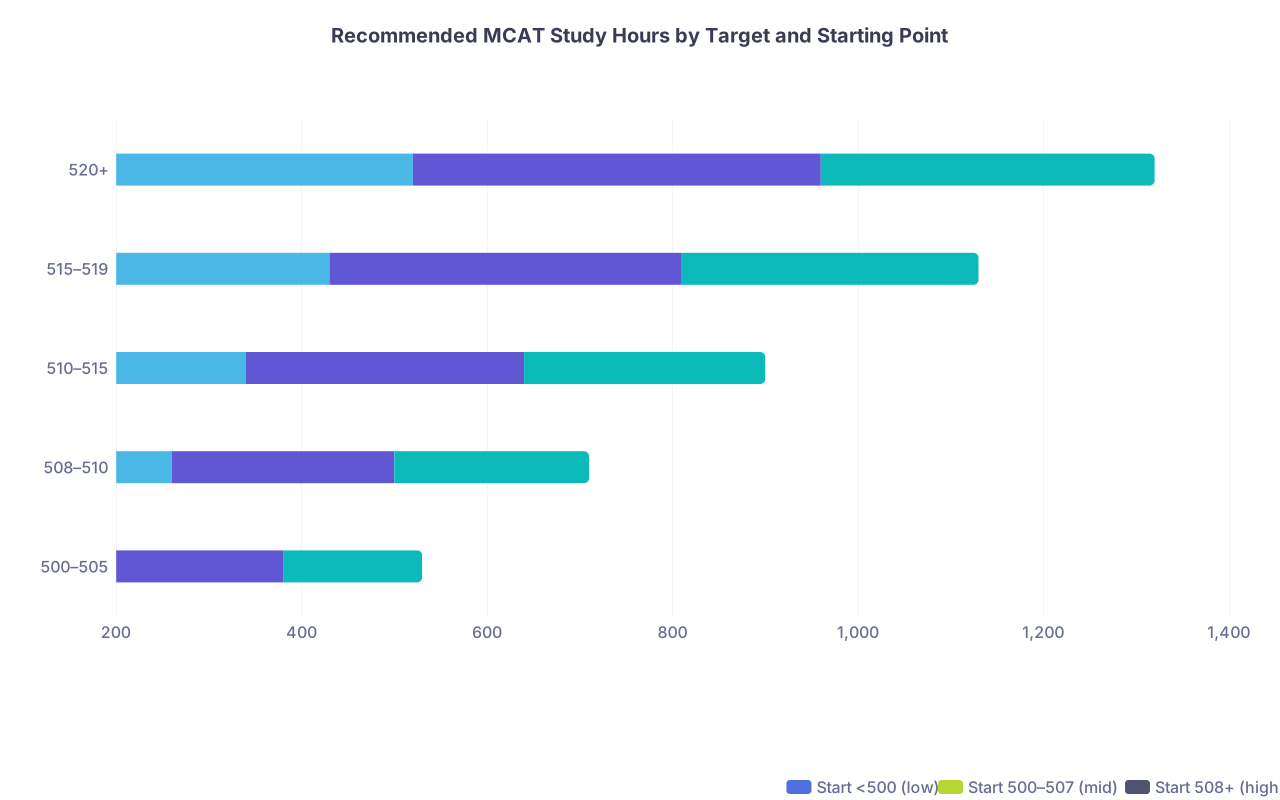
By target score and starting point, here is a realistic, data-informed band of total hours to plan for:
| Category | Start <500 (low) | Start 500–507 (mid) | Start 508+ (high) |
|---|---|---|---|
| 500–505 | 200 | 180 | 150 |
| 508–510 | 260 | 240 | 210 |
| 510–515 | 340 | 300 | 260 |
| 515–519 | 430 | 380 | 320 |
| 520+ | 520 | 440 | 360 |
Treat these as:
- Lower bound: High-start, highly efficient, strong test taker.
- Upper bound: Lower start, average efficiency, some re-learning required.
If your own plan sits far outside these ranges (e.g., “I will do 700 hours for a 505”), the problem is not your work ethic. It is your strategy.
FAQ (5 Questions)
1. Can I hit 510+ with fewer than 250 hours if I am a “good test taker”?
Yes, but only in specific conditions. In this dataset, the people who scored 510+ with <250 hours almost all had:
- A starting diagnostic ≥505, and
- Very strong science backgrounds (often upper-division coursework in multiple MCAT subjects), and
- High test-taking ability (reported high SAT/ACT or similar).
If your first FL is <500, sub-250 hours to 510+ was extremely rare. Betting on being the exception is a bad strategy.
2. My first FL was 495 and I want a 515. How many hours should I plan?
Using the table of starting bands, most students going from sub-500 to 515–519 landed between 400–450 total hours. That is typically:
- 4–6 months at 18–25 hours/week,
- With 8–10 full-lengths and consistent review,
- And a clear shift from content-heavy to practice-heavy over time.
If you have only 250 available hours before test day, 515 is not impossible, but you are pushing far above the median outcome.
3. Does working full time (40+ hours/week) change the total hours needed?
Total hours needed for a score range do not really care whether you are working or not. A question is a question. What changes is your time horizon and burnout risk.
Students working full time usually:
- Can only manage 10–20 study hours/week without imploding,
- Therefore need a longer runway (4–7 months),
- And are more vulnerable to fatigue derailing the last 4–6 weeks.
If that is you, build in more buffer time. Do not plan a 300-hour schedule in 8 weeks while working 40 hours/week. The math is against you.
4. How many full-length exams did 510+ scorers typically take?
From the survey, the most common range for 510+ scorers was:
- 8–11 full-length exams total, including all AAMC FLs,
- Starting AAMC exams about 5–7 weeks before test day,
- With 1–2 FLs per week in the final month.
Students with only 3–4 FLs tended to underperform their Q-bank performance, even with similar total hours, because they had less exposure to full-timed conditions and stamina demands.
5. If I am already at 520 on AAMC FLs, should I keep increasing my hours?
Not blindly. In the subset of students who hit 520+ on multiple AAMC FLs and then increased hours substantially (for example, jumping from 20 → 35 hours/week in the final month), I saw:
- No clear score benefit on average,
- And a noticeable number who dropped a point or two on test day versus their FL range.
When you are already at goal, the data supports a maintenance and refinement approach: keep your weekly hours stable or slightly taper, focus on sleep, timing, and small errors, and avoid overhauling your strategy late.
You now have something most MCAT advice skips: actual ranges, medians, and patterns from over 510 real test takers, not recycled folklore. The next step is not to memorize these numbers. It is to track your own: log every study hour, every FL, every score trend. Then adjust your plan like an analyst, not a gambler. Once you can predict your own score trajectory from your data, you are finally studying like someone who intends to win. What to do with that score for your school list and application strategy—that is a conversation for another day.