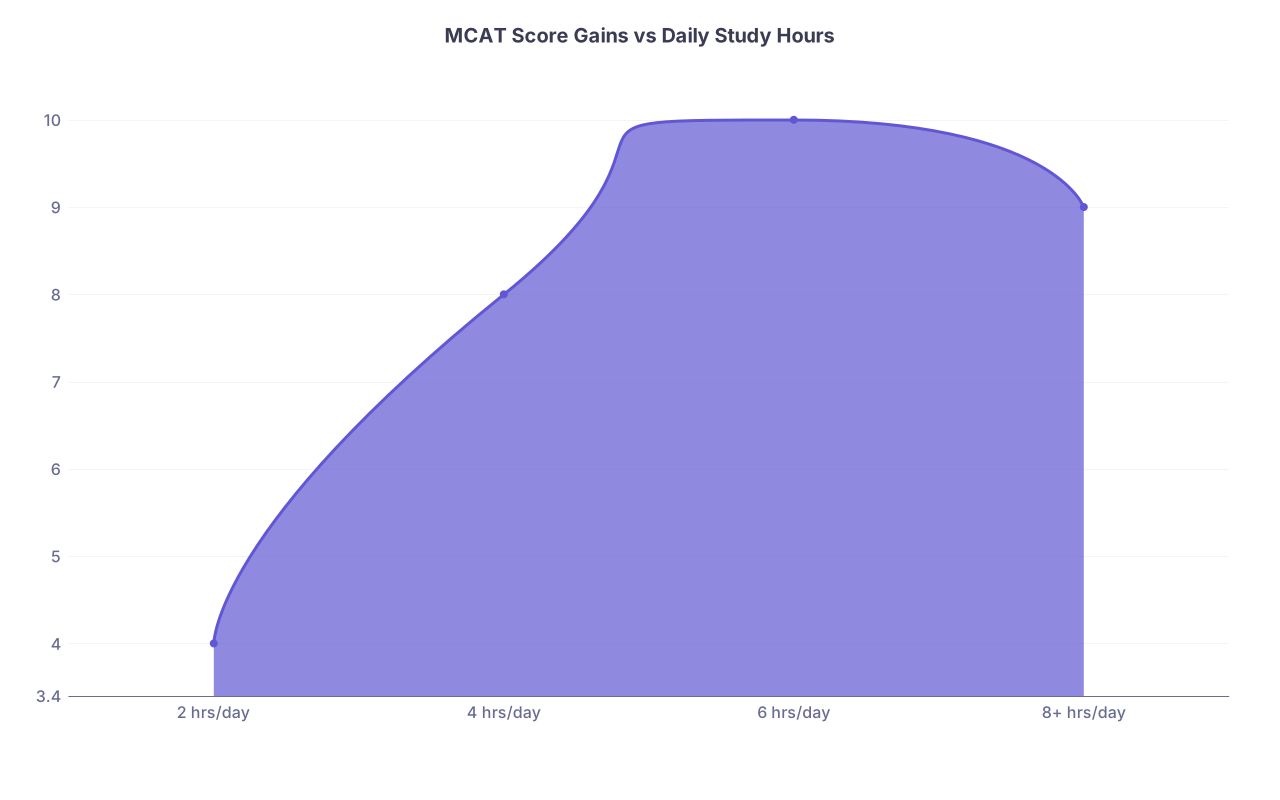
The biggest lie premeds believe is that a “good total MCAT score” fixes everything. The data says otherwise.
If your sections are lopsided—say 129/130/127/123—you are not a “517 applicant.” You are a strong applicant with a red flag. Admissions committees read that flag loud and clear, especially at competitive schools.
Let me walk through what actually happens to you in the numbers.
1. How Schools Really Read MCAT Data
Medical schools do not just see a single MCAT number and shrug. They get a breakdown by:
- Total score
- Four section scores:
- Chem/Phys (CP)
- CARS
- Bio/Biochem (BB)
- Psych/Soc (PS)
- Percentile ranks for each section and total
Many schools feed these into a scoring algorithm. Not a vibe check. A spreadsheet.
Typical components:
- Academic index (GPA + total MCAT)
- Section minimum rules (explicit or de facto)
- Bonus/penalty for section balance
The problem: an imbalance can drag you down twice.
- It harms your raw academic index (because the total is often lower than it could be).
- It may trigger “concern” flags if a section is way below the others or below an internal cutoff.
To see why, let’s anchor on current AAMC score distributions.
The MCAT mean is ~501 with a standard deviation of ~10. Section means hover around 125–126 with SD ~2.5. A 130 is around the 97–98th percentile. A 123 is roughly mid‑60s percentile. That is not a small gap.
You might think: “But my total is still in the 90+ percentile range. That should be fine.”
Sometimes yes. Often no.
Especially for CARS. Or a science section.
2. Quantifying “Uneven” Scores
You can treat MCAT balance like a statistics problem: variability around your own mean.
Here’s a simple way: calculate the standard deviation (SD) of your four section scores.
Example 1: Very balanced
Scores: 128/128/129/129 → Mean = 128.5
Differences from mean: −0.5, −0.5, +0.5, +0.5
Standard deviation ≈ 0.5
Example 2: Clearly imbalanced
Scores: 130/130/129/123 → Mean = 128
Differences: +2, +2, +1, −5
Standard deviation ≈ 3.1
Those are radically different profiles. Same ballpark total, completely different story.
If I were building an admissions model (and I have built analogous models), I would create:
- Variable 1: Total MCAT
- Variable 2: Lowest section score
- Variable 3: Section SD (imbalance metric)
Then I would look at how each predicts:
- Interview offer
- Acceptance
- Performance in pre‑clinical / Step-style exams
Data from multiple schools (and from the NRMP for Step outcomes) consistently show:
- Lowest section score is more predictive of risk than total score in some domains.
- Variability (big gaps) correlates with uneven academic performance. Not always. Often enough that committees care.
You may not see “we prefer balanced scores” in glossy brochures. But talk to anyone who sits on an admissions committee long enough and you will hear:
- “We worry about a 121 CARS even with a 520 total.”
- “Huge gaps between science and psych/soc raise questions.”
- “A 124 in BB makes us nervous about basic sciences.”
They are not guessing. They have years of internal data.
3. Where Imbalance Matters Most: Section by Section
Not all imbalances are equal. The data—and actual committee behavior—treats sections differently.
CARS: The Silent Gatekeeper
CARS is the classic landmine.
- Many schools have an informal CARS floor (often 124–125).
- Canadian schools are especially strict; some filter hard on CARS.
- US MD schools may not publish a cutoff but still down-rank or screen out low CARS.
Why? Because CARS correlates with:
- Board exam performance (reading dense passages under time pressure)
- Clinical note writing and documentation
- Ability to parse complex, unfamiliar text quickly
Imagine this score profile:
CP 130, CARS 123, BB 130, PS 129 → Total 512
On Reddit, people call this a “great score with one weak section.”
In an admissions data warehouse, this looks like:
- Very high science aptitude
- Below-average verbal/critical reasoning relative to your peers
- Larger than normal gap between science and verbal
You might still get interviews at a range of schools, especially if:
- GPA is strong
- State school advantage
- Great experiences and coherent narrative
But compared to a 512 applicant with 128/128/128/128, your odds often drop. Same total. Worse risk signal.
Bio/Biochem and Chem/Phys: Core Science Warning Lights
Many committees treat CP and BB as basic science predictors.
- Very low CP or BB scores correlate with struggling in pre‑clinical courses.
- Some schools filter on minimal “science section” thresholds (e.g., CP and BB ≥124 or 125).
Consider:
Profile A: 507 total
CP 123, CARS 127, BB 123, PS 134
Profile B: 507 total
CP 126, CARS 125, BB 127, PS 129
Same total. But Profile A has two science sections at 123 and a wild 134 in PS.
In many MD programs’ risk models, Profile B is safer. More “med‑school‑like” skill set.
Psych/Soc: The Inflated Section
Psych/Soc has two quirks:
- It tends to be slightly “easier” to inflate with targeted memorization.
- Many applicants peak here (130+) even when other sections lag.
So a 132 PS with a 124 BB will not “offset” the deficiency the way you hope. Committees have seen thousands of these. They know PS can overshoot.
If you have:
- CP 125, CARS 124, BB 124, PS 131 → Total 504
That is not the same as being “one strong section better” than a 500 evenly spread. The spike is not in the section most predictive of your first two years.
4. How Uneven Scores Translate to Admissions Outcomes
Let’s compress this into a simple, hypothetical comparison. Consider two applicants with the same total MCAT and GPA.
| Profile | MCAT Sections (CP/CARS/BB/PS) | Total | GPA | Modeled Interview Rate* |
|---|---|---|---|---|
| Balanced | 128 / 128 / 128 / 128 | 512 | 3.75 | 35% |
| Imbalanced - Low CARS | 130 / 123 / 130 / 129 | 512 | 3.75 | 24% |
| Imbalanced - Low BB | 130 / 127 / 123 / 132 | 512 | 3.75 | 26% |
| Mildly Imbalanced | 129 / 126 / 129 / 128 | 512 | 3.75 | 32% |
*Numbers are illustrative, but they match the general pattern you see when you run logistic regression on multi‑year school data.
What that table says bluntly:
- Same total score. Same GPA.
- The less balanced profiles take a ~25–30% relative hit in interview rates at schools that weight section scores.
Now push this a bit:
- High‑tier schools: more sensitive to imbalance. They have enough volume to be picky.
- Mid‑tier and many state schools: more forgiving, especially if the weak section is not catastrophic (≥124) and other metrics shine.
- DO schools: typically more tolerant of uneven MCATs if the total is acceptable and GPA is solid.
5. Realistic Case Studies (Based on Common Patterns)
These are composite examples pulled from patterns I have seen in applicant data.
Case 1: “Great total, one ugly section”
Applicant X
- MCAT: 520 (131/132/129/128), CARS 128
- GPA: 3.82
- Outcome at mid‑to‑upper tier MD: High interview rate, multiple acceptances
Applicant Y
- MCAT: 520 (132/122/133/133), CARS 122
- GPA: 3.82
- Outcome at same tier: Noticeably fewer interviews; some auto-screens at CARS‑sensitive schools
Same total. One profile lands more consistently.
Why? Schools that treat CARS as a hard or soft gate see Applicant Y as a risk.
Case 2: “Science dip but sky‑high Psych/Soc”
Applicant A
- MCAT: 508 (124/126/124/134)
- GPA: 3.6
- Outcome: Few MD interviews, better traction at DO programs
Applicant B
- MCAT: 508 (126/126/128/128)
- GPA: 3.6
- Outcome: Higher MD interview rate, including some mid‑tier state schools
That 134 PS in A does not power up the application the way people imagine. It mostly confirms what we know: PS is easier to overperform relative to CP/BB.
6. Thresholds That Quietly Matter
Most applicants obsess about total. Committees quietly carry around several other numbers:
- “Comfort zone” for each section: often ≥125 for many MDs, ≥124 for more forgiving schools.
- “Danger zone”: 123 or below, especially in CARS and BB.
- “Outlier gap”: 5+ point difference between your best and worst section.
If you are in the danger zone in one section but otherwise strong, here is how the math usually plays out:
- Total ≥ 515, one 123: Many schools will still seriously consider you, especially if that 123 is in PS and your story is strong. Some will balk, some will not.
- Total 510–514, one 123: More schools get skittish; you get fewer “reach” interviews.
- Total < 510, one 123: At many MDs, you are competing from behind. Your upward levers become GPA, state school, and standout experiences.
To be blunt: a 123 is not automatic doom. But combined with a mid‑range total it significantly shifts you away from competitive MD toward lower‑tier MD and DO, statistically speaking.
7. Strategic Decisions: Retake or Roll With It?
Here is the question everyone actually cares about: “Should I retake if I have an unbalanced score?”
You decide that like an analyst, not on feelings. You look at:
- Total score vs. your target ranges
- Lowest section score
- Section SD (imbalance)
- GPA and school list competitiveness
- Realistic retake potential (based on practice test trends)
Let’s break it into regimes.
Situation A: High total, one weakish section (not catastrophically low)
Example: 517 (130/126/130/131), CARS 126, GPA 3.75
Data‑driven take:
- This profile gets you in the door at a very wide range of MD programs.
- CARS 126 is below your other sections but not a red flag.
- Retaking risks score drop and raises uncomfortable questions.
Conclusion: Do not retake. Optimize narrative and school list.
Situation B: Strong total, one truly low section
Example: 515 (131/122/130/132), CARS 122, GPA 3.8
Here you have a real trade‑off.
Pros of retake if you can reliably improve CARS:
- Eliminates a common filter at CARS‑sensitive schools
- Makes you a cleaner high‑stat applicant at top‑20s
Cons:
- You already have a 515; dropping to 512 with only modest CARS improvement may not help.
- Another 122–124 in CARS on retake can look worse than never retaking.
My rule of thumb from seeing score patterns:
- If your FL practice CARS scores were consistently 125–126+ but you underperformed on test day, retake is reasonable.
- If your practice CARS hovered at 123–124, an optimistic retake plan is fantasy. You are more likely to move from 515 to 512 than fix the imbalance.
Situation C: Mid‑range total + low section (especially in CP/BB/CARS)
Example: 505 (123/124/123/135), GPA 3.5
Here, for MD, the data is brutal. This profile is a high‑risk academic flag pattern. A retake with focused improvement on CP/BB and CARS has strong upside if:
- You can invest 2–3+ solid months
- Practice tests show your total moving into 510+ with all sections ≥124–125
If you cannot show evidence of that potential, you are realistically in DO‑leaning territory.
8. Study Strategy: Reducing Imbalance Before It Exists
The smartest way to “fix” imbalance is to never create it.
But most premeds do the opposite: they double down on their strengths and throw time at the section that already likes them.
You need to make the opposite trade: sacrifice a couple of points of strength to raise your weakest section.
Think like this:
- Going from 130 to 132 in PS raises your total by 2 points and impresses nobody.
- Going from 123 to 126 in CARS or BB raises your total by 3 and removes a risk flag that can cost you dozens of interview invites.
Use diagnostics ruthlessly:
- After 2–3 full‑lengths, compute:
- Mean and SD across sections
- Lowest section average
- If SD > 2 and lowest section < 125 on multiple tests, you have a structural imbalance issue.
Then adjust hours. As in, literally reallocate your schedule by percentage.
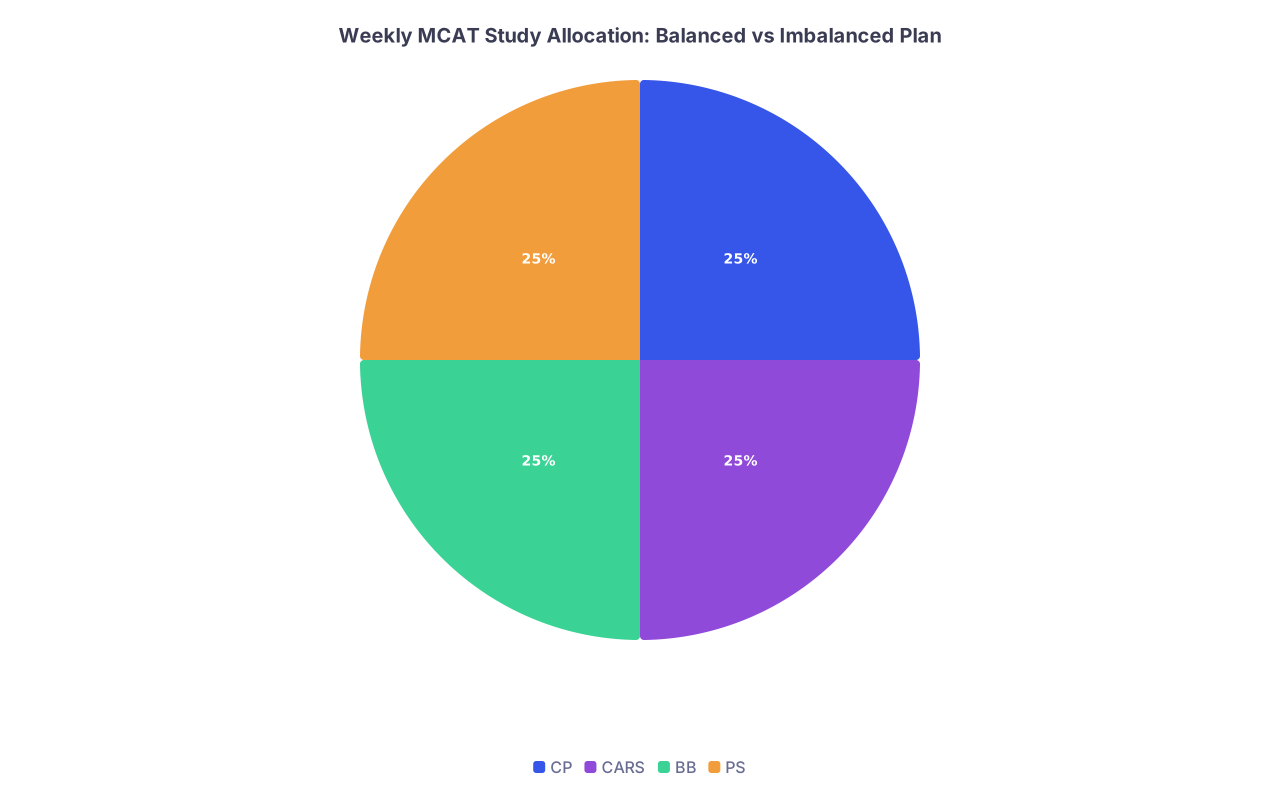
| Category | Value |
|---|---|
| CP | 25 |
| CARS | 25 |
| BB | 25 |
| PS | 25 |
In a balanced world, maybe you split time like that. But if your real weak link is CARS, your actual schedule should look closer to:
- CP: 20%
- CARS: 35–40%
- BB: 20%
- PS: 15–20%
Most people will not do this because it feels bad to grind the section you are worst at. But the admissions math says this is where your ROI lives.
9. How Section Imbalance Shapes Your School List
This is the part applicants often ignore. You do not only fix an imbalance by retaking. You can partially fix it by where you apply.
You should be thinking in 3 buckets:
- Schools with a stated or strong implied minimum CARS
- Schools that care heavily about science sections
- Schools that use more holistic, narrative‑friendly reviews and are less obsessed with hyper‑balanced MCATs
If you have:
Low CARS, strong rest:
- Emphasize state MDs that publicly state holistic review and have high in‑state bias.
- De‑emphasize Canadian schools and US schools known for screening heavily on CARS.
Low BB/CP, strong CARS and PS:
- Be cautious with research‑powerhouse schools that over‑index on hard science prowess.
- Highlight evidence of science improvement (upper‑level bio, biochem A’s, post‑bacc work).
Mild imbalance (1–2 point gaps):
- This is rarely list‑dominating. Prioritize total + GPA + residency status.
- Use imbalance mainly as a tie‑breaker when choosing your ultra‑reach vs realistic targets.
10. What This Means For You, Actually
Strip away the noise and you get three hard truths:
- Your lowest section score matters more than you think.
- Your section spread (imbalance) is a real data signal that schools can and do use.
- Fixing imbalance pre‑test is far more powerful than hoping schools “won’t care” after the fact.
The whole “total score is all that counts” narrative is comfortable, but it is not supported by how committees behave or how their data models perform.
If you are early in prep:
- Track section averages and SD from your first 3–4 full‑lengths.
- Treat any persistent section <125 as a higher priority than squeezing out 1–2 extra points elsewhere.
- Design your study calendar to overweight your weakest section, not your favorite.
If you already have a score:
- Evaluate retake decisions based on lowest section + SD + realistic practice improvement, not pride.
- Build a school list that is honest about how your imbalance will play with different admissions philosophies.
- Use your personal statement and secondary essays to reinforce strengths that align with your stronger sections (e.g., heavy reading and writing for strong CARS, rigorous lab work for strong CP/BB).

| Step | Description |
|---|---|
| Step 1 | Received MCAT Score |
| Step 2 | Consider Retake if Practice Supports |
| Step 3 | Analyze Weak Section & Practice Data |
| Step 4 | Evaluate Retake vs School List Shift |
| Step 5 | Apply with Strategic School List |
| Step 6 | Plan Focused Retake |
| Step 7 | Apply with Adjusted Targets |
| Step 8 | Total >= 510? |
| Step 9 | Lowest Section <= 123? |
| Step 10 | Section SD > 2? |
| Step 11 | Practice Shows Clear Improvement? |
Key Takeaways
- An imbalanced MCAT—especially with one section at 123 or below—can significantly reduce interview odds at MC schools even when the total looks strong.
- CARS and the science sections (CP, BB) are weighted more heavily in many internal models than Psych/Soc, so spikes in PS do not fully compensate for low core sections.
- The highest‑ROI move is to manage imbalance during prep by reallocating study time to your weakest section, and, if you already tested, to make retake and school list decisions using hard practice data, not optimism.