
CARS is the section faculty pretend is “just one part of the MCAT”—then use as a quiet filter when they build their rank lists.
Let me tell you what really happens behind those closed-door admissions meetings and selection committees. Because what you see on Reddit and what PDs and faculty actually say to each other are not the same thing.
The Myth: “CARS Just Tests Reading”
Most premeds treat CARS like an annoying side quest. Bio/Biochem and Chem/Phys feel “real” because they look like what you’ll see again. Psych/Soc feels high-yield for Step 1–style content. CARS? “It’s just reading.”
That’s not how faculty look at it.
Faculty—especially in MD programs and top DO schools—have a very different narrative in the room:
- “Low CARS again. I’d be nervous about their ability to handle our curriculum.”
- “Strong science, but CARS is a 123. That worries me.”
- “I trust CARS more than GPA from [insert school with known grade inflation].”
I’ve sat in meetings where two applicants had almost identical total MCAT scores. One had a 129 CARS and 126 Bio/Biochem. The other had 125 CARS and 130 Bio/Biochem. The committee leaned toward the first one. Not because they hate biochemistry. Because CARS tells them something they don’t trust anything else to tell them.
They’ll never say this in a public info session. But off the record? They absolutely talk about CARS as a proxy for how your brain actually works with complex text under pressure.
What Faculty Really Use CARS To Predict
They do not care whether you can analyze 19th-century philosophy for its own sake. They care what that skill predicts. And they’ve learned, the hard way, that certain MCAT sections line up with certain pain points in medical school.
Let me spell out the subtext they never publish on their websites.
1. How you’ll handle dense, high-stakes reading
Most premeds underestimate how much of medicine is reading and interpreting text fast, accurately, and under fatigue.
— Admissions director at a Northeast MD school, in a meeting:
“Look, if they struggle with CARS, they’re going to drown first year here. Our exams are basically CARS questions dressed up as pathophysiology.”
That sounds dramatic. It’s not.
Those long-stem NBME-style questions? They’re CARS with labs and vital signs stapled on. Misread one clause, flip cause and effect, or get sloppy with “most likely” vs “least likely,” and you’re wrong. Faculty see CARS as a stress test for that kind of precision.
2. Clinical reasoning and note-writing
No one will say, “We chose them because of their CARS score; they’ll write better H&Ps.” But that’s the chain of logic.
CARS taps:
- Extracting the main point out of noise
- Weighing conflicting viewpoints
- Distinguishing what’s implied vs explicitly stated
That’s exactly what goes into:
- Interpreting a messy history when the patient gives you 11 irrelevant facts and 2 crucial ones
- Writing SOAP notes that are coherent and defensible
- Reading consultant notes and discharge summaries quickly without missing landmines
Your ability to hold a complex argument in your head and track a shifting perspective? That’s CARS. And that’s also every consult, every sign-out note, every poorly written radiology report you’ll ever read at 3 AM.
3. Performance on later standardized exams
Here’s the part they do not advertise but absolutely track internally: correlations.
At several schools, faculty and assessment offices quietly look at MCAT subscore correlations with Step 1, Step 2, and their own in-house exam failure rates. They don’t always publish the data. But admissions committees see the summaries.
I’ve heard versions of:
- “Our low-CARS students are overrepresented in students needing remediation after first year.”
- “Strong CARS tends to show up in our top-third Step 2 takers.”
Not every school. Not perfectly. But often enough that some committees view a very low CARS as a flashing yellow warning light.
Is that fair? Not always. Is it happening? Yes.
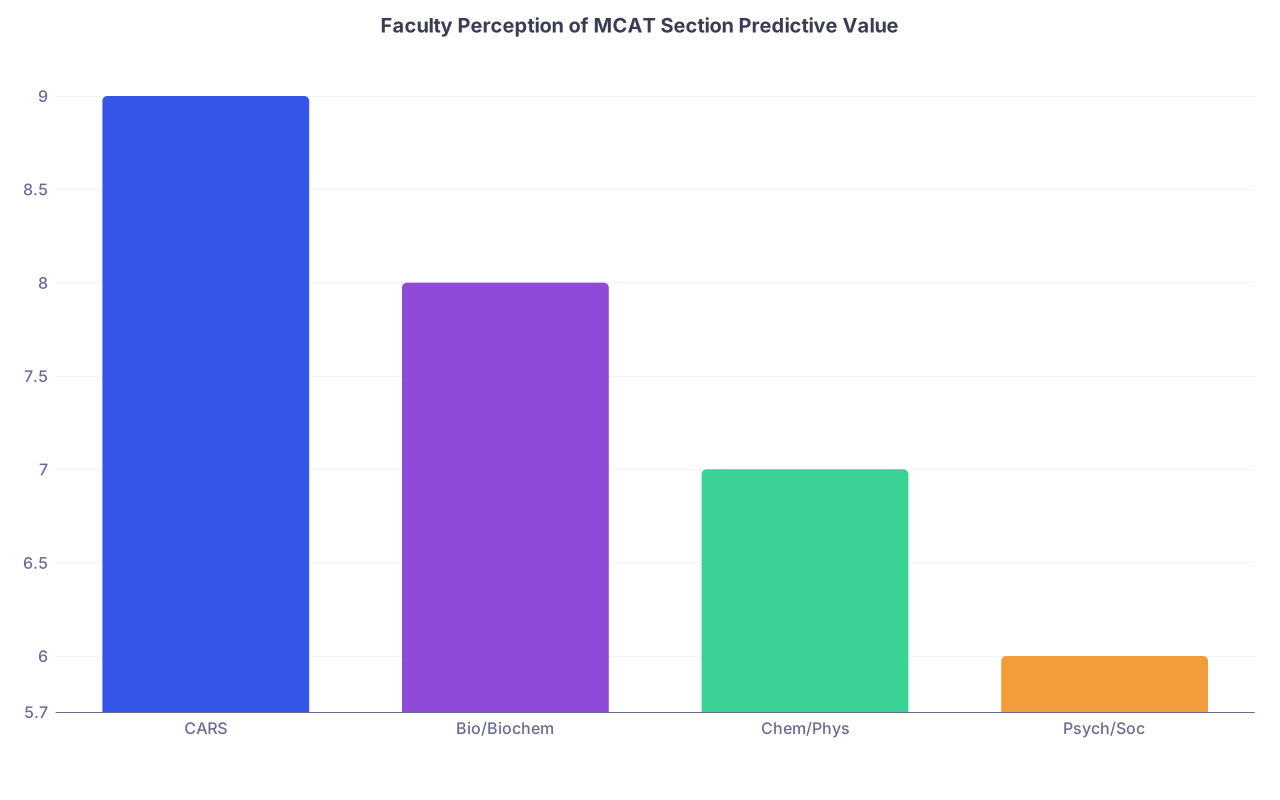
| Category | Value |
|---|---|
| CARS | 9 |
| Bio/Biochem | 8 |
| Chem/Phys | 7 |
| Psych/Soc | 6 |
(Values here reflect how many senior faculty on one committee rated each section as “highly predictive” of success, out of 10. CARS usually isn’t last.)
How Committees Quietly Use CARS in Screening
On paper, schools say they use the “highest total MCAT” or “most recent MCAT.” True. But inside the room, they rarely stop at the total number.
They start asking “shape of the score” questions.
The unofficial red flags
Here’s where people get nervous, and they should. Because this kind of conversation happens a lot more than applicants realize:
- “Their total MCAT is 512, but CARS is a 123. That’s our bottom 10th percentile. Are we comfortable with that?”
- “We’ve had trouble before with 122–124 CARS who struggle with our exam style.”
- “We should at least talk about whether that CARS is acceptable in the context of their story.”
Notice something: nobody says “auto-reject.” But low CARS forces a conversation. A conversation you’d rather they not have about you.
Now flip it.
A strong CARS can rescue a weaker section more often than the reverse. I’ve seen a:
- 509 total with a 129 CARS and okay science subscores
get more enthusiasm than - 514 with a 124 CARS and sky-high sciences
Different schools, different risk tolerance. But that pattern shows up over and over, especially at schools that pride themselves on “training thoughtful, reflective clinicians.”
When CARS becomes the tie-breaker
The most honest quote I’ve heard from an admissions committee member:
“Once you’re above our basic academic threshold, I don’t really care if you’re a 511 or a 517. I care if you can think. CARS is one of the only numbers that even attempts to measure that.”
When two applicants look similar:
- Same GPA ballpark
- Similar total MCAT
- Both have some research, some volunteering
What do they use?
- CARS
- Quality of personal statement and essays
- Rigor of undergrad institution
- Letters (when specific and detailed)
CARS functions like a sanity check on your narrative. If you sound thoughtful and nuanced in your essays and interviews and your CARS is solid, everything feels coherent. If you sound brilliant but CARS is strangely tanked, it creates dissonance. Some committees overlook it. Others don’t.
Why Faculty Trust CARS More Than Your GPA
Faculty have been burned by pretty transcripts. Repeatedly.
They’ve admitted students from “elite” undergrads only to discover:
- Some courses were open-book, collaborative, curved generously
- Exams were not passage-based, so speed and processing weren’t tested
- Students melted down on their first NBME-style block exam
GPA tells them you can play your school’s game. It doesn’t always tell them how you’ll do with their game.
CARS, for all its flaws, is standardized, timed, and brutal in exactly the way their exams are brutal: dense language, subtle traps, and answer choices that all look partially correct.
A faculty member at a Midwestern MD school once said bluntly in committee:
“I trust a 128–129 CARS from a mediocre undergrad more than a 4.0 GPA from a place we know inflates like crazy.”
She wasn’t joking.
| Metric | What Faculty Really Infer |
|---|---|
| GPA | Work ethic, consistency, ability to pass coursework at that institution |
| Total MCAT | Overall cognitive horsepower and test-taking ability |
| CARS Subscore | Text processing, reasoning under ambiguity, exam style readiness |
| Science Subscores | Content foundation, especially preclinical readiness |
The Ugly Truth: Some Schools Do Quiet CARS Cutoffs
Publicly, schools swear they use a holistic review. And many genuinely try.
But inside the first-pass screening spreadsheets? I’ve seen versions like:
- “Flag if CARS <124 for discussion.”
- “Prefer CARS ≥126 unless compelling context.”
- “Watch 122–123 CARS even with high total scores.”
Not a hard cutoff. More like a pressure point. The file reader pauses. The applicant has to justify the score with the rest of the application.
You’ll never see this on a website. But when you see a school whose “median CARS” is 128–129, understand what that implies about who’s actually getting in. They are not randomly ending up with a class full of 129 CARS by accident.
Why Med School Faculty Personally Care About CARS
This part’s more personal, and it comes out in faculty conversations when the admissions dean isn’t in the room.
They’ve taught students who:
- Memorized everything but couldn’t parse a question
- Knew the facts but misread the stem nuance and missed the point
- Froze on exams with long vignettes
- Could not write a coherent paragraph in a clerkship evaluation
Those students are exhausting to remediate. Faculty remember them. They remember long remediation meetings, professionalism committees, students repeating a year.
So when they see a pattern—like a cluster of those struggling students having weak CARS scores from day one—that sticks. It colors how they look at the next application cycle.
A lot of them quietly think:
“Give me the student with a strong CARS and slightly weaker science subscores. I can teach them the content. I can’t rewire their reading brain at age 24.”
What This Means For How You Treat CARS in Prep
You wanted insider truth. Here it is: if you’re treating CARS like the “annoying 25%” and banking on your science sections to make you irresistible, you’re playing the wrong game.
Here’s how students sabotage themselves:
- They leave CARS for last in their prep timeline.
- They do a few half-hearted passages, shrug, and say, “I’m just bad at reading.”
- They avoid real timed sections because “CARS is demoralizing.”
- They sink 80% of their study hours into content-heavy sections, hoping brute force will compensate.
Then they end up with:
- 129–130 in Bio/Biochem
- 126–128 in Chem/Phys and Psych/Soc
- 123–124 in CARS
Total is fine. But the shape of that score raises questions for the people on the other side.
How serious students treat CARS (the ones committees like)
They treat CARS like a skill that can be trained, not a personality trait. And they start early.
They:
- Do passages 4–6 days a week, even on “light” days.
- Review why wrong answers are wrong—line by line—until patterns of traps become obvious.
- Practice reading without subvocalizing every word, focusing on meaning, tone, and argument structure.
- Work under time pressure often enough that pacing becomes automatic, not a panic-inducing surprise.
This doesn’t require 6 hours a day. But it does require consistency. CARS rewards daily reps more than heroic last-minute cramming.

| Step | Description |
|---|---|
| Step 1 | Start 3-4 Months Out |
| Step 2 | Daily CARS Passages |
| Step 3 | Content Review Sciences |
| Step 4 | Weekly Full CARS Sections |
| Step 5 | Mixed Practice Blocks |
| Step 6 | Full-Length Exams |
The Med Student Phase: Why CARS Still Haunts You
You might think CARS stops mattering once you get in. It doesn’t. Not directly as a score, but as a skill.
That same reading brain has to:
- Decode 50-page clerkship syllabi full of vague expectations
- Interpret poorly written exam stems with double negatives
- Read subtle hints in patient narratives that never make it into the “key symptoms” list
- Understand dense guidelines and policy documents that affect your evaluations
The students who did well in CARS often find:
- NBME-style school exams feel more “familiar,” even when content is new
- They can skim long stems faster and conserve brain power for reasoning
- They are less likely to get tricked by wording, qualifiers, or tone in test questions
This is why some faculty look at a high CARS and breathe a little easier. They see fewer late-night emails, fewer “I didn’t understand what the question wanted” conversations, fewer academic reviews.
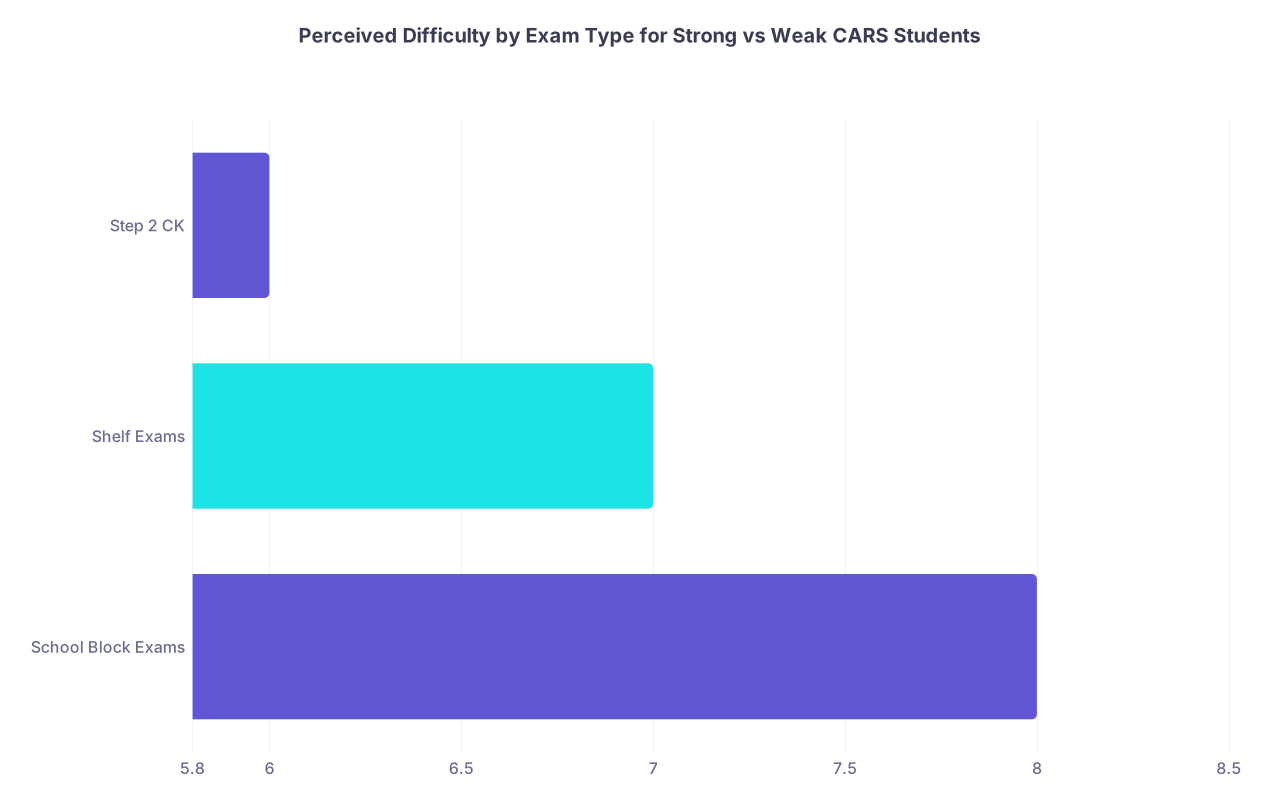
| Category | Value |
|---|---|
| School Block Exams | 8 |
| Shelf Exams | 7 |
| Step 2 CK | 6 |
(Think of these as “pain levels” for students who came in with weak CARS; students with strong CARS usually report 1–2 points lower on each.)
If Your CARS Is Currently Weak
You’re not doomed. But you need to stop lying to yourself about what’s going on.
A 123–124 CARS with otherwise strong sections doesn’t mean you’re stupid. It usually means:
- You never learned to read argumentatively
- You default to content-hunting instead of idea-tracking
- You panic under timed, high-density reading
All trainable. But not if you treat CARS as an afterthought.
You need to:
- Make CARS a daily non-negotiable, even 30–45 minutes
- Do brutal, honest review of every missed question
- Stop looking for “tricks” and start understanding structure: who’s speaking, what they believe, how the argument shifts
No magic. Just deliberate training. The same way you’d train for a sport you’re not naturally good at.

The Bottom Line Faculty Won’t Say Out Loud
If you walked into a closed-door admissions meeting and listened long enough, you’d pick up three patterns:
- Extremely low CARS makes people nervous, even with a great total score.
- Solid or strong CARS calms those nerves more than you realize.
- Nobody cares how much you complain that “CARS is unfair.” They care whether you figured out how to handle it.
So yes, your sciences matter. Yes, your GPA matters. But if you’re ignoring CARS because you think “I want to be a surgeon, not an English major,” you are badly misreading how the people holding the keys think.
In their heads, they’re not asking, “Can you regurgitate enzymes?” They’re asking, “Can you read complexity, think clearly under pressure, and not break when the exam stems get ugly?”
CARS is the only part of the MCAT that comes close to flagging that. That’s why it matters more than you think. And that’s why the smartest applicants stop whining about it and start mastering it.
Years from now, you won’t remember the exact CARS passages you missed. You’ll remember whether you took this weakness seriously enough to change how you think, not just what you know.