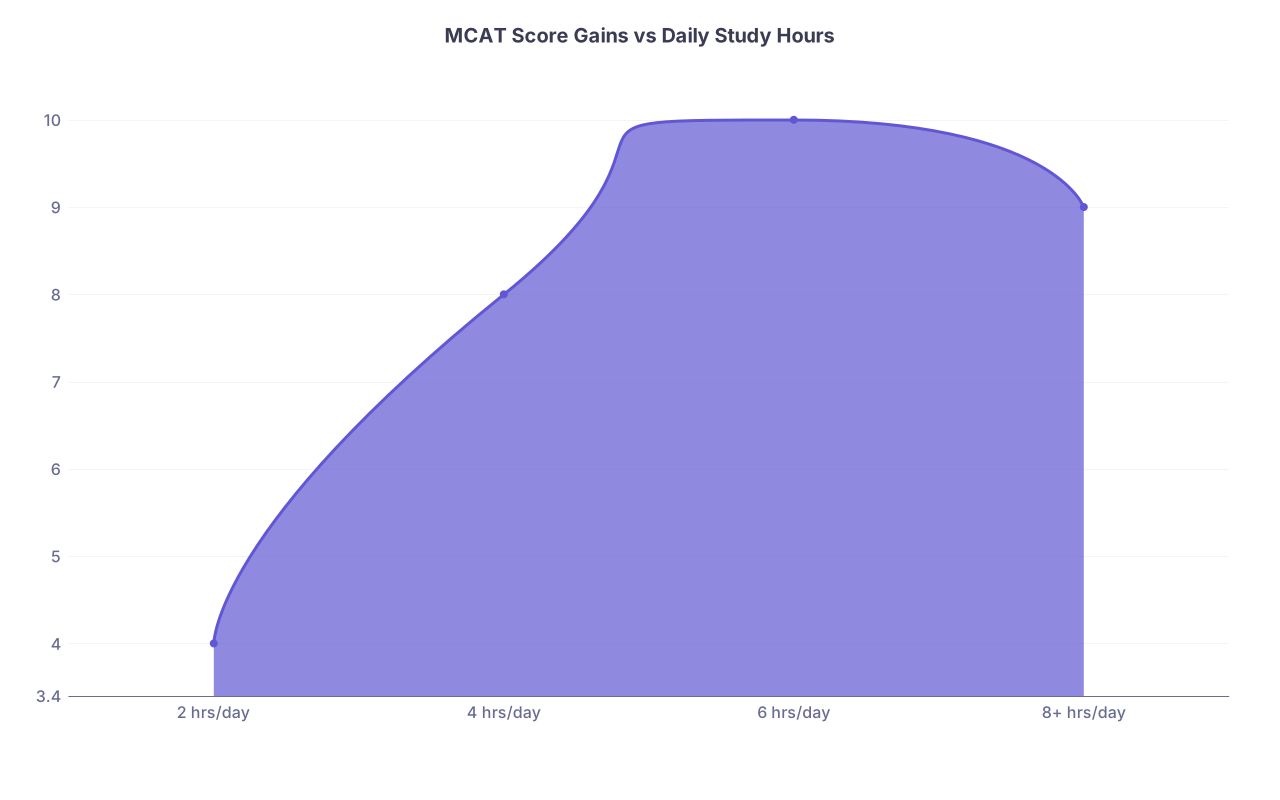
The way most premeds “study” CARS is broken. Not weak. Not suboptimal. Broken.
If you copy what the average Reddit study thread suggests for CARS, you will hard‑cap your score well below your potential. I have watched too many smart students plateau at 124–126 because they made the same predictable mistakes over and over, then tried to compensate with more passages instead of fixing the root problems.
This is protect‑you‑from-yourself territory. CARS is not about how much you grind. It is about how you think, read, and respond under time pressure. And there are specific, ugly mistakes that quietly destroy your top‑score chances.
Let us walk through the big ones so you can stop sabotaging yourself.
1. Treating CARS Like a Vocab or Content Test
The most damaging misconception: believing CARS is about “knowing things.”
It is not.
CARS is not testing:
- Philosophy history
- Art movements
- Political theory facts
- obscure vocabulary
Yet students kill hours making flashcards for random terms from passages. Or trying to “study” philosophy on YouTube as if memorizing Kant will somehow give them a 129.
Here is the mistake pattern:
- You read a confusing passage on aesthetics.
- You feel stupid.
- You assume the problem is content knowledge.
- You decide: “I need to learn more humanities stuff.”
Reality: CARS is testing whether you can:
- Track argument structure
- Distinguish main claims from supporting examples
- Infer implications that are not literally stated
- Recognize author attitude and tone
- Evaluate answer choices with discipline (not with vibes)
You can be completely ignorant of the specific topic and still score 130+ if your reasoning is sharp.
How this mistake crushes your score
- You spend time learning content that will never be directly tested.
- You still miss questions because your reasoning process is sloppy.
- You get frustrated and think “I’m just bad at CARS,” which is wrong; you are just training the wrong skill.
Avoid this:
- When you miss a question, do not ask: “What term did I not know?”
- Ask: “What step in my reasoning led me to eliminate the correct answer or choose the wrong one?”
- If your review notes are full of facts and definitions, you are doing it wrong.
- Your notes should be about patterns of thinking errors, not content gaps.
2. Reading Passages Like a Textbook (Not Like a Debate)
Most premeds read CARS passages like a desperate student cramming for an exam: eyes scanning for “important facts,” trying to remember details, underlining every other sentence.
CARS passages are not chapters in Biology. They are arguments.
If you read to memorize facts instead of understanding the argument, your accuracy will tank.
- Highlighting constantly
- Underlining phrases like “in 1803…” and “for example” but never actually asking “So what?”
- Treating each sentence in isolation instead of connecting it to the author’s main claim
- Trying to retain 100% detail instead of 100% structure
A top CARS reader constantly asks:
- What is the author trying to prove or push me toward?
- How is each paragraph contributing to that purpose?
- Is this sentence a claim, evidence, counterargument, or background?
You need to read like you are listening to someone give a speech you may disagree with. You are tracking where they are going, what they assume, and how they support it.
Quick litmus test
If you finish a passage and remember lots of facts but cannot complete this sentence:
“The author’s main point is that ___ because ___,” you read it wrong.
3. Chasing Speed Before You’ve Built Accuracy
This one ruins more scores than any single strategy error.
Students decide: “CARS is 90 minutes, 9 passages → 10 min per passage. I must hit 10 minutes now.”
So with mediocre comprehension and a shaky question approach, they:
- Force themselves to read faster
- Rush through questions
- Move on as soon as they “have a feeling”
- Celebrate finishing on time… with 50–60% accuracy
That “speed discipline” calcifies bad habits. You get faster at being wrong.
I have watched students stuck at 123–125 for months because they refused to slow down and fix the process first.
The better sequence:
Phase 1 – Accuracy First (untimed)
- Read to understand structure.
- Take as long as needed per passage.
- Goal: 80%+ accuracy untimed before you worry about the clock.
Phase 2 – Controlled Timing
- Light time limits (e.g., 12–13 minutes per passage).
- Maintain 75–80% accuracy.
- If accuracy drops sharply when you add time pressure, you have not automated your process yet.
Phase 3 – Exam Pace
- Now move toward 10–11 minutes per passage.
- Small, systematic adjustments: sometimes you will skip a brutal question and come back; sometimes you will guess and move on.
- You are trading a little precision for time, not slashing 20 points off your accuracy.
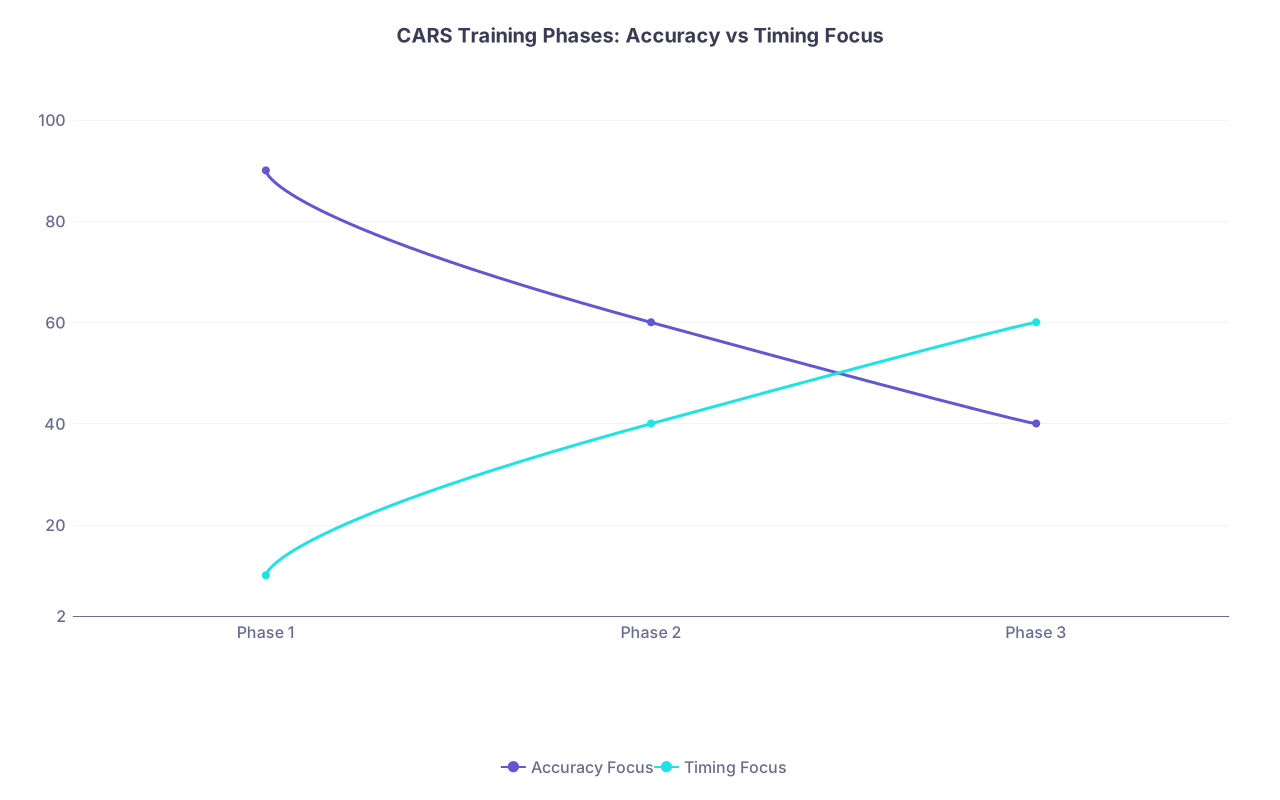
| Category | Accuracy Focus | Timing Focus |
|---|---|---|
| Phase 1 | 90 | 10 |
| Phase 2 | 60 | 40 |
| Phase 3 | 40 | 60 |
If you are still below ~75% correct on practice passages, you have no business obsessing over finishing all 9 on time. Fix accuracy first. Or you will enshrine bad habits.
4. Treating All Practice Passages as Equal
This mistake is subtle but deadly: you treat every passage as just “another set” and never classify what type of thinking it demands.
Not all CARS passages are the same. Neither are the questions.
Common CARS question types:
- Main idea / primary purpose
- Author attitude / tone
- Inference from a single line or paragraph
- Inference from the whole passage
- Application of ideas to a new situation
- Weaken / strengthen / evaluate an argument
- “Except” / “least” trap questions
If your review looks like this: “Ugh, I missed 4. Need to be more careful,” you are wasting your suffering.
Useful review looks like this:
- “I consistently miss main idea questions where the author is neutral but I over‑infer a strong stance.”
- “I fall for choice A whenever it recycles a phrase from the passage, even if it misses the author’s actual point.”
- “Application questions: I keep choosing answers that quote the passage instead of applying its logic to the new scenario.”
You then target those patterns.
| Question Type | Typical Trap Choice |
|---|---|
| Main Idea | Narrow detail disguised as the “big point” |
| Author Attitude | Overly extreme wording |
| Inference | Answer that is *possible* but not supported |
| Application | Direct quote that does not actually apply |
| Weaken/Strengthen | Choice about a side issue, not core claim |
If you never name the type of question you missed and the trap you fell for, your brain will happily repeat the same mistake on test day.
5. Falling for “Feels True” Answers Instead of Passage‑True
Here is a brutal fact: your intelligence will backfire on CARS if you let your outside knowledge and opinions creep into answer selection.
The exam does not care what is “actually true” in the real world. It only cares what is supported within the passage.
Common forms of this mistake:
- You know something about politics / ethics / science and you use that to judge answers.
- You dislike the author’s stance and subconsciously resist picking an answer that supports it.
- You think: “But in real life X…” and talk yourself out of the correct passage‑consistent option.
CARS is a closed universe. The passage defines reality. If Einstein walks into the room and assures you an answer is true in real life but the passage does not support it, the exam still marks it wrong.
How to train this out of yourself
During review, ask for every missed question:
- Was my wrong choice:
- Unsupported by the passage?
- Too extreme compared to the text?
- Bringing in outside knowledge or assumptions?
You should train a reflex: “I do not care if this feels true. Show me where the passage commits to it.”
When you catch yourself saying, “But the author probably thinks…” stop. If it is not clearly implied, it is probably not the answer.
6. Sloppy Passage Annotation (Or None At All)
Two equal dangers here:
- You annotate nothing and rely on raw memory.
- You annotate everything and bury yourself in useless marks.
Both kill time and accuracy.
The goal of annotation is not to decorate the text. It is to create a quick skeleton of the passage so you can:
- Reorient quickly during questions
- Avoid rereading entire paragraphs
- Recall the role of each section at a glance
A simple, effective system that students actually stick with:
- At the end of each paragraph, scribble 3–5 words in the margin:
- P1: “Critique of X theory”
- P2: “Alt view introduced”
- P3: “Author prefers alt; gives example”
- Circle or lightly underline:
- Author’s main claim(s)
- Contrast words: however, but, although, yet
- Strong attitude words: “unjustified,” “elegant,” “naïve”
What you should not do:
- Underline entire sentences every few lines
- Highlight random name drops and dates
- Write long summaries mid‑passage (you do not have time)
If your page looks like a rainbow explosion, you are not annotating. You are avoiding thinking.
7. Doing “Practice” Without Ruthless Review
This might be the #1 score‑killer across the board.
Students grind 3–5 passages a day, then “review” by:
- Checking the answer key
- Reading the explanation once
- Thinking “Ah okay, that makes sense,” then moving on
That is not review. That is entertainment.
Real CARS review is slow, slightly painful, and transformative. For each missed (or guessed‑correct) question, you should be able to answer:
- What did I think the author’s main point was? Was it wrong or just imprecise?
- What was my reasoning process when I picked my answer?
- At what exact step did the error happen?
- Misread the question stem?
- Misinterpreted a word?
- Misunderstood the passage’s structure?
- Fell for a classic trap (too extreme, outside knowledge, reverses logic, etc.)?
- What concrete rule or reminder will prevent me from making this same mistake next time?
That last one is critical. Turn errors into rules.
Examples:
- “If two answers both feel sort of right, I must go back to the specific lines mentioned before choosing.”
- “Any answer with absolute language (always, never, entirely) gets extra suspicion unless the passage is clearly absolute.”
- “For tone questions, if the author never uses emotional or evaluative language, I will not choose a strongly positive/negative answer.”
You should be building a short, personal “CARS commandments” list from your mistakes. I have seen students raise CARS 3–4 points just by finally taking review seriously.
8. Ignoring Stamina and Mental Burnout
A common delusion: “I do 3 passages a day and do fine. So on test day I will do 9 under full‑length pressure and it will be the same.”
No. It will not.
The mental fatigue of a full exam is different from a 30‑minute CARS session at your desk with coffee and no anxiety.
What goes wrong when you never train stamina:
- Your accuracy drops sharply in the last 3 passages.
- You start skimming to save time because your brain is tired.
- You make more impulsive answer choices because you want to get out of the test.
Look at your practice. Are you only doing short sets? If yes, you are practicing to be good at short sets, not at the actual exam.
You need:
- Regular full CARS sections (all 9 passages) under real timing
- In the context of full‑length exams, not just isolated CARS sessions
- Honest tracking: does your accuracy fall off in the second half?
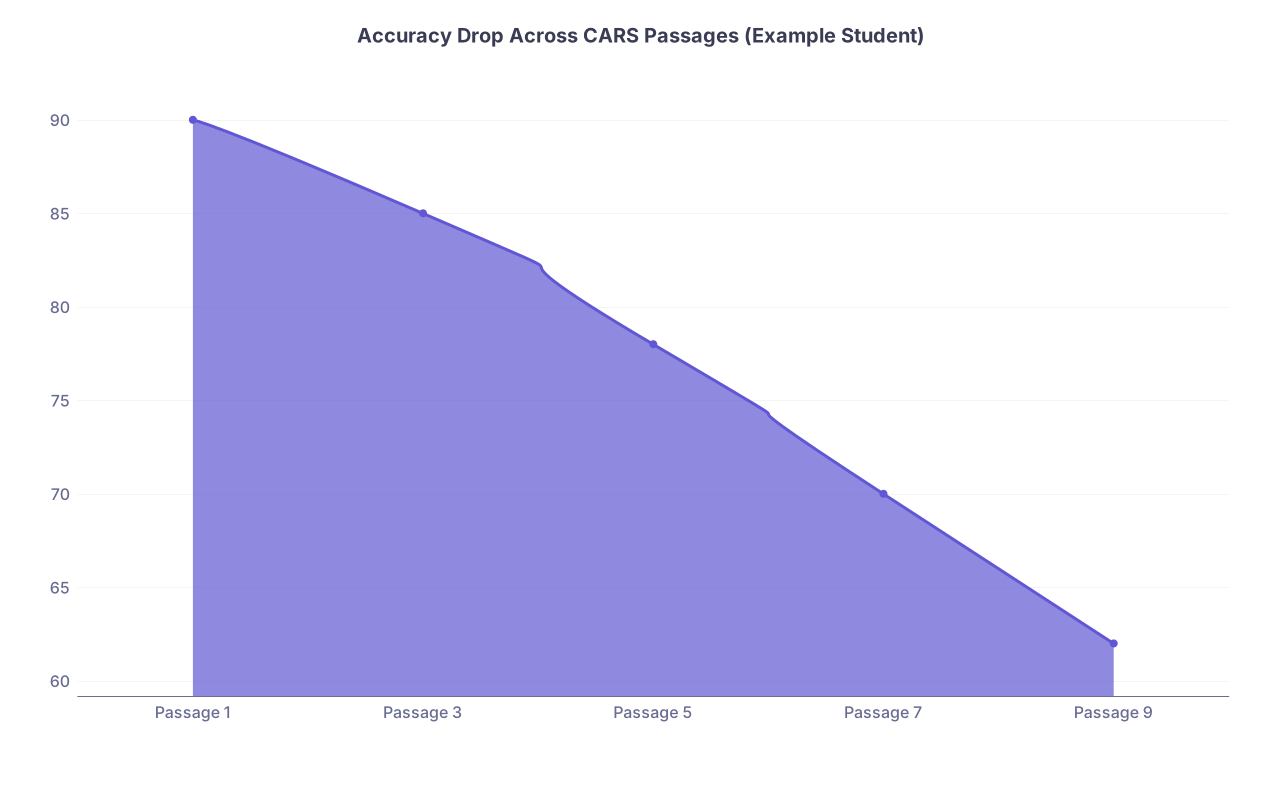
| Category | Value |
|---|---|
| Passage 1 | 90 |
| Passage 3 | 85 |
| Passage 5 | 78 |
| Passage 7 | 70 |
| Passage 9 | 62 |
If your end‑of‑section accuracy is cratering, the issue is not just “I’m bad at hard passages.” It is that you never trained your brain to think precisely when tired.
9. Obsessing Over Resources Instead of Mastery
Another mistake that masquerades as productivity: constantly switching CARS resources, hoping the next one will finally “click.”
Common behavior pattern:
- Start with Khan Academy. Feel stuck.
- Switch to Jack Westin. Feel stuck.
- Buy Examkrackers. Feel stuck.
- Panic and buy more third‑party CARS books.
- Still stuck.
Here is the unglamorous truth: the specific resource matters far less than what you do with it.
If your approach is shallow—no detailed review, no error tracking, no pattern recognition—no resource on Earth will save you.
Yes, some materials better approximate AAMC style. You should absolutely prioritize official AAMC CARS for final prep and calibration. But switching to AAMC does not magically fix sloppy thinking.
You need depth over breadth:
- Use one main non‑AAMC resource for building skills.
- Use AAMC CARS carefully, closer to the exam, to calibrate to real style.
- For each set, squeeze every drop of learning out of your mistakes.
Do not burn through AAMC CARS like daily drills. You will run out of the only truly representative material and still not know how to think better.
10. Letting Anxiety Drive Your Decisions
CARS is the section where anxiety shouts the loudest.
- “You are slow.”
- “You are behind.”
- “You are not understanding anything.”
- “You need to catch up now.”
So you:
- Rush the current passage to “make up time”
- Switch your strategy mid‑test
- Change answers impulsively without re‑checking the passage
- Spend 4 minutes on a single killer question because you refuse to guess
I have watched students with solid practice performance drop 3–5 points on test day from panic‑driven microdecisions.
You need pre‑decided rules for:
- When to guess and move on (e.g., 45–60 seconds of genuine stuckness)
- When to skip a question and come back
- Whether you ever change an answer without clear textual evidence (hint: rarely)
Decide this before test day. Feelings during the section are not reliable.
And yes, accept this: on a real exam, you will not feel comfortable. You will feel behind at some point. Your job is not to feel good. Your job is to execute a plan you have rehearsed.
11. Refusing to Accept That CARS Is a Trainable Skill
The most dangerous mindset of all: “I am just bad at CARS.”
Often based on:
- One low diagnostic score
- A few confusing passages
- English being a second language
- Coming from a heavily STEM background
I have seen students start at 121–122 and climb into the 127–129 range. Not because they became humanities experts. Because they treated CARS as a skill they could train.
People who stay stuck usually share the same pattern:
- They believe reading ability is fixed.
- They cling to “I’m a math/science person.”
- They do not perform painful, surgical review.
- They stop trying to refine their process because “this is just how I read.”
If you hold onto that identity, you are building your own ceiling.
You do not have to love CARS. You do have to respect it enough to train it like any other complex skill: deliberate practice, feedback, iteration.
What You Should Do Today
Do not just “feel motivated” and move on. Take one concrete step.
Here is the next move:
Open your last CARS practice set—just one—and for every single question you missed or guessed, write down exactly why your reasoning failed and what rule you will follow next time to avoid that same trap. If you cannot do that, you are not really practicing CARS yet.