It is 9:42 a.m. You are halfway through the Chem/Phys section. Question 37 stares back at you from the screen. The passage is dense, you read it once already, maybe twice, and you are still not sure what is going on. Your eyes dart to the clock. That small spike of panic hits: “How did I just spend four minutes and I still do not know what this passage is about?”
This is how good scores die. Not from lack of knowledge. From leaks in your timing. Most of those leaks happen during passage reading—tiny, repeated errors that quietly steal seconds until you suddenly find yourself rushing the last ten questions.
Let me be blunt: if you do not fix your passage-reading habits, no amount of extra content review will save your score.
Here are the most common passage-reading mistakes I see students make, and exactly how to avoid them before they burn through your exam clock.
1. Treating Every Passage Like a Textbook Chapter
The classic error: you read MCAT passages like you are trying to actually learn the content.
You stop to “understand” every detail. You reread dense sentences. You chase down every unfamiliar term in your head. That is how you read in class. It is exactly how the MCAT punishes you.
On the MCAT, the passage is not a lecture. It is a trap with just enough real science to lure you into over-reading.
The test does not care if you deeply understand each paragraph. It cares whether you can:
- Grasp the main point and structure
- Track relationships (cause–effect, comparison, hypothesis–result)
- Extract the 2–4 key ideas each passage is built around
Everything else is noise.
The time-wasting version of this mistake looks like:
- Reading each sentence twice “just to be safe”
- Pausing to mentally re-explain a mechanism to yourself
- Trying to reconcile passage content with what you learned in class
- Feeling compelled to decode every symbol, every reagent, every experimental detail
You end up reading 500 words like it is a textbook plus a board-review book plus your notes. For a set of six questions that might only test one figure and one equation.
Avoid this by forcing yourself to read for structure, not for mastery.
When you read a passage, your mental checklist should be:
- Who/what is this about?
- What is the author doing? (Arguing, describing, comparing, testing)
- Where are the key claims, hypotheses, or findings?
- How is the passage organized? (Old vs new theory, method vs results, problem vs solution)
That is it. If you find yourself trying to fully learn “Advanced quantum dot biosensors in cancer detection” in 90 seconds, you are doing it wrong.
I have watched students lose 2–3 minutes on the first pass of a passage… and then still get most of the questions wrong. Not because they are not smart. Because they were trying to read for understanding at the wrong depth.
2. Rereading the Passage Completely Before Touching Questions
You read the passage. You feel foggy. You panic. So you reread the whole thing.
This is the MCAT equivalent of lighting your time on fire.
Double-reading entire passages is usually a symptom of two deeper problems:
- You think you must “perfectly understand” the passage before answering anything
- You have no structured way of skimming back selectively when you need details
On the real exam, you do not have the luxury of rereading entire passages that do not click immediately. If you do this even 3–4 times across the test, you have just donated 6–10 minutes to the void.
The better approach: accept that your first read will be incomplete and slightly fuzzy. It is supposed to be. Your job on first read is to build a mental map of the passage, not memorize it.
Then you let the questions tell you where to go back.
You do not pre-emptively reread everything “just in case.” You surgically reread the specific lines or figure that a question actually uses.
Train this deliberately during practice:
- After your first read, force yourself to go straight to the questions, even if you feel you “did not get it”
- When you need more info, scan back only to the relevant paragraph or figure
- If you catch yourself starting to reread an entire passage, stop and ask: “What exactly am I looking for?” If you cannot answer, you are rereading from anxiety, not strategy
Rereading the whole passage is not extra “carefulness.” It is usually unstructured worry disguised as effort.
3. Highlighting Everything, So Nothing Stands Out
Digital highlighters are dangerous. They give you the illusion of doing something productive while quietly destroying your focus.
The common pattern:
- Highlight every bold term
- Then every definition
- Then every “important-looking” detail
- Then half the passage is yellow or blue and none of it is actually useful
So when a question asks about a specific claim or contrast, you stare at a neon mess and still have to reread.
Highlighter abuse is a time sink because:
- You pause constantly to decide what to mark
- You over-mark, then cannot find what matters later
- You never build the skill of holding structure in your head
Here is the rule I give students: your highlighting should look almost too minimal.
On CARS and science passages, focus on marking only:
- The main claim or thesis of the passage (1–2 short phrases)
- Major contrasts: “However,” “In contrast,” “On the other hand”
- Experimental variables or key results that are clearly central to the study
And even then—short fragments. Not full sentences. Not whole paragraphs.
If you are highlighting more than ~10–15% of a passage, you are almost certainly overdoing it.
Remember: highlighting is not how you understand. It is how you make later scanning faster. If it does not speed up question answering, it is wasted motion.
4. Ignoring Question Stems Before Diving Deep into the Passage
Another nasty, common time-waster: reading an entire passage in detail without even glancing at the questions.
Then discovering that three questions only care about Figure 2, one about a single definition in paragraph 3, and one about a high-level conclusion.
You could have read much more efficiently if you knew what the exam cared about.
I am not telling you to full-on “read questions first” like some gimmicky strategy guide. That often leads to memorizing question details and then getting lost trying to “hunt” for them.
But there is a middle ground most high scorers use:
- Glance quickly at the question stems before or after a fast read of the passage
- Notice patterns: Are many questions about experimental design? About the author’s attitude? About a particular model?
This preview teaches you what level of detail to care about. It also tells you what parts of the passage you can afford to skim more aggressively.
If three questions mention “Compound X,” then when “Compound X” shows up in the passage, you pay attention. If no questions mention the historical background in the first paragraph, you do not spend 40 seconds studying it like it is gospel.
When you skip that preview and just read everything equally, you are volunteering to waste time on low-yield portions of the passage.
Use question stems as a guide for emphasis, not a script you must memorize.
5. Reading Figures and Tables Like Decorative Art
Figures are not decoration. They are often the main event.
Students routinely commit two opposite but equally bad mistakes here:
- Skipping figures entirely on first read “to save time”
- Getting sucked into over-analyzing every number in a figure before seeing any questions
Both waste minutes in different ways.
On your first pass through a passage with data:
- Spend 10–20 seconds per figure max
- Identify axes, units, general trend, and any obvious outlier groups
- Ask yourself: “What is the broad story of this figure?” (e.g., “As dose increases, response increases then plateaus”)
That is it. No memorizing exact numbers. No decoding every bar.
When a question refers to a figure, then you zoom in, read labels, and do the actual analysis. You want to be familiar enough not to be lost, but not so entrenched that you waste a minute on a chart the exam never touches.
The mistake I see constantly: student spends a full minute decoding Figure 3… and then gets zero questions about it. You just donated a minute to a dead end.
If you learn to do a fast “headline read” of each figure first, then a deeper dive only when asked, you stop bleeding time on irrelevant details.
6. Chasing Outside Knowledge Instead of Using the Passage
You hit a concept you half-remember from sophomore year. Action potentials. VSEPR. Hardy–Weinberg. Your brain immediately tries to reconstruct the lecture from 2.5 years ago.
This is where people lose massive amounts of time: mentally reviewing class material instead of using the information the passage literally gives them.
Typical internal monologue:
“Wait, for this equilibrium shift… Le Châtelier says… was it volume or pressure that does X? And what did my professor say about exceptions…?”
Meanwhile, the passage already told you exactly how this specific system behaves. The MCAT often changes standard relationships, adds twists, or sets up artificial scenarios. If you cling to your lecture notes more tightly than the passage text, you will get both slow and wrong.
You must accept an unglamorous truth: for passage-based questions, the passage is always primary, even if it contradicts what you remember.
Outside knowledge can:
- Help you interpret results faster
- Make it easier to follow logic
- Fill in basic fundamentals that are not described
But it should not lead you into side calculations that the question does not require. If you catch yourself mentally re-deriving half of general chemistry, stop. Ask: “What does this question actually ask me to do right now?”
If the passage gives you:
- A new definition of a term
- A modified equation
- A weird, artificial biological mechanism
Then you treat that as the truth for that passage’s universe, even if you “know” it is wrong in real life.
Fighting the passage wastes time and lowers your score. You are not here to win an argument with AAMC science writers. You are here to answer the question in front of you.
7. Refusing to Cut Losses on a Bad Passage
Some passages will just not click. You will misread them, lose focus, or panic. It happens to people who score 520+.
The mistake that kills timing: refusing to let go.
You get stuck trying to untangle a confusing paragraph. You reread. You stare. You sweat. Then you notice three minutes just vanished and you have not answered a single question.
This is sunk cost fallacy in real time. You already spent time on this passage, so you feel obligated to “make it worth it” by staying until you “understand.” Meanwhile, easier questions later in the section go unanswered.
You need a hard rule for yourself: No passage gets to sink your entire section.
Practically, that means:
- If a passage feels unusually dense or confusing on first read, explicitly limit your time: “I will give this 7–8 minutes total and then move on no matter what.”
- If, by the fourth question, you still feel totally lost and the clock is screaming, you guess strategically and move on. Mark, guess, get out.
Yes, you might miss a couple more questions in that set. But you protect time for the rest of the exam, which is where most of your points will come from.
Every high scorer I know has had at least one awful passage on their real MCAT. The difference is not that they understood everything. It is that they refused to let one trainwreck passage derail their timing for the entire section.
8. Reading at the Same Speed No Matter the Passage Type
You cannot read a CARS philosophy passage, a Psych/Soc survey study, and a dense Biochem experiment at the same speed and expect to survive the clock.
Yet many students do exactly that. Same pace. Same level of attention to each sentence. Then they wonder why they are running out of time.
Different passage types demand different reading speeds:
- Background-heavy, high-level narrative? You can skim more quickly, grab structure and main ideas, and keep moving.
- Methods/results-heavy experimental passage? You slow down slightly around design and results, maybe reread key sentences, and give more attention to figures.
- Abstract, argumentative CARS passage? You pay close attention to shifts in viewpoint, contrast words, and the author’s tone. You do not waste time on dense examples that are clearly just illustrations.
The mistake is treating every line as equally important. It is not. Some lines exist purely to give flavor or context. Others carry the question-generating weight of the passage.
During practice, start marking for yourself: which sentences actually showed up in questions? Which parts of the passage were never referenced?
Very quickly, you will notice patterns—what I call “question magnets.” Those are usually:
- Stated hypotheses or predictions
- Key definitions that contradict common assumptions
- Results that surprise or conflict with previous expectations
- Strong opinion statements or value judgments in CARS
Train yourself to slow down for those and speed up for everything else. If you refuse to “change gears” based on passage type and content, the exam will run you over.
9. Reading Without a Clear Time Budget
You cannot “kind of” manage time on the MCAT. If you do not have concrete time limits in your head, you are almost guaranteed to drift.
I have seen people aim for 90 seconds per passage read in CARS, then check their logs and discover they are routinely spending 2:15–2:30 without realizing it. That adds up brutally.
You need a section-level and passage-level time plan, not just a vague sense of “I should be faster.”
For example, in CARS:
- ~10 minutes per passage set (passage + 5–7 questions)
- Aim ~3 minutes for reading + initial understanding
- ~7 minutes for questions, including brief look-backs
For science sections:
- Roughly 8–9 minutes per passage set (varies, but you get the idea)
- The more figures/equations, the more of that needs to be in question time, not first-pass reading
Then you must actually monitor this during practice.
Track your timing per passage for several practice sets. Look for trends:
| Passage | Planned Time (min) | Actual Time (min) | Notes |
|---|---|---|---|
| 1 | 10 | 11.5 | Over-read details |
| 2 | 10 | 9.0 | On-target |
| 3 | 10 | 13.0 | Reread whole text |
| 4 | 10 | 9.5 | Better skim |
If one passage type (e.g., philosophy CARS, dense biochem) routinely blows your budget, you know where to focus.
Reading without a defined time budget feels more relaxed in the moment. It is also how people walk out of the test center saying, “I ran out of time on the last eight questions.” That is not bad luck. That is predictable.
10. Trying New Reading “Tricks” on Full-Length Test Day
The last mistake is sneakier but just as dangerous: experimenting with reading strategies when it actually counts.
You read some forum post where someone swears by reading questions first. Or only reading topic sentences. Or not reading the passage at all and just hunting.
So you decide to “try it” on your next full-length. Or worse—on the real exam.
I have watched this destroy otherwise solid test takers.
They change how they read CARS the week before the test. They start skimming science passages more aggressively without months of practice. The result is predictable: confusion, backtracking, and massive time loss.
Whatever passage-reading approach you are going to use on test day needs to be fully broken in by then. Boringly familiar. Muscle memory.
This means:
- No major new strategies in the last 2–3 weeks
- No copying someone else’s method wholesale without extensive trial runs
- No Hail Mary “maybe this will make me faster” experiments on scored practice tests
You refine between full-lengths. You test on section banks, question packs, and untimed practice. By the time your actual MCAT comes, you are not thinking about how to read. You are simply executing something you have done hundreds of times.
Trying a flashy new reading trick on test day is like changing your golf swing on the 18th hole of a tournament. It feels “proactive.” It usually costs you the game.
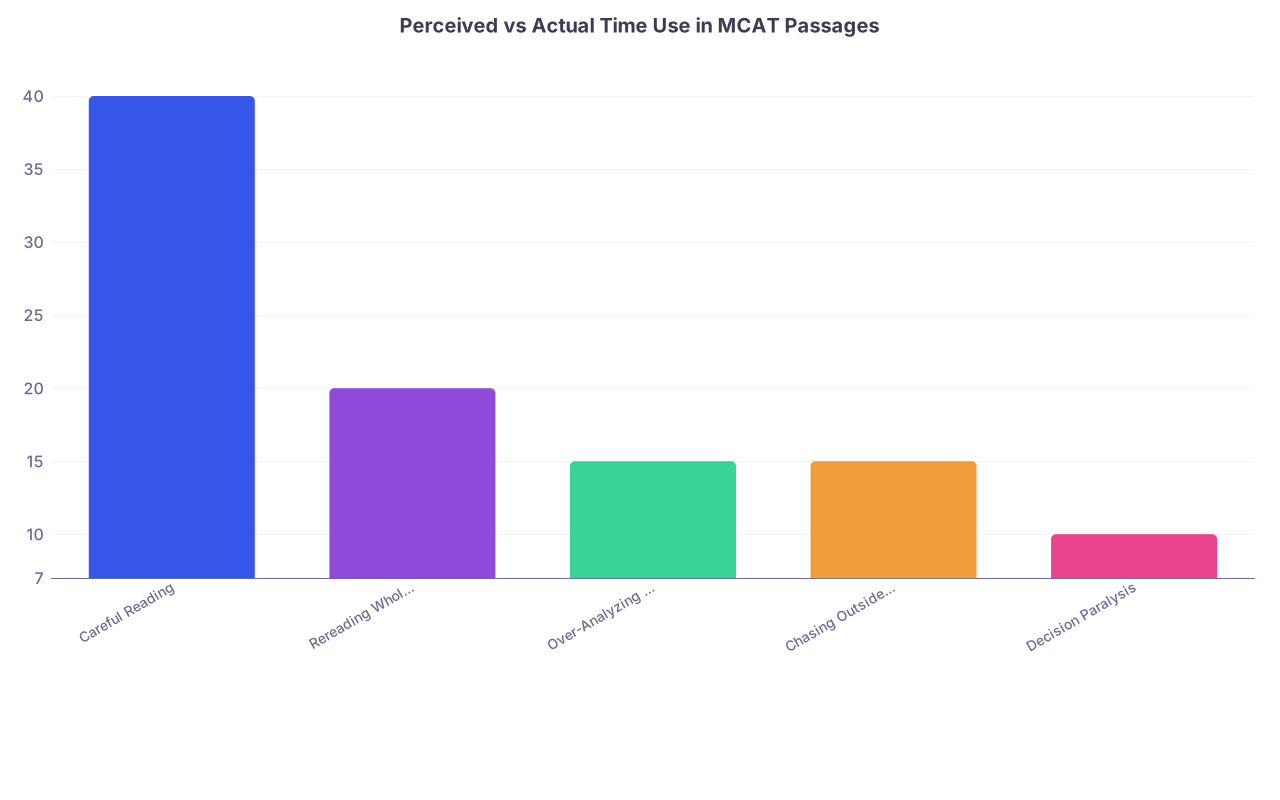
One Visual to Remember: Where Your Time Really Goes
Here is roughly how most students think their time is spent vs. where it actually leaks away during passage-based sections.
| Category | Value |
|---|---|
| Careful Reading | 40 |
| Rereading Whole Passages | 20 |
| Over-Analyzing Figures | 15 |
| Chasing Outside Knowledge | 15 |
| Decision Paralysis | 10 |
Most of this is fixable. But only if you are honest about where your minutes are going.
How to Fix These Mistakes Without Overwhelming Yourself
You do not fix passage-reading errors by “trying harder” on the next full-length. You fix them by isolating and training them like specific skills.
A few focused drills that actually work:
Blind timing checks
Do a CARS or science section but only check timestamps after each passage, not during. Write down your estimated time, then the real time. You will quickly see where your self-perception is lying to you.Structured reread bans
For one practice session, forbid yourself from rereading entire passages. You may only jump back to specific paragraphs or figures prompted by questions. Yes, it will feel uncomfortable. That is the point.Minimal highlighting drills
Force yourself to highlight at most three short phrases per passage. You will hate it for two passages. Then you will notice nothing broke, and your question time feels freer.Figure-first sprints
Take a passage with heavy figures. Spend exactly 15 seconds on each figure, summarizing the “story” out loud in one simple sentence. Then do questions. This trains you to extract signal without drowning in detail.Post-hoc question-mapping
After finishing a passage set, go back and mark which lines/figures each question used. You will start to see what you over-read and what you correctly focused on. That pattern recognition is how your reading becomes efficient.
Mix 1–2 of these into your weekly studying. You do not need to rebuild your entire approach at once. You just need to stop repeating the same unexamined bad habits.
To see how this fits into your broader prep timeline, picture a simple flow like this:

| Step | Description |
|---|---|
| Step 1 | Content Review Phase |
| Step 2 | Introduce Light Passage Practice |
| Step 3 | Add Focused Timing Drills |
| Step 4 | Full-Length Exams |
| Step 5 | Targeted Review of Reading Errors |
| Step 6 | Refined, Stable Strategy for Test Day |
Do not cram reading strategy fixes into the last two weeks. They belong in the middle of your prep, tested and refined long before the real exam.
Final Red Flags to Watch for
If you see these during practice, you are still leaking time on passage reading:
- You routinely “come back” to passages because you did not feel ready to answer on the first pass
- You cannot summarize the main point of a passage in one or two sentences after reading
- Your highlighting looks like a coloring book
- You finish sections with a cluster of rushed or random guesses at the end
These are not character flaws. They are fixable technical problems.

The Bottom Line
Keep this simple. Three things matter most:
- Stop reading passages like textbooks. Read for structure, not perfection, and let the questions pull you back to details.
- Cut the big leaks: whole-passage rereads, highlighter abuse, and chasing outside knowledge instead of using what the passage gives you.
- Lock in a stable, timed reading routine during practice and refuse to experiment on test day.
Protect your minutes. The content you already studied only counts if you are still on the clock when the questions show up.