
The worst way to study for the MCAT is to “study for the MCAT.”
You are not “studying.” You are executing a 12‑month project with specific milestones, failure points, and recovery windows. Treat it like that, or the test will eat you alive.
Here’s your year, broken down month‑by‑month, then week‑by‑week as you get closer. I’ll tell you exactly what you should be doing at each point and what red flags to watch for.
Big Picture: Your 12-Month MCAT Roadmap
Before we go month by month, lock in the structure.
- Months 1–3: Foundation content review (slow and thorough)
- Months 4–6: Deeper content + integrate practice passages
- Months 7–9: Practice-heavy, full sections, identify weak systems
- Months 10–11: Full-length exams, endurance, test-day simulation
- Month 12: Final refinement, lighter review, test day
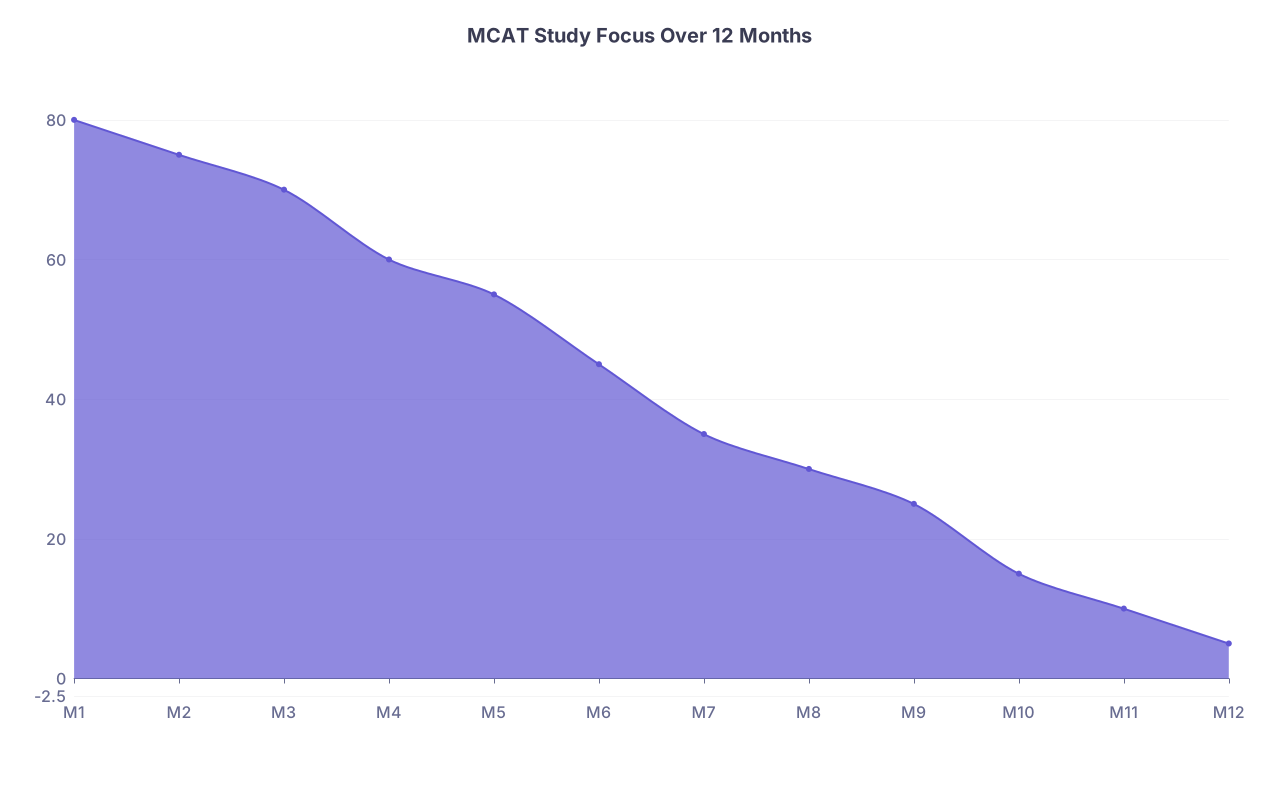
Here’s what the broad allocation of your effort should look like over the year:
| Category | Value |
|---|---|
| M1 | 80 |
| M2 | 75 |
| M3 | 70 |
| M4 | 60 |
| M5 | 55 |
| M6 | 45 |
| M7 | 35 |
| M8 | 30 |
| M9 | 25 |
| M10 | 15 |
| M11 | 10 |
| M12 | 5 |
(That “values” line is your % of time on raw content review. The rest shifts into questions, passages, and full-lengths.)
Non‑negotiables you set up before Month 1:
- Test date booked 11–12 months out (or at least a target month)
- Study hours blocked in your weekly schedule (and protected like a job)
- Primary resources chosen (not five books per subject; pick 1–2 main sources)
- AAMC materials reserved for later (don’t burn them in Month 2 “just to see”)
Now let’s walk the year.
Months 1–3: Build the Base (Content First, Ego Later)
At this point you should forget about your score and focus on fluency.
Month 1: Orientation + First Pass Through Chem/Phys & Bio/Biochem
Target: 8–10 focused hours/week (more if you’ve already finished key prereqs).
By the end of Month 1 you should:
- Have a realistic schedule that you actually followed for 3–4 weeks
- Complete a first-pass review of:
- General Chemistry basics (atomic structure, periodic trends, bonding, stoichiometry, gases, solutions)
- Intro Physics (kinematics, forces, work/energy, basic fluids)
- Cell biology fundamentals (organelles, membranes, transport, enzymes)
Week-by-week:
Week 1: Setup + Diagnostic
At this point you should:
- Take a cold diagnostic (not AAMC; use a third-party FL or half-length)
- Identify your weakest sections (usually CARS and physics, let’s be honest)
- Lock in your primary resources (example combo):
- Kaplan set for content
- Anki or premade decks (Miledown, Jack Westin Biochem, etc.)
- One practice question bank (UWorld or Kaplan Qbank)
If your diagnostic is below ~500, fine. If it’s below 490, your year plan needs strict consistency or you’ll be in trouble later.
Weeks 2–4: Systematic Chem/Phys + Bio/Biochem
At this point you should:
- Study ~5 days/week, 90–120 minutes per session
- Follow a predictable pattern:
- 45–60 min: read or video review of 1–2 subtopics
- 20–30 min: targeted practice (discrete questions, short passages)
- 15–20 min: Anki review
Key rule: every concept gets tested with at least 5 questions the same day you “learn” it.
Month 2: Finish Core Sciences I, Start CARS
By the end of Month 2 you should:
- Have covered all of:
- Gen Chem
- Most of Physics 1 topics
- Core cell biology + metabolism (glycolysis, TCA, ETC, oxidative phosphorylation)
- Have a consistent CARS habit (even if you’re terrible at it)
At this point you should be adding:
- Daily CARS (15–30 min, 3–5 passages/day)
- Use Jack Westin, UWorld, or any solid passage set
- No skipping. CARS is skill, and skill = repetition + feedback
Weekly targets:
- 3 days science-heavy (chem/phys + bio/biochem)
- 1 day lighter review + CARS focus
- 1 “catch-up” day for missed topics / extra practice
Red flags this month:
- “I’m going to wait to start CARS until I’m better at science.” Wrong. You’re burying yourself.
- 2+ weeks where you don’t touch Anki or spaced repetition. You’re wasting your content review.
Month 3: Psych/Soc + Solidifying Biochem
By the end of Month 3 you should:
- Have a first-pass through:
- Most physics relevant to MCAT
- Big biochem topics (enzymes, metabolism, amino acids, gene expression, recombinant DNA)
- 60–70% of Psych/Soc terms
At this point you should:
- Shift ~20–30% of your time into Psych/Soc
- Maintain:
- 3–4 CARS days/week
- 4–5 days/week of Anki
Structure your weeks around “systems”:
- Week focus examples:
- Week 9: Biochem (metabolism) + Psych (learning/memory)
- Week 10: Physics (fluids, electrostatics) + Psych (sensation/perception)
- Week 11–12: Review & integration
If you’re still “reading chapters” with no questions by the end of Month 3, you’re behind. Start practice now.
Months 4–6: Content + Integrated Practice (The Grind Zone)
This is where most people drift. You will not.
Month 4: Full First Pass Complete + Start Section Banks (3rd Party)
By the end of Month 4 you should:
- Have seen every major content area at least once:
- Chem/Phys, Bio/Biochem, Psych/Soc, CARS
- Be doing:
- 3–5 CARS passages/day (4–5 days/week)
- 2–3 sets of science passages/week (7–9 passages total)
Now you shift from “learning” to “applying.”
At this point you should:
- Start timed passage sets:
- 3 passages in 30 minutes
- 4 passages in 40 minutes, etc.
- Track your performance in a simple log:
- Section, resource, # questions, % correct, top 3 error types
| Day | Focus |
|---|---|
| Mon | Chem/Phys passages + CARS |
| Tue | Psych/Soc passages + Anki |
| Wed | Bio/Biochem passages + CARS |
| Thu | Mixed discrete questions |
| Fri | Review + extra CARS |
Red flag: spending 3 hours “reviewing” one set of 6 questions. Over-analysis is just procrastination in a lab coat.
Month 5: Targeted Weakness Work
By the end of Month 5 you should:
- Know your weakest two content domains (e.g., fluids and endocrine)
- Have done at least:
- 300–400 CARS passages total
- 600–800 science practice questions
At this point you should:
- Build 2-week “attack blocks” for weak areas:
- Example: “Next 2 weeks = fluids + optics + CARS inference questions”
- For each weak topic:
- Relearn concept from primary resource
- Do 20–30 targeted questions
- Create or tag flashcards specifically for that topic
- Re-test 3–4 days later with new questions
You’re not just “doing more questions.” You’re running experiments:
- Hypothesis: “I struggle with multi-step calculations under time pressure”
- Intervention: “1 timed calculation set/day for 7 days”
- Outcome: % correct, time per question
Month 6: Pre-AAMC Assessment Month
This is the month before you start burning your AAMC full-lengths.
By the end of Month 6 you should:
- Take a second full-length (still third-party)
- Aim to be:
- ~505+ if you’re ultimately targeting ~510
- ~510+ if you’re targeting 515–520
If your score is dramatically below your goal range (e.g., 495 and you want 515), you either:
- Increase your study hours, or
- Push your test date. The curve will not bend for you.
At this point you should:
- Start simulating test conditions more:
- Full sections timed
- Sit for at least 2–3 hours at a stretch
- Tighten your review:
- Every missed question → tagged by error type:
- Content gap
- Misread question
- Rushed / time
- Overthinking / second-guess
- Every missed question → tagged by error type:
Months 7–9: AAMC Phase & Full Sections
This is where you stop guessing what the MCAT “is like” and actually see it.
Month 7: Begin AAMC Question Packs & Section Banks
By the end of Month 7 you should:
- Start using AAMC materials (but not all at once)
- Prioritize:
- AAMC Question Packs (CARS especially)
- AAMC Section Bank (for sciences) in chunks
At this point you should:
- Do 3–4 “MCAT-style” sits/week:
- Example: one 95-minute Chem/Phys section on Wednesday
- One 90-minute CARS block on Saturday
- Review ruthlessly:
- Write out why the right answer is right in one sentence
- Write out your specific wrong assumption in one sentence
Do not burn through all AAMC in 4 weeks. You want them spread from Month 7 through Month 11.
Month 8: First AAMC Full-Length
By the end of Month 8 you should:
- Take your first AAMC full-length under strict conditions:
- 8 a.m. start time (or your actual testing time)
- Proper breaks, no phone, quiet environment
- Get your first “real” AAMC-based baseline.
Score interpretation:
- If you’re within 5 points of your target: good place.
- If you’re more than 7–8 points away, you need either:
- More hours per week, or
- A longer runway (push test)
At this point you should:
- Start rotating:
- Week A: Full-length + 2 heavy review days + 2 light practice days
- Week B: Section-focused (target weak sections) + CARS daily
Month 9: Pattern Fixing, Not Panic
By the end of Month 9 you should:
- Have at least:
- 2 AAMC full-lengths done
- Most AAMC question packs finished
- Have a clear list of 5–10 recurring mistakes
Example recurring patterns I see constantly:
- CARS: answering based on “what makes sense” instead of “what’s in the passage”
- Chem/Phys: skipping unit checks, messing up exponents
- Bio/Biochem: treating memorized pathways as trivia instead of mechanisms
At this point you should:
- Track performance by question type:
- CARS: main idea vs detail vs inference vs function
- Psych/Soc: term recall vs application vs experiment interpretation
- Build micro-drills:
- 15 minutes/day only for ratios / proportion questions
- 10 minutes/day for “Why wrong?” analysis on CARS
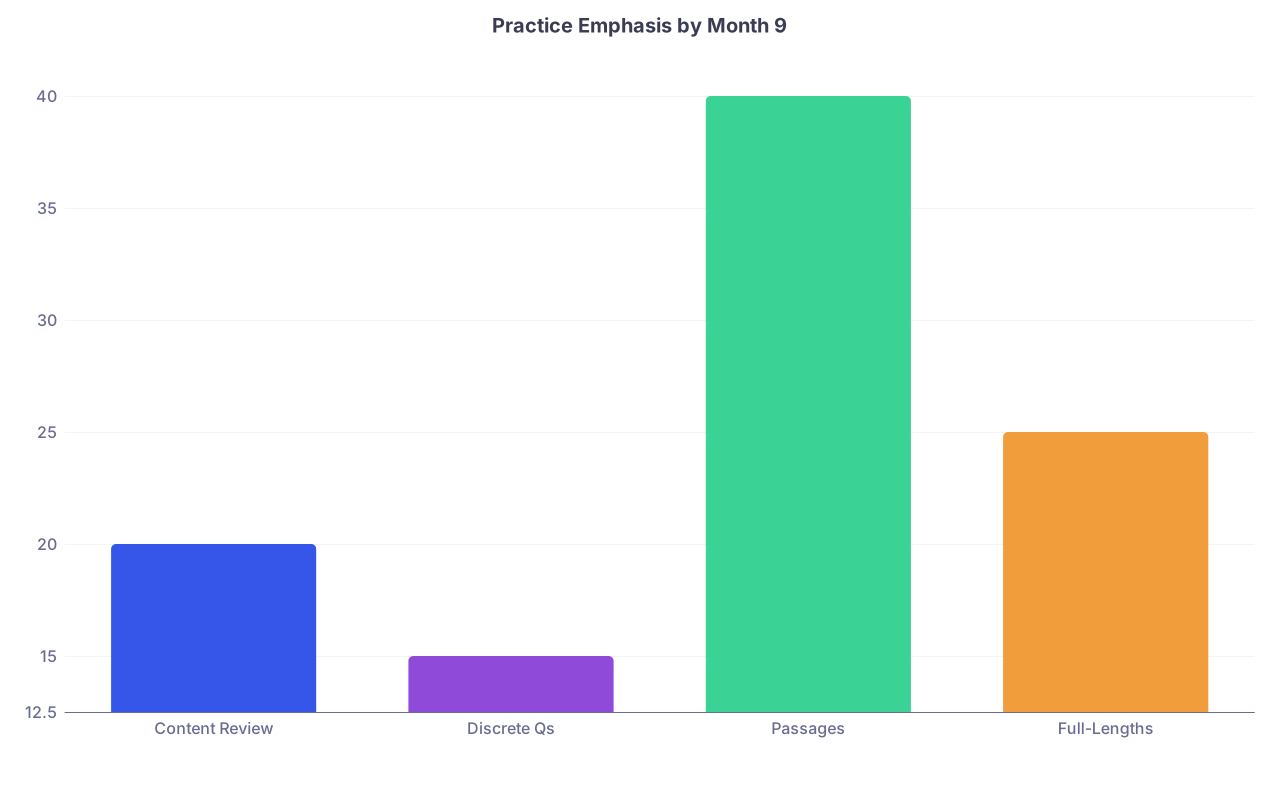
Here’s a simple visual for how your practice should be skewed by this point:
| Category | Value |
|---|---|
| Content Review | 20 |
| Discrete Qs | 15 |
| Passages | 40 |
| Full-Lengths | 25 |
Months 10–11: Simulation and Fine-Tuning
This is where semi-prepared students plateau and disciplined ones surge.
Month 10: Full-Length Every 1–2 Weeks
By the end of Month 10 you should:
- Have taken 3–4 AAMC full-lengths total
- Have at least 2 scores within 3 points of your target
At this point you should:
- Follow a two-week cycle:
Week 1: Full-Length Week
- Day 1: FL exam (AAMC) under full conditions
- Day 2–3: Deep review (at least 6–8 hours total):
- Log every missed and every guessed-right question
- Identify theme-level issues (e.g., “I rush last 10 questions in C/P”)
- Day 4–5: Targeted practice based on FL mistakes
Week 2: Section & Skill Week
- 1–2 days of full timed sections (CARS + a science)
- 2–3 days of mixed passages and review
- Lighter content refreshers (especially Psych/Soc terms, amino acids, equations)
You are not cramming “new” content now. New content enters only if:
- It’s obviously high-yield
- It’s been repeatedly tested on you (missed 3+ times)
Month 11: Lock-In Month
By the end of Month 11 you should:
- Have finished all AAMC full-lengths you plan to use (typically 4–6)
- See your scores:
- Stable or trending up
- Within 2–3 points of goal, repeatedly
At this point you should:
- Shift toward:
- 60–70% time: practice & review
- 30–40% time: quick-hit content refresh
- Develop your Test Day Playbook:
- Sleep schedule 1–2 weeks before
- Exact breakfast and hydration plan
- What you’ll do during each break (snack, bathroom, breathing)
This is also the month for final logistical checks:
- Test center location confirmed
- Transportation plan (drive, ride, backup)
- Required IDs, confirmation email, etc.
Month 12: Final Approach and Test Day
This is not the time to heroically “push harder” and burn out. It’s precision work.
Weeks 1–2 of Month 12: Last Full-Length + Gentle Taper
At this point you should:
- Take your last full-length 7–10 days before actual test day
- Spend 2–3 days reviewing it, but do not obsess over every point
The focus now:
- Light, focused sessions:
- 60–90 minutes 1–2 times/day
- Activities:
- Flashcards (amino acids, formulas, Psych/Soc terms)
- Selected AAMC passages that align with your weak areas
- CARS: 2–3 passages/day, mostly to maintain rhythm
No more brand-new full resources. No starting a fresh Qbank now. That’s panic disguised as productivity.
Final 3–4 Days Before the MCAT
At this point you should:
3–4 days out
- Do only light practice:
- A few passages
- Flashcards
- Some equation drills
- Review your error log:
- Remind yourself of your most common traps
- Write them on a single page: “Test Day Reminders”
2 days out
- No full-lengths.
- Maybe one short (30–45 min) timed block to keep your brain calibrated.
- Go over:
- High-yield lists (AA structures, key hormones, common experimental designs)
- Your personal “do not do this” notes (e.g., “Don’t rush last 5 CARS questions”)
Day before the test
- No heavy studying.
- Quick 30–60 minute skim of flashcards if that calms you.
- Drive to the test center if you’ve never been there.
- Lay out:
- Clothes
- Snacks
- Water
- ID
- Confirmation
You don’t get fitter the day before a marathon. You just avoid stupid injuries.
Test Day: Execution Only
At this point you should:
- Wake up with enough buffer to arrive at least 30–45 minutes early
- Eat a breakfast you’ve already tested on full-length days
- During each section:
- Stick to your timing plan (e.g., checkpoint every 30 minutes)
- Guess and move on if you’re stuck more than 90 seconds
- During breaks:
- Don’t review questions in your head
- Eat, drink, breathe, reset
Your job now isn’t to suddenly become smarter. It’s to not sabotage the work you did all year.
If You’re Starting Late or Already Mid-Year
If you’re reading this and your test is in 8 months, not 12, you compress the early content phases and start AAMC a bit earlier. But the structure stays the same:
- Foundation → Integrated practice → AAMC-heavy → Simulation → Taper
Do not try to do “everything” in less time. Do the right things, even if that means fewer total questions but better-reviewed ones.
Today, do one concrete thing:
Pick your Month 1–3 block on a calendar and write in exactly which subjects you’ll hit each week. Not “study MCAT.” Write “Week 2: Gen Chem (gases/solutions) + Cell Bio (membranes/transport) + 3 days CARS.” Then protect those blocks like they’re a class you’d fail if you skipped.