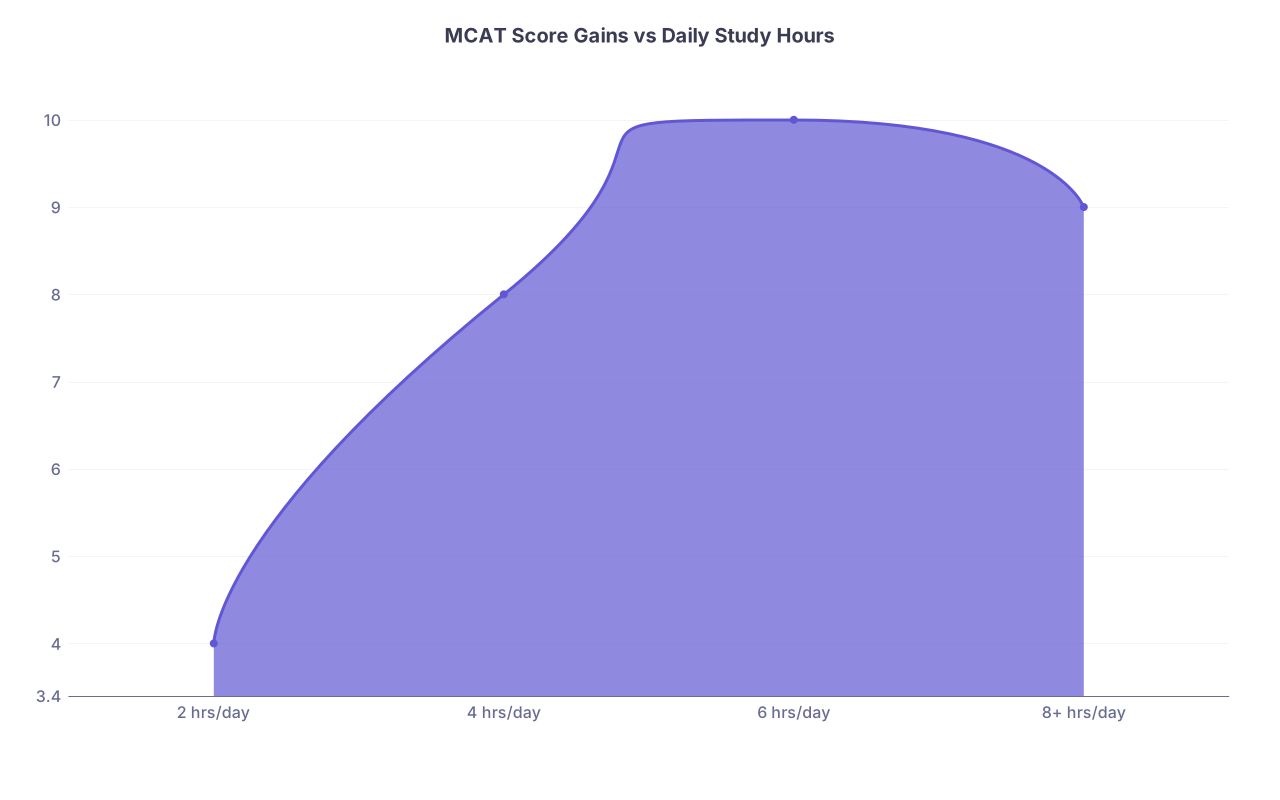
The worst MCAT mistake isn’t a bad score. It’s drifting into May without a real plan and then wondering why you plateaued at 503.
You want a May MCAT? Fine. Then August-to-May needs a blueprint, not vibes.
Below is a month‑by‑month, then week‑by‑week, then final month day‑by‑day prep timeline specifically for a May test date. I’m assuming:
- You’re taking a full‑length exam in May (any date).
- You’re starting in August of the year before.
- You’ve got typical premed constraints: classes, maybe work, maybe research.
Adjust hours as needed, but don’t mess with the sequence without a good reason.
Big‑Picture Structure: August to May
First, here’s the high‑level arc so you can see the whole thing at once:
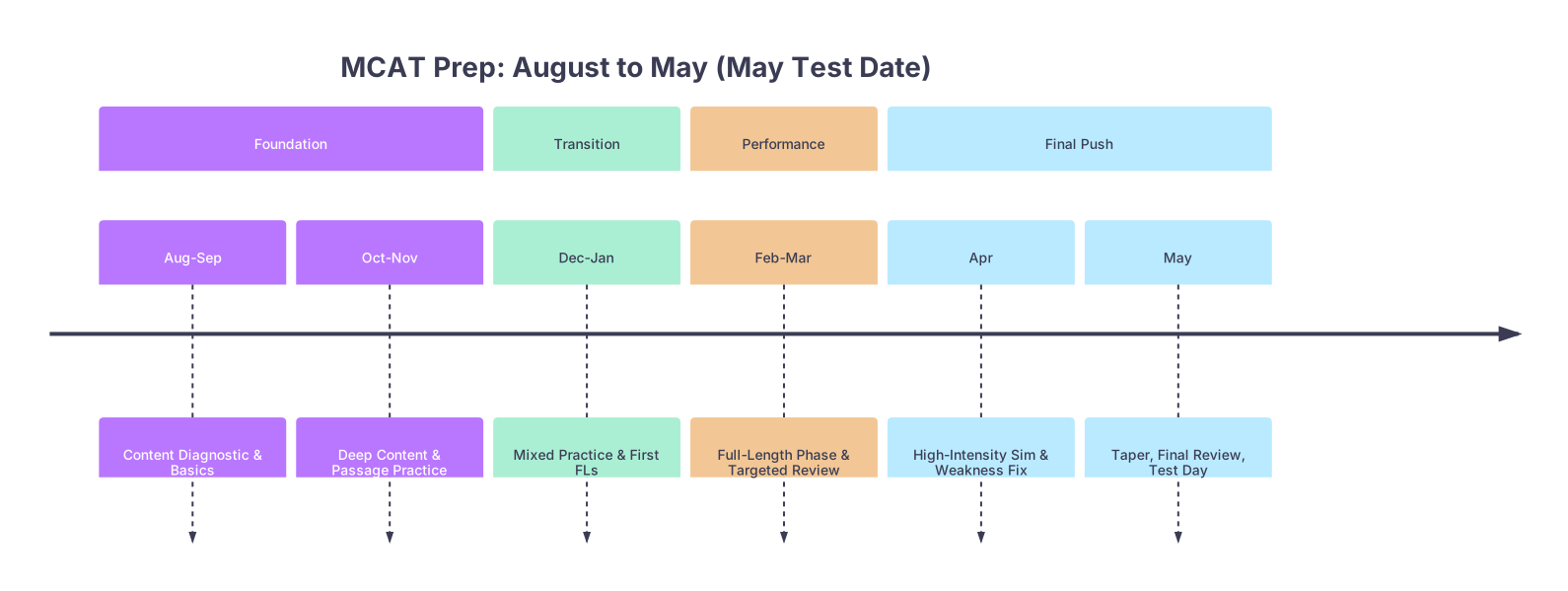
| Period | Event |
|---|---|
| title MCAT Prep | August to May (May Test Date) |
| Foundation - Aug-Sep | Content Diagnostic & Basics |
| Foundation - Oct-Nov | Deep Content & Passage Practice |
| Transition - Dec-Jan | Mixed Practice & First FLs |
| Performance - Feb-Mar | Full-Length Phase & Targeted Review |
| Final Push - Apr | High-Intensity Sim & Weakness Fix |
| Final Push - May | Taper, Final Review, Test Day |
That’s the skeleton. Now let’s put flesh on it.
August–September: Foundation & Reality Check
At this point you should stop pretending you “kind of remember” orgo and find out where you actually stand.
Week 1 (Early August): Baseline & Setup
Goals this week:
- Get a baseline score.
- Pick your materials.
- Build a realistic weekly schedule.
Tasks:
Take a full‑length diagnostic (AAMC Sample or a reputable third‑party exam).
- Take it timed, in one sitting.
- Do not study first. You need a clean baseline.
Analyze the score, don’t just stare at it.
- Write down:
- Overall score
- Section scores
- Content areas you obviously had no idea about
- Timing problems (e.g., CARS sections left blank, panicked guessing in last passages)
- Write down:
Choose your main resources (and commit):
- One content set (Kaplan/Blueprint/Princeton Review/Oxford etc.).
- One question bank (UWorld, Kaplan qbank, Blueprint qbank).
- You will also use all AAMC materials starting later: Question Packs, Section Banks, FLs.
Build a weekly time budget.
- During fall classes, aim for 10–15 hours/week.
- Example:
- 2 hours × 3 weekdays
- 3–4 hours × 1–2 weekend days
If you skip this week’s work and “just start grinding content,” you’ll waste months on the wrong subjects.
Rest of August–September (Weeks 2–8): Structured Content Review – Round 1
At this point you should be rebuilding your science foundation and learning how MCAT passages feel.
Focus: content-heavy with light passage exposure.
Weekly structure (template):
- 6–8 hours content review (videos or books)
- 4–6 hours topic‑specific practice questions
- 1–2 hours error log & review
Order of attack (approximate):
- C/P: Gen chem basics, key physics (kinematics, forces, energy, fluids)
- B/B: Biochemistry fundamentals (amino acids, enzymes, metabolism), core bio (cell, membranes, DNA/RNA)
- P/S: High‑yield psych theories, basic sociology terms
- CARS: Start early, small doses
CARS from Day 1:
- 3–4 passages, 3–4 days/week, timed.
- Do not binge CARS once a week. It’s like a language—small, frequent doses.
By end of September you should:
- Have finished a first pass of:
- Most gen chem
- Core physics 1 material
- Foundational bio/biochem
- Basic P/S terms
- Be consistently doing some CARS and practice questions each week.
- Have an error log started (Excel, Notion, notebook—doesn’t matter, just use it).
October–November: Deep Content + Heavier Practice
At this point you should stop pretending the MCAT is “just content” and start training the test.
You’re still in content season, but practice ramps up.
October: Finish Content Core, Increase Question Volume
Targets for October:
- Wrap most remaining content review:
- Orgo basics (reactions, mechanisms, spectroscopy, lab techniques)
- Remaining physics (electricity, magnetism, optics)
- Advanced biochem (signal transduction, metabolic pathways)
- Deeper P/S (research methods, more obscure terms)
Weekly structure (during classes):
- 4–6 hours content
- 6–8 hours practice (discrete + passages)
- CARS: 4–5 days/week, 3–4 passages/day
Specific actions:
- For each content block (e.g., acid–base, kinematics), do:
- 1–2 hours review
- 20–30 targeted questions
- After each set:
- Review every missed question.
- For anything you missed because of concept gap, add to a “Content Hole” list.
- For anything missed because of carelessness or reading, write “what I should have done instead” in your error log.
November: Integrated Passages & Mini Exams
By November, at this point you should be:
- Mostly done with primary content.
- Transitioning to passage‑first thinking.
Add “mini‑exam blocks” (1–2 hours each):
- 3–4 passages back‑to‑back in one subject.
- Timed strictly.
- Then 30–40 minutes of review.
Do this 2–3 times per week.
CARS:
- Bump to 5–6 days/week, 4–5 passages/day.
- Focus on:
- Staying calm with unfamiliar topics.
- Answering from the passage, not from outside knowledge.
- Eliminating obviously wrong answers decisively.
End of November checkpoint:
You should:
- Have completed most or all of your first full pass through content.
- Be doing multiple passage sets per week in every science section.
- Feel less terrified when you see long blocks of text with weird graphs.
If you still haven’t finished content by late November, you’re behind. Not doomed, but you’ll have to push hard in December.
December–January: Transition to Full-Length Mindset
Now we shift from “learning the material” to “training for a 7.5‑hour endurance event.”
December: Mixed Practice & Content Cleanup
December is messy because of finals. That’s fine. Work around it, not against it.
If your finals are heavy:
Early December (pre‑finals):
- 1 science day, 1 CARS day, 1 mixed day per week.
- Keep the MCAT alive so you don’t restart from zero in January.
Finals week(s):
- 2–3 short CARS sessions per week, 2–3 passages at a time.
- Light content review for 30 minutes here and there.
- Do not attempt full‑lengths during finals.
After finals (late December):
You probably get a small break. Use it hard.
- Plan for 20–25 hours/week if possible during winter break.
- Do your first full‑length if you didn’t in early December:
- Preferably a third‑party FL (save AAMC for later).
- Full test conditions: morning start, breaks, no phone, quiet room.
- Spend a full day reviewing it:
- For each section:
- Tag questions: content vs. strategy vs. timing.
- Note patterns like “always mess up graph questions,” “panic on last passage.”
- For each section:
January: Serious Full‑Length Phase Begins
At this point you should be pivoting from “study chapters” to “simulate the exam.”
Target in January (during school):
- 1 full‑length every 2–3 weeks.
- 12–18 hours/week total MCAT work.
Weekly structure example:
- Day 1: FL (if scheduled that week)
- Day 2: FL review (half the test)
- Day 3: FL review (other half) + 2–3 CARS passages
- Day 4: Content patching of weaknesses seen on FL
- Day 5: Mixed passages (science) + CARS
- Day 6 (optional): Light content review + error log maintenance
If your January score is still low, that’s normal. Let’s quantify it with a realistic trend:
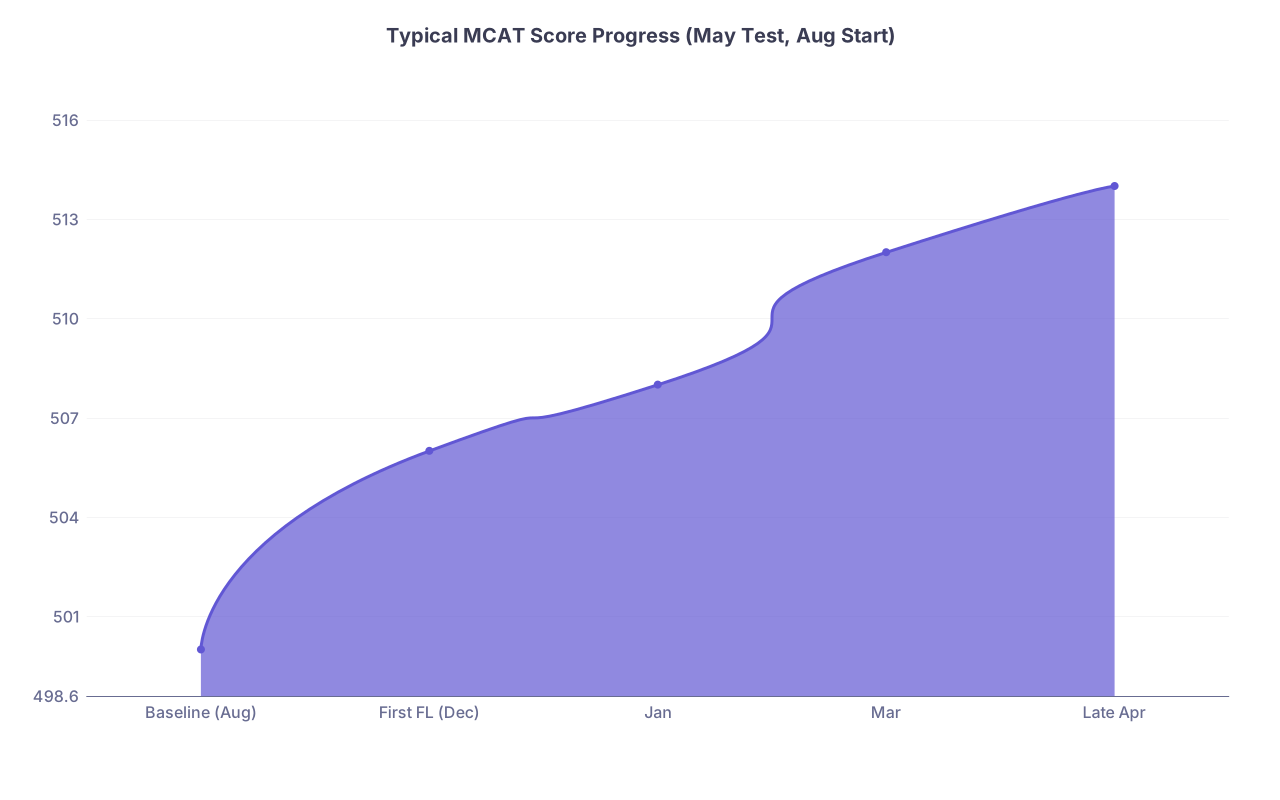
| Category | Value |
|---|---|
| Baseline (Aug) | 500 |
| First FL (Dec) | 506 |
| Jan | 508 |
| Mar | 512 |
| Late Apr | 514 |
Notice: the big jump is often February–April, not September–November.
February–March: Full-Length Engine & Targeted Repair
Now we’re in the prime scoring window. At this point you should live and breathe testing patterns, not chapter notes.
February: Regular Full‑Lengths, AAMC Comes In
Schedule:
- Every other week: 1 full‑length exam.
- You can start using AAMC FL 1 here if your content base is solid.
- Off‑weeks: heavy on AAMC Question Packs/Section Bank and targeted passages.
Weekly rhythm (with an FL):
- Day 1: FL (7.5 hours)
- Day 2: Review C/P + CARS in detail
- Day 3: Review B/B + P/S in detail
- Day 4: Targeted practice on biggest section weakness from FL
- Day 5: Mixed practice (passages from all sections)
- Day 6: CARS + light content refresh
CARS intensity now:
- 5–6 days/week.
- 4–6 passages/day.
- Once a week, run a full CARS section (9 passages) timed.
March: Weekly FLs & Fine-Tuning
By March, with a May test date, at this point you should be on a weekly FL schedule or very close.
Goal:
- Hit 4–5 total AAMC FLs before test day.
- Use non‑AAMC FLs as extra reps, but treat AAMC as gold.
Ideal March pattern:
- Week 1: AAMC FL 1
- Week 2: Review + targeted practice, NO new FL
- Week 3: AAMC FL 2
- Week 4: Review + targeted practice
If you handle heavy load well, you can push to 3 FLs in March; just do not sacrifice quality of review.
Score expectations:
By late March, your AAMC FLs should be:
- Within 2–3 points of your score goal, or
- Clearly trending upward into that range.
If AAMC scores are still stuck way below your target (e.g., goal 515, stuck at 503), you do not solve that by just adding more FLs. You solve it by:
- Doing brutal post‑FL analysis.
- Identifying repeat mistake categories.
- Spending 2–3 days in a row on the worst offenders (e.g., data interpretation in B/B, P/S definitions, CARS main idea questions).
April: Final Push Before the May Exam
This is where people either sharpen or burn out. The difference is planning.
At this point you should stop pretending you can “cram content” and instead treat April like a dress rehearsal month.
Early April (Weeks 1–2): High-Intensity, But Controlled
Plan for:
- 2–3 full‑lengths total across April (depending on exact test date).
- Remaining AAMC FLs scheduled 2–3 weeks and 1–2 weeks before test day.
Example for a mid‑May test:
- First week of April: AAMC FL 3
- Third week of April: AAMC FL 4
In between:
- AAMC Section Bank passages
- Re‑doing tricky questions from older FLs
- Focused CARS sections (9 passages)
What your review sessions should look like now:
- Less “let me reread the whole chapter.”
- More “why did I choose this wrong answer, step‑by‑step.”
- Build a “Top 50 mistakes” document.
- Short bullets.
- Example:
- “C/P: I forget that Ksp only applies to saturated solutions → check context first.”
- “CARS: I add my own opinion → stay strictly within author’s tone.”
Late April (Weeks 3–4): Peak & Taper
You do not want to be exhausted on May 1st.
Move from heavy simulations to maintenance and confidence building.
Last AAMC FL:
- Schedule it 7–10 days before your test day (not 2 days before).
- Treat it like a real test day—wake time, food, breaks all matching.
After that final FL:
- Don’t chase another full‑length unless your schedule is completely off or the last FL was a disaster and you know why.
- Shift into:
- Re‑reading error log.
- Quick passes through high‑yield summaries/Anki decks.
- Short, focused practice blocks (3–5 passages at a time).
- CARS 3–4 passages every other day.
May: The Final 10 Days (Day-by-Day Style)
Now we go granular. Assume a Saturday test date in mid‑May; adjust weekdays accordingly.
10 Days Out (Wednesday, Week Before Last)
At this point you should lock in your logistics.
- Confirm:
- Test center location & travel time.
- Required IDs.
- Allowed snacks and drinks.
- Run a half‑length (e.g., C/P + CARS) in the morning at test time.
- Afternoon:
- Review that half test.
- Light content touch‑ups only on those misses.
9 Days Out (Thursday)
- Focus day for your weakest section.
- 4–5 passages targeted in that section.
- 2–3 CARS passages.
- Spend 1–2 hours making sure all equations you need are:
- Memorized.
- Understood conceptually.
8 Days Out (Friday)
- Light to moderate day.
- 2–3 B/B passages.
- 2–3 P/S passages.
- A few discretes from C/P.
- 30–45 minutes: review your Top 50 mistakes list.
- Night: start syncing sleep to test schedule. Go to bed at your planned test‑day bedtime.
7 Days Out (Saturday, One Week Before)
This is your last “long” effort day, not a full FL.
- Morning:
- Full CARS section (9 passages) timed.
- Afternoon:
- 4–6 mixed science passages (from Section Banks or trusted source).
- Evening:
- Review the hardest half of those questions.
- Stop studying at least 2 hours before bed.
6 Days Out (Sunday)
- Recovery + light review.
- No long practice sets.
- 1–2 hours:
- Skim formula sheets.
- Quick look at P/S terms.
- Review 10–15 of your highest‑yield flashcards.
5 Days Out (Monday)
At this point you should not be trying to make big score jumps. You’re polishing.
- 3–4 C/P passages.
- 3–4 B/B passages.
- 2–3 CARS passages.
- 30–45 minutes reviewing old FL questions you struggled with but now understand (this reinforces confidence).
4 Days Out (Tuesday)
- Short day.
- 3–4 P/S passages + a handful of discretes.
- 2–3 CARS passages.
- Double‑check:
- Test‑day bag.
- Route to test center, backup route.
- Wake‑up alarms set (yes, plural).
3 Days Out (Wednesday)
This is your last real “work” day, but not heavy.
- Optional: one half‑length (B/B + P/S) in the morning if you feel mentally fresh and not anxious.
- Afternoon: review selected old errors.
- Evening: very light reading, zero new content.
2 Days Out (Thursday)
Deliberate taper.
- 1–1.5 hours total:
- 2–3 CARS passages.
- 2–3 mixed science passages at most.
- No timing pressure. Focus on calm reasoning.
- Get outside. Walk. Breathe like a human, not a test machine.
1 Day Out (Friday)
At this point you should be done.
- No practice tests.
- No heavy passages.
- If you absolutely must do something academic:
- Skim formula sheet for 10–15 minutes.
- Glance at a small set of P/S terms you chronically forget.
- Otherwise:
- Light physical activity.
- Prepare clothes, snacks, water, ID, confirmation email.
- Early, screen‑free night.
Sample Weekly Schedules by Phase
Here’s a compact view so you can sanity‑check your own plan:
| Phase | Months | Hours/Week | FL Frequency |
|---|---|---|---|
| Foundation | Aug–Sep | 10–15 | Diagnostic only |
| Heavy Content+Practice | Oct–Nov | 12–18 | 0–1 per month |
| Transition | Dec–Jan | 15–25* | 1 per 2–3 weeks |
| Full-Length Focus | Feb–Mar | 18–25 | 1 per 1–2 weeks |
| Final Push | Apr | 18–22 | 2–3 total |
| Taper | Early–Mid May | 8–15 | Last FL 7–10 days prior |
*Higher end during winter break, lower during heavy exam weeks.
Final Thoughts: What Actually Matters
Strip away all the noise. For a May MCAT with an August start, the three things that move the needle most:
- Early and honest diagnostics. Know your baseline in August, not January. Then keep confronting your real weaknesses instead of hiding in comfortable topics.
- Full‑length discipline. Simulate the real exam regularly from January onward, and spend at least as long reviewing as you did testing.
- A proper taper. April and early May are for sharpening and protecting your brain, not last‑minute content marathons that leave you fried on test day.
Follow this timeline with reasonable consistency, and by the time May rolls around, you will not be “hoping” you’re ready. You’ll have eight months of structured proof.