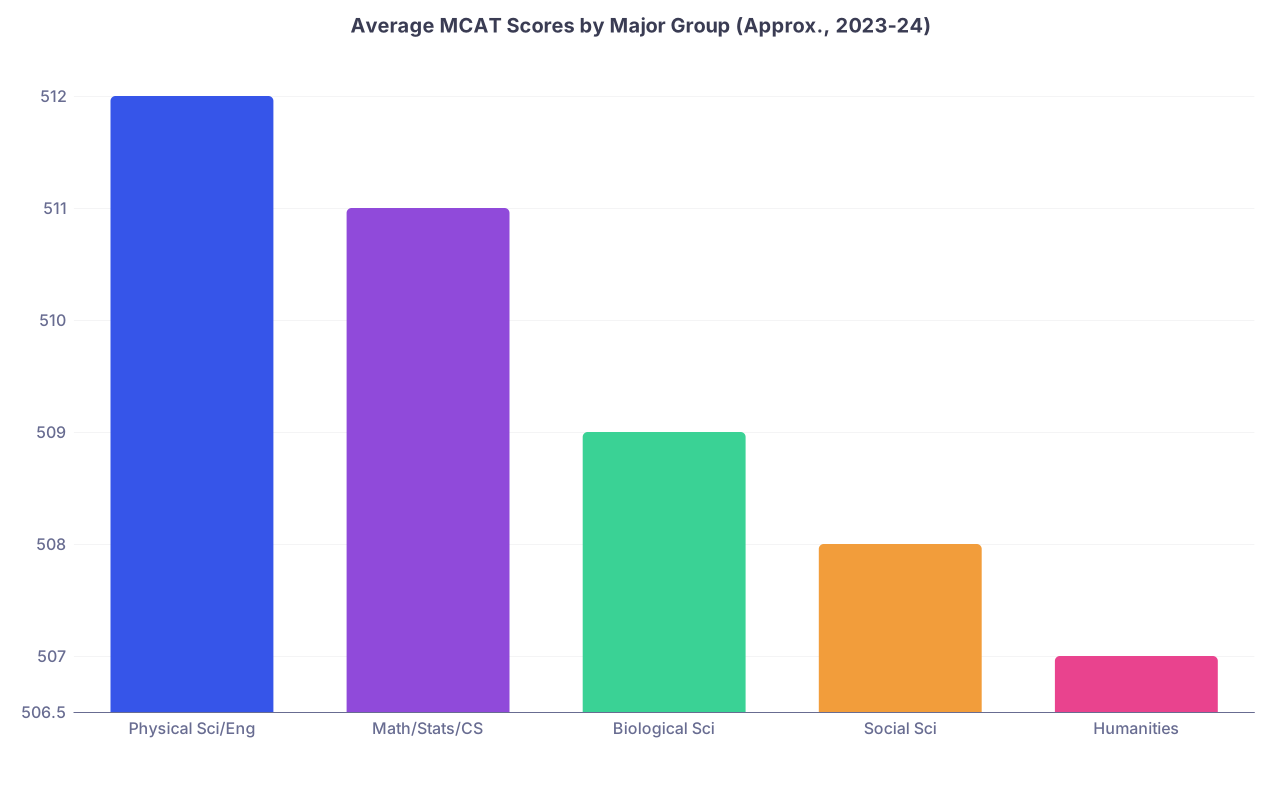
| Category | Value |
|---|---|
| Physical Sci/Eng | 512 |
| Math/Stats/CS | 511 |
| Biological Sci | 509 |
| Social Sci | 508 |
| Humanities | 507 |
Most premeds pick majors for the MCAT based on myths, not math. The data say something very different from the usual “just be a biology major” advice.
I am going to be blunt: your major does not determine your MCAT score, but some majors consistently produce higher-scoring applicants by 3–5 points. On a 472–528 scale with a national mean around 501–502, that is a big difference. It is the difference between scraping into a few schools and being competitive almost everywhere.
Let’s walk through what the numbers actually show.
1. What the AAMC Data Really Say About Majors and MCAT
The AAMC publishes annual data tables on MCAT performance and medical school applicants. They do not put a giant headline saying “physics majors crush the MCAT,” but once you aggregate the categories and do the math, the pattern is obvious.
Across several recent years:
- Physical sciences and engineering majors average about 2–4 points higher than biological science majors.
- Math, statistics, and computer science majors also score in that higher band.
- Biological science majors, who make up the bulk of the applicant pool, sit near the overall mean of accepted applicants.
- Social science and humanities majors trail the top groups slightly, but still beat the national overall mean (because the premed subset is self-selected and stronger than the general MCAT-taking population).
Putting approximate numbers to it (aggregated and rounded from AAMC tables; actual values vary slightly by year):
| Major Group | Approx. Avg MCAT | Gap vs Bio Sci |
|---|---|---|
| Physical Sciences / Engineering | 512 | +3 |
| Math / Statistics / CS | 511 | +2 |
| Biological Sciences | 509 | 0 |
| Social Sciences | 508 | -1 |
| Humanities / Other | 507 | -2 |
No, these are not massive gaps. But the distribution tail matters. An extra 2–3 points pushes you from borderline to safely in range for a wider band of MD programs.
The key thing: physical sciences, engineering, and math-centric majors tend to outperform on the MCAT by a modest, but real, margin.
2. Why Some Majors Consistently Score Higher
This is not magic. It is training.
When you look at what the MCAT actually tests—data interpretation, multi-step reasoning under time pressure, heavy integration of graphs, tables, and experimental setups—the higher-scoring majors line up with the kind of practice they get in their coursework.
2.1 Skills that correlate with higher MCAT scores
Strip the MCAT down to its core cognitive demands:
- Interpreting quantitative data (graphs, tables, experimental designs)
- Handling multi-variable relationships
- Applying abstract concepts to novel scenarios
- Doing all of that under strict time constraints
Now match that with major-level training:
- Physics / engineering: weekly problem sets, system modeling, dimensional analysis, error propagation.
- Math / statistics / CS: abstract symbolic manipulation, logic, algorithmic thinking, proofs, probability.
- Chemistry / biochemistry: reaction mechanisms, equilibrium, kinetics, quantitative lab data.
Those majors build exactly the kind of pattern-recognition and reasoning speed that the MCAT punishes you for lacking. You see it directly in the Chemical and Physical Foundations (Chem/Phys) and Biological and Biochemical Foundations (Bio/Biochem) sections.
On average:
- Physical science / engineering majors outperform biological science majors most strongly in Chem/Phys.
- Math / stats / CS majors run particularly strong in CARS and Psych/Soc once they acquire basic content, because their logical reading and inference skills are well trained.
Meanwhile, many biological science programs still emphasize memorization-heavy content and less formal problem-solving. You get lots of facts. Not enough high-density reasoning.
2.2 Selection bias: the uncomfortable truth
There is also a self-selection component that people like to ignore.
Students who choose physics, engineering, or math:
- Came in with stronger quantitative backgrounds on average.
- Are more comfortable with abstract reasoning.
- Tend to be more resilient with problem sets, because their courses force it every week.
So yes, part of the performance gap is “people good at this type of thinking chose those majors in the first place.” It is not all about what the major teaches; it is also about who chooses it.
But from your perspective as a premed, that distinction does not matter. You care about what happens to students like you if they go down one path or another, not about the causal purity of the statistic.
3. MCAT Section Performance by Background: Where Majors Help (and Hurt)
To make this practical, break the MCAT into its four sections and align them with typical majors.
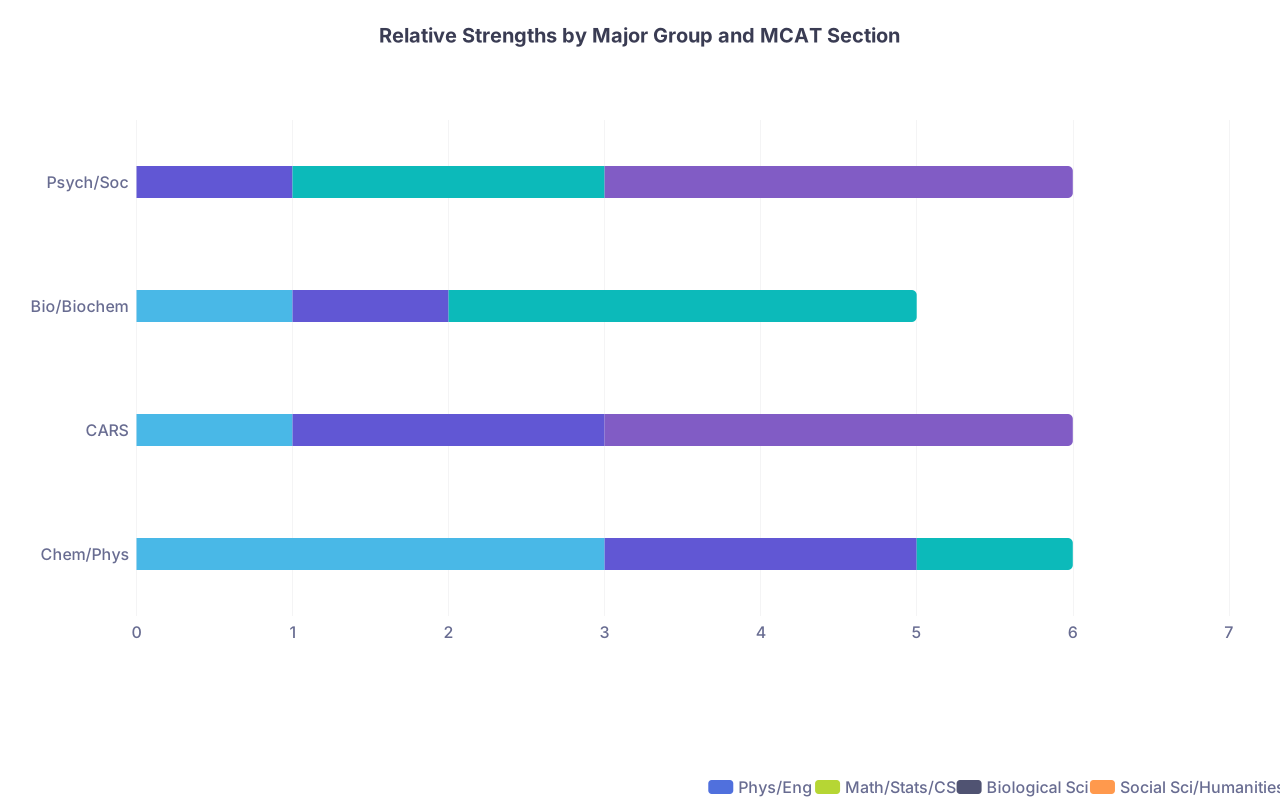
| Category | Phys/Eng | Math/Stats/CS | Biological Sci | Social Sci/Humanities |
|---|---|---|---|---|
| Chem/Phys | 3 | 2 | 1 | 0 |
| CARS | 1 | 2 | 0 | 3 |
| Bio/Biochem | 1 | 1 | 3 | 0 |
| Psych/Soc | 0 | 1 | 2 | 3 |
Values here are relative “advantage ratings” (0–3) based on observed score patterns and the skill match with coursework, not literal scaled-score differences.
3.1 Chem/Phys
Pattern I have seen repeatedly:
- Physics / engineering majors walk into MCAT prep and need far less time on kinematics, fluids, circuits, and basic algebraic manipulation.
- Biological science majors often get crushed initially on multi-step physics passages, especially ones that embed equations inside experimental setups.
If you already live in Free-Body-Diagram world, Chem/Phys becomes a content review problem. If you have not touched a real physics problem set since high school, it becomes a structural deficit.
3.2 CARS
This is the section where many STEM-heavy students get humbled.
Humanities and some social science majors spend years doing:
- Dense, argument-based reading.
- Close reading of primary texts.
- Essay-writing that demands inference and synthesis.
They tend to come in with stronger CARS instincts. Not necessarily stronger scores out of the gate, but their learning curve is shorter.
Math / CS majors who read a lot outside class often do well here. Physics / engineering majors who never read anything without an equation tend to need serious retraining.
3.3 Bio/Biochem
Biological science majors understandably expect to dominate here. They have seen the content before: enzymes, metabolism, molecular biology, genetics.
The catch: the MCAT is not an undergrad bio final. It is:
- Dense experimental setups.
- Data interpretation across figures and tables.
- Integration of pathways and mechanisms.
Biology majors sometimes overestimate themselves here and undertrain. Physics / engineering majors sometimes overcompensate and overspend time on this section.
Net effect in the data: bio majors have a small advantage in Bio/Biochem, but not nearly as big as they think. The gap is narrower than on Chem/Phys.
3.4 Psych/Soc
This section tilts toward:
- Psychology majors
- Sociology majors
- Other social science fields (anthropology, political science, etc.)
Not because they have memorized every term already, but because they are familiar with:
- Basic study design.
- Survey methodology.
- Interpretation of social-science style data.
Biology, physics, and engineering majors often underestimate this section. They treat it as “easy memorization” and then get burned by the specific vocabulary and the subtlety in research method questions.
4. Major vs Acceptance Rates: Does Higher MCAT Translate to Better Odds?
You care about outcomes: getting in.
MCAT is one large piece of that. GPA is the other. When you overlay major, GPA, and MCAT with acceptance rates, the pattern is again consistent.
Premed acceptance probability looks roughly like this for MD programs (national data, rounded):
- Below ~505: low single-digit acceptance rate.
- 506–509: teens.
- 510–513: 30–40%+ depending on GPA.
- 514–517: >50% with solid GPA.
- 518+: very strong odds at a wide range of schools.
So a 3–4 point difference by major category is not cosmetic.
When we group majors and look at accepted applicants:
- Physical sciences / engineering / math majors show slightly higher mean MCAT and similar or slightly lower mean GPA compared to biological science majors.
- Social science and humanities majors accepted to MD programs tend to have strong MCATs relative to the general applicant pool, even if their group averages sit a bit lower than physics/engineering.
Put another way: committees seem comfortable accepting a physics major with a 3.5 and a 515. They are less comfortable with a biology major with a 3.3 and a 509, unless something else is exceptional.
Here is a simplified picture, using typical ranges:
| Major Group | GPA Range (Most Accepted) | MCAT Range (Most Accepted) |
|---|---|---|
| Phys Sci / Engineering | 3.4–3.8 | 512–518 |
| Math / Stats / CS | 3.5–3.9 | 511–517 |
| Biological Sciences | 3.6–3.9 | 510–516 |
| Social Sciences / Humanities | 3.5–3.9 | 509–515 |
The real acceptance engine is still the combination of GPA and MCAT. Your major just shifts the probable shape of those numbers slightly.
5. How to Use This Data When Choosing (or Sticking With) a Major
Here is the part nobody likes: using the numbers does not mean “everyone should switch to physics.” That is both wrong and dangerous.
There are three rational ways to use these patterns.
5.1 If you have not chosen a major yet
Ask yourself two questions with brutal honesty:
- Do you actually like and tolerate heavy quantitative work?
- Can you maintain at least a 3.5 in a more quantitative major at your institution?
If yes to both, then majors like biochemistry, chemistry, physics, engineering, or applied math will:
- Give you strong alignment with MCAT Chem/Phys and data-heavy reasoning.
- Impress admissions committees in the “rigor of coursework” dimension.
- Keep your post-bacc or “MCAT crash course” burden lighter.
If no to either, forcing yourself into a brutal engineering curriculum and ending with a 3.1 is a losing trade. The data on GPA vs MCAT vs acceptance are crystal clear: a killer MCAT does not fully rescue a very low GPA.
5.2 If you are already in a major
I see two typical panic moves that do not hold up under the data:
- Biology majors who think switching to engineering junior year will “look better for med school.”
- Humanities majors who think they are doomed on the MCAT and consider tacking on a second STEM major late.
Both usually backfire.
You are better off:
- Keeping your current major.
- Maximizing GPA.
- Systematically backfilling the skills your major does not naturally train.
Examples:
- Biology major? You probably need extra reps in physics problem-solving and CARS-style reading.
- Engineering major? You probably need deliberate work on Psych/Soc vocabulary and CARS inference.
- Psychology major? You probably need structured work in Gen Chem, Biochem, and some advanced physics-style problem sets.
Majors do not “lock in” your MCAT outcome. They just change what you must overtrain during prep.
6. Designing Your MCAT Prep Around Your Major’s Strengths and Weaknesses
This is where an actual data-driven approach pays off. You design your prep around your profile, not around some generic 3-month schedule you found on Reddit.
6.1 Map your major to likely section weaknesses
Let me be specific.
Biological Sciences major:
- Likely weak: deep physics problem-solving, timing and endurance in CARS.
- Strategy: front-load MCAT prep with physics-heavy problem sets and daily CARS passages; treat Bio/Biochem as review and integration, not raw memorization.
Physics / Engineering major:
- Likely weak: core biology pathways, biochemistry details, Psych/Soc content, sometimes CARS nuance.
- Strategy: content-heavy ramp-up for Bio/Biochem and Psych/Soc; CARS every day; trust your Chem/Phys foundation but still practice passage style.
Math / Stats / CS major:
- Likely weak: specific science content (e.g., amino acids, signaling pathways), sometimes reading speed.
- Strategy: structured content review in bio and chem; timing drills for passages; leverage your data reasoning strength on all four sections.
Social Science / Humanities major:
- Likely weak: Chem/Phys, equation manipulation, some Bio/Biochem detail.
- Strategy: slow, steady build in prerequisite sciences; more months of prep; you will probably outperform expectations on CARS and Psych/Soc if you train correctly.
6.2 Align prep intensity with data, not anxiety
The common mistake is misallocating prep time:
- Biological science majors spend 60%+ of their time re-memorizing biology, when their score ceiling is being limited by physics and CARS.
- Engineering majors obsess over Chem/Phys perfection and neglect Psych/Soc, leaving 3–4 free points on the table.
If I plot “where students actually study” vs “where score gains are largest,” the mismatch is obvious.
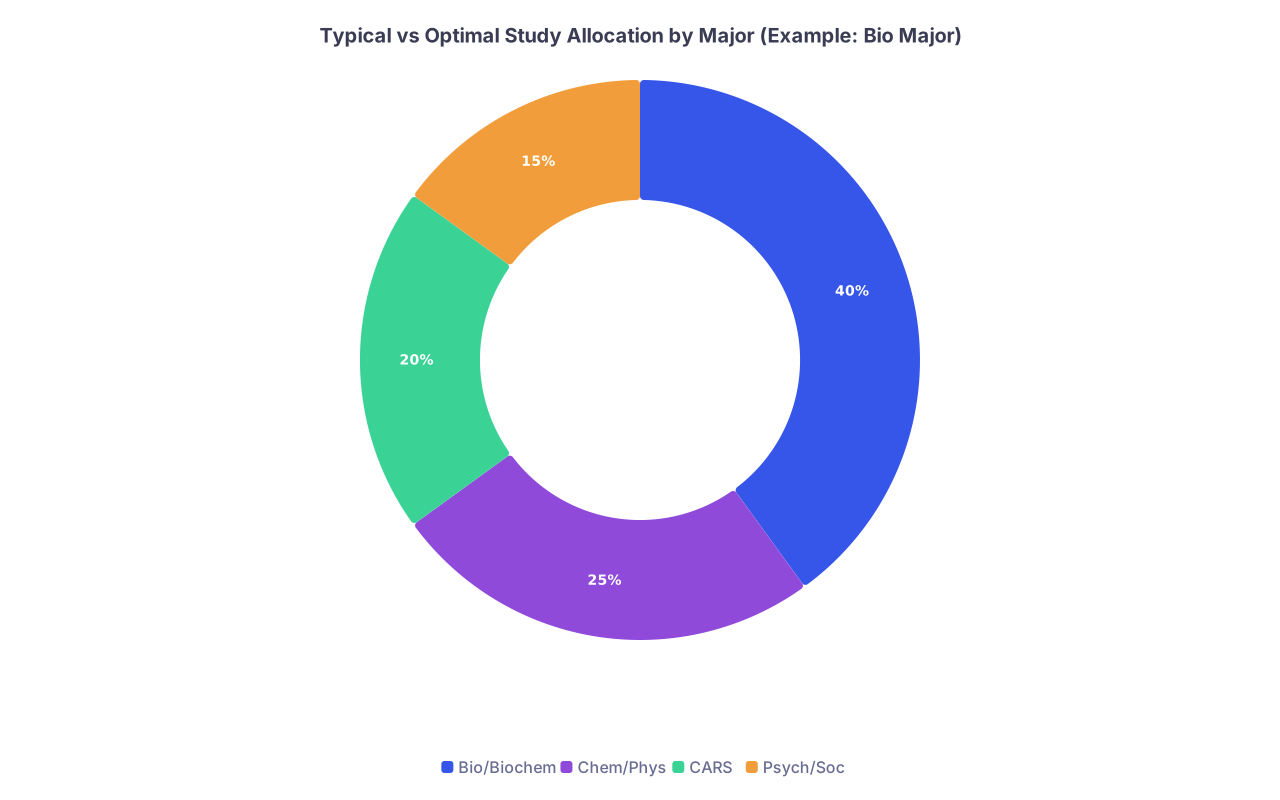
| Category | Value |
|---|---|
| Bio/Biochem | 40 |
| Chem/Phys | 25 |
| CARS | 20 |
| Psych/Soc | 15 |
Imagine the chart above as the typical allocation for a biology major. The optimal allocation for many would tilt more toward Chem/Phys and CARS, because marginal improvements there usually move the total score more.
7. The Major Question: What Actually Matters Most?
Let me cut through the noise.
Three things drive your competitiveness far more than the name of your major:
GPA quality and trend
- A 3.8 in biology beats a 3.2 in engineering almost every day of the week.
- A rising GPA trend late in college softens earlier stumbles.
MCAT score relative to your major and context
- A 515 from a humanities major is not viewed the same as a 515 from a physics major in a vacuum—but both are clearly strong.
- A 502 from any major will limit your options brutally.
Evidence of challenge and follow-through
- Hard science coursework, upper-level classes, research, and consistent performance matter more than the precise label on your degree.
Your major is a second-order variable. It shifts the statistical distribution of your MCAT and GPA possibilities and shapes how committees read your file. It does not override the raw numbers.
8. Where Majors Truly “Outperform” on the MCAT
To answer the original question directly:
- Highest average MCAT scores tend to come from physical science, engineering, and math/statistics/CS majors.
- Middle band: biological sciences—large group, averages close to accepted applicant mean.
- Slightly lower but still strong-performing subset: social sciences and humanities, especially once you condition on those who actually apply.
But that is the 30,000-foot view. The more useful level is this:
- Quant-heavy majors buy you a natural advantage in Chem/Phys and data-driven reasoning.
- Reading- and argument-heavy majors buy you a natural advantage in CARS (and often Psych/Soc).
- Biology-centric majors buy you slightly easier entry into the Bio/Biochem content, but not a free pass.
The highest-scoring students in each major category are the ones who plug their major-specific gaps early and aggressively.

| Step | Description |
|---|---|
| Step 1 | Choose or Confirm Major |
| Step 2 | Leverage for Chem/Phys |
| Step 3 | Plan Extra Quant Training |
| Step 4 | Identify Weak Sections |
| Step 5 | Design Major-Specific Study Plan |
| Step 6 | Monitor Scores by Section |
| Step 7 | Adjust Time Allocation |
| Step 8 | Reach Target MCAT Range |
| Step 9 | Quant-Heavy Major? |
Key Takeaways
- Physical sciences, engineering, and math-heavy majors statistically outperform on the MCAT by a few points, mainly due to stronger quantitative reasoning practice and self-selection.
- Your major’s real impact is section-specific: what you study changes where your strengths and blind spots lie, not your destiny.
- The winning strategy is not chasing a “magic” major, but combining a high GPA, a major-specific MCAT prep plan, and deliberate work on your weakest cognitive skills, regardless of what is printed on your diploma.