
The AAMC is painfully predictable about one thing: the kinds of experimental graphs it loves to throw at you.
If you treat MCAT experimental design as random chaos, you will keep missing questions you are perfectly capable of getting right. Once you see the patterns in how AAMC builds graphs and data passages, the “hard” questions start looking embarrassingly routine.
Let me break this down specifically.
The Four Graph Archetypes The AAMC Reuses Constantly
Most MCAT science passages (especially Bio/Biochem and Chem/Phys) boil down to four recurring graph/data archetypes:
- Dose–response or “change vs concentration” curves
- Time-course experiments
- Before/after group comparisons (bar graphs with error bars)
- Kinetics/transport curves (hyperbolic or sigmoidal)
If you can read those fluently, you have already neutralized 70–80% of the “scary-looking” figures.
1. Dose–Response Curves
Picture the classic: x-axis is [substrate], [drug], or [inhibitor]; y-axis is “response,” “activity,” “rate,” “% of max,” or “optical density.”
AAMC toys it up with:
- Multiple lines (Control vs Treatment A vs Treatment B)
- Log scales on the x-axis
- IC50 / EC50 comparisons
- Competitive vs noncompetitive inhibitor patterns when enzymes are involved
Key mental checkpoints:
- Does the curve approach a plateau? Then you are looking at some kind of saturation (receptors or enzymes maxed out).
- Does one curve shift right without changing maximum? Classic signature of competitive effects.
- Does maximum drop while apparent affinity stays similar? Think noncompetitive / allosteric effects.
What kills people is not content. It is rushing the axes. If you do not read the units and scaling, you will answer the wrong question about the right idea.
2. Time-Course Experiments
These are the “over 60 minutes,” “over 24 hours,” “over 8 days” graphs. Usually line graphs.
Typical MCAT versions:
- Concentration of a drug or metabolite vs time
- Expression level of a protein after adding a treatment
- Bacterial or viral load vs time post-infection
You will usually get multiple conditions: untreated vs treated; knockout vs wild-type; fed vs fasted.
Questions the AAMC asks off these:
- “At what time point does the greatest difference occur between groups?”
- “Which condition returns to baseline first?”
- “Which conclusion is best supported by the data in Figure X?” (they are asking if you can correctly verbalize a trend)
The trick: ignore your mental story and follow the actual line. Students love to impose a physiology narrative that is mostly right but slightly mismatched with the graph. The MCAT punishes that.
3. Bar Graphs with Error Bars
This is the AAMC’s favorite for “interpret the statistics without doing math.”
Standard puzzle pieces:
- A few bars (2–5), each representing a group or condition
- Mean value on the y-axis
- Error bars labeled as SD, SEM, or sometimes not labeled (annoying but survivable)
- Maybe asterisks over some bars indicating significance (p < 0.05)
What they actually test here:
- Can you tell when two groups are likely different from each other?
- Does the confidence interval / spread overlap meaningfully?
- Do you understand that “statistically significant” is not the same as “biologically massive”?
MCAT-level takeaway:
- If error bars overlap a lot → you should be cautious declaring a difference.
- If the passage says “p < 0.05” between specific groups, you are allowed to treat that difference as real, regardless of whether the visual overlap looks big.
But: never infer significance that the passage does not give you. The AAMC loves wrong answer choices that over-interpret small bar differences as huge breakthroughs.
4. Kinetics and Transport Curves
These are the Michaelis–Menten, hemoglobin, and transporter graphs.
The best way to think about them:
- Hyperbolic (classic enzyme kinetics; simple carrier-mediated transport)
- Sigmoidal (cooperative binding, usually hemoglobin or something that mimics it)
Patterns the AAMC uses again and again:
- V vs [S] with different Km and/or Vmax
- Oxygen saturation vs pO₂ for oxyhemoglobin, with right/left shifts
- Facilitated vs simple diffusion: saturated vs linear relationship
If you recognize the shape and the shift, the question becomes trivial. If you treat every curved line as generic, you will burn time re-deriving what you should recognize on sight.
The Non-Negotiable Habit: Read the Axes Before the Passage
I am not exaggerating: one of the highest-yield changes you can make is this:
When a passage opens with a figure, you scan the axes and legends before you read a single word of the text.
You want a mental placeholder: “Okay, they measured fluorescence vs time for three treatment conditions.” Then, when you read the methods, every sentence now has a hook to hang on.
Common AAMC axis traps:
- Log scales on x-axis (10⁻³ to 10³) but choices talk like changes are linear
- Y-axes labeled as “% of control” or “Relative expression (fold-change)”
- Inverted axes (e.g., lower on the graph means higher pH or lower ΔG depending on context)
- Normalized data (Control set to 1.0, others relative to that)
If you do not clarify these up front, you will repeatedly misinterpret “twice as much,” “half as much,” or “no change” questions.
How the AAMC Builds Experimental Design Questions Around Graphs
They do not just show data and ask you to read it. They wrap the data into specific question archetypes. Let’s go through the main ones.
1. “Which conclusion is best supported by the data?”
This is their favorite. It looks innocent, but they expect discipline.
Steps I use and teach:
- Translate the graph into one sentence per line or bar set.
- Cross-check that against the conditions. Who got which treatment? What was actually being measured?
- For each answer choice, ask: Does this strictly follow from those sentences, or does it smuggle in an extra assumption?
Wrong answers usually:
- Go beyond what is measured (e.g., claiming “increased survival” when the graph only showed enzyme activity)
- Confuse correlation with mechanism (“X caused Y” when all we saw were simultaneous changes)
- Generalize from one cell type or condition to “all tissues” or “the whole organism”
The right choices usually:
- Are boringly modest.
- Literally restate a trend in the figure, maybe with the condition labels swapped into words.
2. “Which variable is the dependent/independent variable?”
AAMC likes to check whether you know basic experimental design language.
General rule:
- Independent variable → what experimenters change
- Dependent variable → what they measure
Graphically:
- X-axis → almost always independent (time, dosage, treatment condition)
- Y-axis → almost always dependent (signal, response, activity, concentration)
They will try to mess you up with:
- Grouped bar graphs where condition labels are on the x-axis (control, treated) and the real independent variable is something described in the passage (presence/absence of drug, etc.)
- Multi-panel figures where each panel tweaks a different independent variable
You should be able to answer: “What did they manipulate?” and “What was the readout?” in one breath.
3. “Which experimental control is missing / most appropriate?”
Control questions are absolutely core to MCAT experimental design.
You are usually staring at a bar graph or line graph and they ask what additional condition should have been included.
Standard control types you must recognize:
- Negative control: No treatment / placebo / knock-out / buffer only
- Positive control: Known stimulator or inhibitor that proves your assay actually works
- Internal control: Housekeeping gene, loading control, baseline sample
The AAMC loves to ask something like:
- A western blot figure shows protein X expression after drug Y. What control should they include? → Correct answer: probing for a housekeeping protein (like actin) to ensure equal loading.
Or:
- A graph shows fluorescence only in cells exposed to a labeled antibody. Appropriate negative control? → Cells exposed to unlabeled antibody or secondary antibody alone.
Graphically, you should be able to visualize where that control bar or line would sit. That makes it trivial to choose among look-alike choices.
4. “Which additional experiment would best test [hypothesis]?”
This is slightly upstream of graphs but still directly connected.
The AAMC passes you a pattern:
- Graph: when we add Drug A, Protein B decreases.
- Question: They hypothesize Drug A increases degradation rather than decreasing synthesis. Which experiment tests that?
You are expected to propose:
- A time-course with an inhibitor of degradation
- A pulse-chase or labeling experiment tracking synthesis rate
- A translation inhibitor (e.g., cycloheximide) with and without Drug A to see what changes
The structure is always:
- Identify current graph’s limitation.
- Suggest a more direct measurement of the mechanism they care about.
Three Example Graphs the AAMC Loves, Dissected
Let’s walk through a few archetypes and how questions grow out of them.
Example 1: Enzyme Kinetics Line Graph
Imagine:
- X-axis: [Substrate] (mM)
- Y-axis: Reaction rate (μmol/min)
- Lines: Control (no inhibitor), Inhibitor 1 (Drug A), Inhibitor 2 (Drug B)
Control: hyperbolic increase to Vmax ~100
Drug A: curve reaches same Vmax but at higher substrate concentrations (right-shift)
Drug B: curve plateaus at Vmax ~50 lower than control, with similar apparent Km
What AAMC can ask:
- “Which of the following best describes Drug A?” → Competitive inhibitor.
- “Compared to control, Drug B most likely:” → decreases Vmax, consistent with noncompetitive inhibition.
- “If the data were plotted as 1/V vs 1/[S], what would happen to the y-intercept for Drug B?” → Increase (since y-intercept = 1/Vmax).
The catch: you do not need to derive Michaelis–Menten from scratch. Recognize patterns: right-shift same max = competitive; lowered plateau = noncompetitive or uncompetitive depending on context.
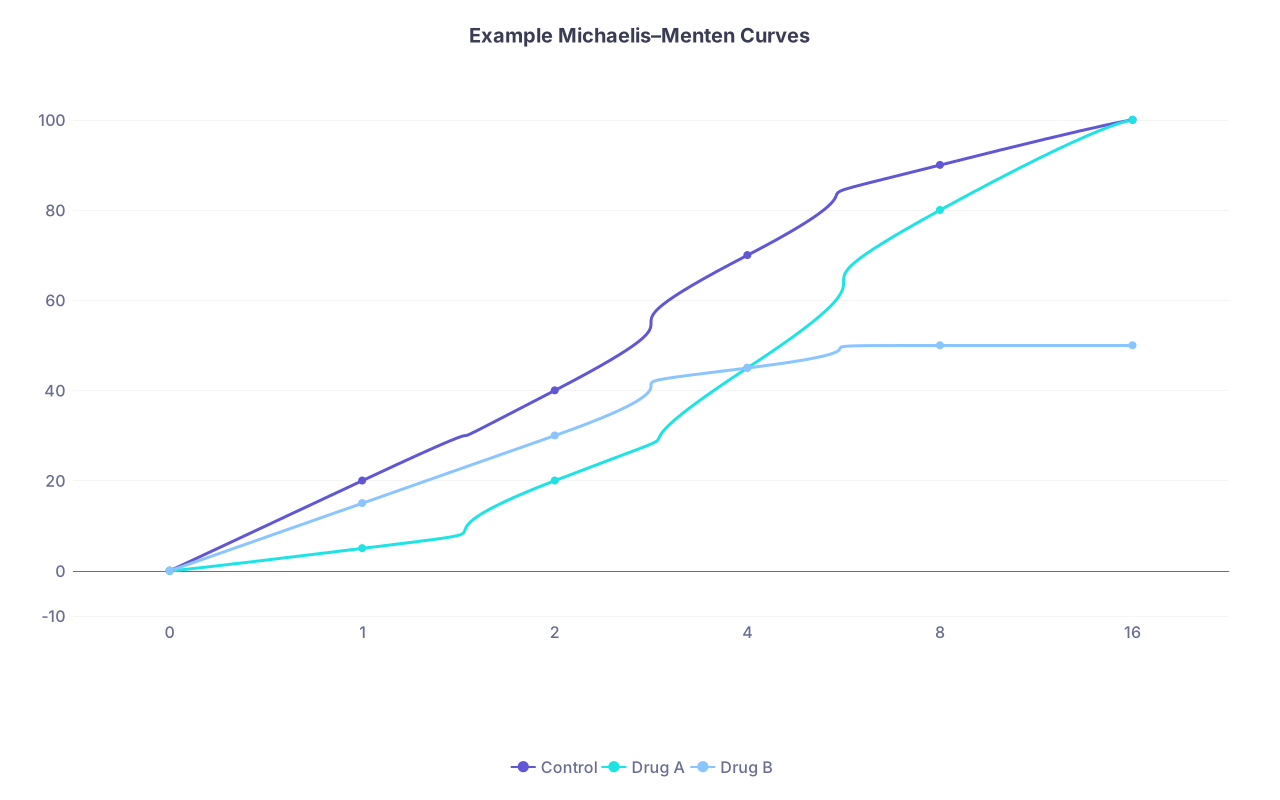
| Category | Control | Drug A | Drug B |
|---|---|---|---|
| 0 | 0 | 0 | 0 |
| 1 | 20 | 5 | 15 |
| 2 | 40 | 20 | 30 |
| 4 | 70 | 45 | 45 |
| 8 | 90 | 80 | 50 |
| 16 | 100 | 100 | 50 |
Example 2: Bar Graph with Error Bars (Expression Levels)
Set-up:
- Bars: Control, Treatment 1, Treatment 2
- Y-axis: Relative mRNA expression (fold change)
- Control = 1.0
- Treatment 1 = 2.0 ± 0.2
- Treatment 2 = 0.5 ± 0.1
Common question frames:
- “Which group shows a significant decrease relative to control?” → Treatment 2.
- “Which conclusion is most consistent with the data?” → Treatment 1 upregulates transcription; Treatment 2 downregulates.
- A wrong answer: “Treatment 1 doubles protein levels” – but the graph only measured mRNA, not protein.
So you watch for:
- Expression vs activity vs amount vs localization.
- Whether the outcome is about mRNA, protein, enzyme activity, or a phenotypic effect.
AAMC loves to test whether you know that “increased mRNA” does not automatically equal “increased protein function” without additional evidence.
Example 3: Hb–O₂ Dissociation Curve
Classic MCAT trap.
X-axis: pO₂ (mmHg)
Y-axis: % saturation of hemoglobin with O₂
Curves:
- Normal adult Hb at pH 7.4
- Right-shifted curve (pH 7.2, high CO₂, high temperature, high 2,3-BPG)
- Maybe a fetal Hb curve left-shifted
Expected questions:
- “At pO₂ of 40 mmHg (tissues), which condition has the lowest O₂ saturation?” → Right-shifted.
- “Which statement explains the physiological advantage of the fetal curve?” → Higher affinity promotes O₂ transfer from maternal to fetal blood.
- “Which of the following would cause a rightward shift of the curve shown?” → Increased PCO₂, increased temperature, decreased pH.
The graph is the same story every time: Tissues vs lungs, loading vs unloading. Once you fix that in your head, you can usually answer without re-reading the figure in depth.
AAMC-Style Experimental Flowcharts
Many passages essentially walk you through a sequence of experimental steps that generate the graphs. If you can “see” the flow, the figures stop being random.
Here is how that usually looks, abstracted:

| Step | Description |
|---|---|
| Step 1 | Hypothesis |
| Step 2 | Choose model system |
| Step 3 | Manipulate variable (drug, knockout, condition) |
| Step 4 | Measure outcome (activity, expression, signal) |
| Step 5 | Plot data (graph or table) |
| Step 6 | Interpret pattern |
| Step 7 | New hypothesis or follow-up experiment |
The MCAT question bank is built off that pipeline. They can target any step:
- Was the hypothesis reasonable given background?
- Did they pick a suitable model (yeast vs mouse vs human cell line)?
- Were proper controls included?
- Does the graph actually show what they claim?
- What is the best follow-up?
If you mentally overlay this flow onto every passage, the “random” experimental descriptions start to look very systematic.
How to Practice Graph Interpretation the Right Way
Most students “practice” by skimming graphs then rushing to the questions. That is like training to be a surgeon by watching YouTube clips at 2x speed.
Do this instead, at least for 10–15 passages per section early in your prep:
- Cover the questions.
- Slowly read the passage and annotate the experiment:
- What is the question?
- What is independent vs dependent?
- What are the controls?
- For each figure, write a one-sentence summary:
- “Figure 1: Dose-dependent increase in X with Y treatment, plateauing at high dose.”
- Predict 1–2 likely questions:
- “They will ask if the treatment is saturable”
- “They will ask for a control or mechanism”
Then uncover the questions and see how close you were. You are training pattern recognition, not just brute-force content recall.
You should also occasionally drill just figures:
- Take standalone graphs from AAMC materials or high-quality third-party sources.
- Without the text, identify independent/dependent variable, likely hypothesis, and a plausible conclusion.
Over time, you will see the same shapes and tricks come back again and again.
Specific MCAT Pitfalls With Data and Graphs
Let me call out the patterns that hurt people repeatedly.
1. Confusing statistically significant with biologically huge
The MCAT will happily show you a minuscule change (like 1.0 to 1.1) with p < 0.01 and a big change (like 1.0 to 1.5) that fails to reach significance.
You are supposed to:
- Accept the small change as “real but maybe modest”
- Refuse to over-interpret the large-but-nonsignificant difference
If an answer choice says “no difference” when p > 0.05, that is often the correct interpretation, even though your eyes see tall vs short bars.
2. Ignoring sample size
Sometimes they quietly give n = 3 vs n = 500 in different experiments.
- Tiny n with big effect size → result may be unstable, large error bars, need replication
- Large n with small but consistent effect → easier to reach significance
You are not doing heavy stats on the MCAT, but you are expected to grasp that a figure with n = 2 per group is weaker than one with n = 100.
3. Getting seduced by mechanistic explanations
AAMC loves distractor answers that sound mechanistically brilliant but have weak support from the graphs. The correct answer is usually:
- Closest to what was literally measured
- Least speculative about unseen pathways
The exam is not rewarding you for creative pathways. It rewards you for disciplined, almost boring, empiricism.
How to Turn This Into a Study Plan (Concrete)
If you are serious about mastering “Experimental Design on the MCAT,” here is what I would do over 2–3 weeks:
Create a graph bank.
From AAMC Section Bank, Question Packs, and full-lengths, screenshot or print every figure-related question you miss or feel slow on.Sort by archetype.
Put them into piles: dose–response, time-course, bar graphs with error bars, kinetics/transport, others (odd one-offs like ROC curves or survival curves, which are rarer).For each archetype, write a one-page “pattern sheet.”
Include:- Typical axis labels you have seen
- What the common wrong inferences were
- What the AAMC actually asked
Drill recognition.
Once or twice a week, flip through 10–15 images and, in 5–10 seconds each, identify:- The graph type
- Independent/dependent variables
- One likely conclusion
Integrate with full-lengths.
During full practice exams, enforce the “axes first” rule. Every time a figure appears:- Read the axes and legend fully
- Glance at the overall shape
- Only then read the passage paragraph that introduces it
This is not glamorous studying. But it is the kind that quietly adds 3–5 raw questions to every science section because you stop bleeding points on misread data.
| Graph Type | What AAMC Usually Tests |
|---|---|
| [Dose–response curve](https://residencyadvisor.com/resources/mcat-prep/amino-acid-questions-on-the-mcat-high-yield-patterns-and-shortcuts) | Saturation, inhibitor type, EC50 |
| Time-course line graph | Treatment effects over time, trends |
| Bar graph + error bars | Controls, significance, comparisons |
| Enzyme kinetics curve | Km/Vmax changes, inhibition class |
| Hb–O₂ curve | Affinity shifts, pH/CO₂ effects |

Final Thoughts
The AAMC is not creative with graphs. It is disciplined and repetitive.
Three points to remember:
- Most figures fall into a small set of archetypes you can recognize on sight: dose–response, time-course, bar + error bars, kinetics/transport.
- Read axes and legends before the passage, translate each figure into one plain-English sentence, and pick conclusions that stay inside the data.
- Build a personal graph bank and drill recognition; you are training yourself to see patterns the way the AAMC writes them, not the way your textbook presents them.
If you get those right, “experimental design” stops being a vague fear and becomes one of the most reliable parts of your MCAT score.