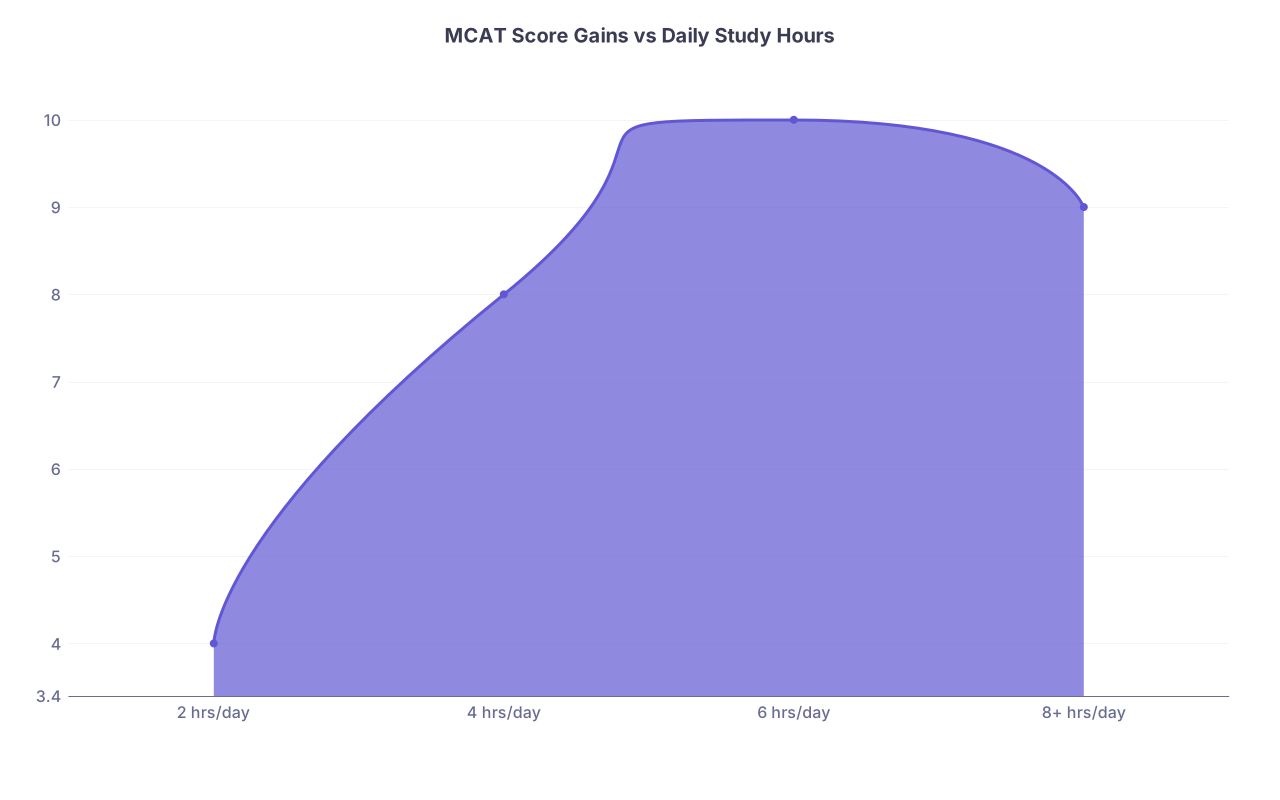
The psych/soc research vignettes on the MCAT are not testing “psychology.” They are testing whether you can smell bad study design from a mile away.
Let me break this down very specifically.
Most students read these passages like content questions with extra words. The test writers wrote them as little landmines of design flaws, subtle statistics, and tricky wording that separates shallow memorizers from people who actually understand research.
You want to be in the second group.
The Core Pattern: Every Vignette Is Really 3 Questions in Disguise
Whether the passage is about social anxiety in college students or stereotype threat in surgeons, the MCAT is usually probing three things:
- Do you recognize study design structure?
- Do you understand measurement and variables?
- Do you interpret results and limitations correctly?
Almost every “research methods” question hangs off one of those.
To make this concrete, I will walk you through:
- How MCAT writers typically structure psych research vignettes
- The common design tricks they use
- The variable/measurement traps
- The statistics-lite questions that still trip people up
- A practical attack plan you can apply to any passage
We will stay very close to what you actually see on test day.
1. How MCAT Psych Vignettes Are Built
These are not random stories. They follow recognizable templates.
The Three Classic Vignette Templates

Most MCAT psych vignettes fall into one of these shapes:
Simple observational correlation
Example skeleton:
- “Researchers surveyed 500 adults about X and Y…”
- No random assignment
- Usually one-time measurement
- Outcome: correlation, association, odds ratio, or mean difference between naturally occurring groups
What they are really testing:
- Can you refrain from saying “cause”?
- Can you identify confounders and alternative explanations?
- Can you identify study type (cross-sectional vs cohort, etc.)?
Basic experiment with manipulation
Example skeleton:
- “Participants were randomly assigned to receive intervention A or B…”
- There is a clear independent variable (IV) manipulated by researchers
- You usually see pre/post tests or between-group comparisons
What they are really testing:
- Can you spot random assignment vs random sampling?
- Can you differentiate control vs experimental conditions?
- Can you identify whether results support a causal claim?
Longitudinal / follow-up / repeated measures
Example skeleton:
- “Participants were followed for 5 years…”
- “They completed the same survey annually…”
- Or: same group, multiple time points, sometimes with an intervention during the interval
What they are really testing:
- Can you distinguish cross-sectional vs longitudinal?
- Do you understand attrition bias, cohort effects, and practice effects?
- Can you track which variables change over time and which are fixed?
If you train yourself to identify which skeleton you are dealing with by the end of the first paragraph, the later questions become painfully predictable.
2. The Design Tricks: How They Try to Confuse You
The MCAT does not use complicated stats. It uses simple designs disguised by messy wording.
Let us go through the most common tricks I see over and over.
Trick #1: Sloppy Causal Language in Observational Designs
MCAT writers love to give you an obviously correlational study and then drop a tempting causal phrase in the stem or answer choices.
Example pattern:
- Passage: “Researchers surveyed high school students about time spent on social media and self-reported depressive symptoms.”
- Actual design: cross-sectional, no manipulation, no random assignment.
- Bad answer choice they want you to reject: “The study demonstrates that social media use causes depression.”
- Better answer choice: “The study suggests an association between social media use and depressive symptoms, but cannot establish causality.”
Rule: If there is no random assignment to conditions, you do not claim causality. Full stop.
Common MCAT phrasing red flags:
- “leads to”
- “results in”
- “causes”
- “is due to”
You can say:
- “associated with”
- “linked to”
- “correlated with”
- “predicts (statistically)”
But not “causes,” unless the design earned it.
Trick #2: Random Sampling vs Random Assignment
This is a favorite distinction they weaponize.
- Random sampling: how you pick people from the population
- Random assignment: how you assign participants to groups/conditions
Only random assignment supports causality within an experiment. Random sampling helps with generalizability but not causality.
Quick example:
“Researchers randomly selected 300 adults from a city registry. Those who reported insomnia were compared with those without insomnia on measures of anxiety.”
Students see “randomly selected” and think “experimental.” Wrong. No one was assigned to “insomnia” or “no insomnia”. That is observational.
Correct thinking:
- Random sampling → better external validity (sample may better represent population)
- Still correlational → cannot infer cause
If a question asks: “Which study design best describes this research?” the correct answer is some kind of observational or cross-sectional, not “randomized controlled experiment.”
Trick #3: Matching vs Randomization
Sometimes they match groups (age, sex, SES) and then try to lure you into over-calling the control of confounding.
Example:
- “The researchers created two groups that were matched on age, sex, and income. One group had a diagnosis of major depressive disorder; the other did not.”
- Then they measure outcomes like memory performance.
Key point: Matching controls for specific variables. It does not remove every confound.
So when an answer says “matching fully controlled for confounding variables,” that is incorrect. It controlled only the ones they matched on.
Better answer: “Matching reduces the influence of age, sex, and income as confounders, but other unmeasured variables could still bias results.”
Trick #4: Between-Subjects vs Within-Subjects Confusion
This one gets people when they are tired.
- Between-subjects: Different people in each condition
- Within-subjects (repeated measures): Same people in all conditions
MCAT vignettes often describe something like:
“Participants first completed a baseline assessment, then watched a stressful video, then completed the assessment again.”
That is a within-subjects design (repeated measures). Each person is their own control. Main issues:
- Practice effects
- Fatigue effects
- Carryover from previous conditions
You will see questions like: “Which of the following is a potential limitation of this design?” and correct answers will mention:
- Order effects
- Participants improving due to familiarity with test
- Changes over time unrelated to the manipulation
If instead you see:
“Participants were randomly assigned to either the stressful video group or the neutral video group and then completed the assessment once.”
That is between-subjects. Limitations are different:
- Group differences at baseline
- Need larger sample sizes
- Individual variability masks effects
Trick #5: Convenience Samples Misused
Psych studies in vignettes almost always use convenient populations:
- “Undergraduate volunteers from a university”
- “Students recruited from an introductory psychology course”
- “Patients from a single clinic”
Then a trap answer choice will claim: “Therefore, the study’s findings can be generalized to all adults in the United States.”
No. That is overgeneralization. The correct perspective:
- Internal validity: maybe acceptable (if design is strong)
- External validity: limited to populations similar to the sample
If the question asks about generalizability, you should be thinking:
- How were participants recruited?
- Is the sample representative or biased?
Red flags: one city, one school, one clinic, one demographic.
3. Variable Games: IVs, DVs, Confounders, Moderators, Mediators
If you cannot label variables correctly, the rest of the questions will be noise.
The Four Workhorse Roles
Quick, clean definitions in MCAT language:
- Independent Variable (IV): The variable the researchers manipulate or define as the main predictor.
- Dependent Variable (DV): The outcome they measure.
- Confounder: A variable related to both IV and DV that can create a false association.
- Moderator: A variable that changes the strength/direction of the relationship between IV and DV. “For whom / under what conditions?”
- Mediator: A variable that explains how or why the IV affects the DV. “Through what mechanism?”
The test loves mixing moderator vs mediator.
Example they might use:
“Researchers study the relationship between socioeconomic status (SES) and depression. They hypothesize that access to mental health resources explains this relationship.”
- IV: SES
- DV: Depression
- Mediator: Access to resources (SES → resources → depression)
If instead they say:
“They hypothesize that the relationship between SES and depression differs based on level of social support.”
- IV: SES
- DV: Depression
- Moderator: Social support (relationship stronger for those with low support, weaker for high)
So:
- Mediator: in the causal pathway
- Moderator: alters the pathway’s strength, not in the middle of it
MCAT questions about this are usually very literal. The passage practically says “explains” (mediator) or “changes the strength of the relationship” (moderator).
Operationalization and Construct Validity Tricks
Psych vignettes love to bury you with scales and questionnaires.
Example flavor:
“Researchers assessed self-esteem using a 5-item Likert scale where higher scores indicated greater self-esteem.”
They will then ask:
- Is this a valid measure?
- Is it reliable?
- What type of variable is this?
Things to watch:
Scale type
- Likert items: technically ordinal
- Often treated as interval for analysis, but conceptually, order is what matters
- MCAT usually cares more about concept than strict stats detail
Construct validity: Does the scale actually measure the construct it claims to?
- Poor validity example: measuring “aggression” only through self-report of “I rarely get angry,” with no behavioral observation. That is narrow and likely biased.
- Better measures use multiple items and sometimes multiple methods (self-report + observation)
Reliability: Is the measure consistent?
- Internal consistency (items on a scale correlate)
- Test–retest (same scale, same person, similar results over time)
If a question asks “Which change would most improve the reliability of this measure?”, the right answer usually involves:
- Adding more items that measure the same construct
- Improving clarity of items
- Standardizing administration
If it asks about validity, the right answer involves:
- Using multiple methods
- Comparing to gold-standard measures
- Ensuring items actually tap the construct, not something else
4. Statistics Lite: What They Actually Expect You to Do
You will not be asked to run an ANOVA. But you are expected to interpret tables and graphs more intelligently than a casual reader.
Common MCAT Statistical Patterns
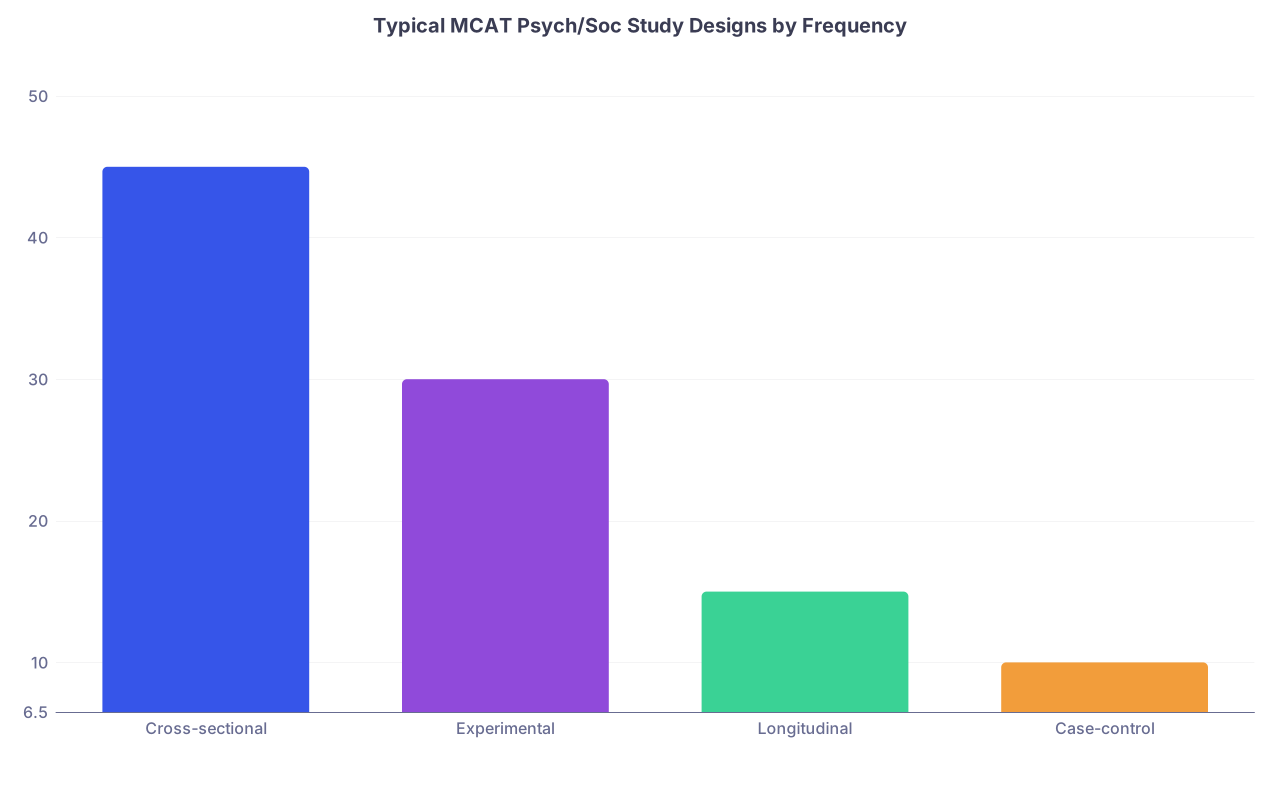
| Category | Value |
|---|---|
| Cross-sectional | 45 |
| Experimental | 30 |
| Longitudinal | 15 |
| Case-control | 10 |
This is approximate, but you get the idea: cross-sectional and simple experiments dominate.
You must be comfortable with:
Means and standard deviations:
- Larger SD → more variability
- Overlapping means with large SDs → weak/uncertain difference
Statistical significance language:
- “p < 0.05” → conventionally considered significant
- But MCAT cares more about logic than actual p-values. If a question asks whether the data “support” a claim, check patterns, not just stars on a table.
Correlations:
- Positive vs negative
- Magnitude (r = 0.8 vs r = 0.1)
- Correlation ≠ causation (again and again)
Groups and conditions:
- Always identify which group is which (control, treatment, baseline)
- Many incorrect answers simply reverse the direction or mix up which group had which outcome
Typical Table Trick
They will give something like:
| Group | Mean Anxiety Score | SD |
|---|---|---|
| Control | 15 | 4 |
| Mindfulness Training | 10 | 3 |
| Mindfulness + Exercise | 8 | 2 |
Then ask:
“Which conclusion is best supported by the data?”
Tempting but wrong:
- “Mindfulness training alone is more effective than the combined intervention.” (False, 10 vs 8)
Better:
- “Participants receiving both mindfulness and exercise had the lowest average anxiety scores.”
Or:
“If the researchers wanted to test whether the combined intervention is significantly more effective than mindfulness alone, which analysis would be most appropriate?”
You do not need to name a specific test like “independent samples t-test,” but if that is an answer, it is probably the right tier of thinking: comparing means between two independent groups.
5. Common MCAT Design Archetypes in Psych/Soc
Let us walk through a few actual “shapes” you will see, and how the exam will attack them.
Archetype 1: Lab-Based Social Psychology Experiment
Structure:
- College students
- Randomly assigned to condition A vs B
- Short, artificial task (e.g., a simulated game, priming task, or staged interaction)
- Measured attitude, bias, or performance
Typical questions:
- Identify IV/DV
- Causality: can they say condition caused difference in outcome?
- Confounds: Did they control for differences between groups?
- Ethical: deception, debriefing, minimal risk
Trap:
- Confusing a manipulation with a measured variable.
Example: “Participants’ trait anxiety was assessed using a questionnaire, then they were given feedback that was either positive or negative.”- Manipulated IV: feedback valence (positive vs negative)
- Measured predictor: trait anxiety (could be another IV or covariate)
The passage can use both; you must be precise about which is which.
Archetype 2: Survey-Based Social Epidemiology Study
Structure:
- Large sample via survey
- Multiple self-report measures (income, education, health status, stress)
- Maybe some follow-up, but often cross-sectional
Typical questions:
- Cross-sectional vs longitudinal
- Correlation vs causation
- Confounders: SES, age, gender, etc.
- Sampling bias and generalizability
Trap:
- Inferring time order that is not stated. If they surveyed at one point in time, you do not know which variable came “first,” so causal language becomes even more suspect.
Archetype 3: Longitudinal Developmental Study
Structure:
- Children or adolescents followed for years
- Repeated measures of cognitive, emotional, or social variables
- Maybe an intervention in between
Typical questions:
- Attrition and selection bias: who drops out?
- Cohort effect: do results generalize to kids from other time periods or cultures?
- Practice effects from repeated testing
Trap:
- Mislabeling as cross-sectional if you miss the “over 5 years” or “annually” phrase.
- Overgeneralizing results across age groups not actually studied.
6. Step-by-Step Attack Plan for Any MCAT Psych Research Vignette
Let me give you a way to mechanically process these passages under time pressure.

| Step | Description |
|---|---|
| Step 1 | Read first paragraph |
| Step 2 | Experimental |
| Step 3 | Observational |
| Step 4 | Label IV and DV |
| Step 5 | Scan for sample and recruitment |
| Step 6 | Identify measures and scales |
| Step 7 | Check tables/figures for patterns |
| Step 8 | Answer questions: design, variables, limits |
| Step 9 | Identify design |
Use this sequence:
First paragraph: classify the design
Ask: Is there random assignment to conditions? Is something manipulated?
- Yes → experimental
- No → observational (cross-sectional, case-control, cohort, etc.)
Highlight the key variables
- What is being manipulated or emphasized as the predictor? (IV)
- What is being measured as the outcome? (DV)
- Any obvious potential confounders mentioned? (age, SES, gender, baseline differences)
Mark the sample characteristics
Quickly note: who, where, how many, and how recruited.
This will rescue you on later generalizability and bias questions.
For any scales or questionnaires
Underline:
- How many items?
- What is the response format? (Likert)
- Does the passage give any info about reliability/validity (e.g., “previously validated”)?
When you hit the table or figure
Do not read everything line by line. First:
- Identify: what is on x-axis / y-axis or columns / rows?
- Map each line or bar to a group/condition.
- Look for large, clear differences first.
Question triage
The questions will fall into a few buckets:
- Design/causality type
- Variable roles (IV, DV, mediator, moderator, confounder)
- Measurement and validity
- Ethics
- Basic statistical interpretation
Recognizing which bucket a question belongs to lets you ignore irrelevant passage details.
7. A Quick Worked Example (Abstracted to MCAT Level)
Imagine a passage describes:
- 200 undergraduate students
- Randomly assigned to either:
- Group 1: read an article about high rates of campus crime
- Group 2: read a neutral article about campus events
- After reading, all complete a questionnaire rating perceived personal safety on a 1–7 scale.
Then a table:
| Group | Mean Safety Score | SD |
|---|---|---|
| Crime Article | 3.2 | 1.0 |
| Neutral Article | 5.6 | 1.2 |
What do I expect the MCAT to ask?
Design type
Correct: randomized experimental design, between-subjects.
Causality question
Supported claim: Exposure to crime-related information reduced perceived safety, relative to neutral information.
Not supported: “Reading crime-related articles causes increased actual crime rates on campus.”Distinguish perceived safety (DV) from real-world events (not measured).
Variable role question
If they mention “trait anxiety was measured and found to strengthen the effect of article type on perceived safety,” trait anxiety is a moderator.
Measurement question
If they ask how to improve measurement of perceived safety:
- Better answer: use multiple items (different questions tapping safety) and create a composite score.
- Bad answer: switch to a yes/no question; that reduces information.
Generalizability question
If a choice says “The results can be generalized to all adults in the country,” that is unjustified. Undergraduate convenience sample only.
That is the exact level of reasoning the exam wants. No more, no less.
8. How to Practice This Efficiently
You do not need to hunt PubMed for real papers. Use your MCAT materials, but interact with passages differently.
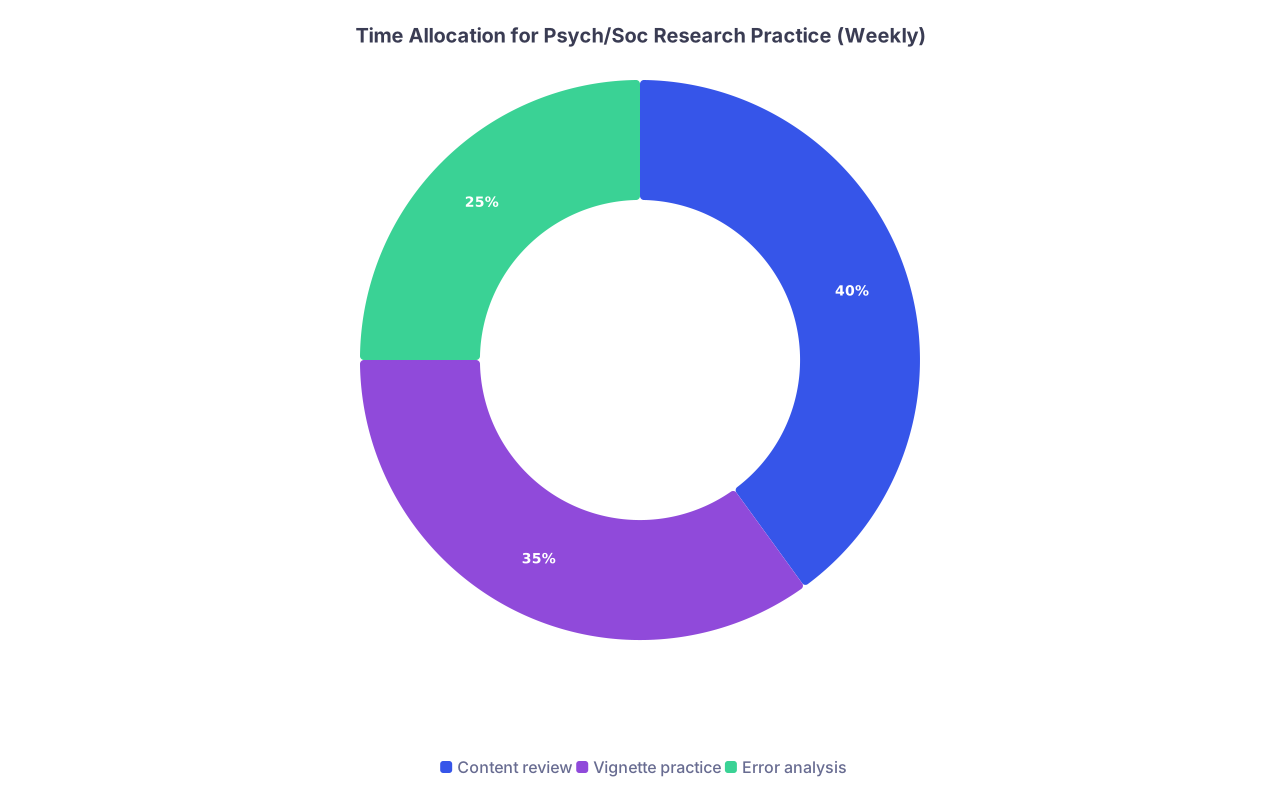
| Category | Value |
|---|---|
| Content review | 40 |
| Vignette practice | 35 |
| Error analysis | 25 |
When you see any psych/soc passage:
Before answering questions, write in the margin (or in your head under timed practice):
- Design type
- IV(s)
- DV(s)
- One likely confound or limitation
When reviewing, do post-mortems on wrong answers:
- Was the issue causality wording?
- Did you mislabel a variable?
- Did you miss the sample description and overgeneralize?
Occasionally, take a passage and:
- Rewrite the study as an experiment if it was observational
- Or as observational if it was experimental
This forces you to internalize what structural changes alter what you can conclude.
Turn tricky stems into “rules” you recognize
Example: You miss a question because you fell for “random sample” = experiment. Translate that into a mental post-it:- “Random sampling ≠ random assignment. Only assignment gives causality.”
You will start to see the same six or seven tricks on repeat.
9. One Last Layer: Ethics and Feasibility
Psych research vignettes sometimes sneak a basic ethics or feasibility question:
- Can you withhold treatment?
- Is deception acceptable?
- Do you need informed consent?
- Is it realistic to randomly assign people to this condition?
Quick sanity checks:
- You cannot ethically assign people to harmful long-term conditions (e.g., “randomly assign to smoke for 10 years”). That has to be observational.
- Deception is allowed in minimal-risk social psych studies if:
- Participants are debriefed
- Risks are low
- You always need informed consent, except in specific, limited settings (e.g., certain field observations where no identifying information is collected and risk is minimal). The MCAT keeps this simple.
If a question asks which proposed modification “would be most ethical” or “feasible,” pick the option that:
- Protects participants from harm
- Does not require impossible procedures
- Still answers the research question in a reasonable way
Key Takeaways
Psych research vignettes are design logic tests, not trivia. Spot the study type, variable roles, and whether causality is justified before you even touch the questions.
The exam reuses the same design tricks endlessly: random sampling vs random assignment, correlation vs causation, mediators vs moderators, and overgeneralizing from convenience samples.
If you systematically label design, variables, sample, and limitations for every practice passage, you stop falling for their traps and start reading these vignettes the way the test writers do.