Most students get MCAT sociology wrong for the same reason: they study definitions, but the exam tests identity and bias as tools inside messy, human scenarios.
Let me unpack that with the precision the test actually demands.
1. How the MCAT Really Tests Sociology: It Is Not a Vocab Quiz
The MCAT sociology/psych section does not care whether you memorized “stereotype” vs “prejudice” vs “discrimination” in a vacuum. It cares whether you can:
- Recognize those constructs embedded in a passage.
- Track who is doing what to whom (actor vs target).
- Infer the psychological and structural consequences.
When identity and bias show up, AAMC leans heavily on these layers:
- Individual-level bias (attitudes, attributions, microaggressions).
- Interactional-level dynamics (patient–physician, teacher–student).
- Structural or institutional bias (policies, resource allocation).
- Identity frameworks (race, gender, class, sexuality, intersectionality).
And they wrap them in passages that look “clinical” or “public health” but are, in reality, pure sociological traps. The trick is pattern recognition, not memorization.
Let’s go through the core question styles you will actually see.
2. Core Identity & Bias Concepts the MCAT Loves to Twist
Before breaking down question styles, you need brutally clear, MCAT-usable definitions. Precise enough to survive a trick answer.
2.1 The Bias Trio: Stereotype, Prejudice, Discrimination
Think of this as thought–feeling–action.
- Stereotype – Cognition. A belief about a group. Can be positive, negative, or neutral. “Asian students are good at math.”
- Prejudice – Affect/attitude. A positive or negative evaluation toward a group. “I dislike obese patients.”
- Discrimination – Behavior. Unequal treatment based on group membership. “The physician spends less time with Medicaid patients.”
AAMC’s favorite move is to give you all three in one short paragraph and see if you can separate them.
Example structure you might see:
- Nurse believes older adults are forgetful → stereotype.
- Nurse feels frustrated when assigned older patients → prejudice.
- Nurse skips detailed counseling with older adults → discrimination.
If you blur cognition vs behavior, you leak points.
2.2 Explicit vs Implicit Bias
- Explicit bias – Conscious, reportable, deliberate.
- “I do not trust undocumented immigrants.”
- Implicit bias – Automatic, unconscious associations, often contradictory to stated beliefs.
- Physician endorses equality but systematically offers fewer treatment options to Black patients.
The MCAT flags implicit bias with phrases like:
- “Unaware that…”
- “Despite endorsing egalitarian values…”
- “Without realizing…”
- “Nonconsciously…”
If the actor is aware and can state the bias, it is not implicit.
2.3 Stigma and Labeling
Two frameworks they love to integrate with identity:
Stigma – Social disapproval linked to an attribute (mental illness, HIV, obesity).
- Dimensions often invoked: visibility, controllability, treatability.
Labeling theory – Labels → internalization → self-fulfilling prophecy.
- Primary deviance (rule-breaking).
- Label applied (“troubled kid,” “drug user”).
- Secondary deviance (behaviors that confirm the label).
MCAT twist: labeling and stigma are usually mediators between identity and outcomes like school performance, treatment adherence, or health care utilization.
3. Question Style 1: Pure Concept Identification in Short Stems
These are the closest the MCAT gets to “direct” questions. No long passage, just a short scenario with 2–4 lines. The test here is: can you pin the correct construct quickly.
Example vibe (not verbatim AAMC content):
A physician believes that patients from low-income backgrounds are unlikely to adhere to treatment plans. As a result, she offers them fewer treatment options than she offers her higher-income patients.
Which concept best describes the physician’s behavior?
A. Stereotyping
B. Prejudice
C. Discrimination
D. Social reproduction
Correct: C, discrimination.
Why? The stem explicitly focuses on the unequal behavior: offering fewer treatment options. The belief (“unlikely to adhere”) is the stereotype, but that is not what the question asked.
What AAMC tests here:
- Your ability to isolate what the question is asking: belief vs feeling vs action.
- Your discipline to ignore half-true distractors: “stereotyping” is present, but not the target.
Fast rule:
- If the question stem says “behavior” or shows unequal treatment → discrimination.
- If it emphasizes “belief” or “expectation” about a group → stereotype.
- If it centers “attitude”, “liking/disliking” → prejudice.
4. Question Style 2: Passage-Based Identity Framework + Concept Match
This is the bread and butter. A passage introduces:
- A policy or program.
- A research study about disparities.
- A clinical vignette with identity dynamics.
Then questions ask you to match fragments of the scenario to theoretical concepts.
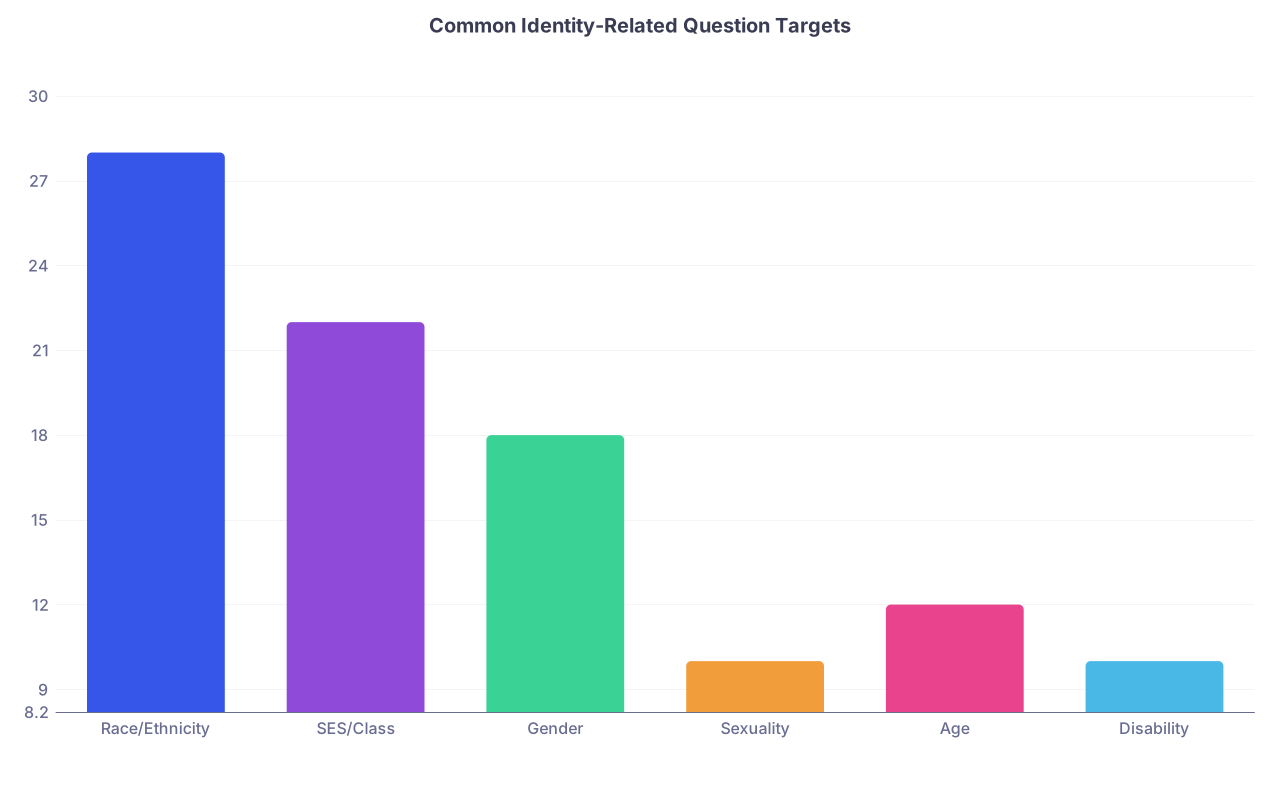
Typical identity themes:
- Racial/ethnic disparities in health outcomes.
- Gender bias in pain management.
- Socioeconomic status and health care access.
- Sexual minority stress and mental health.
- Intersectionality: e.g., Black women’s maternal mortality.
You’re not just naming bias; you’re classifying what kind and at what level.
| Category | Value |
|---|---|
| Race/Ethnicity | 28 |
| SES/Class | 22 |
| Gender | 18 |
| Sexuality | 10 |
| Age | 12 |
| Disability | 10 |
I see students mess this up with two recurring mistakes:
- They forget that the MCAT loves structural explanations.
- They default to “prejudice” for everything.
Example framework question:
A study finds that hospitals serving predominantly low-income, minority neighborhoods have fewer specialists, outdated equipment, and longer wait times than hospitals serving affluent, predominantly White neighborhoods. Researchers argue that systemic patterns in housing, zoning, and resource distribution explain these differences.
Which concept best explains the researchers’ argument?
A. Individual discrimination
B. Structural racism
C. Stereotype threat
D. Symbolic interactionism
Correct: B, structural racism.
Why:
- We are at the level of institutions, policies, and resource allocation.
- Not individual acts, not subjective meaning-making.
So the pattern:
- Focus on institutions and systems → structural/institutional discrimination, structural racism, systemic inequality.
- Focus on one-on-one interpersonal acts → individual discrimination, prejudice.
- Focus on interpretation of symbols/interaction → symbolic interactionism (way overused as a guess; usually wrong unless they explicitly mention shared meanings, symbols, or micro-level interactions).
5. Question Style 3: Stereotype Threat & Self-Fulfilling Prophecy Scenarios
These are subtle but predictable. Identity and bias are being tested through performance outcomes.
5.1 Stereotype Threat
Key signal: Performance drops when a negative stereotype about a group is highlighted or made salient.
Cues the MCAT uses:
- “Reminded of their gender/race before a test…”
- “Told that the test measures innate ability…”
- “Informed that their group typically performs poorly…”
Structure:
Group with stigmatized identity → exposed to stereotype → anxiety/self-monitoring → impaired performance.
Not to be confused with:
- Mere discrimination (being treated differently).
- Self-fulfilling prophecy via external expectations (teacher expectancy).
5.2 Self-Fulfilling Prophecy
External expectations shape behavior which then confirms the expectation.
Classic MCAT pattern:
- Teacher expects some students to be “gifted” → gives them more attention, harder material → they perform better → expectation seems “true.”
Or:
- Physician expects patient will not adhere → gives a less effective plan / less emphasis → patient indeed does poorly.
The MCAT’s favorite trick: give you both stereotype threat and self-fulfilling prophecy in the same passage and see if you can label each part correctly.
- Internalized anxiety about stereotype → stereotype threat.
- Authority figure’s expectations changing their own behavior → self-fulfilling prophecy.
6. Question Style 4: Attribution, Identity, and Blame
This is where bias hides inside explanations.
6.1 Attribution Theory on the MCAT
- Dispositional (internal) attribution – “They are lazy, careless, noncompliant.”
- Situational (external) attribution – “They lack transportation, face food insecurity, have unstable housing.”
When identity is involved, the MCAT uses attribution patterns to test bias. Think:
- Physician assumes a low-income patient’s nonadherence is due to “lack of motivation” instead of lack of money or transportation.
- Teacher interprets a Black student’s quietness as “disinterest” rather than anxiety or stereotype threat.
That’s not just attribution; it is bias in how the cause is assigned.
AAMC often layers in:
- Fundamental attribution error – Overemphasizing personality, underemphasizing situational factors.
- Actor–observer bias – Different attributions for self vs others.
Now add race, class, or gender and they are testing bias through attribution.
6.2 Question Patterns
You will see stems like:
“Which cognitive bias contributes most to the physician’s interpretation of the patient’s behavior?”
Correct answers often include:
- Fundamental attribution error.
- Confirmation bias (seeing what you expect in a stigmatized group).
- Stereotyping.
Wrong but tempting answers:
- Groupthink (if there is no group decision-making).
- Social loafing (not relevant to attribution).
- Bystander effect (off-topic).
7. Question Style 5: Identity, Intersectionality, and Health Disparities
Intersectionality is not a buzzword on the MCAT. It is a favorite conceptual anchor.
Intersectionality = multiple social identities (race, gender, class, sexuality, etc.) interact to create unique experiences of advantage or disadvantage that cannot be reduced to just “race + gender” separately.
Example pattern:
A study examines maternal health outcomes among three groups: White women, Black women, and Black transgender women. Black transgender women have the highest rates of inadequate prenatal care and pregnancy-related complications. Researchers argue that the combined effects of racism, sexism, and transphobia shape these outcomes.
Which concept best captures the researchers’ framework?
A. Social identity theory
B. Intersectionality
C. Social constructionism
D. Role conflict
Correct: B, intersectionality.
What they are testing:
- Your ability to recognize multiple interacting identities.
- Not just additive disadvantage, but qualitatively different experiences.
They love to contrast:
- Social identity theory – group membership → in-group vs out-group, self-esteem.
- Intersectionality – simultaneous, overlapping social categories structuring power and oppression.
So when you see:
- “Combined,” “overlapping,” “simultaneous inequalities” across race/gender/class/sexuality → intersectionality.
- “Belonging,” “in-group,” “out-group,” “social comparison” → social identity theory.
8. Question Style 6: Implicit Bias and Clinical Decision-Making
This is newer but has been creeping into more questions.
Setup:
- Physicians rate pain differently based on patient race.
- Clinicians underestimate symptoms in women vs men.
- LGBTQ+ patients report negative experiences and avoid care.
Then they ask:
- Which concept is illustrated?
- Which intervention would best reduce this bias?
Correct conceptual labels:
- Implicit bias.
- Stereotyping.
- Structural discrimination (if policy-level).
For interventions, AAMC leans toward:
- Perspective taking.
- Structured decision tools/standardized protocols.
- Blinded evaluations when possible.
- Training that emphasizes awareness + change of behavior, not just “increasing knowledge.”
Answers that sound pretty but are weak:
- “Encouraging clinicians to rely on intuition.” (No. This usually amplifies implicit bias.)
- “Allow clinicians complete discretion without guidelines.” (Opposite of what evidence supports.)
If the question asks how to reduce the impact of implicit bias:
- You want system-level fixes + reflective practices.
- Not just good intentions.
9. Question Style 7: Social Identity, Group Processes, and Bias
Here they care about:
- In-group favoritism.
- Out-group discrimination.
- Social categorization.
- Minimal group paradigm (grouping by arbitrary criteria still produces bias).
Typical moves:
- Students are randomly assigned to “red” and “blue” teams and then show preferential evaluation of their own team.
- Physicians show more warmth and shared decision-making with patients who share their background.
Identity question then asks:
- Which concept explains this preference?
Correct: in-group favoritism, social identity theory.
Do not overcomplicate. If you see:
- Self-esteem derived from group membership.
- Distinguishing “us” vs “them.”
- Biased evaluation favoring one’s own group.
You’re in social identity theory territory, not strictly “prejudice” alone.
10. How AAMC Embeds These in Experimental Designs
You will often get passages with actual study designs:
- Quasi-experiments on stereotype threat.
- Cross-sectional studies on health disparities by race and SES.
- Field experiments on discrimination (e.g., resumes with “White-sounding” vs “Black-sounding” names).
Your tasks include:
- Identify the independent variable – usually identity-related (race, gender, SES).
- Identify mediators – stigma, stress, implicit bias, access to care.
- Identify dependent variables – performance, health outcomes, utilization of services.
Then they hit you with classic design questions:
- Is this experimental, quasi-experimental, or correlational?
- Is this structural discrimination or individual prejudice?
- What is a likely confounder? (e.g., income when studying race, education when studying SES).

| Step | Description |
|---|---|
| Step 1 | Social Identity Variable (race, gender, SES) |
| Step 2 | Experiences of Bias (stigma, discrimination, stereotype threat) |
| Step 3 | Psychological & Behavioral Responses (stress, mistrust, adherence) |
| Step 4 | Health or Performance Outcomes |
| Step 5 | Structural Factors (policies, neighborhood, resources) |
When you train yourself to see these flows, questions become much easier because you know what role each variable is playing.
11. A Targeted Strategy to Master These Question Styles
This is not about another Anki deck of definitions. It is about pattern training.
Here is how I advise serious premeds to nail identity and bias questions:
Build a one-page “Bias Map.”
Three columns:- Concept (stereotype, prejudice, discrimination, implicit bias, stereotype threat, self-fulfilling prophecy, stigma, labeling, structural discrimination, intersectionality).
- Level (individual cognition, interpersonal, institutional, structural).
- Typical MCAT signal phrases.
Do focused practice on identity/bias questions only.
Pull 50–100 identity/bias questions from:- AAMC Section Bank (especially P/S).
- AAMC Question Packs.
- High-quality third-party banks.
Tag each question by:
- Concept being tested.
- Style (short stem vs passage, theory-matching vs mechanism).
Post-game your misses in detail.
For each wrong answer:- What exact phrase in the stem signaled the right concept?
- What trap did you fall for? (Level confusion? Bias vs stereotype threat? Individual vs structural?)
Mentally re-label the question in your own words.
I have students rewrite the stem with explicit labels:- “This is an intersectionality + structural racism question disguised as a health disparities vignette.”
- “This is stereotype threat created by priming race before the exam.”
You repeat that enough times, and identity/bias questions stop feeling like sociology and start feeling like pattern recognition—exactly what the MCAT rewards.
12. Summary Table: High-Yield Identity & Bias Constructs
| Concept | MCAT Signal / Key Feature |
|---|---|
| Stereotype | Belief/expectation about a group |
| Prejudice | Attitude/affect toward a group |
| Discrimination | Unequal treatment/behavior |
| Implicit bias | Unconscious, automatic bias influencing behavior |
| Stereotype threat | Performance drops when stereotype is made salient |
| Self-fulfilling prophecy | Expectations change behavior → confirm expectation |
| Stigma | Social disapproval tied to identity/condition |
| Structural discrimination | Policies/institutions create unequal outcomes |
13. Identity & Bias: How This Actually Shows Up on Test Day
To make this concrete, let me give you a composite of what you are up against.
You are in a P/S passage. It describes:
- A randomized study where half of minority students are asked to report their race before a standardized exam, half after.
- Scores in the “report race first” group are lower.
- Surveys show higher anxiety in that group.
- The researchers argue that stereotypes about minority academic ability are contributing.
Questions then ask:
- “Which concept best explains the lower performance?” → Stereotype threat.
- “Which variable mediates the effect of the manipulation on performance?” → Anxiety.
- “The study’s results are most consistent with which broader framework?” → Social-cognitive perspective, or sociocultural if they extend to structural implications.
Next passage: a large public hospital that primarily serves low-income minority patients has fewer specialists and worse outcomes. Researchers link these differences to historical housing policies and funding allocations.
Questions:
- “Which concept best describes the long-term effects described?” → Structural racism / institutional discrimination.
- “Which of the following interventions targets the same level of analysis?” → Changing funding formulas or policy-level interventions, not just “provider education.”
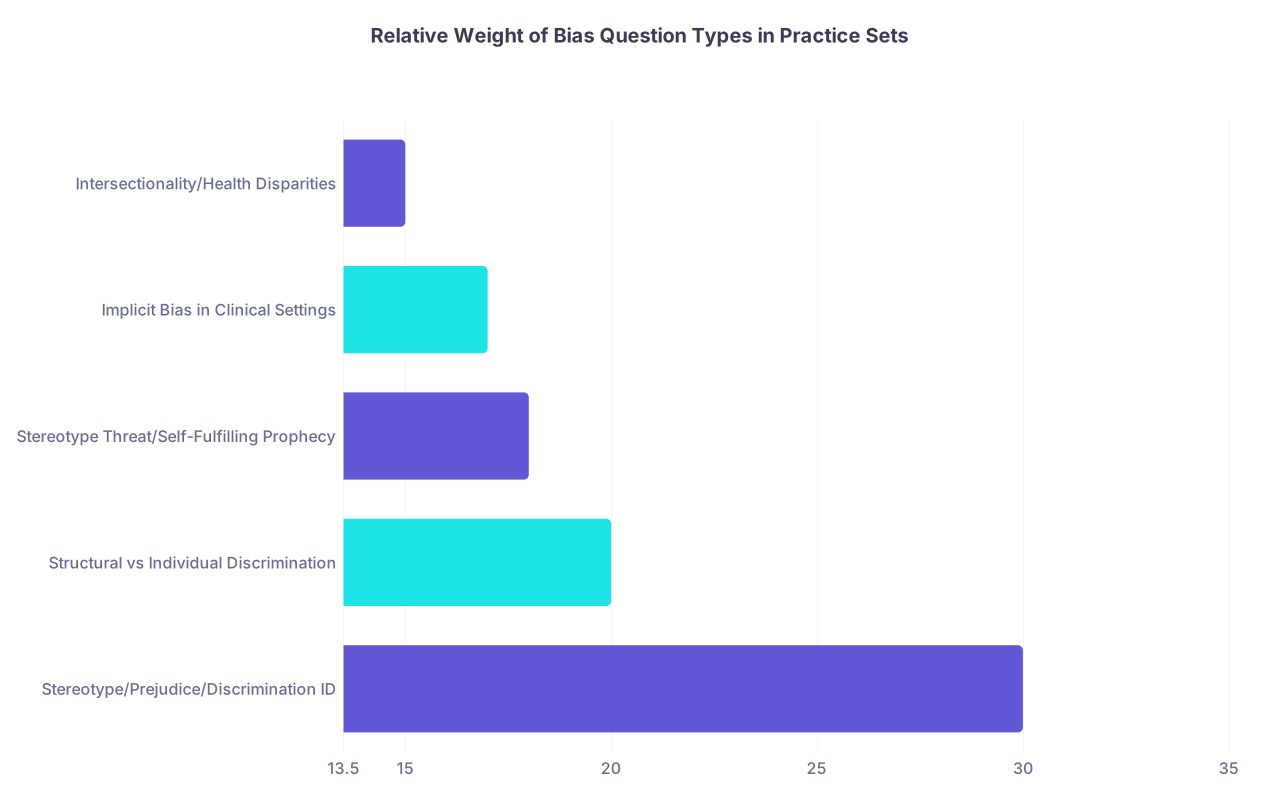
If you can read those two passages and instantly map them to:
- Stereotype threat + mediators.
- Structural discrimination + policy-level solutions.
You are playing the game correctly.
| Category | Value |
|---|---|
| Stereotype/Prejudice/Discrimination ID | 30 |
| Structural vs Individual Discrimination | 20 |
| Stereotype Threat/Self-Fulfilling Prophecy | 18 |
| Implicit Bias in Clinical Settings | 17 |
| Intersectionality/Health Disparities | 15 |
FAQ (Exactly 5 Questions)
1. Do I really need to know terms like “structural racism” for the MCAT, or is that too specific?
Yes, you do. AAMC has moved decisively toward structural and systemic explanations for health disparities. They expect you to distinguish:
- Individual prejudice/discrimination (person-level acts) from
- Structural/institutional discrimination (policy-level, resource allocation, historical patterns).
If a passage talks about zoning laws, hospital funding, or school district lines, you should be thinking structural, not individual.
2. How often does stereotype threat actually appear on the MCAT?
Often enough that ignoring it is foolish. You will not see the phrase “stereotype threat” in every exam, but the construct—groups performing worse after being reminded of a negative stereotype—shows up frequently in AAMC materials. You need to recognize the pattern, even if they hide the term and ask you to describe the mechanism (e.g., anxiety, cognitive load).
3. Is it safe to pick “implicit bias” anytime a clinician behaves unfairly but denies being biased?
Not automatically. Implicit bias is about unconscious, automatic associations. If the stem:
- Emphasizes the clinician is unaware.
- Shows systematic differences in behavior despite “egalitarian” attitudes.
Then yes, implicit bias is a strong candidate. But if the clinician clearly states negative beliefs, that is explicit prejudice plus discrimination. Read the language carefully. “Unaware,” “automatic,” and “nonconscious” are your implicit bias flags.
4. How can I quickly distinguish a self-fulfilling prophecy from stereotype threat in a question?
Ask: Who is generating the expectation, and where does the pressure come from?
- Self-fulfilling prophecy: An authority or observer holds an expectation (teacher, doctor, parent) → they change their behavior toward the target → the target’s behavior/outcome shifts to match the expectation.
- Stereotype threat: The target is aware of a negative stereotype about their own group → internal anxiety and monitoring → performance drops.
If the bias acts through the behavior of an authority figure changing, you are in self-fulfilling prophecy territory. If it acts within the targeted individual by making them anxious about confirming a stereotype, you are in stereotype threat territory.
5. What is the single best way to improve my accuracy on identity and bias questions?
Deliberate pattern practice. Do not just “do more questions.” Specifically:
- Extract 5–10 identity/bias questions at a time.
- For each, label: the main concept, the level (individual/interactional/structural), and the key phrase that signaled it.
- Keep a running cheat sheet of these signal phrases.
After 50–100 such questions, your brain will start auto-tagging patterns during new passages. That is the shift you need: from “this is a hard sociology topic” to “oh, this is another stereotype threat + structural inequality combo; I know how they write these.”
Key points:
- The MCAT tests identity and bias through scenarios, study designs, and health disparities, not isolated definitions.
- Your job is to rapidly classify which bias construct is operating (and at what level) using very specific textual cues.
- Treat these as pattern-recognition problems, train on those patterns deliberately, and you will turn one of the slipperiest sections of P/S into free points.