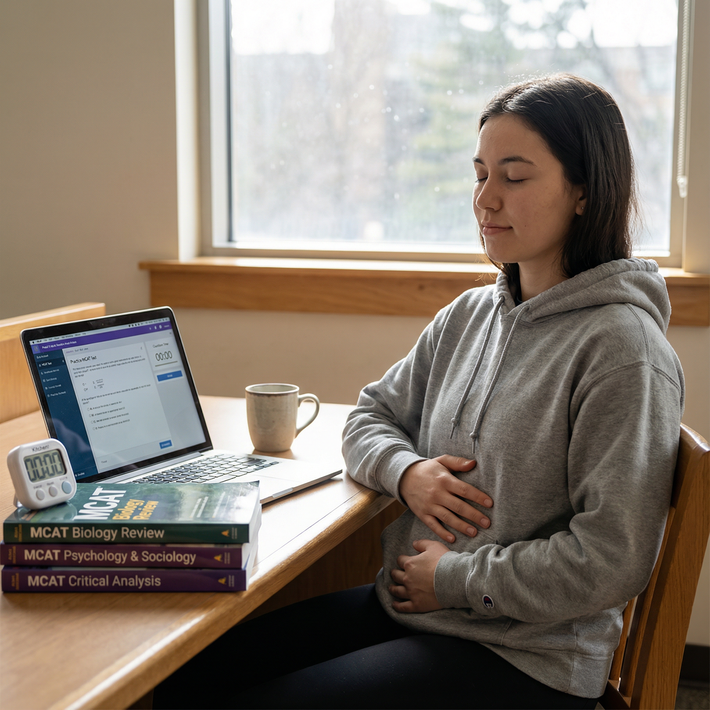
How many times have you told yourself, “I just need to review content one more time before I really start doing questions”?
If that sounds familiar, you’re exactly who this is for.
The most common MCAT myth I see is brutally simple:
“If I’m not scoring well, I need more content review.”
More Kaplan chapters. More Anki decks. More 400-page summaries of every metabolic pathway known to man.
And it feels logical. Until you look at the data.
The Content Review Trap: Why It Feels Right and Still Fails
Here’s what actually happens with a lot of people.
You buy a big-name book set. You schedule 8–10 weeks of "content review." You tell yourself you’ll start practice tests “once I’ve finished the material.” Every day: read, highlight, maybe a few end-of-chapter questions. You feel productive.
Then you take your first full-length.
Score: way lower than you expected. Panic.
Your brain’s reflex: “I must not remember enough content. Go back and review.”
That’s the trap.
Because the MCAT is not a content recall exam. AAMC tells you this openly if you actually read their design documents: it’s a reasoning-in-science test built around passages, data, and application. Content is the entry ticket, not the game.
The students I see stuck in the 496–504 range after months of “studying” almost always have one thing in common:
They’re doing way too much passive content review and nowhere near enough high‑quality practice with feedback.
Not my opinion. The data from actual score trajectories backs this up.
What the Data Actually Shows About Score Gains
Let’s start with something concrete: how students’ scores move over time.
When you track students from the beginning of their prep to their final scores, you see a pattern:
- Early content review gives some quick gains.
- Score increases slow down sharply unless practice volume and quality go up.
- Past a certain point, more content review alone is basically flat.
Here’s a simplified version of what I’ve seen in hundreds of students’ score curves (and it’s consistent with what major prep companies see internally, even when their marketing doesn’t say it out loud):
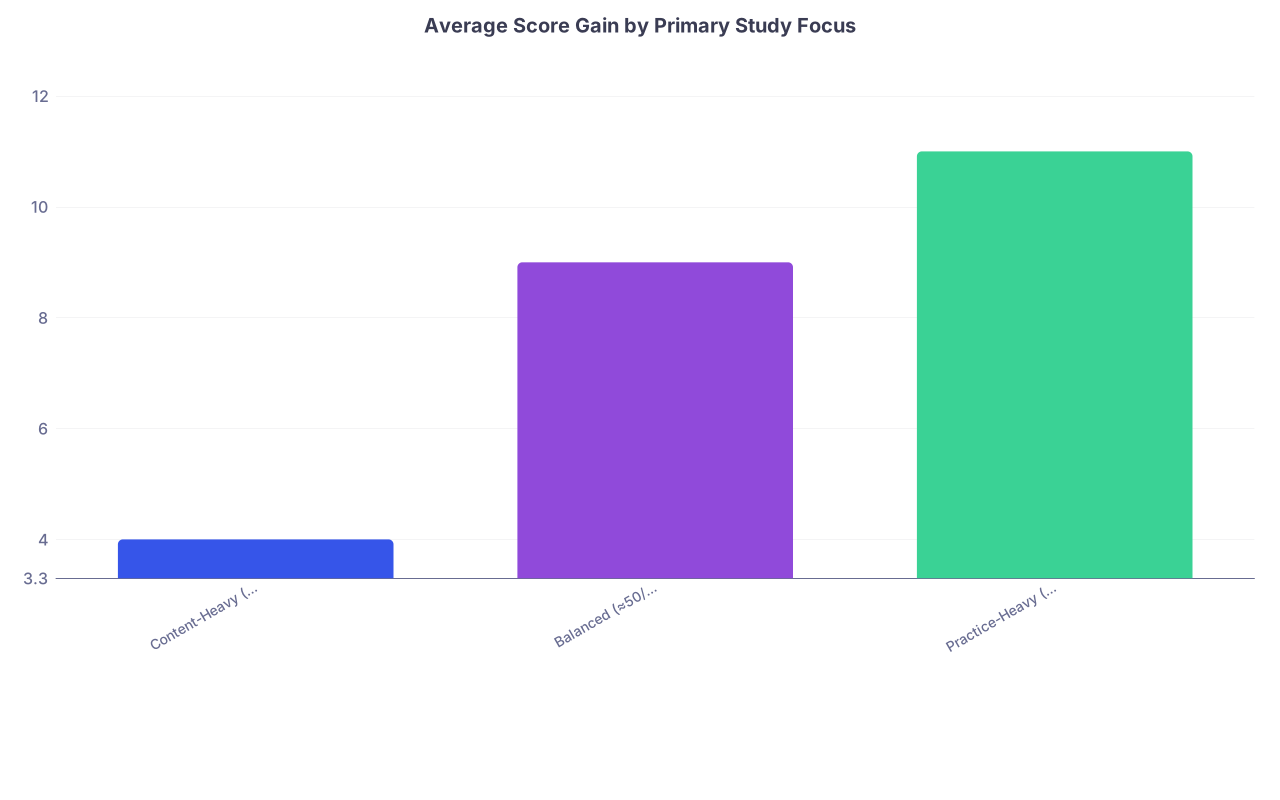
| Category | Value |
|---|---|
| Content-Heavy (70%+) | 4 |
| Balanced (≈50/50) | 9 |
| Practice-Heavy (70%+) | 11 |
Interpret that in plain English:
- Students who spend the majority of their time on content review tend to see modest improvements (around 3–5 points).
- Students who balance content with lots of timed practice and thorough review see much larger gains.
- Students who emphasize practice, with targeted content review plugged into their weaknesses, tend to see the biggest jumps.
Do not twist this into “never review content.” That’s stupid. You need a foundation.
But the belief that “more content = higher score” is linear and unlimited? That’s fantasy. The returns shrink fast.
I’ve had students read every page of Examkrackers twice, do 3,000 Anki cards, and still sit at 502 because they never learned to:
- Handle dense passages under time pressure
- Interpret figures and tables accurately
- Translate experimental setups into equations and predictions
- Eliminate attractive-but-wrong answer choices consistently
That’s not a content problem. That’s a skills, strategy, and execution problem.
How the MCAT Is Actually Built (And Why Content Review Tops Out)
Let’s pull this out of feelings and look at the exam design itself.
The MCAT blueprint (AAMC’s own documents) is explicit:
- It’s a passage-based exam
- It prioritizes scientific reasoning, data interpretation, and application
- Most questions are written at the level of “What do you do with this information?” not “What do you remember?”
Even in the allegedly “content-heavy” sections (Chem/Phys, Bio/Biochem), pure recall questions are a minority.
Rough ballpark from item analyses and representative samples:
| Section | Mostly Application/Data | Mostly Straight Recall |
|---|---|---|
| Chem/Phys | ~70–80% | ~20–30% |
| CARS | ~95% | ~5% |
| Bio/Biochem | ~70–80% | ~20–30% |
| Psych/Soc | ~60–70% | ~30–40% |
Even Psych/Soc, the section people love to brute-force with flashcards, leans heavily toward application in real AAMC material.
So what happens if your study plan is 80–90% content review?
You’re overtraining for the 20–30% of the exam that looks like discrete fact recall. And undertraining for the 70–80% that expects you to think with those facts under time pressure.
It’s like trying to become a great chess player by memorizing openings but never playing full games or reviewing your losses. You’ll crush the first 8 moves. Then flop.
Where Content Review Actually Matters (And Where It Doesn’t)
Let me be blunt: lack of content can absolutely hold you back. But it’s usually not the villain students think it is.
There are three situations where content review legitimately drives score jumps:
You’re missing foundational prerequisites.
You never really learned electrochemistry, optics, or basic genetics. Your first diagnostic is a disaster in those topics. A few focused weeks of real learning (not just reading) can move you from “random guessing” to “competent.” Big gain.You have major conceptual gaps in high‑yield topics.
Not memorizing every amino acid. I’m talking about not understanding Le Châtelier, fluid dynamics basics, enzyme kinetics, or Mendelian vs non‑Mendelian inheritance. Filling those gaps helps everything downstream.You’re transitioning from raw memorization to conceptual frameworks.
You stop memorizing every enzyme in glycolysis and instead learn: “What’s the point of this pathway? What regulates it? What happens if X enzyme fails?” That conceptual shift makes passages easier.
Now, contrast that with how most students use content review:
- Re-reading chapters they already “kind of” know
- Rewatching entire lecture series because they “don’t feel ready”
- Grinding 500+ flashcards on minor psych theories or obscure bio details
Low-yield. Anxiety-driven. Comfort work.
I’ve seen people spend 3 weeks trying to perfectly memorize every amino acid property and 15 variants of learning theory, then miss questions in those areas anyway — not because they didn’t know the fact, but because they couldn’t recognize how it was being used in the passage.
The content was in their head. It just never made it to the answer choice.
Practice vs. Review: What Actually Moves Your Score
Here’s the pattern in students who jump 10+ points:
They don’t just “do a lot of questions.” They do brutally honest, targeted, disciplined review of those questions.
That’s the part almost everyone skips. They do the passage, glance at the answer explanations, and call it done. Then wonder why their score plateaued.
The ones who improve fast consistently do things like:
- After each passage, they categorize every miss:
Content gap? Misread the question? Rushed? Misinterpreted the figure? Fell for a trap answer? - They keep a log of recurring patterns: “I keep misreading axis labels,” “I always screw up multi-step calculations under time pressure,” “I don’t map experimental design clearly.”
- For content-related misses, they go back and learn that specific concept deeply, not reread the whole chapter.
- For reasoning-related misses, they adjust their process: reading strategy, note style, timing, how they eliminate choices.
You see the difference? Same practice questions. Completely different score impact, because the review is surgical, not lazy.
And here’s the uncomfortable part: this type of work is mentally exhausting and ego-bruising. It forces you to confront exactly where you’re predictable and beatable. Content review, by contrast, feels safe.
People hide in content review because questions expose them.
Concrete Study Patterns: High vs Low Yield
Let’s compare two real-world scenarios I see all the time.
| Pattern | Time Use | Typical Outcome |
|---|---|---|
| Content-First, Practice-Late | 8 weeks content, 4 weeks practice | Small gain, plateau |
| Mixed from the Start | Content + practice every week | Steady, larger gain |
| Practice-Driven, Targeted Review | Many passages + focused review | Largest, sustained gain |
And timeline wise, it often looks like this:
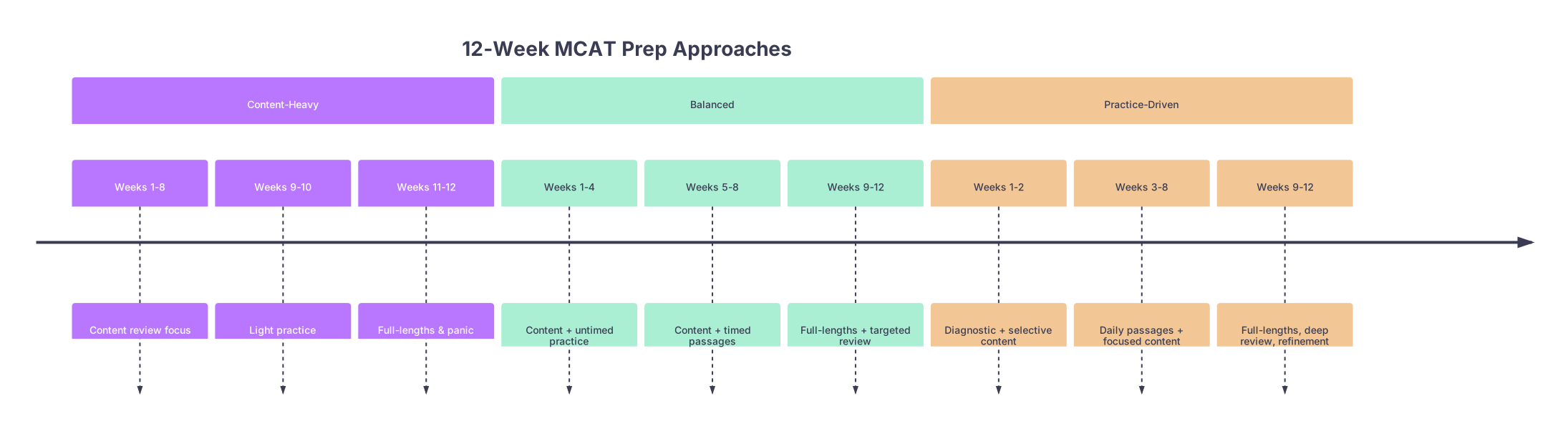
| Period | Event |
|---|---|
| Content-Heavy - Weeks 1-8 | Content review focus |
| Content-Heavy - Weeks 9-10 | Light practice |
| Content-Heavy - Weeks 11-12 | Full-lengths & panic |
| Balanced - Weeks 1-4 | Content + untimed practice |
| Balanced - Weeks 5-8 | Content + timed passages |
| Balanced - Weeks 9-12 | Full-lengths + targeted review |
| Practice-Driven - Weeks 1-2 | Diagnostic + selective content |
| Practice-Driven - Weeks 3-8 | Daily passages + focused content |
| Practice-Driven - Weeks 9-12 | Full-lengths, deep review, refinement |
I’ve watched this play out in real scores:
- Student A: 495 diagnostic → 502 after 8 weeks content → 505 after 4 weeks frantic practice. Very frustrated. “But I studied so much.”
- Student B: 498 diagnostic → starts AAMC Question Packs and UWorld in week 2, reviews misses in painful detail, uses content review only to plug holes. Ends at 511–513.
- Student C: 503 diagnostic → takes a full-length every 7–10 days for two months, reviews each over 2–3 days, tracks every error type, builds mini content reviews around patterns. Finishes at 515+.
These aren’t outliers. They’re what happens when you stop equating “MCAT studying” with “sitting in front of content.”
How to Tell If Content Review Is No Longer Your Bottleneck
You may be wondering: “So how do I know if content is really my problem or not?”
Here’s the litmus test I use when I talk to students:
If I hand you an AAMC passage on a topic you say you “know,” and you:
- Understand 70–80% of the science
- But still miss half the questions
Then your problem is not content. It’s:
- Passage mapping
- Data interpretation
- Logical precision
- Time management
- Answer-choice discipline
On the flip side, if you read a passage and you’re lost from sentence two — you don’t know the basic vocabulary, can’t follow the experiment, and the equations are unfamiliar — then yes, content gaps are killing you.
One more test: take a section bank set (AAMC SB Bio/Biochem is a good stress test). After you finish:
- Go through every missed question.
- For each one, write down the real reason you missed it.
If more than half of your errors are not “I had never seen this concept before,” then more content review is a bad investment. You’re pouring water into the wrong bucket.
The Ugly Truth: Anxiety Masquerading as Study Strategy
You need to hear this, because no one on Reddit or YouTube wants to say it plainly:
A huge portion of excessive content review is anxiety in disguise.
“I want to feel prepared before I start doing timed passages.”
“I’ll start AAMC once I’ve finished all my content so I don’t waste it.”
“I just don’t feel confident with [insert topic], so I’m going to reread it again.”
I’ve watched people “feel unready” for CARS for three months and then somehow be shocked that their CARS never improves. You don’t fix reading and reasoning by reviewing biochemistry flashcards.
Or the classic: saving AAMC materials “for when I’m finally ready.” Then they use them late, when there’s no time to actually fix what those exams expose.
Content review is controllable. Safe. It doesn’t judge you. Passages and full-lengths do. That’s why people avoid them and convince themselves they’re being “thorough.”
They’re not. They’re stalling.
So What Should Your MCAT Study Actually Look Like?
No magic formula. But here’s a pattern that works far more often than it fails:
- Use an initial 2–3 weeks for focused content foundation + light untimed practice. Not 8–10 weeks.
- By week 3–4, you’re doing daily practice passages, even if you feel “not ready.”
- You treat every practice question as data about your brain, not just a score.
- Content review becomes reactive and surgical: driven by patterns in your misses, not by vague unease.
If you want a quick mental target: by the second half of your prep, at least half of your study time should be doing and deeply reviewing questions, not reading or watching.
And if your score has plateaued for more than 3–4 weeks?
The answer almost never is, “Do more content review.”
It’s, “Change how you practice, how you review, and how honest you are about your actual weaknesses.”
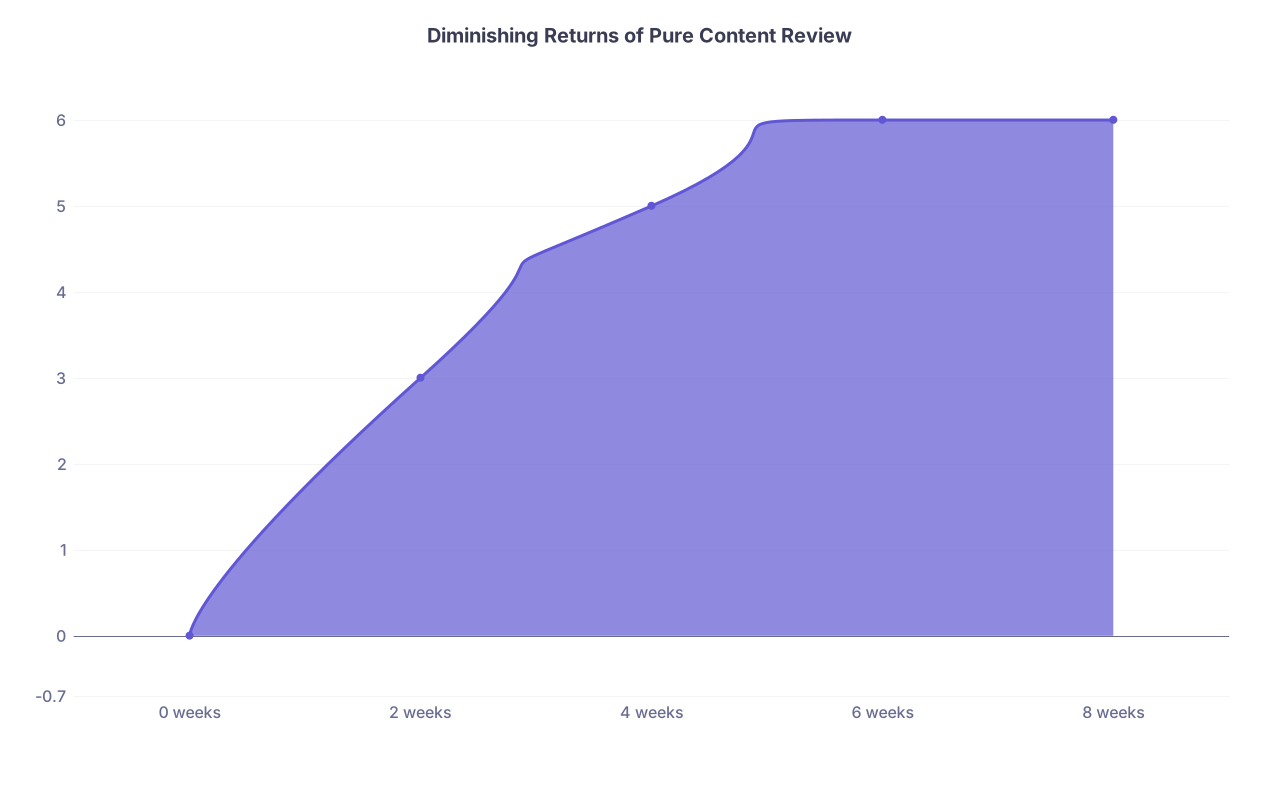
| Category | Value |
|---|---|
| 0 weeks | 0 |
| 2 weeks | 3 |
| 4 weeks | 5 |
| 6 weeks | 6 |
| 8 weeks | 6 |
Notice how gains flatten while content review continues. That’s the reality most people refuse to acknowledge.
The Bottom Line
Let me cut it down to the essentials.
- More content review does not linearly equal higher MCAT scores. It helps early, then hits a hard ceiling unless you’re doing serious, structured practice with deep review.
- Most mid-range and plateaued scores are not “content problems.” They’re reasoning, timing, and application problems disguised as “I just need to review more.”
- If you’re not improving, stop hiding in content. Increase timed practice, brutal error analysis, and targeted content repair. That’s where real score jumps come from.