
It’s late June. You’re staring at your score report: 511.
Your friend just texted you: “Omg 515!!!” Same test date. Same curve. Suddenly you’re spiraling.
Do you retake? Will top schools write you off? Are you now “mid-tier only”?
Let me tell you what actually happens in those committee rooms. Not the sanitized premed advisor version. The real version.
Because I’ve sat in rooms where entire careers get steered over a four‑point difference. Sometimes it matters. Sometimes it absolutely does not. And students are usually wrong about which is which.
First, the Uncomfortable Truth: A 515 Sounds “Safe”; a 511 Sounds “Questionable”
On paper, both scores are objectively good. Most applicants never see a 510. But on admissions spreadsheets, they live in different psychological neighborhoods.
Here’s how people on the inside actually react when they see these scores:
- 515 → “Solid. Competitive. Probably fine anywhere outside the absolute top of the top if the rest is decent.”
- 511 → “Borderline for our pool. Let’s see what the rest looks like. Could go either way.”
Nobody will say that to your face at an info session. They’ll say “we review holistically.” Which is technically true, but incomplete.
Let me break down how the numbers play out behind closed doors.
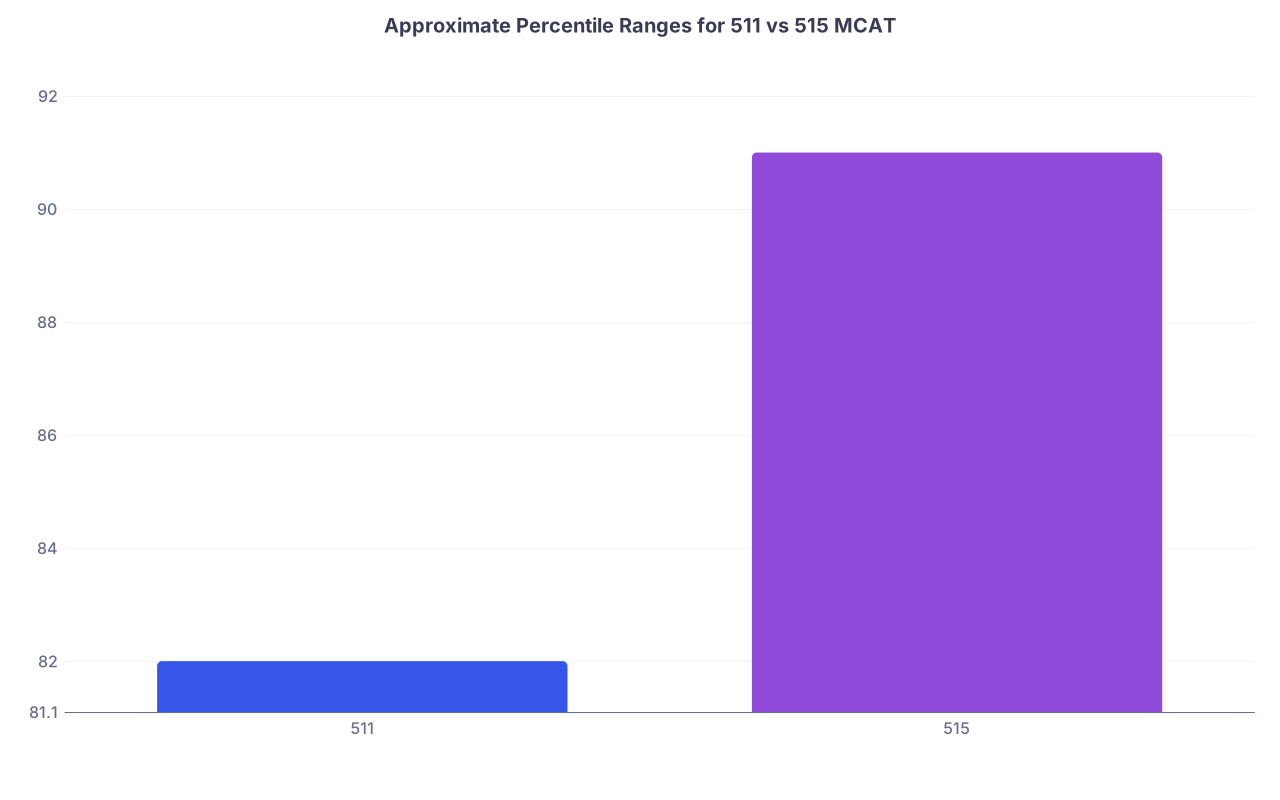
| Category | Value |
|---|---|
| 511 | 82 |
| 515 | 91 |
Is this exact? No. But it’s close enough to capture what the committee sees: 511 lives in the “strong but common” range. 515 moves into “top decile” territory. That’s a psychological line.
And psychological lines matter when you’re scanning 8,000 files in November.
How the File is Actually Screened: Where 511 vs 515 Bites You
Here’s how this really works at most MD schools, especially mid- to high-tier:
There are two big gates:
- Initial Screen (do you get read at all?)
- Interview / Rank Decisions (do you get a serious shot?)
Gate 1: The Spreadsheet Death Line
Every school has some version of a giant Excel or database view with:
- GPA (sGPA, cGPA)
- MCAT total
- Section scores
- State / residency
- School name
- URM / special status flags
- Special programs (BS/MD, linkage, etc.)
They sort. They filter. And yes, they hard‑cut. Even if they swear they don’t.
What numbers are we talking?
At many mid-tier MD schools, internal screening thresholds often look something like this (even if the website says otherwise):
| School Type | MCAT Soft Floor | MCAT “Comfort” Zone | sGPA Soft Floor |
|---|---|---|---|
| State MD (mid-tier) | [507–508](https://residencyadvisor.com/resources/mcat-prep/the-mcat-signal-what-a-508-tells-committees-about-you) | 510–513 | 3.3–3.4 |
| Mid / Upper-mid MD | 509–511 | 512–515 | 3.5–3.6 |
| Top 20 MD | 511–513 | 515+ | 3.7+ |
A 511 clears the floor almost everywhere outside the ultra-competitive top cluster. A 515 doesn’t just clear it, it bumps you into the “we feel comfortable inviting this person if the rest of the app doesn’t suck” bucket.
Where you feel the difference most sharply:
- At high-volume mid-tier schools that are drowning in 510–513 applicants.
- At prestige schools (Top 20-ish) that get ridiculous numbers of 515–525 applicants.
At a place like UCSF, a 511 MD-only applicant with no crazy hook? You’re already on life support before anyone reads your essays. Harsh, but I’ve seen those conversations:
“Good student, but not in range for our pool this year. Pass.”
At a place like University of Iowa? 511 may be completely fine if you’re in-state with a solid GPA.
Gate 2: Once You’re Actually Being Read
Here’s where the myth starts: people think once your score clears the floor, anything above is just “extra.” That’s not really how it plays out.
Once you’re in front of a human reviewer, the 511 vs 515 difference becomes:
- A tie-breaker between otherwise similar applicants
- A confidence signal about whether you can handle a heavy basic science curriculum
- A risk flag if paired with weaker sections or borderline GPA
Example from a real committee meeting (school in the U.S. News 20–30 range, not naming names):
Two applicants, same reviewer:
- Applicant A: 3.8 GPA, 515 MCAT, strong research, decent clinical, average essays
- Applicant B: 3.85 GPA, 511 MCAT, stronger clinical, slightly weaker research, much better letters
Reviewer leans toward B because of the humanistic stuff. In committee?
Chair: “Stats?”
Reviewer: “A is 3.8/515, B is 3.85/511. I prefer B overall.”
Another member: “We have a lot of 511s already. Do we want to take the one with the 515 instead?”
That’s the unspoken game. They’re not comparing you to some abstract bar. They’re comparing you to this year’s actual pile. If the pile has a glut of 511–512 applicants and fewer 515s, that matters.
Score Breakdown: When a 511 Can Beat a 515 (And When It Won’t)
This is where almost every premed gets it wrong. They obsess over total score and ignore the subscores.
Admissions doesn’t.
I’ve literally seen people passed over with a higher total score because their distribution scared us more.
You show me these two:
- Candidate 1: 515 (129/130/126/130)
- Candidate 2: 511 (128/127/128/128)
A lot of committees will like Candidate 2 more. Why? Because that 126 in Candidate 1 screams: “possible weakness, especially in CARS or Psych/Soc” depending on where it sits. Wide variance means risk.
At some schools, especially those that care a lot about verbal reasoning and professionalism, a low CARS sticks out. The side conversations are very predictable:
- “Great total, but that 124 CARS worries me.”
- “We’ve had issues with students who tank CARS then struggle with clinical reasoning OSCEs.”
Is that always fair? No. But it’s real.
Section Priorities (Unspoken but Very Real)
- CARS: Surrogate for reading and clinical reasoning. Certain schools (UChicago, NYU, some Canadian schools) watch this like a hawk.
- Chem/Phys + Bio/Biochem: Signals you can survive preclinical. If you have a 511 with 130+ in science-heavy sections, that softens the “lower total” hit.
- Psych/Soc: Less weighted individually, but a glaring low score (123–124) still raises eyebrows.
A 515 with a lopsided breakdown can quietly lose to a steady 511 if the school has been burned by one-dimensional test-takers before.
Where a 515 Clearly Wins: The Brutal Competitive End
Let’s not sugarcoat it. There are tiers where a 515 moves you into a completely different conversation.
At the most competitive MD programs and BS/MD pipelines, here’s how the internal mindset runs:
For MD-only at the true top (think HMS, Stanford, Penn, Columbia, UCSF, etc.), even a 515 is not magical. You’re still in the “maybe” pile. But a 511 without a serious hook (URM, first-gen, insane story, Olympic medal, etc.) is usually dead on arrival. They won’t tell you that. But it’s how the math works out.
For MD/PhD (especially MSTP funded programs):
- 511 with great research? You’re borderline. They’ll scrutinize you.
- 515 with great research? Now you’re “serious candidate” territory.
Because MD/PhD programs have small cohorts and a flood of high-scorers, a 4-point gap is very real there.
The Retake Question: When a 511 is Fine vs When You Should Roll the Dice
This is the part you actually care about.
You’ve got a 511. You’re asking: “Do I retake for a 515?”
Here’s the insider answer people don’t like but need to hear:
If you retake, the only outcome that helps you is a clear jump. Not 511 → 513. Not 511 → 514 with a weird new subscore imbalance. A clear improvement.
I’ve watched this play out in committee so many times:
We see:
- Attempt 1: 511 (127/128/128/128)
- Attempt 2: 513 (128/127/129/129)
Conversation goes:
“Okay, small bump, but we’re not going to treat that as meaningfully different. They’re a 511–513 type test taker. No real change in our impression.”
Now compare:
- Attempt 1: 511
- Attempt 2: 518
That actually changes how people talk about you. “Significant improvement” triggers positive bias. Shows work ethic, growth, ceiling.
The problem: most students overestimate their ability to jump 7 points on a retake. Especially when their first score already reflects serious studying.
When I’d Tell You to Seriously Consider a Retake from 511
I’d push the retake discussion if:
- You’re gunning hard for Top 20 MD and
- Your GPA is not a 3.9+ (so the MCAT has more weight) and
- Your practice tests were consistently 514–517+ but you underperformed on test day and
- You have the bandwidth to study again without destroying your GPA, research, or clinical trajectory.
If that entire stack is not true? You’re gambling with a decent score that already opens a huge chunk of the MD landscape.
I’ve seen more careers hurt by an unnecessary retake than helped. One of the saddest patterns: student with a 511, chases a 515, retakes, drops to 507–508. Narrative flips from “strong tester” to “inconsistent tester.” Some schools will straight-up see that as a red flag.
How 511 vs 515 Plays at Different School Tiers
Let’s get more concrete and less theoretical.
Assume average-ish but solid ECs: a year or two of research, some clinical volunteering, some shadowing, no global mission trips that change your life in 7 days.
Here’s how committees at different levels tend to emotionally react to 511 vs 515, if your GPA is in that 3.6–3.8 band.
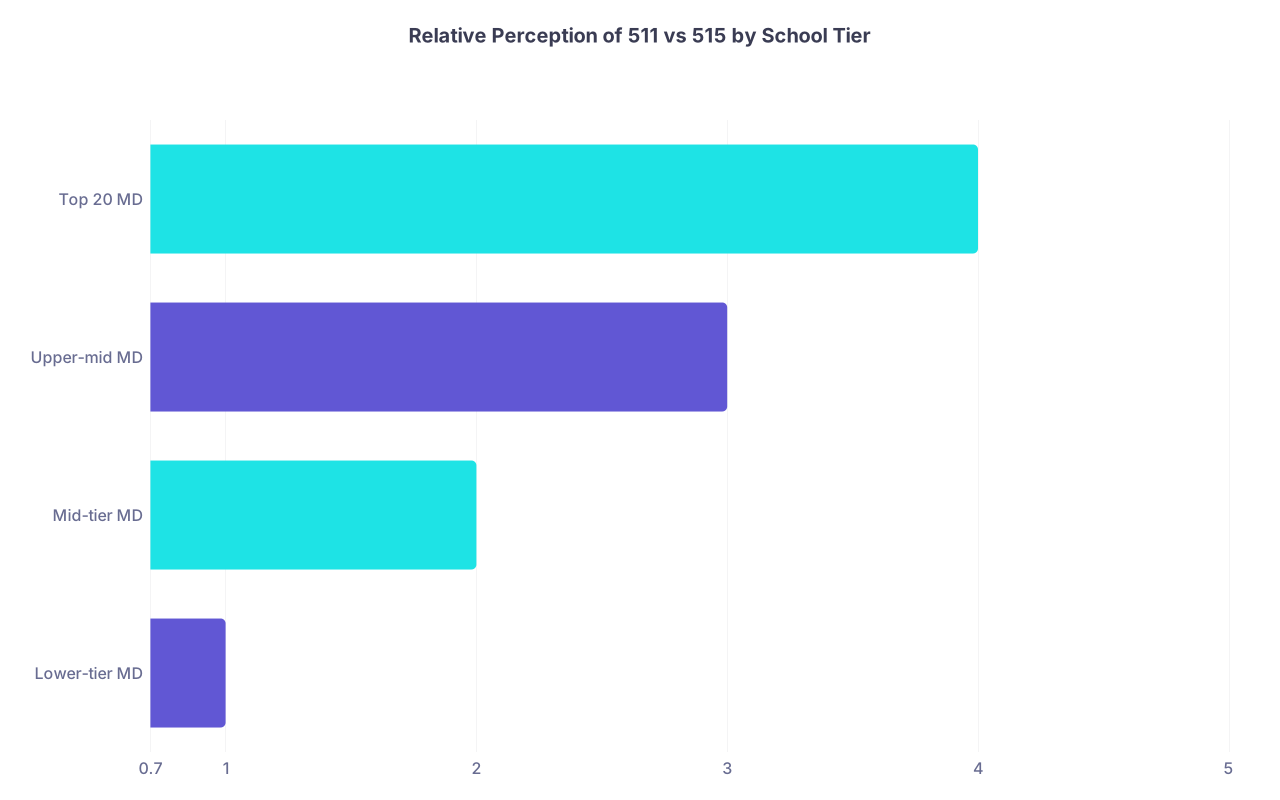
| Category | Value |
|---|---|
| Lower-tier MD | 1 |
| Mid-tier MD | 2 |
| Upper-mid MD | 3 |
| Top 20 MD | 4 |
Interpretation:
- At lower-tier MD / newer schools: 511 and 515 are both “great, love to see it.” The difference is negligible. Other factors dominate.
- At mid-tier MD (think big state schools with decent rank): 515 may push you higher in their invite queue, but a 511 with state residency or better fit still does fine.
- At upper-mid (say 25–40 range): 515 gives you a noticeable advantage; 511 needs stronger support from GPA and ECs.
- At Top 20: 515 does not guarantee you anything, but 511 usually requires a strong “hook” to get traction.
And remember: in-state vs out-of-state changes everything. A 511 IS applicant for a strong state school (UNC, UVA, Ohio State, etc.) might be more competitive than a 515 OOS.
Holistic Admissions: Where 511 Can Quietly Beat a 515
The “holistic” part is not a lie. It’s just misrepresented.
Holistic really means: we will absolutely care about scores, but we’ll sometimes override them for people who obviously fit what we want more.
I’ve been in rooms where this happened:
Applicant A: 3.8 / 515, generic shadowing, OK letters, safe essays.
Applicant B: 3.7 / 511, heavy long-term hospice volunteering, meaningful work as a medical interpreter, incredible letters that describe them as the best student in a decade.
Applicant A gets described as “strong but interchangeable.”
Applicant B gets called “someone we want in our class.”
Guess who wins when a school is trying not to become a Step-score robot factory? The second applicant wins more often than you think.
Here’s the dirty secret: above roughly 510–512, committees absolutely start caring more about story, maturity, and fit. Especially schools that have gotten burned by the “robot 523 applicant” who crumbles on the wards.
But no one on a podium will say: “Yeah, if you’re above 510, we mostly care about who you are as a person now.” They hide behind “holistic” without telling you where the real pivot point is.
So What Should You Do With a 511 or 515?
Let me strip the fluff and give you the straight version.
If you have a 515:
- Stop obsessing about retaking. You’re already in a strong range for almost every MD school.
- Fix your application. Your essays, letters, and activities can absolutely tank you even with a 520. I’ve seen it happen dozens of times.
- Apply broadly. Include reaches, but don’t create an all Top 20 list and then cry in March.
If you have a 511:
- Do not assume you’re doomed. You’re not. You are competitive for a large slice of MD programs—if the rest of your profile is solid and your list is rational.
- Look hard at your GPA, trend, and ECs. If those are average or weak, you cannot rely on your MCAT to save you.
- If you’re thinking retake, be brutally honest: can you reasonably add 5–7 points, or are you gambling 6 months of your life for 1–2 points at best?
The smartest thing most 511 scorers can do is not chase a 515. It’s to build a bulletproof application around the 511 and craft a school list that matches their actual competitiveness, not their fantasy ranking.
FAQs
1. Is 511 “too low” for MD?
No. Standing alone, a 511 is a good score. At many MD schools, especially state schools and mid-tiers, 511 is firmly within their realistic interview range, especially for in-state applicants. It becomes “too low” only when you pair it with a mediocre GPA, generic or weak ECs, and then aim mainly at high-tier or out-of-state-heavy schools.
2. Will Top 20 schools even look at a 511?
They will, but usually only if there’s a strong hook: URM status, truly exceptional life story, major research productivity (actual pubs, not “poster at local conference”), or some distinctive achievement. For the unhooked, non-URM, traditional applicant, 511 at Top 20s usually puts you in long-shot territory. Not impossible, but not something to bank your entire cycle on.
3. How bad does a low section score hurt if my total is strong?
A glaring low (like 123–124) in CARS or a science section with a strong overall (515+) absolutely triggers concern at some schools. They won’t necessarily reject you outright, but they may flag you as a risk. A one-point dip (127 among 128–129s) is not a big deal. A 3–4 point drop below your other sections is.
4. Do schools average multiple MCAT scores or take the highest?
Most MD schools report your highest score for their stats, so they’re incentivized to like that one. But internally, reviewers do look at the full testing history. Some mentally average them, some treat the highest as primary with shading from the others, some heavily value clear upward trends. A tiny bump from 511 to 513 doesn’t impress anyone. A jump from 508 to 517 absolutely does.
5. If I’m scoring 514–517 on practice tests but got a 511 on test day, should I retake?
Maybe. If your practice scores were consistently in that range on official AAMCs (not just random third-party tests), and you can realistically dedicate focused time without harming GPA or ECs, a retake could be worth it—especially if you’re aiming for more competitive programs. But you need a real plan to fix what went wrong (timing, anxiety, content gaps), not just blind hope that “I’ll do better next time.” If your practice scores were 510–512 before, chasing a retake is usually ego, not strategy.
Two things to walk away with:
- A 511 vs 515 does matter—but less like “one is good, one is bad” and more like “one makes life a little easier in the top-heavy parts of the pool.”
- Above ~510, your outcome is driven less by two-to-four points on the MCAT and more by the total package: GPA, trend, experiences, narrative, and whether you actually look like someone schools want to train and stand behind for decades.
Use the score you have as a tool. Not as a verdict.