
The way adcoms talk about the MCAT in public is sanitized. The way they talk about it behind closed doors is not. And the thing they pay more attention to than you realize is not just your total score—it’s the balance between your sections.
Let me be blunt: a 517 with lopsided sections can trigger more discussion in committee than a 510 that’s perfectly even. Not always in your favor.
You’re being judged not only on “how high,” but on “how coherent” your score profile looks. And that coherence tells them stories about you that nobody ever explains to applicants.
This is what they’re really inferring from your MCAT section balance.
The Dirty Secret: 518 ≠ 518
I’ve sat in those rooms. I’ve watched committee members flip past the total and go straight to the subscores. They’ll say things like:
- “Strong overall, but that CARS is rough.”
- “Good score, but I don’t love that 124 in Psych/Soc.”
- “This is a classic test-taker, not a reader.”
Same total score. Completely different emotional reaction.
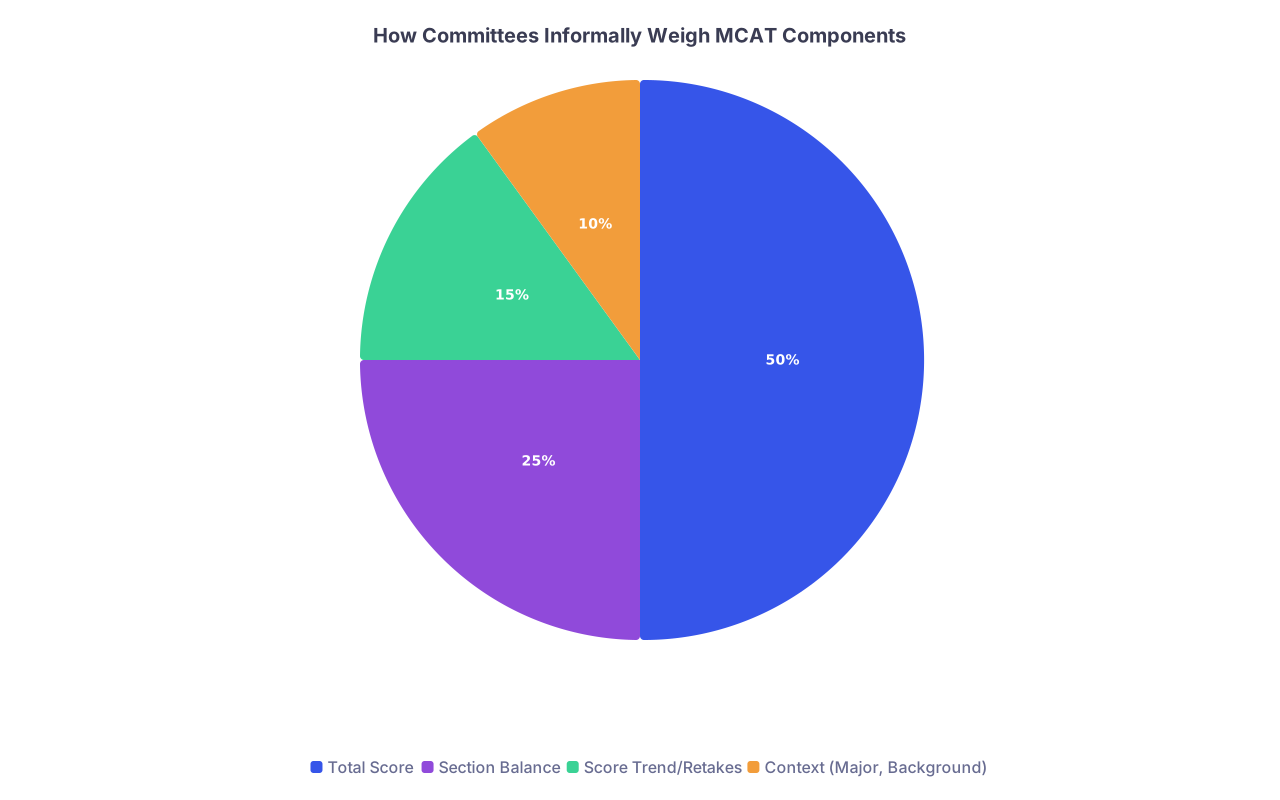
Here’s the crude mental math many schools use, especially mid-to-upper tier MD programs:
- First gate: total score (automatic screens, “do we look deeper?”)
- Second gate: section balance (hidden screen, “do we feel good about this?”)
So yes, your total matters. But how that total is distributed changes how much benefit you actually get from it.
| Category | Value |
|---|---|
| Total Score | 50 |
| Section Balance | 25 |
| Score Trend/Retakes | 15 |
| Context (Major, Background) | 10 |
That chart is approximate, obviously. But it’s close to how people actually think.
What Each Section “Says” About You
Forget the AAMC’s official skill domains for a second. Let’s talk about the unofficial ones—the ones adcoms actually say out loud.
Chem/Phys (CP): “Can you survive the firehose?”
CP is the “can you hang with the basic science” section. A high CP tells them:
- You can grind through dense, technical material.
- You probably won’t drown in biochem, physiology, or pharm.
- You can do math under time pressure without falling apart.
When CP is much higher than everything else (say 131 CP, 125 CARS, 126 BB, 125 PS), the quiet conclusion some faculty draw is: “Engineer brain. Good at problem sets, maybe weaker at nuance, reading, and people.”
Is that always fair? No. But I’ve heard exactly that from a basic science PhD on an adcom: “This is our physical sciences guy; I’m less convinced about everything else.”
Low CP with otherwise strong scores (124 CP, 130+ elsewhere) often gets read as:
- Weak math/traditional science foundation.
- Might struggle on exams that require calculation or unit sense.
- Maybe came from a softer science background and never really fixed the physics/chem gap.
Some schools—especially those with old-school, heavy pre-clinical curricula—get nervous about this. Think places where first-year exams still feel like a Step 1 clone.
CARS: “Do you think like a doctor or just a test-taker?”
CARS is where the strongest opinions live. Committees over-interpret it, for better or worse.
High CARS (129–132) is the golden child. Behind closed doors, it gets translated as:
- “This person can actually read.” (Yes, they say it like that.)
- Good at critical thinking, handling ambiguity, inferring motives, reading between lines.
- More likely to thrive with clinical reasoning, ethics, humanities content.
I’ve watched an application with a borderline GPA get kept on the table because someone pointed at a 130 CARS and said, “I trust this brain.” That happens.
Low CARS (124–125 or below) sets off alarms, especially if everything else is solid:
- “Are they just brute-forcing content?”
- “How will they handle narrative charts, consult notes, nuanced H&Ps?”
- “Are we looking at a memorizer, not a thinker?”
Here’s the part nobody tells you: that low CARS often gets framed as a reading and reasoning issue, not just a “bad day.” A pattern like 128 CP / 129 BB / 128 PS / 124 CARS absolutely gets noticed. Someone on the committee will say, “That CARS is concerning.”
And at some schools, internal guidance really does exist: “We prefer CARS 125+” or “Below 124 in CARS is a risk factor.” They won’t publish that on the website. But it drives quiet decisions.
Bio/Biochem (BB): “Do you actually understand medicine’s language?”
BB is the “do you speak biomedicine” section. High BB means:
- You’re conversant in core pathways and experimental setups.
- You’ll probably follow along in pathology and pathophys lectures without constant remediation.
A low BB with decent CP (say 129 CP, 124 BB) makes people think:
- “Strong physics/chem, but missed the biology boat.”
- Maybe crammed content instead of building conceptual understanding.
Sometimes they contextualize it: non-traditional major, weak undergrad bio, etc. But if your transcript is packed with biology and you still tank BB, that hurts more. It suggests your learning style for biology is flawed, not just exposure.
Psych/Soc (PS): “Have you ever thought hard about people?”
Fair or not, PS gets used as a proxy for how seriously you treat the “softer” side of medicine.
High PS (129–132): someone will inevitably say, “Ok, they’ve clearly thought about behavior, society, disparities.” Especially at schools with strong social medicine / community health identities.
Low PS (124–125) with decent CARS makes people think:
- You either blew this off (“easy section”) or…
- You struggle connecting conceptual theory with applied behavior.
Where it really hurts: schools that lean hard into social determinants, underserved care, or population health. They like applicants who look like they’ll engage with that content. A weak PS undercuts your narrative if you wrote essays about health equity.
Patterns That Make Committees Nervous
It’s not just individual sections. It’s patterns across them. Let me walk you through the ones that generate the most internal debate.
1. The Lopsided Quant
Profile: 130+ CP, 130+ BB, 123–124 CARS, 124–125 PS
What they say:
- “Brilliant in the hard sciences. I’m worried about everything else.”
- “This reads like someone who memorizes Anki decks but doesn’t engage with text deeply.”
- “Is this the resident who aces in-service exams but writes terrible notes and struggles with patient nuance?”
At some research-heavy MD programs, they’ll tolerate this if your research is outstanding. They think: we can teach them communication; we can’t teach 99th percentile scientific reasoning.
At community-facing schools or those heavy on PBL and humanities? This can quietly push you below someone with slightly lower total but more even sections.
2. The Classic Humanities Brain
Profile: 125–126 CP, 130–132 CARS, 129–131 PS, 125–126 BB
You’d think everyone would love this. Mixed reaction.
What they say:
- The clinicians: “I like this. They can read, reason, and handle people.”
- The basic scientists: “Are they going to fail physiology? That CP is soft.”
If your major is English, history, philosophy, etc., some faculty will forgive lower CP/BB more easily: “They didn’t grind orgo full-time.” But the forgiveness depends heavily on school culture.
If you want to play to this profile, your application better show you can survive the science: strong grades in pre-reqs, maybe an upward trend, maybe post-bac coursework. Because otherwise they’ll box you as “great in seminar, mediocre in the lab.”
3. The Spike and Three Holes
Profile: One section 130–132, the others 124–126
This is the one they label as “test-taker profile” or “unbalanced preparation.”
What they say:
- “They hyper-optimized one area and neglected the rest.”
- “Looks like they did question banks for one section and winged the others.”
- “Will they approach med school the same way—cherry-picking what interests them and ignoring the rest?”
A single spike isn’t inherently bad, but if the rest of the application doesn’t contradict that story, it can hurt.
What Committees Like To See In Section Balance
Let me give you the pattern that almost never raises eyebrows.
The 2-Point Range
Example: 127 / 128 / 128 / 127 (510 total)
Or: 129 / 130 / 129 / 128 (516 total)
This says:
- Solid across the board.
- No glaring weaknesses.
- You prepared like an adult: consistently and comprehensively.
I’ve watched committee chairs say, “I like how even this is” as if they’re reading an EKG. It reduces anxiety. They don’t have to defend any weird outliers to other members.
The Small Dip, One Section
Example: 131 / 129 / 128 / 126 CARS
Or: 128 / 126 CP / 129 / 130
When the drop is 2–3 points in one section, this usually becomes a discussion item, not a veto. Someone will say, “CARS is a little low, but…” and then justify it with your major, background, or the rest of the app.
How forgiving they are depends on:
- Your narrative (non-native English speaker with a 124–125 CARS? Often forgiven if everything else is strong.)
- Institutional bias (schools that love humanities are less forgiving of weak CARS; hardcore research schools may cut more slack.)
- Competition in that cycle (in a strong pool, any weakness matters more.)
The “Matches the Major” Pattern
They absolutely compare your MCAT sections to your background.
- Bio major, research experience, lots of lab: they expect BB to be one of your strongest.
- Engineering / physics major: they expect CP to lead.
- Philosophy / English major: they expect CARS to be very strong.
When your MCAT pattern violently contradicts your background, it raises eyebrows. Example: bio major with 127 CP, 125 BB, 130 CARS, 130 PS. Someone will say, “So you did four years of biology but your best performance is in reading and psych?”
Not a dealbreaker. But it triggers a closer look at your transcript and letters.
How This Should Change Your MCAT Prep Strategy
You’re not just trying to hit a total score. You’re trying to avoid a profile that writes the wrong story about you.
Stop Chasing Your Strengths
The biggest self-sabotage I see: students who keep doing practice in the section they’re already good at because it feels good.
- The CP kid who loves physics problems and ignores CARS.
- The humanities kid who keeps “rewarding” themselves with CARS passages and avoids BB.
From an adcom’s perspective, you’re polishing what they already believe. What moves the needle is lifting the weak link so your score profile doesn’t scream “unbalanced.”
If you’re sitting at:
- 129 CP, 123 CARS after two months of prep
and your goal is MD at a reasonably competitive school, then no, you don’t need 131 CP. You need 125–126 CARS. Every extra point in CP past 129 is diminishing returns from an admissions perspective if your CARS is dying.
Set a Floor, Not Just a Ceiling
Instead of only setting a goal score, set a minimum acceptable section profile.
For example:
- “I want 515+, but I’m not okay with anything under 125 in any section.”
- Or: “I’m fine with a 509 if all my sections are 127–128+; I’m not fine with a 512 that includes a 123 CARS.”
Will you always hit that? No. But preparing with that mindset changes how you study and whether you accept “I’ll just make up for it with other sections” (which is exactly how you end up with those ugly spikes).
Understand Where You Can “Afford” To Be Slightly Lower
Reality: very few people are perfectly balanced. You might not get four identical numbers. So where can you be a bit lower without torpedoing your story?
- Future surgeon, hardcore research CV, STEM major? A 125 PS is not ideal, but it won’t kill you if everything else is strong and your essays aren’t tone-deaf.
- Future psychiatrist / primary care / social medicine person? A 124–125 PS or 124 CARS is way more damaging. It contradicts your whole schtick.
Calibrate your section priorities with your narrative. If all your essays and activities scream “I care deeply about underserved communities and communication,” you can’t mail in CARS and PS and expect committees not to notice.
Multiple Attempts: How Section Changes Are Read
Everyone obsesses over “should I retake?” and largely ignore what the section changes will look like to adcoms.
Here’s the quiet rubric:
Same total, better balance: generally good.
510 (132 CP, 123 CARS, 127 BB, 128 PS) → 510 (128/127/128/127).
Committees read this as maturity: you actually worked on your weaknesses.Higher total, same glaring hole: mixed.
511 (129/123/129/130) → 514 (131/124/130/129).
Someone will say, “Impressive improvement, but that CARS issue is persistent.”Higher total, worse balance: ugly.
511 (127/126/129/129) → 514 (131/124/130/129).
You just created a red flag you didn’t have before.
The most impressive profile I’ve seen in this regard:
First attempt: 508 (127/124/128/129)
Second attempt: 513 (128/127/129/129)
On paper, that’s a 5-point jump. In the room, the story was: “They fixed CARS without tanking anything. They listened, learned, and executed.” It landed well.
Special Contexts Adcoms Actually Do Consider
They’re not robots. There is nuance. But nuance only buys you so much.
Non-native English Speakers
Low-ish CARS with strong other sections is often contextualized. I’ve heard:
- “Given that English is their third language, a 124–125 CARS is actually impressive.”
- “Look at their strong PS and BB; they’re clearly capable. I’m okay with this CARS.”
But there’s a limit. A 120–121 CARS is still rough, even with context. Some schools have quiet lines they just do not cross.
First-Gen / Weaker Undergrad Prep
If your whole file screams “I did not come from privilege, but I climbed,” committees sometimes interpret uneven sections more generously—especially if there’s an upward trend academically.
They might say, “Look, they never had a great high school or early college science foundation, but they’ve shown they can grind and improve.”
Still, relying on pity or context is a bad plan. Use your prep time to make the section balance less of a liability so they don’t have to talk themselves into you.
How to Reverse-Engineer Your Own Section Story
Here’s the exercise I give students:
- Write down your current (or practice test) section scores.
- In one sentence, describe what an adcom might infer from that pattern if they were being a little uncharitable.
- Then write the version you want them to infer.
- Adjust your prep plan to move your real profile closer to the second sentence.
Example:
Current: 130 CP / 123 CARS / 128 BB / 129 PS
Uncharitable adcom inference: “Classic memorizer, weak critical reader, may struggle with nuanced reasoning and communication.”
Desired inference: “Scientifically strong, solid reader, no glaring holes.”
Your job: stop doing CP sets for a while. Live in CARS. Kill that weakness enough that it’s no longer the headline.

| Step | Description |
|---|---|
| Step 1 | See Total Score |
| Step 2 | Auto Screen Out |
| Step 3 | Examine Section Scores |
| Step 4 | Discuss Context & Risk |
| Step 5 | Balanced Profile |
| Step 6 | Keep in Competitive Pool |
| Step 7 | Above School Threshold? |
| Step 8 | Major Weakness? |
| Step 9 | Context Justifies? |
| Category | Value |
|---|---|
| Balanced (2-pt range) | 90 |
| High total, 1 weak section | 75 |
| Lopsided quant-heavy | 60 |
| Single spike, 3 weak | 40 |
| Low CARS only | 50 |
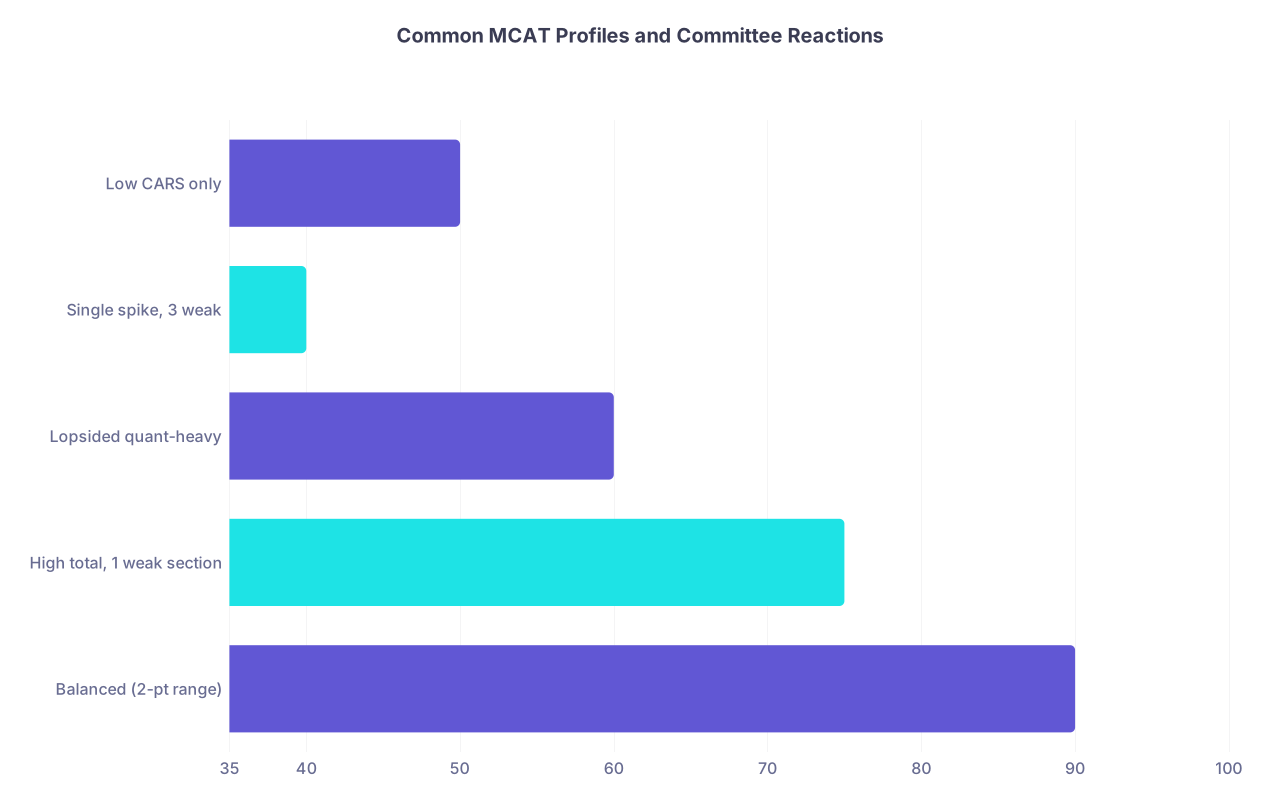
That “reaction score” is not real data, but it mirrors the vibe you’d pick up sitting in those rooms: balance is calming; lopsidedness forces debate.
| Weak Section | Typical Reaction Level* | Most Concerned Schools |
|---|---|---|
| CARS | Very High | Most MD, esp. mid/upper tier |
| BB | High | Research-heavy, basic science-focused |
| CP | Moderate–High | Traditional, exam-heavy curricula |
| PS | Moderate | Social medicine / primary care-focused |
| Multiple | Extremely High | All schools |
*Reaction level = how much discussion / doubt it tends to trigger

The Part Nobody Tells You: “Good Enough” Balance Beats Perfect
You’re not trying to produce a museum-quality score report. You’re trying to avoid a pattern that makes someone lean back in their chair and say, “Hmm. I’m not sure about this.”
If your sections are within 2–3 points of each other, none in the danger zone (sub-124), and your total meets your target school range, you’re fine. Most of the hair-splitting I just walked you through matters most for:
- Competitive MD programs
- Borderline GPAs where MCAT has to “rescue” you
- Applicants claiming a particular narrative (future psychiatrist with 123 PS and 123 CARS is going to get side-eye)
So you don’t need perfect symmetry. You need to not give them an easy reason to doubt you.