What if the way you’re using Anki for MCAT is actually making you worse, not better?
People hate hearing this. They install Anki, subscribe to a big shared deck, do some cards, and assume they’re “being efficient.” Then they pull a 502 after “doing 5,000 flashcards” and wonder what happened.
I’ve watched that disaster play out more times than I can count.
Anki isn’t magic. It’s a tool. And there are some very specific, very common ways premeds use it that almost guarantee mediocre MCAT scores—no matter how many hours they spend “doing cards.”
Let’s walk through the worst mistakes so you don’t waste months tricking yourself into thinking you’re studying when you’re really just clicking “Good” over and over.
Mistake #1: Treating Anki as Your Only MCAT Resource
If your “study plan” is basically:
- Download a deck
- Grind cards every day
- Maybe do a few practice passages
you’re setting yourself up to be blindsided by the real exam.
The MCAT is not a trivia contest. It’s an applied reasoning exam wrapped around content. Anki is great for content recall. It’s terrible for:
- Learning how to interpret graphs and figures
- Handling long, dense passages
- Practicing timing and endurance
- Integrating multiple topics in one scenario
Yet I see students relying on Anki like it can somehow replace:
- A structured content review (Kaplan, TPR, AAMC, or decent videos + notes)
- Lots of practice questions and passages
- Full-length exams
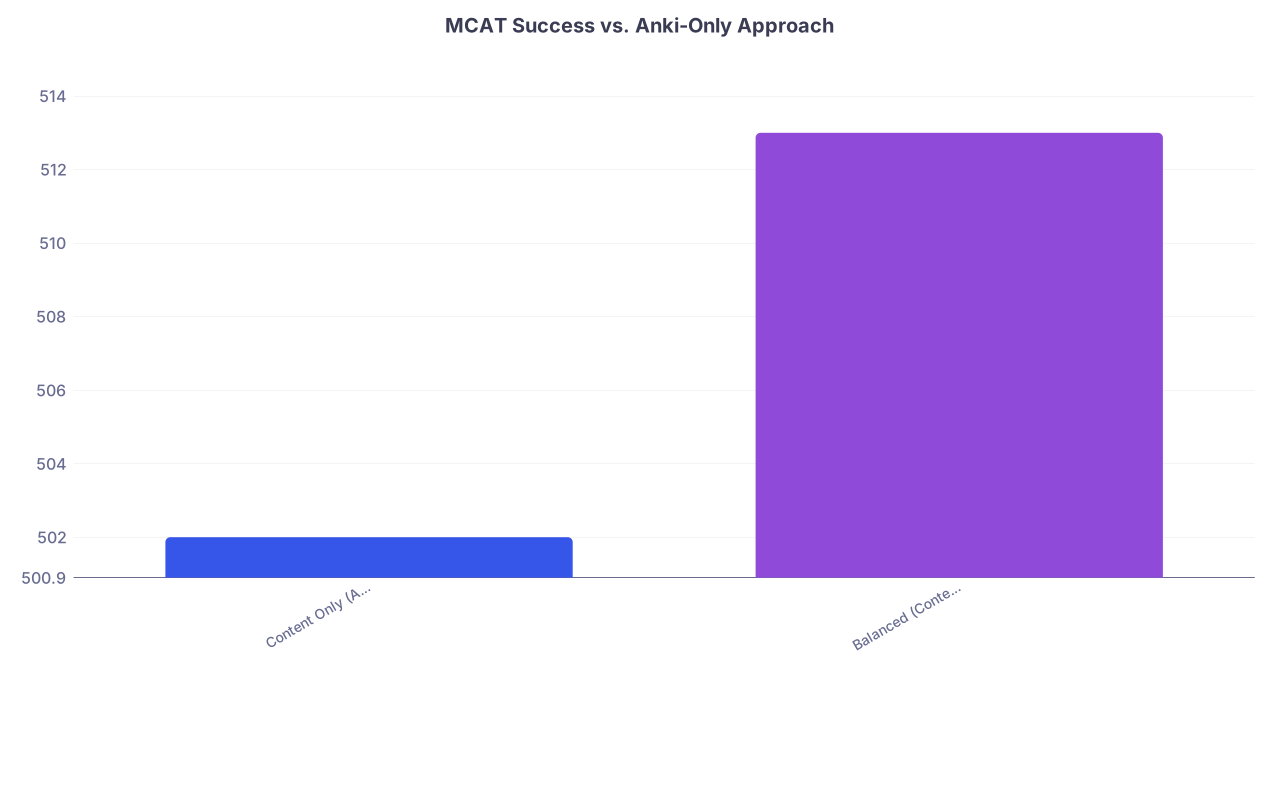
| Category | Value |
|---|---|
| Content Only (Anki-heavy) | 502 |
| Balanced (Content + Passages + FLs) | 513 |
The pattern I see:
- “Anki-only” students: Good at spitting out definitions, terrible at applying them. Scores cluster in the low 500s or worse.
- Balanced students: Use Anki plus a heavy dose of passages and full lengths. They actually improve.
What to do instead
Use Anki as a supporting tool, not the main course. Rough ratio that usually works:
- 30–40% of study time: Anki (new + reviews)
- 30–40%: Practice passages/questions
- 20–30%: Content review, reviewing mistakes, strategy
If Anki is eating 70–90% of your time, you’re making a big mistake. Rebalance now, not two weeks before test day.
Mistake #2: Blindly Using Giant Premade Decks
AnKing. Milesdown. JackSparrow. You know the names.
The decks themselves aren’t the problem. The way people use them is.
The worst pattern:
- Download a massive deck
- Don’t touch the settings
- Don’t suspend irrelevant cards
- Don’t add your own cards
- Start “from the beginning” like a robot
Then you drown. Thousands of cards you don’t understand, on concepts you haven’t learned, written in someone else’s language.
If you’re doing Biochem cards that mention pathways you’ve never actually studied, you’re not being efficient. You’re just memorizing noise.
Common red flags with premade decks
- You’re memorizing card wording instead of understanding concepts
- You’re seeing content wildly out of order compared to your review schedule
- You’re forced to guess on cards because you’ve never actually learned the topic
- Your daily review count explodes to 500+ and you’re just clicking
What to do instead
Use premade decks as a base, not a religion.
- Suspend aggressively. If you haven’t covered a chapter yet, suspend those cards. All of them.
- Unsuspend by topic. Finished reading fluids? Unsuspend only the fluids deck.
- Modify cards you don’t like. If a card is wordy, vague, or confusing, rewrite it.
- Add your own cards from missed questions and confusing concepts. This is where real learning sticks.
If a deck feels like it’s controlling you instead of supporting you, that’s a sign you’re doing it wrong.
Mistake #3: Using Anki to Learn, Instead of to Reinforce
Anki is not a textbook. It’s not a video course. It’s not where you should see concepts for the first time.
Big mistake students make: they open Anki, see “Henry’s Law,” and try to learn it from the card itself. That’s backwards.
You should first:
- Watch/read the topic
- Take some short, focused notes
- Maybe do a couple of example questions
- Then build or unsuspend Anki cards to lock it in
If your first exposure to a topic is through a flashcard, you’re going to:
- Memorize shallow definitions
- Not understand the “why”
- Panic when the MCAT twists it in a passage
An MCAT passage about V/Q mismatch doesn’t care whether you know the exact definition you memorized on a basic card. It cares whether you understand what happens to oxygen and carbon dioxide in that situation.
What to do instead
Treat Anki as “second contact,” not “day one.”
Workflow that actually works:
- Learn the topic from primary resources (book/video).
- Do a handful of related practice questions to see how it behaves.
- Create / unsuspend Anki cards about the key takeaways and mistakes.
- Use Anki over days/weeks to keep it accessible.
If you catch yourself thinking, “I’ll just learn this topic through Anki,” stop. That’s lazy and it will burn you later.
Mistake #4: Writing Garbage Cards (And Then Drowning in Them)
Bad cards create the illusion of work. You answer them, you feel busy, but your score doesn’t move.
Here’s what bad MCAT Anki cards look like:
- Vague cloze deletions: “The ___ is involved in memory.” (Great, which memory? How? Why does that matter?)
- Overspecific trivia: “The pKa of lactic acid is ___.” (Why? For what?)
- Paragraph-length questions: You’re basically re-reading a textbook each review.
- Cards with 3–5 facts buried in one: You’ll remember 1, miss 4, and never really know which.
I’ve seen decks where one card is:
“List all 10 steps of glycolysis in order with enzymes and cofactors.”
That’s not a flashcard. That’s a punishment.
| Type | Bad Card Example | Better Card Example |
|---|---|---|
| Vague | “What does the hippocampus do?” | “What type of memory is the hippocampus critical for?” |
| Overloaded | “List the steps of glycolysis with all enzymes.” | “What enzyme catalyzes the rate-limiting step of glycolysis?” |
| Useless | “pKa of lactic acid?” | “Lower pKa means stronger or weaker acid?” |
What to do instead
For the MCAT, you want:
- One precise idea per card
- Short questions, short answers
- Focus on what the exam tests, not obscure trivia
Good MCAT cards tend to be:
- Simple definition / concept recall
- Directional relationships (“If X increases, what happens to Y?”)
- Cause–effect in physiology and biochem
- Concept checks from questions you actually missed
Ask yourself: “Will knowing the answer to this card help me answer a passage question faster and more accurately?”
If the answer is no, the card is probably trash. Delete or fix it.
Mistake #5: Ignoring Settings and Letting the Algorithm Crush You
Default Anki settings are… not optimized for MCAT. And just accepting whatever the app gives you is how you wake up one morning with 800 reviews and a rising sense of doom.
I see students do this constantly:
- Install Anki
- Never touch the deck options
- Add hundreds of new cards per day for two weeks
- Hit a wall of reviews they cannot possibly finish
- Either rage-quit or start randomly clicking “Easy”
Both outcomes are bad.
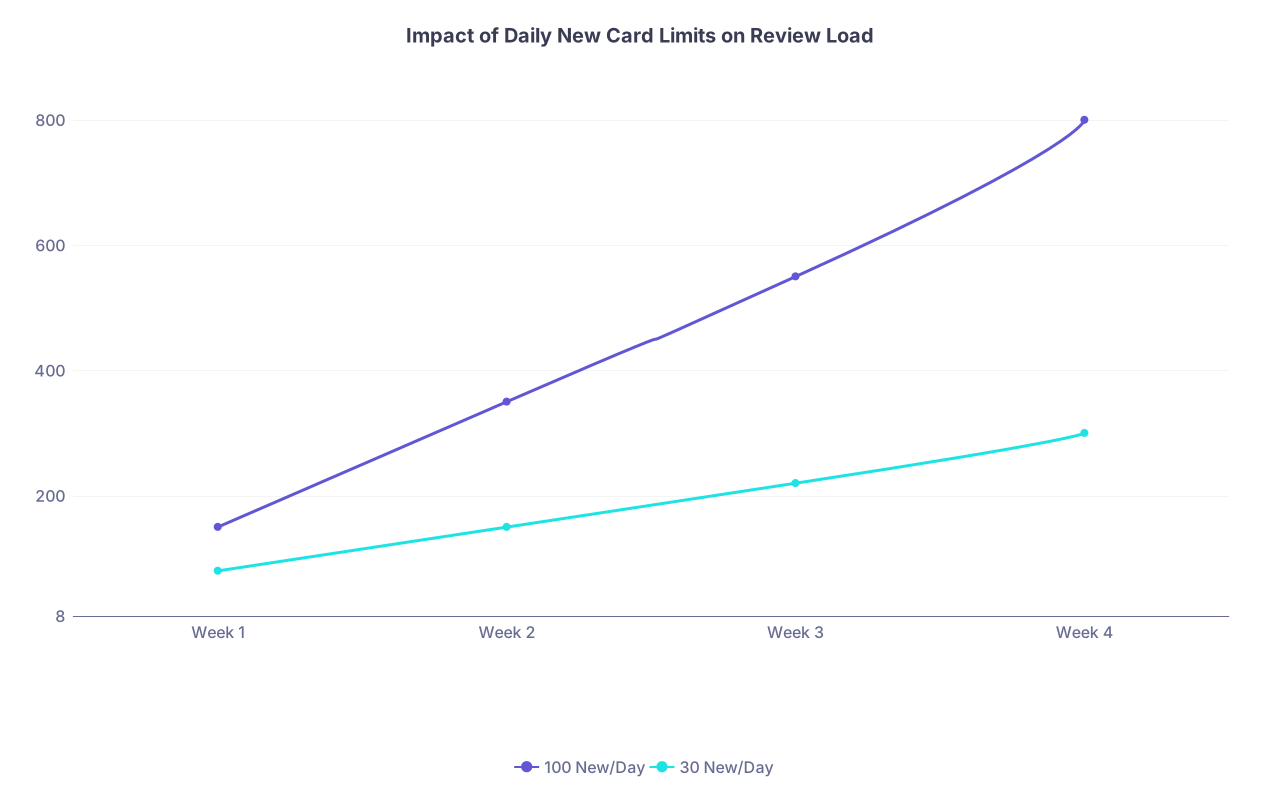
| Category | 100 New/Day | 30 New/Day |
|---|---|---|
| Week 1 | 150 | 80 |
| Week 2 | 350 | 150 |
| Week 3 | 550 | 220 |
| Week 4 | 800 | 300 |
What to adjust (and mistake-proof)
I’m not going to give you a magic setting set. But I’ll tell you where most people screw up:
New cards per day set way too high
If you’re doing 80–150 new cards daily early on, your future reviews will explode. Most students do better in the 20–40 new/day range per major deck.Max reviews per day left unlimited
That’s how you get suffocated. Set a review cap that’s challenging but realistic. For many, 200–300/day is already a lot when you also have passages and content.Hitting “Easy” constantly
You’re basically telling Anki: “Don’t show me this for a long time,” even if the memory isn’t strong yet. For MCAT, “Good” and “Again” are usually your workhorses. “Easy” is rare.Reviewing too late at night when fried
Tired brain = false confidence. You click “Good” on guesses you should have marked as “Again.”
What to do instead
- Start with conservative new-card limits; you can always increase later.
- Actually monitor how long reviews are taking you. Adjust limits weekly.
- Be honest with yourself: if you “kind of knew it,” that’s not “Easy.” That’s usually “Good” or even “Again.”
You’re not trying to impress the algorithm. You’re trying to train your brain.
Mistake #6: Memorizing Facts, Ignoring Application
The MCAT doesn’t care that you know “RAAS stands for renin–angiotensin–aldosterone system.” It cares whether, in a patient with renal artery stenosis, you can deduce what happens to blood pressure, aldosterone, and potassium.
Most Anki decks are packed with straight fact recall. And students fall for it. They feel productive nailing tons of short definition cards every day.
Then they open an AAMC passage and freeze.
Common pattern:
- Great at stand-alone recall questions
- Collapse when a question combines 3–4 concepts inside a dense paragraph

| Step | Description |
|---|---|
| Step 1 | Memorize Facts with Anki |
| Step 2 | Do Practice Passages |
| Step 3 | Identify Weak Application Areas |
| Step 4 | Create Application-Focused Cards |
What to do instead
You need cards that bridge the gap between “fact” and “passage.”
Examples of better, application-oriented cards:
- “If aldosterone increases, what happens to serum K+?”
- “In a leftward shift of the O2-Hb curve, is O2 unloading increased or decreased in tissues?”
- “Competitive inhibitor effect on Vmax and Km?”
And crucially: pull these from questions you miss in practice. Your missed questions are gold. Most students just read the explanation once and move on. Then miss the same idea a week later.
Every time you miss a question for a conceptual reason, ask:
- What did I misunderstand?
- What key relationship or rule did I forget?
- How can I turn that into 1–2 sharp Anki cards?
That’s how you use Anki to train application, not just parroting.
Mistake #7: Letting Anki Run Your Life (and Kill Your Practice Time)
I’ve seen students proudly say, “I did 600 reviews today,” and then quietly admit they did zero passages.
That’s not impressive. That’s a misallocation of time.
The MCAT is a timed exam with long sections. If you aren’t regularly doing:
- CARS passages
- Science passages
- Full-lengths under timed conditions
then you’re sabotaging yourself, even if your Anki streak is 200 days.
Warning signs Anki is running you
- You delay starting full-lengths “until you finish the deck” (you never will)
- You feel guilty skipping Anki, but not guilty skipping practice questions
- You cram reviews late at night when you’re mentally dead, just to keep a streak

What to do instead
Hard rule: Anki must serve your overall MCAT plan, not dominate it.
Try this structure:
- Non-negotiable blocks for passages and full-lengths
- Anki fit around those, not the other way
- On full-length days, expect to reduce or even skip new cards
If your choice is:
- 2 hours of Anki reviews
or - 1 hour of targeted reviews + 1 hour of practice passages
Pick the second one. Every time.
You don’t get points on test day for your Anki stats. You get points for answering questions under pressure.
Mistake #8: Using Anki Inconsistently (Then Blaming the Tool)
Here’s another painful pattern:
- Week 1–2: “I’m doing amazing, 300 reviews a day!”
- Week 3–4: You get busy, miss a few days
- Week 5: 900+ overdue cards, you panic, reset, or give up
- Week 6: You tell people “Anki didn’t work for me”
Anki punishes inconsistency. That’s how spaced repetition works. If you’re constantly starting and stopping, you’ll never see the real benefit.
What to do instead
You don’t need perfection. You need realistic consistency.
- Aim for most days, not all. 5–6 days a week done consistently beats 7 days of insanity followed by burnout.
- On “hell days” (work, family emergency, etc.), do a 10–15 minute “lifeboat” session: clear the highest-priority reviews, ignore new cards.
- If you fall behind, don’t hit the nuclear reset. Use filtered decks or temporarily lower new-card limits and chip away.
Anki is like brushing your teeth. Skip one night, you’re fine. Skip a week, you’ve got a problem.
Mistake #9: Refusing to Customize Anything
Last big one: using someone else’s system like gospel.
Every student learns slightly differently. Yet a ton of premeds act like editing a shared deck is some sort of crime.
They think:
- “If I suspend this card, I’ll miss something critical.”
- “If I rewrite this, it won’t be as good as the original.”
- “If I change settings, I’ll break it.”
So they keep doing cards that don’t work for them, in a format that doesn’t suit them, at a pace they can’t sustain.
That’s how you burn out.
What to do instead
Give yourself permission to make Anki yours:
- Delete truly useless cards
- Suspend super low-yield or redundant clutter
- Rewrite confusing questions in your own words
- Tag cards by resource (AAMC, UWorld, etc.) and topic so you can focus where you’re weak
You are not beholden to the deck creator. They are not taking the MCAT for you.
The Bottom Line: Anki Should Make Your MCAT Stronger, Not Just Busier
Used badly, Anki becomes an extremely efficient way to waste time and build false confidence.
Used well, it’s one of the best tools you have to:
- Keep key content fresh for months
- Reinforce lessons from your practice
- Free up mental space so you can focus on passages and reasoning
Your job is to avoid the lazy traps:
- Anki as your only resource
- Blind worship of giant premade decks
- Using cards to “learn” instead of reinforce
- Writing vague, overloaded, or trivial cards
- Letting default settings bury you in reviews
- Hoarding facts while ignoring application
- Letting Anki crowd out practice passages and full-lengths
- Being wildly inconsistent and then blaming the tool
- Refusing to customize anything
Fix those, and suddenly the time you spend in Anki actually moves your score.
What You Should Do Today
Don’t just nod and move on. Do something concrete right now:
Open your Anki and do these three things:
Check your “New cards/day” and “Maximum reviews/day” for your main MCAT deck.
- If new > 40 or reviews regularly > 300, lower them to something you can sustain.
Sort your deck by subdeck or tags and suspend at least one chunk of cards you haven’t actually studied yet.
- Stop pretending you know content you’ve never learned.
Pull up your last practice set (or full-length), find 3 questions you missed for conceptual reasons, and create 3–6 targeted cards from them.
Do that today. Not tomorrow.
Because the longer you let bad Anki habits run the show, the deeper the hole you’ll have to climb out of before test day.