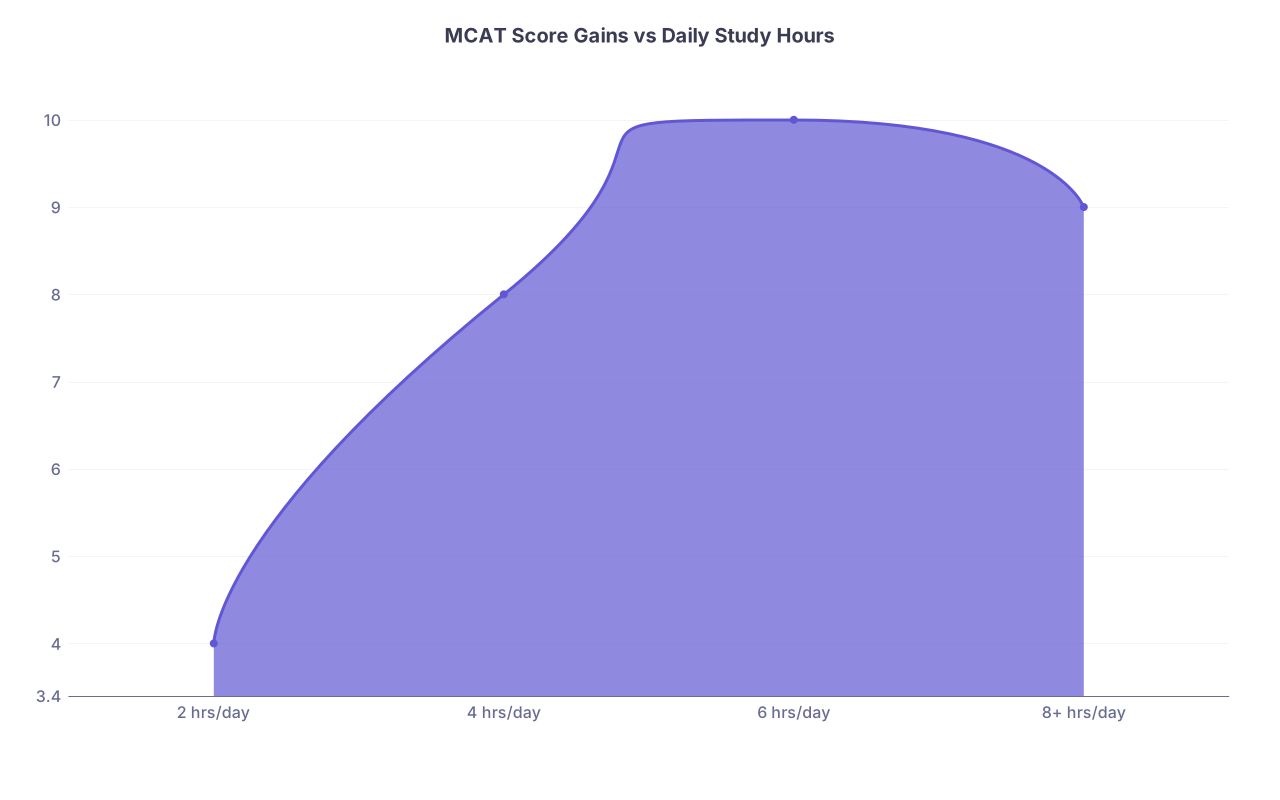
The MCAT does not care how hard you study. It only cares how precisely you train. If you are stuck around a 505, your problem is not effort. It is strategy.
Here is the fix: a 4-week, no-nonsense rescue protocol built for one goal—breaking that 505 plateau.
Step 0: Hard Reset – Diagnose Why You Are Stuck
Before you grind another 1,000 questions, you need to know exactly why you are sitting at 503–507 every practice test. “I just need to do more practice” is not a diagnosis. It is avoidance.
A. Pull Your Last 2–3 Practice Exams
Ideally from:
- AAMC FLs
- Blueprint / Kaplan / Princeton Review full lengths
Collect:
- Section scores (CP, CARS, BB, PS)
- Question type breakdown (most platforms show this)
- Timing data per section
Now do what almost no premed actually does: a failure autopsy.
B. Categorize Every Missed Question
Take your last full-length and do a 2–3 hour post‑test analysis session. No distractions. No new questions. Just analysis.
For each wrong question, label it with:
- Content gap – You flat-out did not know the fact / mechanism / equation.
- Application gap – You knew the content but could not apply it in a new way.
- Reading / interpretation – Misread the question, missed a key word, fell for a trap.
- Timing / rushing – Last 5–7 questions where you were guessing.
- Careless error – Math sign, unit conversion, clicked the wrong option, etc.
When I walk students through this, the pattern is obvious within 30 questions.
Typical profiles:
- Content-heavy misses in CP/BB → weak foundations, especially in biochem and experimental reasoning.
- Application/interpretation misses in CARS and PS → poor passage strategy, not lack of knowledge.
- Cluster of wrong answers in final 10 questions → timing trainwreck.
You cannot run the same plan for all three. The protocol below assumes you did this audit and are serious about fixing what it reveals.
Step 1: Set a 4-Week Target and Daily Structure
“Improve my score” is useless. You need surgical targets.
A. Set Clear Score Targets
Example if you are sitting at a 505:
Current pattern
- CP: 125
- CARS: 126
- BB: 126
- PS: 128
4-week realistic target (approx +4–6 total)
- CP: 127
- CARS: 127
- BB: 128
- PS: 129
That is a 511. Aggressive but possible if you remove waste and fix your biggest leaks. No fluff.
B. Decide Your Weekly Practice Test Schedule
For a 4-week rescue, you will run:
- Week 1: 1 full-length
- Week 2: 1 full-length
- Week 3: 1 full-length
- Week 4: 1 full-length (ideally AAMC)
That is 4 tests in 4 weeks. Non‑negotiable. The gain comes from what you do between them, not the tests themselves.
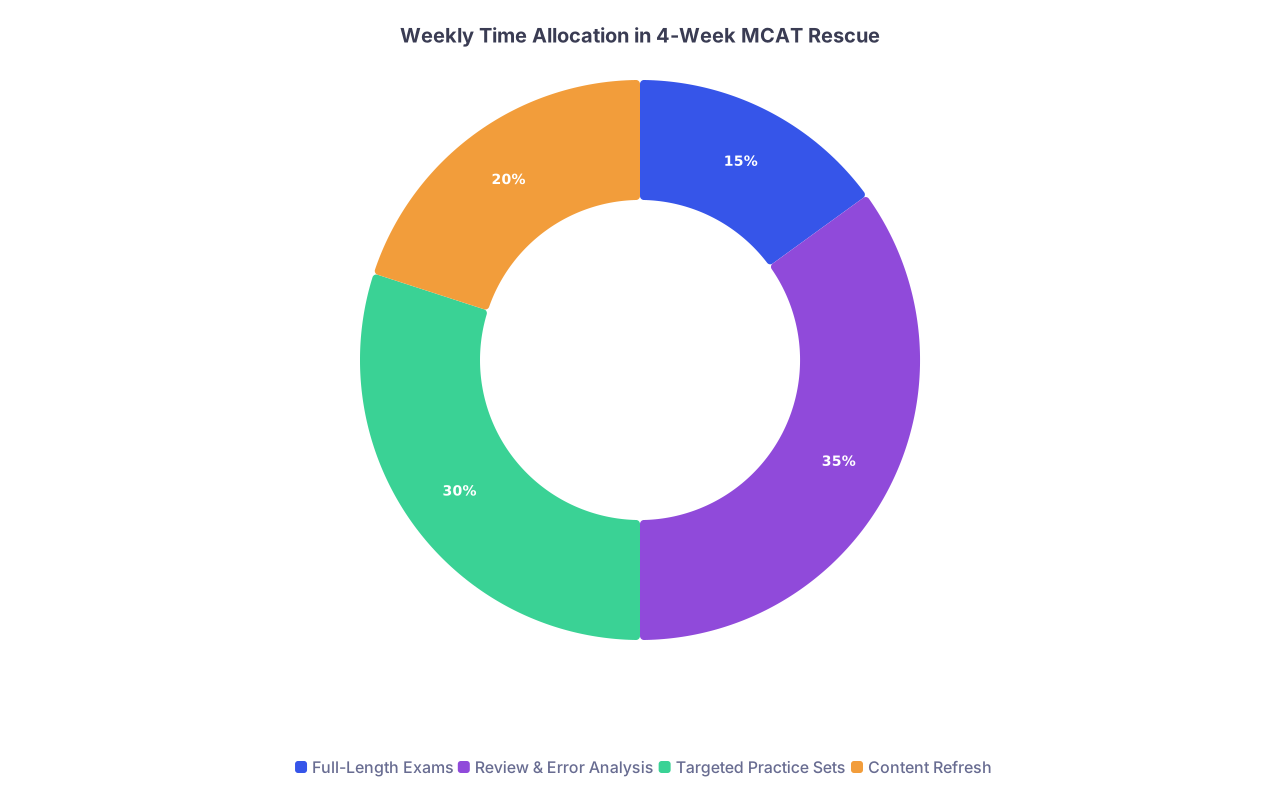
| Category | Value |
|---|---|
| Full-Length Exams | 15 |
| Review & Error Analysis | 35 |
| Targeted Practice Sets | 30 |
| Content Refresh | 20 |
C. Daily Time Structure (Assuming ~6–8 hours / day)
On non-full-length days:
- 2–3 hours: Deep review of last exam or practice set
- 2–3 hours: Targeted practice (timed, passage-based, section-specific)
- 1–2 hours: High-yield content refresh (only things you are actually missing)
On full-length days:
- 7.5 hours: Simulated test (with 10–30 minute breaks like test day)
- 1–2 hours: Immediate high-level review (mark major pain points while fresh)
You are not casually studying anymore. For 4 weeks, this is a focused sprint.
Step 2: Section-Specific Rescue Protocols
You do not fix a 505 with generic “study more.” You fix it by running tight, section‑specific protocols.
A. Chem/Phys (CP) Rescue
Typical plateau issues:
- Weak math execution under time pressure
- Poor interpretation of graphs/figures
- Memorized formulas, no idea when to use them
Weekly CP Plan (for 4 weeks)
Daily 30–45 min: Math and formula drills
- Re‑memorize and write out all essential equations from memory each morning.
- Do 10–15 discrete calculation questions (from UWorld / Blueprint / Kaplan).
- Force dimensional analysis on every calculation, even if you “know” the shortcut.
3–4 days/week: 3–4 CP passages (timed)
- 62–63 minutes total for 9 passages on test day → ~7 minutes per passage.
- In practice, aim for 6–6.5 minutes/passage to build buffer.
- After each set, do full review:
- What type of passage: conceptual, calculation-heavy, experiment-based?
- Why did you miss each question? (Use the categories from Step 0.)
- Rewrite the minimal content needed to have solved it.
Content refresh rules
- Focus on:
- Electrochemistry, circuits, waves, fluids, thermodynamics
- Acid-base, titrations, equilibria, kinetics
- Do not re-read entire chapters. Use:
- Condensed review notes
- Missed-question‑driven micro‑reviews (10–15 min targeted bursts)
- Focus on:
If CP is your worst section (e.g., 123–125), allocate an extra 45–60 minutes/day to CP and scale down other sections slightly.
B. CARS Rescue (Most People Plateau Here)
If you are stuck at 124–126, you are not going to brute-force your way to a 128+ with content. There is no content. This is strategy + reading discipline.
Common CARS problems:
- Rushing the passage to “save time”
- Treating questions as trivia, not as logical consequences of the author’s argument
- Changing your answer from right to wrong out of insecurity
Non-negotiable CARS Rules
- You read every passage. No skipping. No random guessing spree.
- You answer based on what the passage says, not “what you know about the topic.”
- You limit question review time on exam day. Overthinking kills.
4-Week CARS Plan
Daily: 2–3 passages timed (AAMC Question Packs if possible)
- Use 10 minutes per passage in practice.
- Start timer:
- 4–5 minutes reading
- 5–6 minutes questions
Once per week: 5–6 passage CARS “mini-section”
- 90 minutes, test conditions.
- No music. No breaks. No phone.
CARS Review Protocol (the part no one does properly):
- For each passage:
- Write 1–2 sentences: What is the main point? What is the author’s tone?
- For each missed question:
- Find the exact line or phrase in the passage that supports the correct answer.
- Identify the trap category:
- Out of scope
- Extreme wording
- Opposite meaning
- Half right, half wrong
You are retraining your brain to see CARS as pattern recognition, not a reading IQ test.
C. Bio/Biochem (BB) Rescue
Most 505-level students are “okay” at bio/biochem but leak points relentlessly because:
- They know individual pathways but not how they interact.
- They skim experiments without understanding the setup.
- They ignore figures and just search the passage for “keywords.”
High-Yield BB Focus Areas (4 weeks)
You will get the most return from:
- Enzyme kinetics, inhibition, Michaelis-Menten
- Hormones and endocrine feedback loops
- Metabolism (glycolysis, TCA, ETC, oxidative phosphorylation, gluconeogenesis)
- Membrane transport, receptors, signal transduction
- Genetics (pedigrees, inheritance patterns, gene expression regulation)
- Lab techniques (Western, Southern, PCR, ELISA, knockout models, etc.)
Weekly BB Structure
- 3–4 days/week: 3–4 BB passages (timed)
- 2 days/week: 20–30 minutes pure content refresh on pathways and lab methods
- Every full-length: Treat BB review as top priority for content linking
BB Review Protocol
- For each experiment-based passage:
- Sketch the experimental setup in 30 seconds.
- Identify: independent variable, dependent variable, control group.
- Ask: What result was the researcher expecting? Did it happen?
- For each wrong question:
- Was this a content issue or an experiment-logic issue?
- If content: Make a 1–2 line flashcard and add it to your daily review.
- If logic: Rewrite the question in your own words. Explain the correct answer out loud.
D. Psych/Soc (PS) Rescue
Psych/Soc is usually the cheapest section to raise in 4 weeks because:
- Content is finite and repetitive.
- Many questions are definition + scenario.
- A lot of 505 students under-study it.
If your PS is <127, you are leaving easy points on the table.
4-Week PS Fix
Content blitz – Days 1–7
- Use a tight resource (Anki deck, concise notes, or 30–40 page summary).
- Each day:
- 30–45 minutes: pure term review.
- 15 minutes: write out high-yield theories and names from memory.
- Erikson, Piaget, Kohlberg, Freud, Bandura
- Social identity, attribution theory, groupthink, etc.
Question practice – Days 8–28
- 15–20 discrete PS questions daily.
- 1–2 PS passages daily.
Review
- For every missed term-based question:
- Add the term + 1 example sentence to your flashcards.
- For every scenario question:
- Identify which concept the test is really asking about.
- Practice translating “story → underlying concept” in one sentence.
- For every missed term-based question:
Step 3: Full-Length Exam Protocol – How to Actually Learn From FLs
Most students waste their full-lengths. They obsess over the final score and barely mine the data. That is how you stay parked at 505.
A. Test Day Simulation Rules
For each of the 4 weeks:
- Same start time as real test (within 1 hour).
- Same breaks as AAMC.
- No phone, no email, no chatting between sections.
- Use scratch paper and simple calculator if allowed by practice platform.
You are training test-day behavior, not just knowledge.
B. Post-Exam: 24–48 Hour Review Protocol
Within 2–3 hours of finishing:
- Log your raw and scaled scores by section.
- Write a quick “test debrief”:
- Which section felt worst?
- Did you struggle with time?
- Mental fatigue pattern (e.g., “CP ok, dead by BB”).
Within 24 hours: Deep Review (4–6 hours total, can be split into 2 days)
Global metrics
- Number of questions missed per section.
- Timing: Where did you guess blindly at the end?
- Was there a mid-section slump (common around Q25–35)?
Question-level drilldown For each wrong question:
- Label it: content / application / interpretation / timing / careless.
- Ask: Could I have gotten this right with my current knowledge if I slowed down? If yes, it is not content.
- Track this in a simple spreadsheet or notebook.
Pattern extraction
- After ~3 exams, you will see repeat offenders:
- “I keep misreading ‘EXCEPT’ questions.”
- “Anything with electrochemistry is a mess.”
- “I lose discipline in the last 15 CARS questions.”
- After ~3 exams, you will see repeat offenders:
Those patterns become your Week 2–4 daily priorities.
| Pattern | Primary Fix Focus |
|---|---|
| Low CP (123–125) | Math drills + equation use in context |
| Flat CARS at 124–126 | Daily timed passages + deep review |
| BB mid-range but unstable | Experimental design + pathways links |
| PS below 127 | [Definition blitz + discrete practice](https://residencyadvisor.com/resources/mcat-prep/how-to-fix-weak-psychsoc-scores-in-one-focused-study-month) |
| Consistent timing crashes late in set | Strict per-passage timing drills |
Step 4: The 4-Week Rescue Schedule (Concrete)
Here is how I would structure the actual 4 weeks for a 505 plateaued student aiming for ~510–512.
Week 1 – Assessment + Foundation
Goal: Identify precise weaknesses and stabilize timing.
Day 1
- Full-length exam (prefer non-AAMC if you still have some left).
- Quick scoring + jot down immediate impressions.
Day 2–3
- Deep FL review (split over 2 days).
- Build your error log with reason categories.
- 30–45 minutes per day: content review only for topics that cost you questions.
Day 4–6
- CP: 3 passages/day + 10–15 discrete questions.
- CARS: 2 passages/day.
- BB: 3 passages spread over 2 days.
- PS: 20 discrete questions/day.
- 60–90 minutes/day of targeted content review (from your FL misses).
Day 7
- CARS 5–6 passage mini-section (90 minutes).
- Light content review + rest.
Week 2 – Targeted Attack
Goal: Fix the top 2–3 high-yield weaknesses identified in Week 1.
Day 1
- Full-length exam #2.
Day 2–3
- Full-length deep review.
- Compare error patterns to Week 1:
- What is improving?
- What is not changing?
Day 4–6
- Daily targeted blocks:
- If CP is weak: 4–5 CP passages/day.
- If CARS is weak: 3 passages/day instead of 2.
- If PS is low: 30–40 discrete questions/day + 1–2 passages.
- 45–60 minutes/day: content drills only from repeat miss areas.
- Daily targeted blocks:
Day 7
- Rest from full testing.
- Do 2 CP, 2 BB passages, 2 CARS passages at half speed focusing on accuracy.
Week 3 – Refinement and Endurance
Goal: Normalize higher performance; reduce careless errors.
Day 1
- Full-length exam #3 (ideally AAMC if available).
Day 2–3
- Full review + error log update.
- Prioritize fixing error types:
- If you have many “interpretation” errors, slow your reading and mark restrictive words (NOT, EXCEPT, LEAST, MOST).
Day 4–6
- Same structure as Week 2, slightly shorter sessions if fatigue is high, but keep:
- 2–3 CP passages/day
- 2–3 CARS passages/day
- 2–3 BB passages spread out
- 15–20 PS discrete questions/day
- Same structure as Week 2, slightly shorter sessions if fatigue is high, but keep:
Day 7
- Light day:
- 1 CARS passage.
- 1 passage each from CP, BB, PS.
- 30–45 minutes of formula + term review.
- Light day:

| Period | Event |
|---|---|
| Week 1 - Day 1 | Full-length #1 |
| Week 1 - Day 2-3 | Deep review + error log |
| Week 1 - Day 4-6 | Targeted practice + content |
| Week 1 - Day 7 | CARS mini-section |
| Week 2 - Day 8 | Full-length #2 |
| Week 2 - Day 9-10 | Deep review |
| Week 2 - Day 11-13 | Aggressive weak-section work |
| Week 2 - Day 14 | Mixed light practice |
| Week 3 - Day 15 | Full-length #3 prefer AAMC |
| Week 3 - Day 16-17 | Review + pattern focus |
| Week 3 - Day 18-20 | Refinement practice |
| Week 3 - Day 21 | Light mixed day |
| Week 4 - Day 22 | Full-length #4 AAMC |
| Week 4 - Day 23-24 | Shallow review, calm focus |
| Week 4 - Day 25-27 | Short, sharp sessions only |
| Week 4 - Day 28 | Rest + mental prep |
Week 4 – Lock-In and Taper
Goal: Peak on test day, not 7 days before.
Day 1
- Full-length exam #4 (preferably AAMC FL 3 or 4 if you have them).
Day 2
- High-level review only:
- Look for glaring, surprising errors.
- Do not launch into huge new content topics now.
- High-level review only:
Day 3–5
- Short, focused sessions:
- 1–2 CP passages/day.
- 2 CARS passages/day.
- 1–2 BB passages + 10 PS discretes/day.
- 30–45 minutes: flashcard review (formulas, psych/soc terms, hormone charts).
- Short, focused sessions:
Day 6
- Very light:
- 2–3 CARS passages untimed or slightly timed.
- Brief walk through your cheat sheets (formulas, pathways).
- No new difficult practice.
- Very light:
Day 7 (Day before exam)
- No heavy studying.
- Brief (30 min) look at:
- Formula sheet.
- A few tricky psych/soc terms.
- Then stop. Sleep on time. You are not gaining 3 points at 11 p.m. the night before.
Step 5: Fix the Non-Content Killers (Timing, Mindset, and Sleep)
You can know everything and still score 505 if you mess up these three.
A. Timing Discipline
You must practice with:
Per-passage time caps
- CP/BB/PS: 7–7.5 min/passage in exam; 6–7 min in practice.
- CARS: 9–10 min/passage.
Hard move-on rule
- If you are stuck for 60–75 seconds on a question, pick your best guess, mark it, and move on.
- Dying on one question and then guessing on five at the end is how people stay at 505.
B. Mental Game
Common 505 mindset errors:
- Panicking after one hard passage and mentally checking out.
- Over-attaching to “I have to get a 510 or my life is over.”
- Reading passages with low engagement because “this is stupid humanities stuff.”
Fixes:
- Before each section, take 2 deep breaths, repeat a simple script: “One passage at a time.”
- Treat every passage like it counts equally. Because it does.
- Turn frustration into data: “I hated this passage. Good. Now I know I need more like it.”
C. Sleep and Schedule
If you are doing 4 full-lengths in 4 weeks, you cannot run on 4–5 hours of sleep.
- Aim for 7–8 hours/night, same general sleep and wake time daily.
- On FL days, replicate test-day timing as closely as possible.
- Caffeine: Use the same pattern you plan for test day. No experimenting the week of.

Step 6: What to Ignore for 4 Weeks
You do not have time for everything. You need to be ruthless about what you drop.
Skip:
- Long, passive content videos on topics where you are already scoring well.
- “MCAT motivation” rabbit holes on YouTube and Reddit.
- Re-reading full chapters “just to be safe” without question practice attached.
Deprioritize:
- Brand new resources. Stick to what you already have and know how to use.
- Exotic memorization (every cytokine, every obscure psych term) that has never shown up in your practice.
Prioritize:
- AAMC materials first (FLs, Section Bank, Question Packs).
- Question review over new questions when you are fatigued.
- Fixing patterns instead of obsessing over one bizarre experimental question.
Final Check: Are You Actually Moving Off the Plateau?
By the end of Week 3, you should see at least one of:
- Section scores creeping up by 1–2 points compared to Week 1.
- Fewer “careless” and “timing” labels in your error log.
- Less panic and more control during full-lengths.
If your numbers are almost identical and you changed nothing about how you work, that is on you. The protocol works if you actually follow it, track your errors, and adjust week by week.
Core Takeaways
- A 505 plateau is almost always a strategy problem, not an effort problem. Without structured review and an error log, you are just doing random reps.
- Four weeks is enough to gain 4–6 points if you aggressively target your weakest sections, run weekly full-lengths, and mine them for patterns.
- The students who break through do one thing differently: they treat every mistake as a data point to exploit, not a reason to panic.