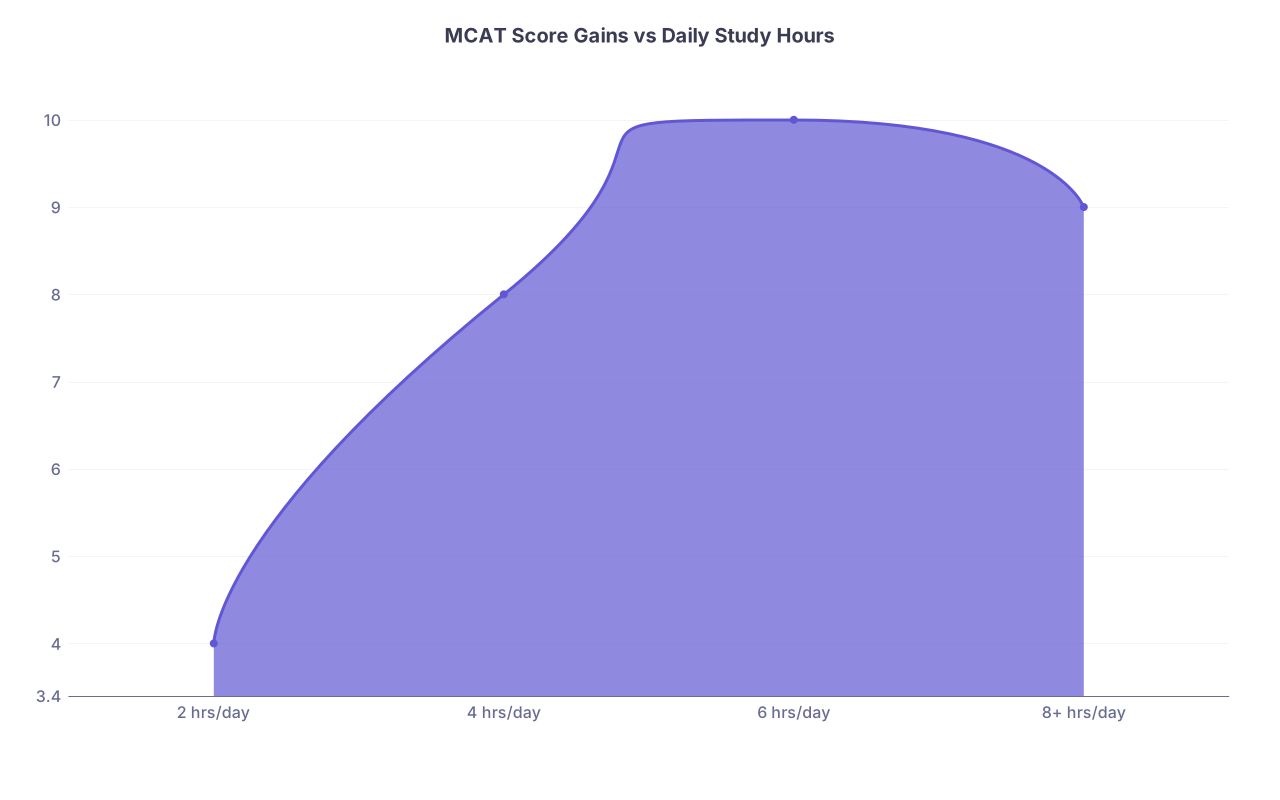
The reason you feel broken by the MCAT is not that you are weak. It is that you ran the engine too hard with a bad maintenance schedule.
You do not need “more motivation.” You need a structured reset.
This is a 10–day, step‑by‑step protocol to pull yourself out of MCAT burnout and restart studying without crashing again. I am not going to tell you to “just take a weekend off” and hope your brain magically recovers. That rarely works, and you already know it.
What follows is a deliberate reset: physical, mental, and strategic. You will stop digging the hole deeper. Then rebuild a smarter study system that you can actually sustain.
Step 0: Diagnose The Burnout (Today, Before You Start)
Before you jump into the 10‑day reset, you need to be blunt about where you are. No sugarcoating.
Ask yourself:
- How many hours per day have you been “studying” (including doom‑scrolling UWorld, half‑focused)?
- How many full days off have you taken in the last 3 weeks?
- Average sleep in the last 2 weeks (not what you think you “should” be getting)?
- When you sit down to study, what do you feel first: dread, numbness, panic, or nothing at all?
If your answers look anything like what I see from burned‑out students:
- 7–10 hours daily “studying”
- 0–2 full days off in 3 weeks
- 5–6 hours sleep on weekdays
- Emotion on study start: dread + guilt
You are not in a “motivation slump.” You are in genuine burnout territory. The fix is not “try harder.” The fix is a reset.
The 10‑Day MCAT Burnout Reset: Overview
You are going to do three things across these 10 days:
Days 1–3: Full Stop + Stabilize
No MCAT content. You will think about the exam only in terms of logistics and boundaries.Days 4–7: Low‑Gear Restart (1–3 hours/day)
You will reintroduce MCAT work with tight constraints and strict rules.Days 8–10: Build The Sustainable Plan
You will craft and test‑drive a realistic study schedule and habits you can maintain for weeks.
Here is the rough arc in numbers:
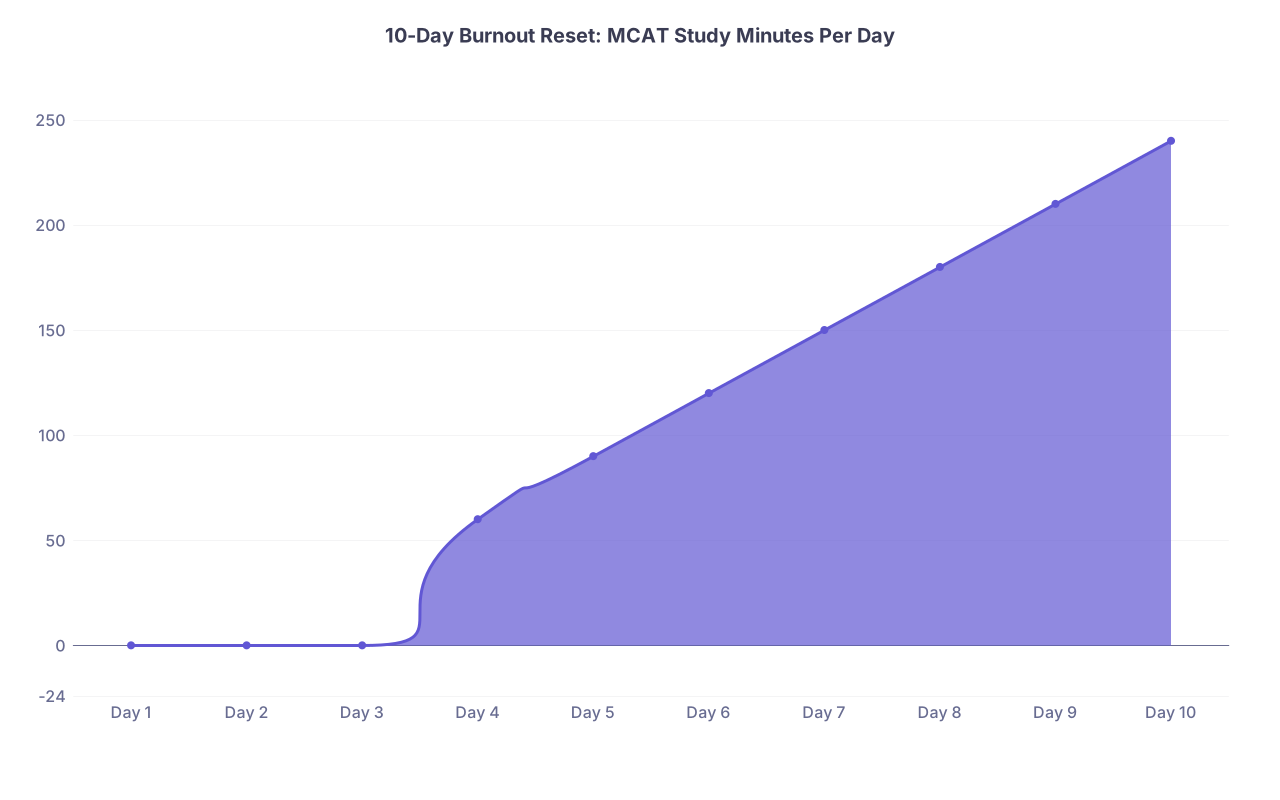
| Category | Value |
|---|---|
| Day 1 | 0 |
| Day 2 | 0 |
| Day 3 | 0 |
| Day 4 | 60 |
| Day 5 | 90 |
| Day 6 | 120 |
| Day 7 | 150 |
| Day 8 | 180 |
| Day 9 | 210 |
| Day 10 | 240 |
You are not “losing” 10 days. You are preventing the next 30–60 days from becoming ineffective misery.
Days 1–3: Full Stop, No MCAT Content
These three days are not “active rest” where you sneak in Anki on your phone. They are a hard reset.
If you cheat here, the rest of the plan collapses.
Day 1: Shut The System Down
Your only job today: remove all the constant MCAT friction from your environment and stabilise your body a bit.
Physically close the loop
- Put your MCAT books/notebooks in a box or on a high shelf. Out of arm’s reach.
- Log out of:
- Anki
- UWorld / Kaplan / AAMC interface
- Reddit MCAT / Discord MCAT servers / “premed grind” group chats
- Turn off email notifications for MCAT prep companies.
Tell 2–3 people what you are doing
- One friend or partner: “I am taking a 10‑day MCAT reset so I do not flame out. If you see me studying content before Day 4, call me out.”
- One family member or roommate (if helpful).
- Optional: a mentor/advisor if they are not panic‑inducing.
Set your minimum physical baseline Today, hit three non‑negotiables:
- Sleep: 7–9 hours at night. No “just one more episode.”
- Food: Eat 3 actual meals. Real food, not just coffee and crackers.
- Movement: 20–30 minutes of light movement (walk, easy bike, yoga).
Not to “optimize performance.” Just to bring your nervous system down a notch.
Day 2: Clear Mental Clutter (But Still Zero Content)
Now you deal with the anxiety storm in your head without touching MCAT material.
Dump everything swirling in your head onto paper Get a blank sheet or doc and write:
- “I am currently worried about:” then list everything.
- Scores, dates, “I am falling behind,” “everyone else is ahead,” whatever. This is not journaling for Instagram. It is taking mental tabs and putting them on a table.
Separate facts from fear Draw two columns: Facts vs Stories.
Example:
- Fact: Last FL score was 503 on 12/10.
- Story: “I will never break 510.”
- Fact: I have 8 weeks until my scheduled exam.
- Story: “Eight weeks is not enough; I am screwed.”
Your burnout brain blends these. You need them separated before you can plan.
Decide: postpone, keep, or undecided You do not need a final decision yet, but you do need a ballpark.
Write down:
- Current test date
- Earliest date you could realistically test with a sane schedule
- Hard deadlines (application cycle, committee letter timelines, etc.)
Then label your current date:
- “Likely keep”
- “Likely postpone”
- Or “Undecided – revisit on Day 9”
You are just clearing mental fog so you can think like an adult again later.
Day 3: Rebuild Some Basic Human Function
You are still not studying MCAT content. You are rebuilding the human who is supposed to take this exam.
Design a consistent daily anchor schedule Do this in 4 blocks; write it down with actual times:
- Wake time (same every day ±30 minutes)
- Sleep time
- Fixed meals
- Movement window
Example:
- Wake: 7:30
- Breakfast: 8:00
- Lunch: 12:30
- Walk/gym: 4:30–5:00
- Dinner: 7:00
- Phone off: 10:30
- Sleep: 11:00
This will be the skeleton your study sits on, not the other way around.
Do one “I am not just my MCAT” activity for 1–2 hours Something that reminds you you are a person:
- Cooking something real
- A hobby you dropped (guitar, sketching, running)
- Seeing a friend in person, with a strict “no MCAT talk” rule
Set the rulebook for the rest of the reset Write down:
- “Days 1–3: No MCAT content.”
- “Days 4–7: Max X hours of study per day.”
- “Days 8–10: Build and test my new plan; no full‑length exams.”
Put it somewhere you see it (fridge, desk wall, lock screen).
Days 4–7: Low‑Gear Restart (1–3 Hours Max)
Now your job is to re‑introduce MCAT work like physical therapy, not like a CrossFit competition.
The core rule for these days:
You stop your MCAT work each day while you still have gas in the tank.
Not when you are dead.
What You Are Allowed To Do
- Light content review
- Very small question sets (no more than 15–20 questions at a time)
- Low‑pressure planning / reflection
What you are not allowed to do:
- Full‑lengths
- Back‑to‑back 60–90 question blocks
- 6–8 hour “catch‑up” marathons
Day 4: One Hour Only
Concrete plan:
15–20 minutes: Scan your old data
- Look at last 2–3 practice exam breakdowns.
- Identify one content bucket that is clearly weak (e.g., electrochemistry, amino acids, endocrine). Do not study yet. Just pick the target for today.
30–40 minutes: Single focused content block
- Pick that one topic.
- Use a single resource (one chapter, one video set, one short summary).
- Take handwritten notes or a very small number of targeted flashcards (10–15 max).
10–15 minutes: Micro question set
- 5–10 questions only on that topic (from UWorld, Kaplan, whatever you use).
- Do them untimed or with very generous timing.
- For each question you miss, write one line: “Missed because ___ (content / careless / misread / panic).”
Then you stop.
Yes, even if you “feel like you could do more.” That is the point. You are teaching your brain that MCAT work does not automatically equal total exhaustion.
Day 5: Ninety Minutes
Break it into two blocks separated by at least a 30–60 minute non‑MCAT activity.
Example structure:
Block 1 (45 minutes)
- 10 minutes: Quick review of yesterday’s notes and misses.
- 25 minutes: New content on a related or second weak area.
- 10 minutes: 5–8 practice questions.
Break (at least 30 minutes)
- Walk, shower, cook, phone call. Not social media MCAT talk.
Block 2 (45 minutes)
- 15–20 minutes: Mixed content review from strong/medium topics (to remember you are not terrible at everything).
- 20–25 minutes: 10–12 mixed questions (lightly timed if you feel steady).
Again, you stop at 90 minutes. No extending “because I’m behind.”
Day 6: Two Hours, Introduce Timing Gently
Now you can test your stress response a little.
Block 1 (60 minutes)
- 10 minutes: Plan your block (topic + resources + question source).
- 30 minutes: Focused content review on a high‑yield weak area.
- 20 minutes: 10–15 questions, lightly timed (e.g., ~90 seconds per question, but no panic if you go over).
Block 2 (60 minutes)
- 15 minutes: Thorough review of Block 1 questions.
- For each miss: classify miss type, write a 1–2 sentence fix.
- 30 minutes: Mixed CARS practice (1–2 passages).
- 15 minutes: Debrief. Write:
- What went better than before burnout.
- What still feels fragile.
- 15 minutes: Thorough review of Block 1 questions.
Day 7: Two and a Half Hours, Simulate a “Real” Study Morning
By now you should be able to handle a longer session without the same dread or complete mental shutdown. If you are still hitting a wall at 60–90 minutes, that is data; we work with it, not against it.
Example for Day 7:
Block 1 (90 minutes) – Morning
- 10 minutes: Quick planning and review of yesterday’s biggest insights.
- 35 minutes: Content review on your #1 weak science area.
- 30 minutes: 15–20 questions mixed passage + discrete on that topic, timed.
- 15 minutes: Rapid review (not deep post‑mortem yet).
Break (at least 1 hour): Real break Eat, move, do something non‑academic.
Block 2 (60 minutes) – Early afternoon
- 20–25 minutes: CARS (2 passages).
- 20 minutes: Review of those CARS passages.
- 15–20 minutes: Light planning for Days 8–10 (what sections need what).
If 150 minutes feels easy, do not ramp higher. Your job is to show your brain a normal day that ends before you are fried.
Days 8–10: Build and Test Your Sustainable Plan
Now you are past pure recovery and into reconstruction. This is where most students blow it. They feel a little better and immediately launch back into 8‑hour days.
You are going to do the opposite. You will:
- Lock in realistic weekly hours
- Balance content vs. practice vs. review
- Create a weekly template so each day is not a new improvisation
Step 1: Decide Your Weekly Capacity (Be Ruthless)
There are only three honest buckets for MCAT time during a prep phase:
| Level | Hours/Week | Who This Fits |
|---|---|---|
| Light | 10–15 | [Full-time job](https://residencyadvisor.com/resources/mcat-prep/balancing-mcat-prep-with-a-full-course-load-weekly-blueprint) or 18+ credit semester |
| Moderate | 20–25 | Part-time work or lighter academic load |
| Aggressive | 30–35 | Dedicated study period, minimal other obligations |
If you wrote 40–50 hours, and you have classes, a job, or family responsibilities, I will be blunt: you are lying to yourself. On paper you might schedule it. In reality, you will burn out, skip rest days, and your effective hours will drop and become low quality.
Pick your bucket. That is your hard cap, not a “goal.”
Step 2: Split Those Hours Intelligently
The MCAT is not just content, and it is not just questions. Both extremes are wrong.
A solid weekly split for most students:
- 40% active practice (questions, passages, FLs when you get back to them)
- 35% targeted content review (driven by what you are missing)
- 25% review/meta (reviewing wrong answers, error logging, strategy adjustment)
Illustrated:
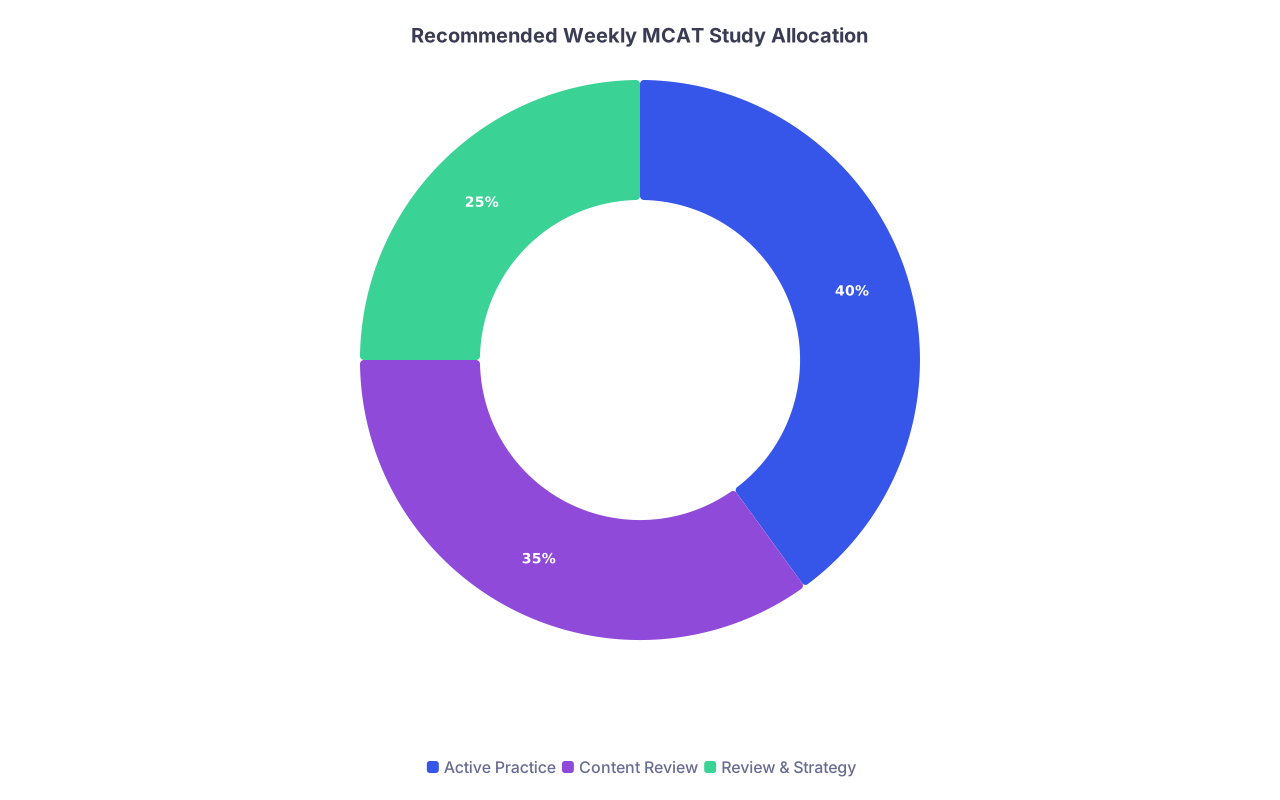
| Category | Value |
|---|---|
| Active Practice | 40 |
| Content Review | 35 |
| Review & Strategy | 25 |
If you have been doing 80–90% “content review” with almost no questions, that imbalance is part of why you are fried and not seeing score movement. Passive review is a soul‑sucking trap.
Step 3: Build A Weekly Template (Days 8–10)
You are going to design, then partially test this schedule over Days 8–10.
Think in blocks, not “I study all day.”
Common block lengths that humans can actually sustain:
- 45 minutes
- 60 minutes
- 75 minutes (once you are in better shape)
With 10–15 minute breaks in between.
Day 8: Draft Your Template
Pick your standard wake and sleep times.
Use what you tested in Days 3–7.Place your non‑negotiables first.
- Classes
- Work
- Commutes
- Family responsibilities
Layer in MCAT blocks around those, respecting your weekly hour cap.
Example for a “Moderate” (20–25 hours) week:
- Mon–Fri:
- 2 blocks/day on weekdays (60–75 minutes each) → ~10–12 hours
- Sat:
- 3–4 blocks of 60 minutes → 3–4 hours
- Sun:
- 2–3 blocks of 60 minutes → 2–3 hours
- Total: ~18–19 hours; you can add 1 extra block a few days to hit 22–24 if energy allows.
Assign themes to days This prevents decision fatigue and spreads the load:
- Monday: Bio/Biochem + CARS
- Tuesday: Chem/Phys + Review
- Wednesday: Psych/Soc + CARS
- Thursday: Bio/Biochem + mixed practice
- Friday: Chem/Phys + Review
- Saturday: Larger mixed blocks, eventually FLs
- Sunday: Light content + heavy review / planning
Do not aim for a perfect plan. Aim for something you can execute at 80–90% adherence.
Day 9: Reality Check + Test Drive
Today, you run your weekday version of the plan as if it is a normal study day. No full-length exam, but slightly longer total time than Day 7.
Goal: about 3–3.5 hours of study, in blocks.
- Morning: 1 block (60–75 minutes)
- Midday or afternoon: 1 block (60 minutes)
- Evening (if needed): 1 shorter block (45–60 minutes)
Watch for:
- When your focus falls off a cliff.
- Which type of task drains you fastest (CARS, dense passages, heavy content).
- How your mood shifts through the day.
At the end, answer honestly:
- Did I hit my blocks without dragging myself?
- Which block felt worst? Why?
- Is my weekly hour cap realistic or delusional?
If the day felt like a death march at 3 hours, your weekly target should not be 30. Drop the cap. You will score higher studying 20 focused hours than 35 half‑baked, burned‑out hours.
Day 10: Lock It In And Define Hard Rules
Today is half practice, half logistics.
Morning: 2 hours of solid work
- 1 content‑heavy block
- 1 practice‑heavy block This is a stress test at your new baseline.
Afternoon: Build your “MCAT Operating Manual”
On one sheet (or doc), write:
My weekly hour cap: X hours
My default daily pattern:
Example: “Wake 7:00, 2 blocks (8–10am, 3–4pm), review Sunday evenings.”My hard non‑negotiables:
- 1 full day off from MCAT per week (no questions, no videos).
- Minimum 7 hours of sleep before any FL.
- No more than 3.5–4 hours MCAT on any single day unless it is an FL.
- No back‑to‑back FLs within 5–7 days.
My early warning signs of new burnout: List personalized red flags. For example:
- I start re‑reading the same sentence 5 times.
- I feel dread before every block for 3 days in a row.
- I am sacrificing sleep for 2+ nights in a row to “catch up.”
- I am rage‑googling “MCAT reschedule” at midnight.
My emergency protocol (if I see these signs):
- Immediately cut the next day’s workload in half.
- Switch one study day in the next 3 to a full rest day.
- Replace heavy content with lighter review or just error‑log analysis.
- If symptoms persist for 5+ days, enforce a 3–5 day mini‑reset (similar to Days 1–3, but shorter).
Put this where you cannot ignore it. Treat it like orders from Past You, who was thinking clearly.
After The Reset: How To Avoid Re‑Burning Yourself
You will be tempted to “make up for lost time” the second you feel even 20% better. That is how students blow this.
There are a few blunt truths you should keep in front of you:
You cannot brute‑force your way out of burnout with more hours.
Beyond a certain point, more time produces worse learning and worse scores. I see it constantly in students who log 60+ “study hours” and plateau.You must respect cognitive limits the same way athletes respect physical limits.
No serious runner decides to fix a stress fracture by running 20 miles “to catch up.” They rest, rehab, then train smarter. You are no different.Your value as an applicant is not determined by how miserable your MCAT prep was.
There is no prize for “suffered the most.” There is a score. That is it. Efficient, lower‑stress prep that gets you to a 512 is infinitely better than heroic self‑destruction for a 505.
If You Need To Move Your Test Date
You may get to Day 9 or 10 and realize: with a sane schedule, your current date is not realistic.
Here is how I advise people to decide:
- Look at your last 2–3 FL scores.
- Estimate realistic improvement per 2 weeks of solid, non‑burned‑out studying:
- Many students can gain ~2–3 points every 2–3 weeks early on.
- Gains slow later; chasing the last 2–3 points can take longer.
If you are at a 498 and want a 512 in 4 weeks while working full time, that is fantasy. Move the date. You are not “weak” for rescheduling; you are strategic.
You can even sketch a quick timeline:
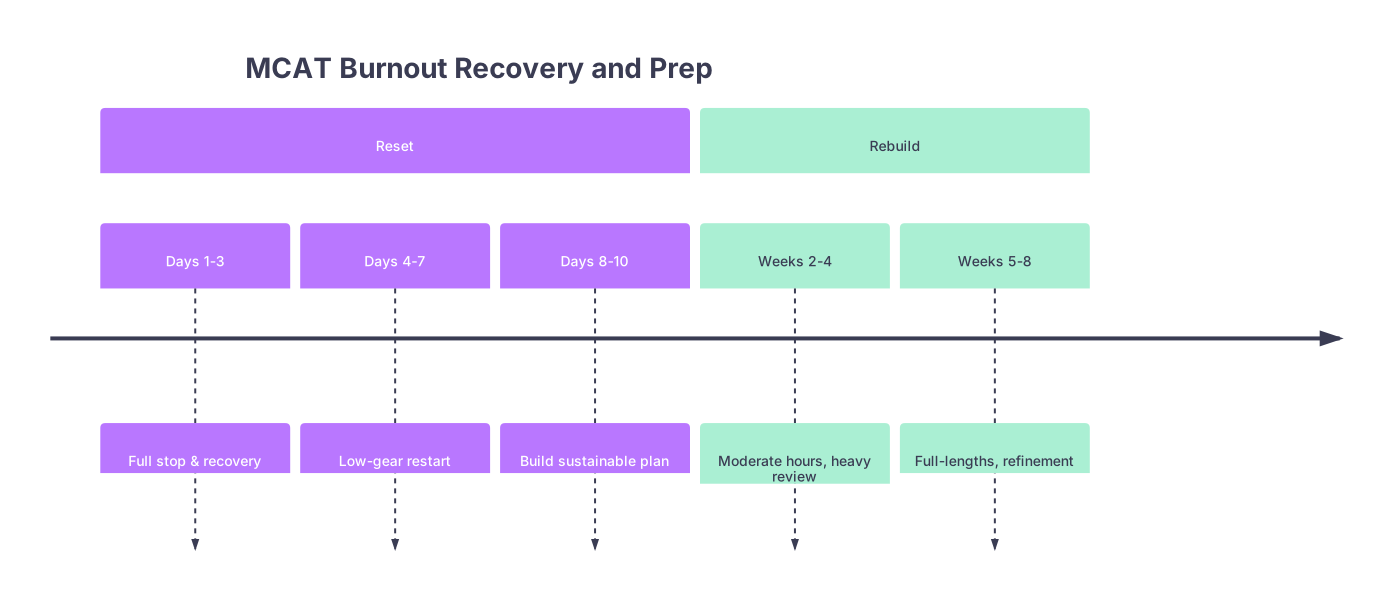
| Period | Event |
|---|---|
| Reset - Days 1-3 | Full stop & recovery |
| Reset - Days 4-7 | Low-gear restart |
| Reset - Days 8-10 | Build sustainable plan |
| Rebuild - Weeks 2-4 | Moderate hours, heavy review |
| Rebuild - Weeks 5-8 | Full-lengths, refinement |
If that rebuild window does not fit before your scheduled exam, reschedule.
What This 10‑Day Reset Actually Changes
If you follow this protocol as written:
- Your brain stops associating the MCAT with immediate exhaustion and panic.
- You get a realistic, test‑driven picture of how many hours you can handle.
- You switch from frantic, guilt‑driven studying to planned, block‑based work.
- You have a written early‑warning system and emergency plan for burnout symptoms.
Most students do not fail the MCAT because they are dumb. They fail it because they treat prep like a hazing ritual instead of a performance that requires recovery.
You are not a machine. Start acting like a professional in training, not a martyr.
Key Takeaways
- Burnout is fixed by a structured reset, not more willpower. You need 3 days of no content and 7 days of controlled re‑entry, not a single “mental health day.”
- A sustainable MCAT plan has a hard weekly hour cap, clear blocks, and at least one true rest day. Fantasy schedules lead straight back to burnout.
- Write and follow your own operating manual. Define your early burnout signs and the exact steps you will take when they appear, before you are in crisis again.